





When is a 3 phase dry type transformer suitable for indoor use?
When Is a 3 Phase Dry Type Transformer Suitable for Indoor Use?
A 3 phase dry type transformer is often the practical answer when a project needs medium- or low-voltage distribution equipment inside a building and cannot accept the added fire-management burden associated with insulating oil. That does not mean dry-type equipment is automatically right for every indoor substation. The decision depends on the electrical duty, available room volume, ambient conditions, access for installation and maintenance, and the rules that apply to the site.
For project managers, the central question is not simply “dry type or oil immersed?” It is whether the transformer can operate at its intended load without excessive temperature rise, whether the room can remove its losses, and whether the chosen design fits the project’s safety and continuity requirements. A good indoor solution is a coordinated package: transformer, enclosure, ventilation path, protection system, cable arrangement, and operating plan.
The indoor situations where dry type makes the most sense
Dry-type transformers use air or solid insulation systems rather than a liquid-filled tank. In indoor projects, that characteristic is especially valuable where a release of flammable liquid would create a difficult design issue. Commercial towers, hospitals, data facilities, transit buildings, schools, production workshops, and public infrastructure commonly place strong emphasis on fire separation, evacuation routes, and equipment-room risk control. In these environments, locating a dry-type unit near the load can simplify the wider distribution layout, provided that thermal conditions are properly addressed.
They are also well suited to buildings where routine maintenance access is constrained. There is no insulating oil level to inspect, no liquid sampling program, and no oil containment arrangement to coordinate. That reduces some maintenance tasks, although it should never be interpreted as maintenance-free operation. Dust accumulation, loose connections, signs of insulation deterioration, abnormal noise, cooling-air obstruction, and temperature alarm history still need attention.
Another favorable case is a project with short secondary cable runs. Placing a 3 phase dry type transformer in an electrical room close to a large load center can reduce cable length, voltage drop, and installation complexity downstream. This approach is common in multi-floor facilities, large mechanical rooms, and industrial buildings with concentrated process loads. The benefit must be weighed against the space needed around the unit for safe access and cooling airflow.
Indoor use is not synonymous with a clean office environment. A dry-type design can serve industrial applications, but the actual atmosphere matters. Fine conductive dust, chemical vapors, salt-laden air entering through ventilation openings, heavy moisture, and recurring condensation can all undermine insulation performance. In those cases, the project team should assess enclosure protection, insulation construction, filtration strategy, room pressurization where appropriate, and the frequency of cleaning. A transformer that is suitable for a controlled electrical room may be unsuitable beside an open process line.
Fire safety is an advantage, not a substitute for room design
The absence of oil is a major reason to consider dry type indoors, particularly where fire risk, spill control, or insurance requirements influence layout decisions. However, a transformer still contains energized conductors and generates heat. Cable terminations, switchgear interfaces, protective devices, clearances, fire-rated barriers, emergency access, and detection arrangements must be designed as a system. The governing building code, electrical code, utility requirements, and insurer guidance may all affect the final room configuration.
It is also worth distinguishing between reduced liquid-related risk and a blanket claim of fireproof performance. Resin-cast and ventilated dry-type constructions have different characteristics, and their suitability should be evaluated against the project’s stated fire performance requirements, not assumed from the word “dry.” Procurement documents should request the relevant test evidence and confirm which standards the installed equipment must meet.
For facilities that remain occupied during an electrical fault investigation or a maintenance outage, the practical value of dry type often lies in risk containment and easier siting. Yet an undersized or poorly ventilated transformer room can create its own reliability problem. Heat is usually the more immediate design constraint.
Check the heat path before approving the equipment
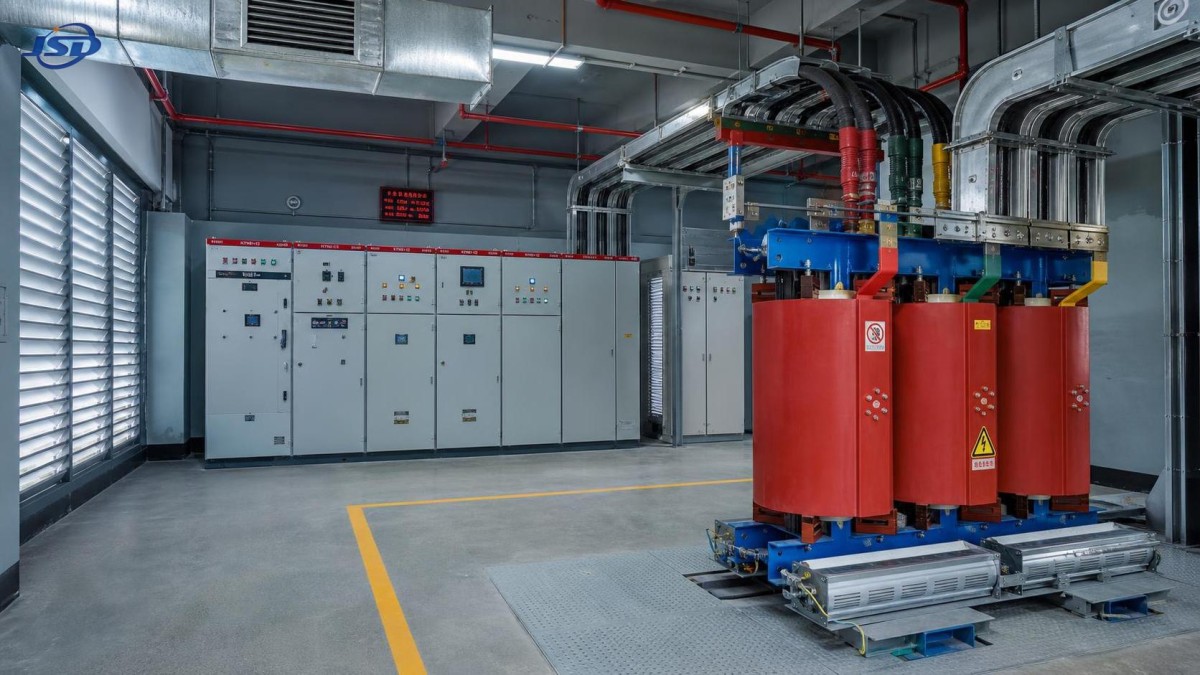
Every transformer produces no-load and load losses. With an oil-immersed unit, the liquid and radiator arrangement play a central role in transferring heat. A dry-type transformer relies heavily on surrounding air and, depending on its design, natural or forced ventilation. The room therefore becomes part of the cooling system.
A frequent project mistake is to reserve a compact electrical room, select a transformer late in the design, and assume louvered doors alone will solve the thermal issue. They may not. Heat can recirculate from an outlet back to an inlet; hot air can become trapped above the transformer; acoustic treatments can unintentionally restrict airflow; and a room shared with switchgear may have a much higher combined heat load than expected.
The design review should identify the transformer losses supplied by the manufacturer, maximum expected loading, room dimensions, ambient temperature range, elevation, ventilation route, and the heat released by adjacent equipment. Natural ventilation can work in some layouts, but it requires a credible path for cool air to enter low and warm air to leave high. Mechanical extraction may be necessary where the room is internal, where outside air is limited, or where summer ambient conditions are demanding. Any fan failure alarm or temperature-monitoring requirement should be integrated into the facility’s operating philosophy.
Altitude deserves attention as well. Thinner air removes heat less effectively, so a transformer installed at elevation may require a review of rating or cooling assumptions. This is not a detail to leave to site commissioning. It should be raised during technical selection, alongside the expected ambient temperature and duty cycle.
Load profile matters more than nameplate capacity alone
A transformer can appear adequately rated on a simple connected-load schedule and still experience difficult operating conditions. Variable-speed drives, rectifiers, UPS systems, welders, arc-related loads, and other nonlinear equipment may introduce harmonic currents. These currents can increase heating in windings and connections. Fast-changing load profiles can also affect thermal cycling. The right question is not only how many kilovolt-amperes the building needs, but what the load actually looks like over time.
During design coordination, ask for the largest continuous load, diversity assumptions, anticipated future load, starting currents for major motors, power-factor correction arrangements, and harmonic information from critical equipment suppliers. Where harmonic duty is material, the transformer specification may need to address it directly rather than relying on a standard selection. Temperature sensors and monitoring can provide useful operating visibility, but they do not correct a mismatch between the load and the transformer design.
Noise is another indoor issue that tends to emerge late. Transformer sound may be acceptable in an industrial plant but objectionable near offices, patient areas, classrooms, residences, or studios. Room acoustics, structure-borne vibration paths, mounting details, and the location of ventilation openings should be considered before construction is fixed. Moving the transformer room a short distance away from sensitive spaces can be more effective than attempting expensive acoustic remedies afterward.
Where an oil-immersed alternative may be the better engineering choice
Dry type is not always the preferred solution simply because the equipment is indoors. Higher ratings, limited room volume, severe thermal conditions, or an installation where outdoor placement is feasible may lead the team toward an oil-immersed transformer with the appropriate civil, fire, and containment provisions. The decision should reflect the full lifecycle arrangement rather than a single equipment characteristic.
For example, a primary distribution scheme may use an outdoor or dedicated-substation 33kV Oil-Immersed Power Distribution Transformer while dry-type units are placed deeper inside the facility near secondary load centers. This is not a contradiction. It is often a sensible division of duties: one transformer technology supports the incoming distribution strategy, while another addresses indoor safety, proximity, and building integration. Voltage level, capacity, maintenance access, site footprint, and local requirements should determine the boundary.
Conversely, a dry-type transformer installed outdoors without suitable protection can face contamination, weather exposure, and thermal challenges that were never part of its intended application. “Dry type” describes the insulation and cooling approach; it does not remove the need to match the equipment to the environment.
A practical approval checklist for the project team
Before releasing a 3 phase dry type transformer for manufacture, a project manager should be able to answer several basic questions clearly:
- Is the transformer’s voltage, rating, vector group, impedance, tap arrangement, and insulation level coordinated with the network study and protection design?
- Has the actual indoor ambient condition been defined, including temperature, altitude, dust, humidity, and possible corrosive contaminants?
- Does the room have sufficient physical clearance for cooling, cable bending, safe maintenance, lifting, and future replacement?
- Has a ventilation calculation or thermal assessment considered transformer losses together with switchgear, UPS equipment, and other heat sources?
- Are nonlinear loads, motor starting conditions, and forecast expansion reflected in the rating decision?
- Have fire, acoustic, seismic, enclosure, and local compliance requirements been documented rather than left as general assumptions?
- Can the installation team bring the unit into the building without removing finished walls, doors, or structural elements?
The last point is surprisingly important. A technically correct transformer can become a schedule problem if transport routes, lifting points, floor loading, and doorway dimensions are ignored. Replacement access is worth considering too, especially in hospitals, transport facilities, and long-life industrial plants where the electrical room may be surrounded by later construction.
Selecting the equipment as part of the whole power system
A reliable indoor transformer installation is usually the result of early engineering coordination, not a late procurement decision. The equipment supplier needs a clear duty specification; the building designer needs credible heat-rejection and access information; the electrical engineer needs confirmed impedance and protection details; and the operator needs practical monitoring and maintenance access.
Jinshida Electric Power Technology Co., Ltd. approaches transformer selection from that system perspective. Its work in the research, manufacture, and application of transmission and distribution equipment is supported by technical teams, controlled manufacturing processes, and quality management practices intended to provide dependable power support across grid, industrial, new-energy, and infrastructure applications. For an indoor installation, the useful conversation is not limited to a catalogue rating. It should include the room environment, network conditions, protection coordination, expected load behavior, and the documentation required for the project.
A 3 phase dry type transformer is suitable for indoor use when its cooling method, insulation construction, electrical duty, and installation environment have been designed to work together. If the room can manage heat, the load is understood, environmental risks are controlled, and local requirements are confirmed, dry type can be a strong and practical choice. If any of those conditions remain uncertain, resolve them before the purchase order—not after the transformer reaches site.

Get a Quote
Regardless of whether you require general advice or specific support, we are happy to help you.
Send Us Your Inquiry Today

Jinshida Electric remains committed to contributing to global energy development through professional manufacturing and superior service.