





How VPI dry type transformers resist moisture in humid facilities
How VPI Dry Type Transformers Resist Moisture in Humid Facilities
In a humid industrial facility, moisture is rarely an isolated problem. It can enter electrical rooms through warm outdoor air, condensation on cold surfaces, washdown activity, poor ventilation, coastal salt air, or simply the daily temperature swings common in plants, tunnels, ports, water-treatment sites, and renewable-energy installations. Once moisture reaches a transformer’s insulation system, the consequences may develop quietly: insulation resistance declines, metallic parts begin to corrode, tracking paths become easier to form, and the risk of unplanned outages increases.
A VPI dry type transformer is designed to address this operating reality. Its core protection comes from vacuum pressure impregnation (VPI), a manufacturing process that drives insulating resin deep into the winding insulation system. Rather than leaving vulnerable air gaps between conductor insulation, coils, and support materials, VPI creates a more integrated and sealed structure that is better able to withstand damp air, dust, and industrial contaminants.
For quality control personnel and safety managers, the important question is not simply whether a dry-type transformer is “moisture resistant.” The practical question is how that resistance is created, how it should be verified, and where its limits are. Understanding those details supports better equipment selection, more meaningful incoming inspection, and safer maintenance decisions.
Humidity does not need direct water contact to create risk
Many transformer failures associated with moisture do not begin with flooding or obvious water ingress. Humid air alone can become a problem when it reaches a cooler transformer surface and condenses. This is especially common when a facility cycles between operating and standby conditions, when HVAC systems are inconsistent, or when electrical rooms are located near process areas with steam, cooling water, chemicals, or frequent door openings.
In conventional insulation systems, small voids and interfaces can retain moisture. Over time, water vapor and contaminants may lower dielectric strength and promote partial discharge activity. Dust makes the situation worse: when dust absorbs moisture, it can form conductive films across insulating surfaces. In corrosive environments, such as coastal plants or wastewater facilities, airborne salts and gases can further accelerate degradation of terminals, frames, fasteners, and connection hardware.
The concern is not limited to immediate electrical failure. Moisture-related deterioration often raises the long-term maintenance burden. A transformer may remain energized and appear normal while its insulation condition slowly becomes less stable. That delayed nature is why humidity control should be treated as both a reliability issue and a safety-management issue.
What vacuum pressure impregnation actually does
VPI is more than a surface coating. During production, transformer windings are placed in a controlled impregnation process. A vacuum is applied to remove air and moisture from the insulation system’s pores and spaces. Insulating resin is then introduced under pressure, encouraging it to penetrate areas that a simple dip coating may not reach effectively. The impregnated windings are cured to form a durable insulation structure.
The result is a winding assembly in which conductors, insulation materials, and resin work together more closely. This contributes to moisture resistance in several ways:
- Reduced voids: Fewer open spaces mean fewer locations where humidity can collect or where internal electrical stress can concentrate.
- Improved dielectric stability: The resin-supported insulation system better maintains its electrical insulating function when ambient conditions are damp or contaminated.
- Better mechanical integrity: VPI bonding helps windings resist movement caused by electromagnetic forces, vibration, and repeated thermal expansion and contraction.
- Lower contamination exposure: A sealed, impregnated surface is less likely to absorb dust, moisture, and airborne process contaminants than untreated porous insulation.
- More consistent heat transfer: Resin-filled interfaces can support a more uniform thermal path through the winding assembly, helping limit localized hot spots that can accelerate insulation aging.
It is important to be precise here: VPI does not make a transformer waterproof in every circumstance. A dry-type unit should not be exposed to standing water, direct hose spray, or environmental conditions beyond its enclosure rating. Its value lies in improving the resilience of the insulation system when humidity, condensation risk, dust, and ordinary industrial contamination are part of normal operation.
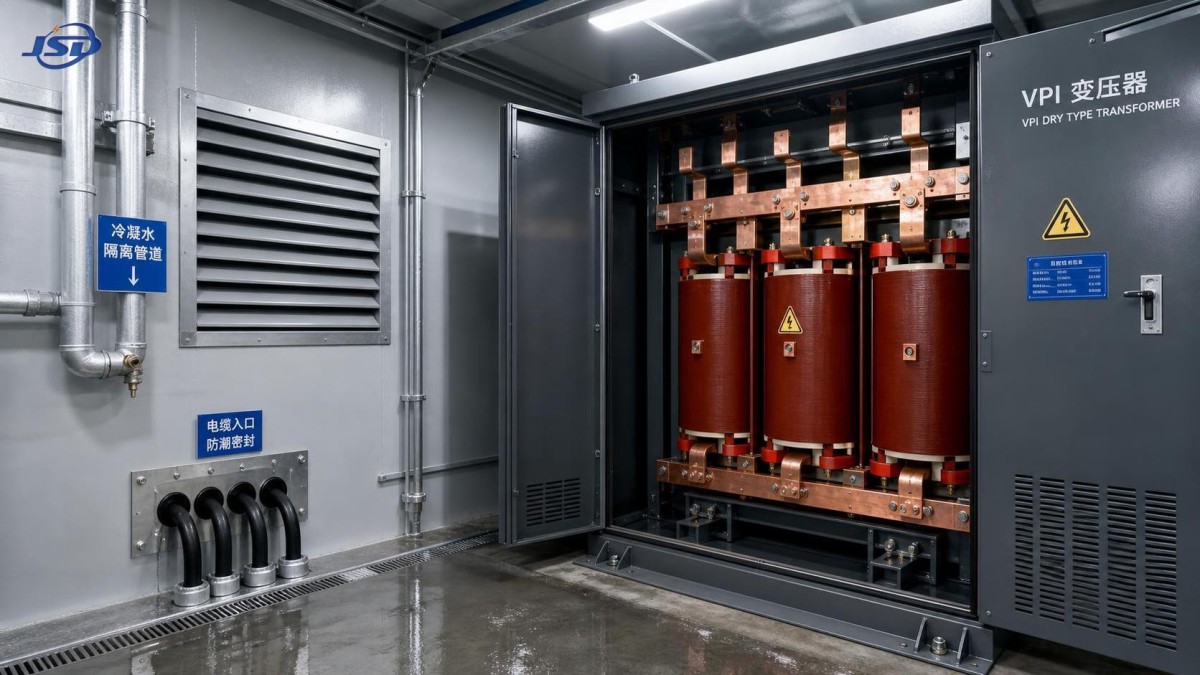
Why VPI matters more than a dry-type label
“Dry type” describes a transformer that uses air and solid insulation rather than liquid dielectric fluid. That is useful in locations where fire safety, indoor installation, or environmental concerns make liquid-filled transformers less desirable. However, dry-type construction alone does not define the same level of environmental durability across all designs.
For humid facilities, the winding treatment and enclosure strategy deserve close attention. Open-wound dry-type transformers may be appropriate in clean, conditioned electrical rooms, but they need more environmental protection where humidity and contaminants are persistent. A VPI dry type transformer offers a more robust winding insulation approach because the resin is intended to penetrate and consolidate the insulation system, not merely cover exposed surfaces.
Quality teams should also distinguish VPI construction from cast-resin construction. Cast-resin transformers use windings encapsulated in resin molds, offering strong resistance to severe environmental exposure. VPI units generally retain more open cooling paths and may provide practical advantages where ventilation, weight, service access, and cost are important. The appropriate choice depends on the actual site conditions, not on a simple ranking of one technology over another.
Where the environment includes heavy condensation, chemical vapors, salt mist, or outdoor exposure, the transformer’s full configuration must be reviewed: winding process, insulation thermal class, enclosure type, ventilation arrangement, terminal protection, corrosion-resistant finishes, and installation location all matter.
Checking moisture resistance during specification and inspection
A good specification turns a broad requirement such as “suitable for humid areas” into verifiable technical expectations. Safety managers should avoid relying only on product descriptions. Instead, ask suppliers to clarify the insulation system, manufacturing method, environmental assumptions, recommended enclosure, and maintenance requirements.
During procurement or factory acceptance review, the following questions are useful:
- Is the transformer produced using a documented vacuum pressure impregnation process?
- What resin system is used, and is it compatible with the expected ambient temperature and contamination conditions?
- What insulation class and temperature-rise design apply to the unit?
- Which enclosure rating is recommended for the intended installation area?
- Are terminals, frames, and hardware protected against corrosion appropriate to the facility environment?
- What routine electrical tests are completed before shipment, such as insulation resistance, winding resistance, ratio, polarity, and dielectric tests?
- Are there special storage instructions if the transformer will remain on site before commissioning?
The answers should be recorded alongside the site risk assessment. A technically sound transformer can still underperform if installed in an enclosure with blocked airflow, placed below leaking pipework, or energized after months of damp storage without inspection.
For medium-voltage distribution projects, the voltage class also affects the level of engineering review required. A properly configured 13.8kV Distribution Transformer may be considered for industrial networks where dependable insulation performance, accessible inspection points, and coordinated protection are essential. The selection should always be matched to the system design, fault level, installation environment, and applicable local electrical requirements.
Environmental standards and practical ratings to review
Standards do not eliminate the need for site judgment, but they provide a common language for evaluating transformer performance. Depending on the market and project requirements, dry-type transformers may be assessed under IEC or IEEE/ANSI frameworks. Relevant documents can address dielectric testing, temperature rise, insulation systems, construction, short-circuit withstand capability, and environmental classifications.
When reviewing documentation, look beyond a single standard reference. Confirm what was actually tested and what environmental condition the designation is meant to cover. Enclosure classifications, for example, relate to protection against ingress of solid objects and water under defined conditions; they do not automatically guarantee resistance to every chemical, salt, or high-pressure washdown environment.
For humid installations, a coordinated review normally includes:
The enclosure is part of the moisture-control strategy
One of the most common mistakes is to treat the VPI process as a substitute for proper installation design. It is not. A transformer can have highly resilient windings and still suffer from corrosion, blocked ventilation, or terminal contamination if the surrounding enclosure is wrong for the facility.
In a relatively clean indoor room with occasional humidity, a ventilated enclosure may be sufficient if the room is well drained and temperature changes are controlled. In a dusty production zone, a higher-protection enclosure may be needed, but designers must account for heat dissipation. In coastal, mining, pulp-and-paper, wastewater, or chemical-processing settings, the analysis should include corrosive atmosphere exposure as well as humidity.
Drainage, mounting height, cable-entry sealing, space-heater arrangements where applicable, and room ventilation all influence the final result. The safest approach is to evaluate the transformer as part of the installation system rather than as a standalone component.
Maintenance signals that should not be ignored
VPI construction reduces vulnerability, but it does not remove the need for inspection. A practical maintenance plan should include visual checks for dust buildup, water staining, corrosion, damaged gaskets, discoloration near terminals, and evidence of tracking. Thermographic inspection can help reveal loose or overheating connections before damage becomes severe.
For planned outages, insulation-resistance testing and other condition assessments should be interpreted against equipment history and manufacturer guidance. A single measurement is less meaningful than a trend. A downward pattern, especially after a wet season or a change in facility operations, deserves investigation.
Safety personnel should also ensure that cleaning practices match the equipment design. Using uncontrolled compressed air can redistribute conductive dust, while wet cleaning methods may introduce the very moisture the insulation system is intended to resist. Lockout/tagout procedures, discharge time, access restrictions, and qualified-person requirements remain essential whenever transformer compartments are opened.
A stronger reliability decision begins before energization
A VPI dry type transformer provides meaningful protection for facilities where humidity is unavoidable but reliable power distribution cannot be compromised. Vacuum pressure impregnation strengthens the winding insulation system by reducing moisture pathways, reinforcing mechanical stability, and limiting contamination uptake. Those benefits are especially valuable in industrial environments where downtime affects production, safety, and maintenance budgets at the same time.
Still, moisture resistance is not a single product feature. It is the outcome of suitable transformer design, documented manufacturing control, correct enclosure selection, disciplined installation, and ongoing condition monitoring. Jinshida Electric Power Technology Co., Ltd. applies this broader view to power transmission and distribution equipment, combining engineering support, controlled manufacturing processes, and quality-focused service for industrial, infrastructure, grid, and new-energy applications.
For quality and safety teams, the most useful decision standard is straightforward: select equipment whose insulation system is appropriate for the real environment, verify the evidence behind its environmental claims, and maintain the installation so that humidity never becomes an unseen path to electrical risk.

Get a Quote
Regardless of whether you require general advice or specific support, we are happy to help you.
Send Us Your Inquiry Today

Jinshida Electric remains committed to contributing to global energy development through professional manufacturing and superior service.