





What determines the price of a distribution power transformer?
For a procurement team, the price of a distribution power transformer is rarely a simple “cost per kVA” calculation. Rated capacity matters, but it is only one part of a larger technical and commercial equation. Two transformers with the same nominal rating can differ substantially in quoted price because they are designed for different voltage systems, operating environments, loss requirements, installation constraints, standards, and service-life expectations.
The practical question is therefore not “Which quotation is lowest?” It is “Which quotation delivers the required electrical performance, compliance, reliability, and lifecycle value for this project?” That distinction matters most in projects where transformer replacement is expensive, unplanned outages carry production risk, or energy losses will accumulate over many years.
Understanding the main price drivers helps buyers compare suppliers on a like-for-like basis, identify quotations that omit critical requirements, and avoid paying for specifications that do not create real value in the intended application.
Capacity sets the starting point, not the final price
Transformer capacity, typically expressed in kVA or MVA, is the most visible pricing factor. A larger unit generally requires more core steel, conductor material, insulation, structural steel, and manufacturing time. However, capacity does not rise in a perfectly linear relationship with price. Material utilization, cooling design, winding arrangement, transport limits, and factory production batches all affect the final figure.
For example, a 1,000 kVA transformer will not necessarily cost exactly twice as much as a 500 kVA unit. Certain fixed-cost elements, including testing, documentation, protection interfaces, enclosures, and accessories, may be similar across both sizes. At the same time, higher-rated units may require a more robust cooling system, larger bushings, stronger short-circuit withstand capability, or special transport arrangements.
Buyers should also verify whether capacity is stated for the actual operating conditions. Ambient temperature, altitude, ventilation, harmonic load, and load profile can all require derating. A lower-priced transformer that only achieves its nameplate rating under favorable conditions may be less economical than a correctly specified larger unit.
Voltage class and insulation level are major cost multipliers
Primary and secondary voltage ratings influence much more than terminal configuration. Higher voltage classes require greater electrical clearances, stronger insulation coordination, appropriately rated bushings or cable terminations, and more demanding dielectric testing. The required lightning impulse withstand level and power-frequency withstand level can also materially affect the insulation design.
A transformer intended for a standard 10 kV or 11 kV distribution network has a different design basis from one specified for a higher-voltage system or for a network with demanding surge conditions. Procurement documents should clearly state:
- Rated high-voltage and low-voltage values;
- System frequency;
- Neutral arrangement and earthing method;
- Required tapping range and tap changer type;
- Insulation level and applicable test requirements;
- Expected overvoltage exposure where relevant.
Ambiguous voltage and insulation requirements create one of the most common quotation problems: suppliers may price technically different products under the same broad description. A comparison based only on capacity and nominal voltage can hide meaningful differences in dielectric margins and equipment suitability.
Core material affects both purchase price and operating cost
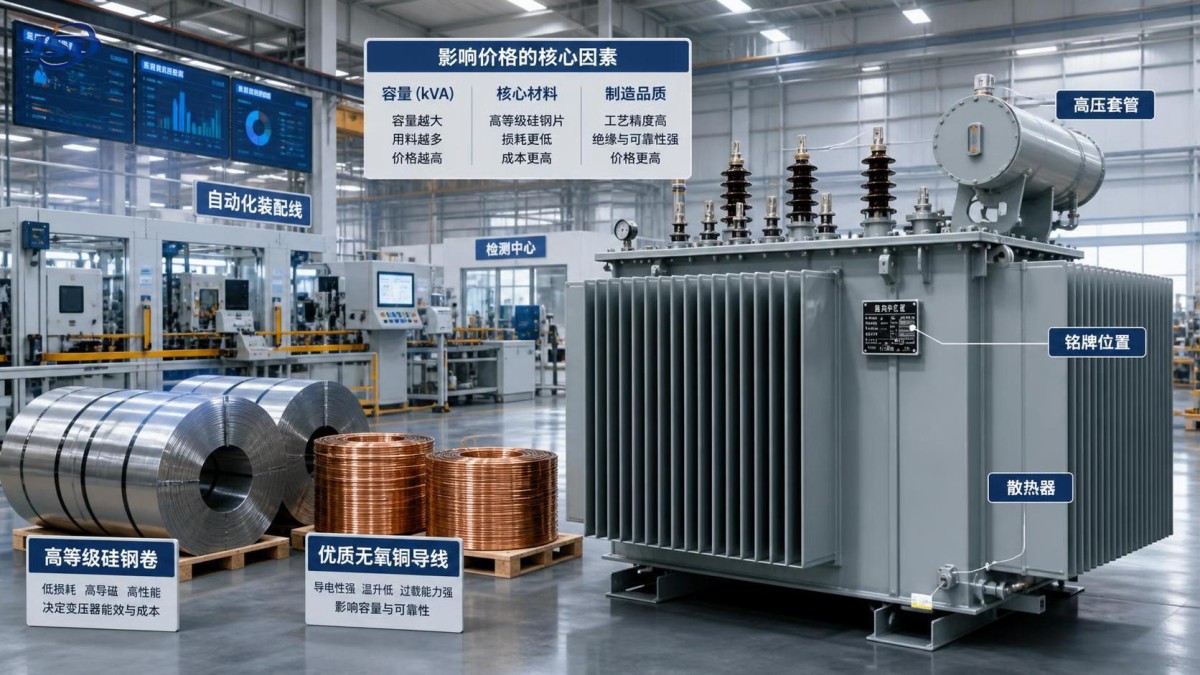
The transformer core is one of the most important cost and performance components. Its design determines a significant part of no-load loss, which occurs whenever the transformer is energized, even when downstream load is low. Since distribution transformers commonly remain energized for long periods, no-load loss deserves particular attention in lifecycle evaluation.
Core material grades, lamination thickness, flux density, joint construction, and manufacturing accuracy all affect losses and cost. A design optimized for low no-load loss may require higher-grade electrical steel, more material, or a larger core section. This can increase initial price, but it may reduce energy waste throughout the transformer’s service life.
Procurement teams should not accept broad claims such as “energy-saving transformer” without requesting guaranteed loss values and the test method used to verify them. The relevant comparison is usually the stated no-load loss and load loss at the specified operating temperature, together with the project’s expected load factor and local energy cost.
A practical evaluation can use a total owning cost approach. The exact calculation varies by utility, industrial operator, or project owner, but the principle is consistent: assign an economic value to guaranteed losses over the expected operating period, then add that value to the purchase price. In many continuously operated installations, the lowest initial quotation is not the lowest-cost option after losses are considered.
Winding conductor choice and loss specification must be read together
Copper and aluminum windings are often discussed as if one option is automatically superior. In practice, the correct choice depends on the approved design, connection method, physical space, current level, thermal requirements, and local operating standards. Copper generally has higher conductivity and can support a compact winding arrangement, while aluminum can offer a lower material cost and remains widely used in properly engineered transformer designs.
The procurement risk is not the conductor material itself. The risk is comparing two offers without confirming whether their loss values, temperature-rise limits, short-circuit performance, terminal arrangements, and warranty obligations are equivalent.
A low-price offer based on aluminum windings may be appropriate for a cost-sensitive project if it meets all required performance criteria. Conversely, copper may be justified where space is constrained, mechanical duty is severe, connection design requires it, or the owner’s technical standard specifies it. Neither should be treated as a shortcut for judging quality.
Buyers should request confirmation of conductor material, winding temperature rise, guaranteed impedance, loss tolerances, and short-circuit withstand capability. These elements affect not only price but also system behavior and future maintenance risk.
Dry-type and oil-immersed designs serve different cost structures
The transformer cooling and insulation system is one of the clearest reasons why similarly rated units can have very different prices. Oil-immersed transformers are commonly selected for outdoor substations, utility distribution, industrial yards, and applications where compact size and established field practice are important. Their price may include items such as radiators, conservators, pressure-relief devices, oil level indicators, oil treatment, and associated protection accessories.
Dry-type transformers, including cast resin designs, are often considered where fire safety, indoor installation, reduced leakage concerns, and limited ventilation options are central project requirements. They can have a higher initial price for an equivalent rating, particularly when specified with demanding insulation, enclosure, environmental, or low-noise requirements. Yet the project-level economics may favor dry type when it reduces fire-protection construction, containment requirements, or indoor installation complexity.
For an indoor medium-voltage distribution room, a solution such as an 11kV Three-Phase Cast Resin Dry-Type Distribution Transformer may be evaluated not simply against another transformer purchase price, but against the combined costs of fire separation, oil containment, ventilation, civil works, and maintenance access. The right comparison is between complete installation options, not equipment nameplate prices alone.
Environmental conditions should be stated early. Dust, salt mist, humidity, condensation, corrosive gases, vibration, seismic exposure, flood risk, and restricted airflow can all affect the enclosure, insulation class, cooling arrangement, and therefore the price.
Efficiency requirements can change the economics significantly
Loss limits are increasingly relevant in transformer procurement, especially for facilities with high operating hours or owners managing large installed fleets. A specification with tighter loss limits may call for more active material, improved core steel, larger conductors, or a different thermal design. It may raise the supplier’s manufacturing cost, but the energy savings can outweigh the premium over time.
There is no universal rule that the highest efficiency level is always the best purchase. The value depends on how the unit will operate. A transformer serving a lightly loaded standby system has a different loss profile from one serving a continuously loaded industrial line, data facility, commercial complex, solar plant auxiliary system, or utility feeder.
Before awarding, buyers should ask suppliers to provide guaranteed no-load and load losses, not only typical values. They should also clarify whether the quoted losses comply with the required local standard or project specification. Where regulations, utility rules, or energy-efficiency labels apply, the current version and jurisdiction should be verified rather than assumed.
Impedance, tap changing, and fault duty affect price beyond the datasheet headline
Transformer impedance is often treated as a routine datasheet value, but it has direct system implications. It affects fault current, voltage regulation, parallel operation, and coordination with switchgear and protection equipment. A non-standard impedance requirement may require changes to the winding design and can influence both cost and delivery time.
Tap changing requirements can have a similar effect. An off-circuit tap changer is commonly sufficient where voltage adjustment is infrequent and planned outages are acceptable. An on-load tap changer introduces more mechanical and control complexity, and its cost must be assessed together with monitoring, drive mechanism, maintenance requirements, and expected switching duty.
In price comparisons, confirm that all suppliers have quoted the same tap range, tap steps, connection group, impedance tolerance, and fault-level requirement. A quotation that appears economical may exclude expensive but essential requirements needed for stable operation in the actual distribution network.
Standards and testing are not paperwork costs alone
Compliance requirements influence material selection, design margins, testing scope, documentation, and factory scheduling. Depending on project location and customer requirements, the relevant framework may include IEC, IEEE, ANSI, national standards, utility specifications, or project-specific technical schedules. The buyer should state the governing requirements clearly and avoid relying on a generic statement such as “international standard.”
Routine tests are normally expected, but special tests can add cost and lead time. Examples may include lightning impulse testing, partial discharge testing, temperature-rise testing, sound-level measurement, short-circuit withstand verification by design evidence, seismic qualification, or tests required by a specific owner standard. Not every application needs every test, but each omitted test should be a conscious risk decision rather than an unnoticed quotation gap.
Documentation quality also matters. Drawings, test certificates, manuals, nameplate data, terminal diagrams, loss guarantees, packing records, and traceability records support inspection, installation, and future asset management. In grid and infrastructure work, incomplete documentation can delay acceptance even when the physical equipment is ready.
Accessories, enclosure design, and interfaces are frequent sources of hidden differences
Many quotation disputes arise because the transformer body has been compared while the supply boundary has not. Buyers should check whether the quoted price includes all required accessories and interfaces, such as:
- High-voltage and low-voltage bushings, plug-in connectors, or cable boxes;
- Neutral terminals and earthing terminals;
- Temperature monitoring, alarms, fans, and control panels for dry-type units;
- Protection devices, gauges, valves, and oil-related accessories for oil-immersed units;
- Indoor or outdoor enclosures with the required ingress protection level;
- Anti-condensation heaters, space heaters, marshalling boxes, and auxiliary power interfaces;
- Lifting, jacking, rollers, transport restraints, and installation hardware.
Noise limits deserve particular attention in urban, commercial, healthcare, educational, and indoor applications. Meeting a lower sound-level requirement may require design changes, not merely an acoustic enclosure added after manufacture. Similarly, an enclosure suitable for a clean indoor electrical room may not be adequate for a humid coastal site or a dusty industrial workshop.
Customization adds value only when it addresses a real operating constraint
Custom engineering can be necessary, but it is also a source of avoidable cost and longer lead times. Special dimensions, unusual voltage combinations, non-standard vector groups, dual-secondary arrangements, restricted transport dimensions, customized paint systems, special terminal layouts, or project-specific monitoring packages may all require design work and procurement of non-standard components.
The buyer’s task is to separate essential customization from preference-driven variation. A requirement is generally worth paying for when it protects safety, ensures grid compatibility, fits the installation space, meets a binding standard, or reduces a measurable operational risk. It deserves review when it simply reproduces an old specification without reference to the current project.
Standardized configurations often provide advantages beyond purchase price: more predictable delivery, simpler spare-parts planning, easier technical evaluation, and lower commissioning uncertainty. Where customization is unavoidable, it should be frozen early. Late changes to voltage, loss level, enclosure class, or interfaces can affect material procurement and factory scheduling.
Supply-chain conditions and delivery terms influence the quotation
Transformer pricing is sensitive to the availability and cost of core steel, copper, aluminum, resin, insulating materials, bushings, tap changers, and control components. Freight, packaging, currency exposure, and destination requirements can also have a meaningful effect, particularly for export projects or heavy units requiring special transport.
A valid commercial comparison should identify the quotation basis: factory delivery, delivered-to-site terms, included packaging, inland transport, marine freight, insurance, customs responsibilities, commissioning support, and warranty coverage. A lower ex-works price may not remain lower after logistics, site handling, and missing accessory costs are added.
Lead time should be treated as a technical-commercial variable, not a footnote. A supplier may offer a short nominal lead time while depending on unconfirmed component availability. Ask which critical materials are already available, what approval documents are needed before production starts, how long testing and inspection will take, and whether the delivery date is contractual or indicative.
How to compare quotations without rewarding missing scope
The most reliable method is to build a technical comparison sheet before commercial negotiation. Put every supplier’s offer against the same required values: rating, voltage, vector group, impedance, losses, insulation level, cooling method, temperature rise, standards, tests, enclosure, accessories, dimensions, weight, delivery terms, warranty, and exclusions.
When major price differences remain after normalization, buyers should ask suppliers to explain the design basis rather than immediately requesting a discount. The difference may reflect superior loss performance, more robust insulation, a broader accessory package, or simply a specification misunderstanding. Each outcome requires a different response.
The lowest price is often a signal to investigate, not a decision
A low quotation can be commercially sound, especially when a supplier has standardized production, efficient sourcing, or suitable local logistics. But it should trigger a disciplined review when it is materially below comparable offers. The essential questions are whether all mandatory technical requirements are included, whether losses are guaranteed, whether test obligations are clear, and whether the supplier can document manufacturing and quality-control capability.
For a distribution power transformer, procurement is ultimately buying a long-lived electrical asset that will sit between the power source and the operation it supports. The initial purchase price is visible on the order. The cost of losses, outages, non-compliance, delayed delivery, and difficult replacement appears later, often in a different budget line.
Good procurement decisions therefore begin with an accurate technical baseline, use lifecycle cost where operating conditions justify it, and treat quotation comparison as an engineering exercise as well as a commercial one. That is how buyers turn transformer price from a single number into a defensible project decision.

Get a Quote
Regardless of whether you require general advice or specific support, we are happy to help you.
Send Us Your Inquiry Today

Jinshida Electric remains committed to contributing to global energy development through professional manufacturing and superior service.