





When does a resin transformer suit a humid industrial facility?
Humidity changes transformer selection from a routine electrical-sizing exercise into an environmental reliability decision. In industrial buildings, moisture rarely appears alone. It often comes with conductive dust, salt aerosols, chemical vapours, washdown activity, rapid temperature changes, restricted ventilation, and an operating culture that leaves little time for preventive maintenance. A resin transformer can perform very well in this setting, but only when the specification matches the actual exposure rather than the general label of “humid site.”
The central question is not whether cast-resin insulation is moisture-resistant in principle. It is whether the complete transformer installation—windings, terminals, enclosure, cooling air path, cable interfaces, protection scheme, and maintenance access—will remain reliable through the facility’s wettest, hottest, dirtiest, and least stable operating periods.
Why humidity is a transformer problem rather than merely a room-condition problem
Moisture affects transformers through several mechanisms. In an oil-filled unit, water can degrade dielectric performance and accelerate insulation aging if it enters the tank or is present in the insulation system. In dry-type equipment, the concern shifts toward surface tracking, condensation at terminals and bushings, corrosion of metallic parts, deterioration of external insulation surfaces, and contamination that becomes conductive when wet.
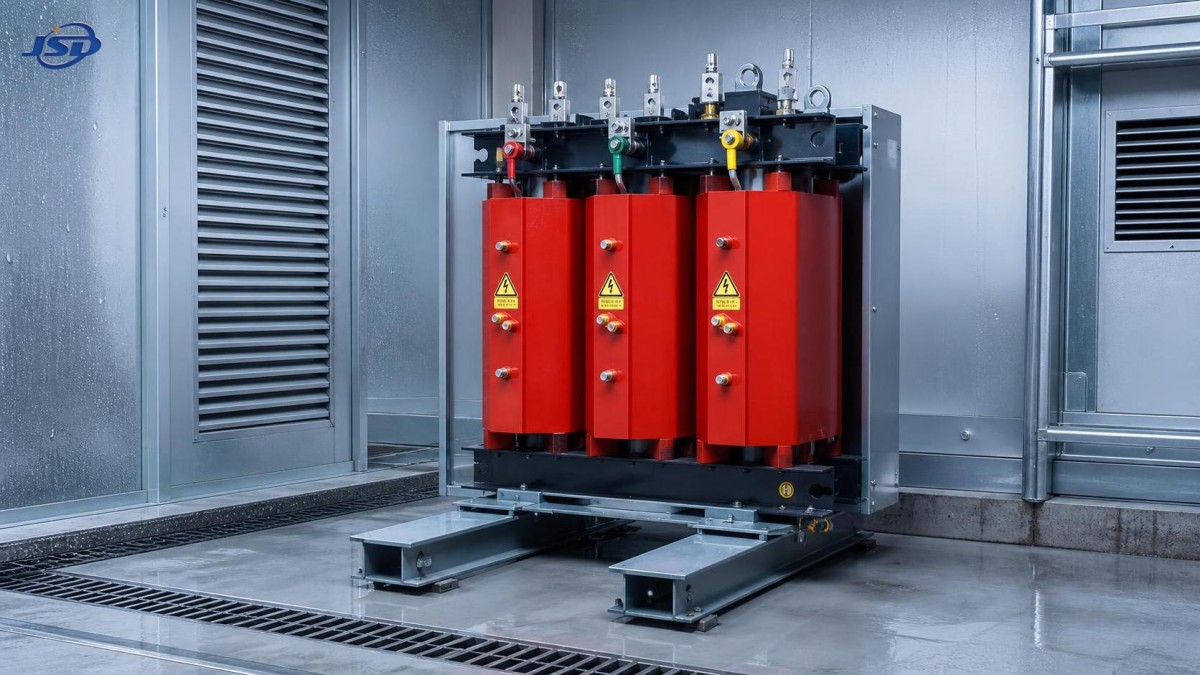
For a cast-resin transformer, the high-voltage windings are encapsulated in epoxy resin. This substantially reduces direct exposure of the winding insulation to ambient moisture and makes the design inherently more robust than open-wound dry-type alternatives in many damp or polluted environments. The resin casting also improves mechanical integrity under short-circuit forces and thermal cycling, provided the design and manufacturing process control voids, cracking risk, and partial-discharge performance.
That does not mean a resin transformer is sealed equipment. Low-voltage windings, tap links, cable terminations, surge arresters, temperature sensors, support insulators, and the enclosure itself remain influenced by site conditions. Where condensation repeatedly forms inside a substation room or outdoor kiosk, a poorly designed installation can still suffer insulation faults and corrosion even if the winding blocks remain in good condition.
A useful distinction is between high humidity and condensation exposure. A facility can have consistently high relative humidity but avoid condensation if equipment temperatures remain above dew point and ventilation is controlled. Conversely, a site with moderate average humidity may experience severe condensation when a transformer is de-energized overnight, doors are opened to warm outside air, or chilled-process areas create sharp temperature gradients. The latter condition is usually more demanding.
Where cast-resin units usually make technical sense
Resin transformers are often well suited to indoor industrial substations where fire safety, limited oil containment, and resistance to variable environmental conditions all matter. Typical examples include food and beverage plants with frequent washdown nearby, pulp and paper facilities, textile mills, wastewater treatment buildings, coastal manufacturing sites, ports, underground works, mining-related process buildings, and industrial sites with high fire-risk zoning.
They are particularly attractive when the transformer must be installed close to the load centre: inside production halls, in multistorey facilities, near occupied areas, or within buildings where an oil bund, fire wall, drainage arrangement, or insurer-driven fire-protection design would make an oil-filled transformer difficult to deploy.
The choice becomes stronger when all of the following are true:
- The transformer room is enclosed but can be kept reasonably clean and ventilated.
- Moisture is present in the ambient air, but direct water jets and persistent pooling can be prevented.
- Fire load, environmental liability, or indoor siting restrictions favour a liquid-free design.
- Load growth is understood and harmonic content can be quantified.
- The project can accept the heat and footprint implications of dry-type equipment.
The last two conditions deserve more attention than they often receive. Cast-resin units generally have higher losses and rely on air for cooling, so their performance is more closely tied to room temperature and ventilation than that of an equivalent liquid-filled transformer. A humid facility with poor air circulation can become a thermal problem even if it is not electrically aggressive.
Read the site as a set of exposures, not a single humidity number
Specifications that state only “relative humidity: 95%” are inadequate for meaningful selection. Relative humidity must be considered with temperature range, condensation frequency, contaminants, altitude, ventilation, and the probability of direct water ingress. A better site survey separates the following conditions.
Condensation and thermal cycling
Ask when the transformer is energized, when HVAC systems are shut down, and whether cold surfaces are exposed to moist air. Repeated cycling across the dew point can leave moisture on terminal boards and insulator surfaces. The transformer may appear dry during daytime inspection yet experience the most severe condition during shutdown or restart.
Measures such as anti-condensation heaters, a properly designed enclosure, thermostatic or hygrostatic control, drained cable-entry arrangements, and ventilation that does not simply pull in wet outdoor air can be as important as the winding insulation technology. Where a transformer is installed outdoors, the enclosure rating and roof design need independent review; an outdoor cabinet is not automatically protected against every driving-rain, flood, or salt-fog condition.
Contaminants carried by moisture
Clean humidity is usually manageable. Humidity combined with fertilizer dust, cement dust, carbon black, metal particles, chlorine-containing vapours, sulfur compounds, or salt creates a different risk profile. Deposits on exposed insulation can absorb moisture and lower surface resistance, creating paths for tracking and flashover. Corrosive atmospheres can also compromise fasteners, earthing connections, door seals, louvres, and terminal hardware.
In these cases, an evaluator should request details on protective coating systems, enclosure material, corrosion category assumptions, internal segregation, ingress protection, and the location of uninsulated live parts. Simply specifying a cast-resin winding will not address corrosion elsewhere in the assembly.
Direct washdown, spray, and flooding
A resin transformer should not be treated as washdown equipment. If the installation is close to cleaning operations, pressure washing, cooling-tower drift, or leaking process pipework, physical separation is preferable. A dedicated electrical room or segregated transformer compartment is more reliable than a higher enclosure rating alone. Flood risk requires equipment elevation, drainage design, cable-sealing strategy, and emergency operating procedures; it is not solved by selecting a dry-type transformer.
Use IEC environmental, climatic, and fire classes correctly
IEC 60076-11 provides a useful framework for dry-type transformers. Environmental classes indicate the conditions that equipment can withstand in service, while climatic classes address low-temperature exposure and fire-behaviour classes address fire performance. In humid industrial discussions, E2 is often cited because it represents a more severe environmental class than E0 or E1, including consideration of condensation and pollution. However, E2 should not be used as shorthand for “suitable for any wet industrial environment.”
The specification should state the required class and require documented conformity from the manufacturer. It should also confirm what that declaration covers: the transformer itself, the enclosure if supplied, and any accessory compartment. Climatic class C2 and fire class F1 are commonly relevant to industrial projects, but their necessity depends on the installation location, local regulations, insurer requirements, fire strategy, and ambient-temperature profile.
Standards are qualification tools, not substitutes for engineering judgement. An E2-class transformer placed in a room with corrosive gas, blocked ventilation, and water entering through unsealed cable trenches may fail for reasons unrelated to the winding qualification test.
Thermal design often decides whether the selection succeeds
In humid facilities, designers sometimes focus so heavily on moisture that they overlook thermal margin. Dry-type transformer ratings are based on defined ambient conditions and cooling arrangements. If ambient temperature is elevated by process heat, if louvres clog with dust, or if several transformers share a compact room, winding temperature can rise materially. This shortens insulation life and can trigger nuisance alarms or load curtailment.
Review the expected load profile rather than only the nameplate kVA. Continuous base load, cyclic peaks, motor starting, nonlinear loads, future expansion, and emergency operation should all be included. Harmonic currents deserve particular attention in facilities with variable-speed drives, rectifiers, welding equipment, induction furnaces, UPS systems, or large battery power-conversion equipment. Harmonics increase eddy-current and stray losses, potentially requiring a transformer designed for the actual harmonic spectrum or a derated operating point.
Temperature monitoring should be treated as part of the protection architecture, not an optional accessory. Winding temperature sensors, alarm and trip settings, fan control where forced-air cooling is used, and integration with the site monitoring system should be established before commissioning. The cooling system must also remain serviceable in dusty humidity-prone rooms; fans may improve capacity but add maintenance dependence.
Check interfaces, especially where energy storage changes the load pattern
Industrial facilities increasingly add battery storage to control demand charges, support critical loads, smooth renewable output, or manage EV charging. This can alter transformer duty in ways that are not visible from connected capacity alone. Charging may add long-duration load during off-peak periods; discharge can change feeder loading rapidly; PCS-generated harmonics and fault-current contribution need review alongside utility supply characteristics.
For example, an outdoor 125kW/261kWh Commercial & Industrial Energy Storage System provides 380 V / 400 V AC output and is intended for functions such as peak shaving, backup support, and renewable-energy integration. When such a system is connected downstream of a resin transformer, the transformer review should cover the PCS harmonic data, maximum import and export scenarios, protection coordination, neutral arrangement, earthing method, and whether battery operation could increase loading during high ambient-temperature periods. Its IP54 enclosure and stated operating range do not remove the need to assess the transformer’s own environment and thermal duty.
Compatibility should also include transient behaviour. Verify inrush-current settings, relay coordination, voltage regulation limits, and the effect of transformer impedance on short-circuit levels and inverter fault detection. In weak-grid sites, impedance selection can influence voltage dip performance for motors as well as inverter control stability.
What a robust procurement specification should ask for
A technically useful procurement package describes the installation and asks the supplier to respond to it, rather than merely listing power rating and voltage ratio. At minimum, it should identify ambient temperature limits, humidity profile, condensation probability, pollution sources, altitude, indoor or outdoor arrangement, ventilation concept, required environmental/climatic/fire classes, and any corrosive agents known to be present.
Electrical data should include frequency, vector group, tapping arrangement, impedance tolerance, insulation level, neutral treatment, fault level, load cycle, harmonic spectrum where available, required efficiency basis, and whether parallel operation is planned. Mechanical details should cover enclosure rating, cable entry direction, clearances, transport limits, seismic requirement if applicable, sound limits at the installation boundary, and access for inspection and replacement.
Documentation is a material part of selection. Request routine-test records, type-test evidence relevant to the proposed design, temperature-rise data, partial-discharge information where specified, drawings of terminal layout, protection wiring diagrams, nameplate data, coating and enclosure details, and maintenance instructions. For export projects, applicable local electrical codes, grid requirements, and project-specific certification obligations must be confirmed separately; CE marking, where relevant, is not a universal replacement for jurisdictional compliance.
Common selection errors in damp industrial projects
The first is treating “dry type” as a complete environmental solution. The winding may be highly resistant, while terminals and cable boxes remain vulnerable. The second is choosing an enclosure with insufficient attention to heat rejection. A sealed or highly protected enclosure can limit the airflow needed for rated operation unless the thermal design explicitly accounts for it.
Another frequent mistake is placing the transformer in the nearest available utility room, which may also house water pipes, chemical-storage lines, compressors, or battery equipment. Location frequently delivers more reliability than an incremental upgrade in transformer class. Separation from wet processes, controlled airflow, raised plinths, and maintainable cable routes can reduce risk more effectively than relying on a single product feature.
Finally, low-maintenance should not be interpreted as no-maintenance. Cast-resin transformers avoid oil sampling and leak management, but periodic inspection remains necessary. A practical routine checks dust accumulation, signs of condensation, corrosion, discoloured terminals, abnormal fan operation, temperature trends, insulation condition of accessible components, and the tightness of electrical connections during planned shutdowns. Thermographic inspection under representative load is often valuable, particularly after commissioning and after major load changes.
The decision threshold
A resin transformer is a sound choice for a humid industrial facility when moisture resistance, indoor fire safety, and reduced liquid-related environmental risk are genuine project priorities, and when the installation can control direct water exposure and reject heat effectively. It is most compelling in enclosed, reasonably maintainable spaces with intermittent condensation risk, moderate contamination, and a need to locate transformation close to sensitive or occupied loads.
It is less convincing when the site is effectively exposed to washdown, flooding, severe uncontained corrosive vapours, or chronic overheating. In those cases, the right answer may involve a different installation architecture, a separately protected substation, or another transformer technology rather than a more ambitious resin specification.
The reliable decision comes from matching the transformer to the complete duty cycle and environmental envelope. Humidity is one input. Condensation, contaminants, thermal behaviour, network characteristics, installation design, and maintenance discipline determine whether that input becomes a manageable operating condition or a recurring source of failure.

Get a Quote
Regardless of whether you require general advice or specific support, we are happy to help you.
Send Us Your Inquiry Today

Jinshida Electric remains committed to contributing to global energy development through professional manufacturing and superior service.