





How does partial discharge affect a cast resin type transformer?
Partial discharge can silently compromise the insulation integrity, operational safety, and service life of a cast resin type transformer. For quality-control and safety professionals, the relevant question is not simply whether a discharge reading exists. It is whether the activity indicates a stable, acceptable insulation condition or the early stage of a defect that may grow under electrical, thermal, and environmental stress.
That distinction matters because cast-resin transformers are often installed close to people and critical loads: inside commercial buildings, tunnels, substations, industrial plants, renewable-energy facilities, and process areas where an unplanned outage can carry a substantial safety or production consequence. Their dry-type construction removes the fire and leakage issues associated with insulating liquid, but it does not remove insulation-system risk. In fact, the condition of the resin, winding insulation, interfaces, and electric-field control becomes central to long-term reliability.
Partial discharge is a condition indicator, not just a test result
Partial discharge (PD) is a localized electrical discharge that bridges only part of the insulation between conductors. It may occur in small voids within resin insulation, at conductor-insulation interfaces, around sharp edges, between poorly bonded layers, or on contaminated surfaces where electrical stress is concentrated. The discharge does not immediately create a phase-to-phase or phase-to-earth fault. That is why it can remain undetected while the transformer continues operating.
For a cast resin type transformer, this is precisely what makes PD important. Epoxy resin insulation is designed to support the winding mechanically and electrically, but localized electrical activity can gradually erode its dielectric strength. The defect may be microscopic at first. Repeated discharges can damage the surrounding resin, carbonize material, create conductive paths, or worsen the original void or delamination. A transformer can therefore pass routine operational checks while its insulation margin is declining.
A low recorded PD level should not automatically be treated as harmless, nor should every detected signal be assumed to originate inside the transformer. Test setup, external electrical noise, cable terminations, switchgear, grounding arrangements, and nearby power electronics can all affect the measurement. The quality task is to identify the source, establish whether the reading is repeatable, and assess it against the applicable design, test, and contractual requirements.
How the damage develops over time
Partial discharge affects a transformer through cumulative rather than instantaneous damage. Each event releases a small amount of energy into a localized region. Over thousands or millions of repetitions, that energy can attack the polymer surface and alter the insulation structure. Heat, chemical degradation, mechanical vibration, and moisture can accelerate the process.
In a typical progression, a manufacturing imperfection or installation-related defect creates a point of elevated electric stress. PD begins intermittently, often at higher voltage or during particular temperature and humidity conditions. As insulation erosion develops, the inception voltage may fall and the discharge pattern may become more active. Eventually, the affected area can no longer withstand normal or transient overvoltage, leading to insulation breakdown, flashover, or an internal winding fault.
The final event may appear sudden to operations personnel, but it is rarely sudden from an insulation-aging perspective. This is why PD management belongs in preventive quality assurance and asset-risk management, rather than only in post-failure investigation.
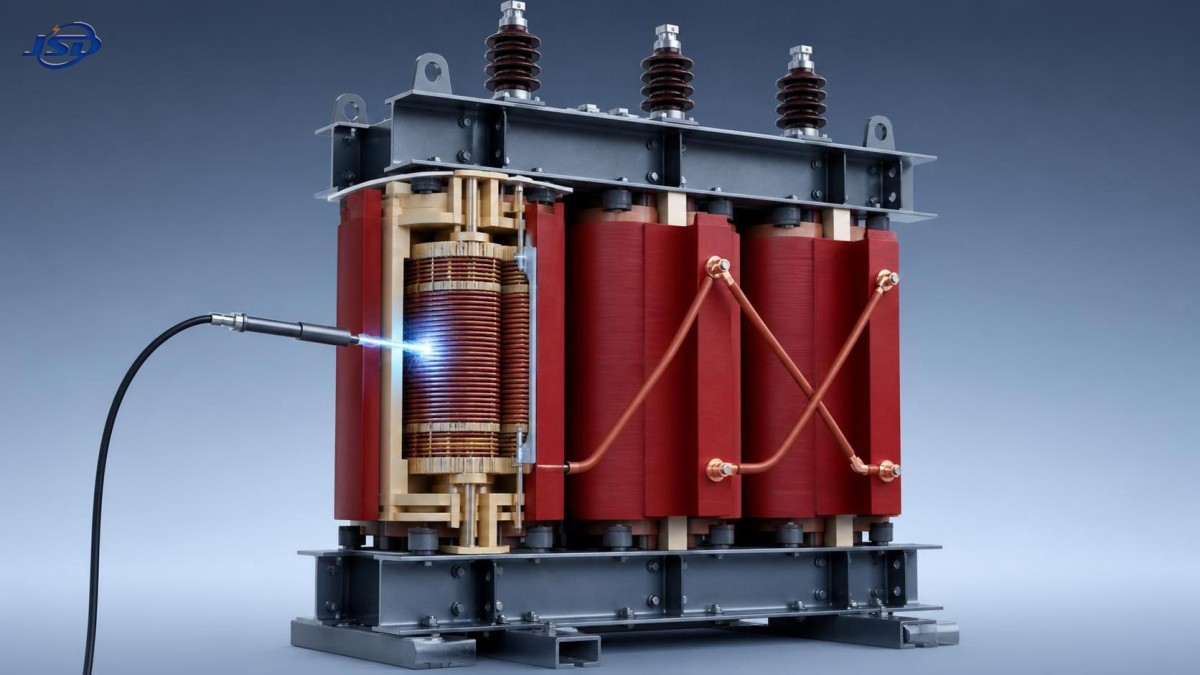
Where PD risk usually originates
Not every PD issue has the same root cause. For purchasing inspection, factory acceptance, site commissioning, and later maintenance, it is useful to separate the main risk categories.
Manufacturing and design-related defects
Voids in cast resin, inadequate impregnation around conductors, uneven curing, poor bonding between insulation layers, contamination introduced during winding or casting, and insufficient clearance at highly stressed points can all contribute to PD. So can inadequate electric-field grading around leads, tapping connections, or winding ends. These issues are particularly relevant because they may be embedded in the insulation system and difficult to inspect visually after manufacture.
Quality control should therefore look beyond a finished-product appearance check. The supplier’s control of resin handling, vacuum casting or impregnation processes, curing profiles, clean-room discipline where applicable, winding geometry, conductor preparation, and test records has a direct bearing on insulation reliability.
Transport, installation, and commissioning damage
A sound transformer can acquire new weaknesses after it leaves the factory. Mechanical shock during transport may affect clamping or insulation interfaces. Incorrect cable termination, inadequate phase clearance, poor earthing, contamination, or unsuitable enclosure ventilation can introduce external discharge or raise local electrical stress.
Commissioning teams should be careful not to interpret all abnormal signals as an internal transformer defect. A loose termination, damaged medium-voltage cable accessory, or contaminated bushing can produce measurements that resemble transformer PD. The investigation boundary should include the complete energized assembly.
Operating stress and environmental conditions
Thermal cycling is especially significant for cast-resin designs. Copper conductors, resin, insulation paper, and structural components expand differently as load changes. Over many cycles, interface stresses can contribute to cracking or delamination if the insulation system, casting quality, or loading profile is unsuitable.
Harmonic-rich loads, frequent starts, voltage transients, high ambient temperatures, blocked cooling paths, condensation, and conductive dust can also change the electrical and thermal environment. PD is not always caused by one exceptional overload. In industrial facilities, a combination of modest but persistent stresses may be more relevant than a single dramatic event.
Operational consequences extend beyond insulation failure
The clearest consequence of sustained PD is reduced dielectric life, but the operational impact is broader. As insulation deteriorates, the probability of an unplanned outage increases. In a critical facility, that can mean loss of a process line, interruption to auxiliary power, emergency switching activity, repair delays, and a more complex safety response.
PD-related degradation can also affect the confidence that operators place in loading decisions. A transformer with an unresolved insulation concern should not be treated as having the same overload capability or remaining-life margin as a unit with stable test evidence. Continuing to load the asset according to nameplate assumptions without considering its actual condition can turn a manageable defect into a forced outage.
For safety managers, the issue is also one of fault energy and location. An internal insulation breakdown can create arcing, pressure effects, smoke, and secondary damage. Dry-type construction may reduce certain fire risks compared with liquid-filled equipment, but it does not eliminate the need for fault containment, ventilation design, protective coordination, and emergency procedures.
Standards provide a framework, but not a single universal limit
Standards are essential for defining test methods and acceptance responsibilities, but they should not be used as a shortcut for engineering judgment. IEC 60270 is widely referenced for high-voltage partial-discharge measurement techniques. For dry-type power transformers, IEC 60076-11 is commonly relevant, while dielectric requirements are addressed within the broader IEC 60076 series. The exact applicable edition, voltage class, transformer design, national requirements, and purchase specification should be confirmed for the project.
A common procurement mistake is to request “PD tested to IEC” without stating the test voltage, acceptance criteria, test circuit, background-noise limit, calibration approach, report format, and treatment of any detected activity. That wording can leave too much open to interpretation.
There is no responsible substitute for a project-specific acceptance requirement. Apparent charge values are influenced by test arrangement and capacitance, and a numerical result alone does not fully describe defect severity. A compliant result is valuable only when the measurement is valid, traceable, and relevant to the equipment being supplied.
What a practical inspection strategy looks like
For new equipment, the strongest approach begins before factory acceptance. The technical specification should define insulation class, service environment, expected load profile, harmonic conditions, installation altitude where relevant, testing responsibilities, and required documentation. Factory PD testing should be treated as one layer of evidence, together with routine tests, dielectric tests, dimensional and connection checks, visual inspection, and review of manufacturing records.
During factory acceptance testing, quality personnel should verify that the tested transformer is the delivered unit, not merely a representative model. The report should identify the serial number, rated voltage, winding configuration, test date, test personnel, measuring arrangement, calibration data, and final conclusion. If a result is close to the contractual threshold, the appropriate response is not automatically acceptance or rejection; it is a technical review of repeatability, phase-resolved pattern, noise separation, and likely source.
At site, baseline testing and careful commissioning records are valuable because they create a reference for later comparison. For assets with high consequence of failure, periodic condition assessment may include offline PD testing, online monitoring, acoustic methods, ultra-high-frequency techniques, thermal inspection, visual examination for contamination or cracking, and review of load and temperature history. The suitable method depends on voltage level, accessibility, background interference, asset criticality, and the ability to take the transformer out of service.
- Investigate trends rather than relying on a single isolated reading.
- Correlate PD data with temperature, humidity, load, switching events, and maintenance history.
- Check cable terminations, bushings, grounding, and nearby equipment before concluding that the winding insulation is defective.
- Escalate promptly when discharge activity rises, changes pattern, or appears with odor, abnormal sound, surface tracking, temperature anomalies, or protective-operation events.
Rectifier and power-electronic loads require closer attention
Transformers supplying rectifier systems, electrolysis equipment, electroplating lines, rail applications, mining loads, or other power-electronic installations may operate under conditions that differ materially from a conventional linear load. Harmonics can increase losses and temperature rise, while switching behavior and system transients may add stress to insulation and connected accessories. The transformer design, cooling method, connection group, shielding, and protection scheme should be assessed as a system rather than as isolated catalogue parameters.
For example, an Isolation and Rectifier Special Transformer intended for demanding industrial rectifier duty should be evaluated not only for voltage ratio and kVA rating, but also for harmonic loading assumptions, thermal margin, copper winding design, insulation coordination, installation environment, and the applicable IEC 60076 requirements. A claimed standard reference is useful evidence, but it does not prove that every project-specific stress has been addressed.
This is also where safety and procurement teams need to challenge generic statements. “Dry-type” does not automatically mean maintenance-free. “Copper winding” does not automatically establish PD resistance. “IEC compliant” does not automatically define the acceptance test that was actually performed. These descriptions can be relevant, but only when connected to traceable design data, test documentation, and the real operating duty.
Deciding when a PD finding needs action
A response should be proportionate to consequence and evidence. A noisy, non-repeatable signal during a site test may require improved measurement conditions and source localization before an asset decision is made. A repeatable internal pattern that increases over time, particularly in a high-criticality transformer, calls for a structured risk assessment and likely intervention planning.
The key questions are practical: Is the source internal or external? Is the activity stable, increasing, or linked to operating conditions? Is there corroborating evidence from temperature, visual inspection, dielectric testing, or protection events? What is the consequence of failure, and is a planned outage available before risk becomes unacceptable?
Partial discharge should therefore be treated as an early warning about insulation quality and insulation aging, not as a standalone pass-or-fail label. For a cast resin type transformer, disciplined specification, valid factory evidence, careful commissioning, and condition-based follow-up provide the best basis for protecting both personnel and continuity of supply.

Get a Quote
Regardless of whether you require general advice or specific support, we are happy to help you.
Send Us Your Inquiry Today

Jinshida Electric remains committed to contributing to global energy development through professional manufacturing and superior service.