





Can a dry type distribution transformer cut no-load energy losses?
Can a dry type distribution transformer meaningfully reduce no-load energy losses in modern power systems? The answer depends less on the absence of insulating oil than on the magnetic design of the transformer: core steel grade, core geometry, flux density, joint construction, excitation performance, and manufacturing precision. A dry-type unit can achieve low no-load loss, but it is not inherently lower-loss than every oil-immersed alternative. The correct comparison is between verified loss values at the same rating, voltage class, frequency, impedance, and applicable efficiency standard.
This distinction matters because no-load loss is present whenever the transformer is energized, including nights, weekends, low-production periods, and partially occupied buildings. In facilities with long energization hours and moderate load factors, core loss may represent a material share of lifetime energy cost. The question is therefore not simply whether dry-type technology is “energy saving,” but whether its specified magnetic losses are justified by the operating profile and site requirements.
No-load loss is fundamentally a core-design issue
No-load loss, also called core loss or iron loss, is the active power consumed when the transformer secondary is open-circuited and rated voltage is applied to the primary winding. It consists mainly of hysteresis loss and eddy-current loss in the magnetic core, with smaller contributions from excitation current effects and structural stray losses.
Unlike load loss, which rises approximately with the square of current, no-load loss remains close to constant at a given voltage and frequency. A 1,000 kVA transformer with a relatively modest load may therefore consume almost the same core-loss energy as it would near rated load. Annual no-load energy consumption can be approximated as:
Annual no-load energy = no-load loss (kW) × energized hours per year
A reduction of 300 W may appear minor in a data sheet, but over 8,760 hours it corresponds to about 2,628 kWh annually. Over a 20- to 30-year operating life, the energy, emissions, and cost implications become significant, especially where electricity prices are high or carbon reporting is relevant.
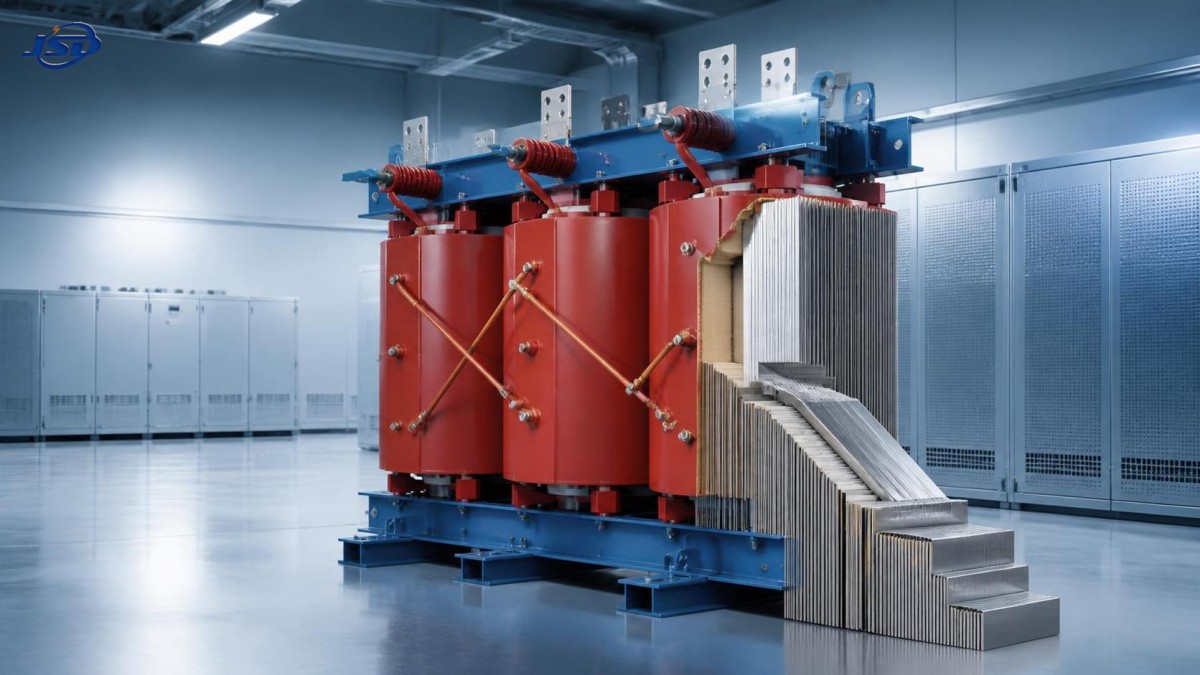
The construction type does not override this physics. Both cast-resin dry-type transformers and liquid-filled transformers use laminated magnetic steel cores in most distribution applications. Whether a transformer has low core loss depends on how effectively that core is designed and manufactured.
Where a dry type distribution transformer can reduce no-load losses
A modern dry type distribution transformer can deliver substantially lower no-load losses than older dry-type designs, particularly where it uses high-grade grain-oriented electrical steel, carefully optimized flux density, precision-cut laminations, and controlled core assembly. The largest gains generally come from four technical choices.
Lower-loss grain-oriented electrical steel
Grain-oriented silicon steel is engineered so that magnetization along the rolling direction requires less energy. Core loss falls when lower specific-loss steel grades are used, although the material cost rises. For many installations, this trade-off is economically sound because core loss is incurred continuously rather than only at peak load.
Material grade alone is not enough. Procurement specifications that merely request “high-quality silicon steel” are too vague to support an efficiency assessment. The purchaser should require guaranteed no-load loss at stated conditions and test verification on the completed transformer.
Core geometry and joint design
Stepped-lap core joints reduce magnetic reluctance and local flux disturbance compared with simpler butt-lap arrangements. Mitred joints, controlled overlap, and accurately aligned laminations can reduce excitation current and localized core loss. In low-loss designs, the geometry of corners and joints matters as much as the nominal steel grade.
Core cross-sectional area also influences the design. Increasing core area permits lower operating flux density for a given voltage, which can reduce no-load loss. The cost is a larger, heavier core with more steel. This is why lower-loss transformer designs may not be the smallest or lowest-priced options.
Controlled flux density
Core loss rises nonlinearly as flux density approaches the upper region of the magnetic material’s operating curve. Designing at a more conservative flux density can lower excitation current and core loss, but it requires a larger core or a different winding/core balance. A transformer optimized for low purchase cost may run at a higher flux density than a unit optimized for lifecycle energy performance.
Voltage is crucial here. Overvoltage increases flux density and can raise no-load loss disproportionately. A transformer tested at nominal voltage may not show the same loss in a system where the sustained supply voltage is above its intended operating point. This should be considered in distribution networks with lightly loaded feeders, tap-position practices, or renewable generation that influences voltage regulation.
Manufacturing quality and mechanical stress control
Electrical steel can lose magnetic performance if it is poorly cut, excessively burred, compressed, damaged during handling, or improperly clamped. Residual stresses in laminations increase loss. Core annealing, insulation coating integrity, burr control, and clamping force are therefore practical quality variables, not factory details of secondary importance.
For dry-type units, transport and installation conditions also deserve attention. Vibration, inadequate mounting, or poor enclosure ventilation may not directly increase core loss in the same way as an overvoltage condition, but they can affect long-term reliability, acoustic behavior, and operating temperature. Loss figures should always be assessed as part of the complete transformer design rather than as an isolated catalogue number.
Dry type does not automatically mean lower no-load loss than oil-immersed
A frequent selection error is to assume that dry-type construction is inherently more efficient because it is often chosen for indoor safety, fire-risk management, or reduced routine maintenance. These are valid selection considerations, but they are separate from magnetic efficiency.
Oil-immersed transformers can also be designed with very low core losses. In some ratings and voltage classes, liquid-filled units may offer a lower-loss or lower-total-cost solution because oil provides efficient heat transfer, allowing designers to optimize core and winding dimensions differently. Conversely, dry-type units can be highly competitive where low-loss cores are specified and the installation benefits of dry insulation are important.
The practical comparison should use a matched basis:
- same rated power, primary and secondary voltage, frequency, vector group, and impedance;
- same applicable loss standard or utility specification;
- guaranteed no-load loss and load loss stated separately;
- defined reference temperature for load-loss measurement;
- the same expected operating load profile and annual energized hours;
- equivalent enclosure, cooling, environmental, and fire-safety requirements.
Where outdoor distribution, large capacities, or grid-connected renewable projects require liquid-filled equipment, an oil-immersed design can remain technically appropriate. For example, a 20kV/0.4kV Oil-Immersed Power Distribution Transformer may be evaluated for urban networks, industrial plants, and renewable-energy interconnection where 20 kV to 400 V conversion is required. Its energy performance should be assessed from certified loss values and operating duty, rather than from the cooling medium alone. Natural ester fluids such as FR3 may also be considered where improved fire point and environmental characteristics are relevant, although they do not by themselves determine core loss.
How standards shape the loss assessment
Efficiency claims require a clear standards context. IEC 60076 is the principal international transformer standard series. IEC 60076-1 covers general requirements, while IEC 60076-11 addresses dry-type transformers. Test methods for no-load loss and no-load current are governed within the IEC 60076 framework. In an acceptance test, no-load loss is measured by applying rated voltage at rated frequency to one winding while the other winding remains open.
For installations governed by European Union ecodesign rules, the applicable framework has included Commission Regulation (EU) No 548/2014, which sets minimum efficiency requirements for small, medium, and large power transformers. Its requirements should not be applied by assumption: applicability depends on transformer category, rating, installation date, and regulatory scope. Project teams should confirm the current legal requirements for the destination market, particularly where equipment is exported or incorporated into larger infrastructure contracts.
Standards establish common measurement and performance references, but they do not eliminate the need to inspect the guaranteed values. Two transformers can both comply with a minimum regulatory tier while having significantly different no-load loss values. Compliance is a floor, not necessarily an optimization target.
The energy case depends on load factor, but not in the way many specifications assume
No-load loss is particularly important when the transformer remains energized for long periods at low or moderate load. This is common in commercial buildings with variable occupancy, public facilities, residential distribution networks, standby-fed essential systems, and sites built with significant future capacity margin.
At high and sustained loading, load loss becomes more influential because winding losses rise with current squared. In that situation, an evaluation that focuses only on core loss can select the wrong design. The appropriate economic method is to calculate annual energy loss using both terms:
Annual loss energy ≈ P0 × 8,760 + Pk × (load factor)2 × 8,760
Here, P0 is no-load loss and Pk is load loss at the defined reference temperature. Real load profiles are not constant, so a more accurate model uses interval load data or a load-loss factor derived from measured demand. The point remains clear: minimizing P0 is valuable, but a technically sound selection balances P0, Pk, capacity, ambient conditions, harmonics, and expected load growth.
Oversizing is one of the most common causes of avoidable no-load energy consumption. A transformer selected solely for a possible future maximum demand may operate for years with a very low load factor while continuously carrying its core loss. Alternatives may include modular capacity additions, parallel transformers with switching logic, or a rating selected from a credible staged-load forecast. Such measures require careful protection and operating design, but they can be more effective than pursuing small incremental reductions in core loss alone.
Conditions that can undermine the expected savings
Low-loss nameplate values do not guarantee low-loss operation. Several field conditions deserve explicit review before specifying a dry type distribution transformer.
Supply voltage deviation and tap selection
Because core loss is sensitive to voltage, sustained operation above the intended voltage can erode the expected savings. Verify normal and maximum system voltage, the available tap range, tap position at commissioning, and whether voltage regulation practices may change as distributed generation expands.
Harmonic voltage distortion
Nonlinear loads are usually discussed in relation to winding eddy-current losses and thermal derating, but distorted voltage can also affect magnetic excitation. Data centers, variable-speed drives, rectifiers, and power-electronic renewable interfaces require a harmonic review. A transformer designed for conventional sinusoidal supply may need additional thermal and electromagnetic consideration in such environments.
High ambient temperature and ventilation limits
Ambient temperature does not materially change the fundamental mechanism of core loss to the same extent that it affects winding resistance and load loss. However, it strongly affects temperature rise, insulation life, usable loading, and the enclosure’s ability to reject heat. A dry-type transformer installed in a poorly ventilated electrical room can face operational constraints that outweigh a modest no-load-loss advantage.
Acoustic limits
Low-loss cores are not automatically quieter. Magnetostriction, joint construction, clamping, enclosure resonance, and applied voltage all affect sound level. In hospitals, commercial buildings, transit facilities, and dense urban projects, sound requirements must be specified separately from loss requirements. A design change intended to reduce core loss may alter the acoustic profile and should be verified through guaranteed sound-power or sound-pressure data under defined test conditions.
What should be requested during technical evaluation
A robust specification should not rely on broad phrases such as “energy-efficient dry transformer.” Request the following information in a comparable bid schedule:
- guaranteed no-load loss, no-load current, and load loss, with test voltage, frequency, and reference temperature clearly stated;
- core material type, core construction approach, and whether step-lap joints are used;
- factory routine-test records in accordance with the agreed IEC or destination-market standard;
- permitted voltage variation, tap arrangement, insulation class, temperature-rise limits, and cooling designation;
- harmonic-loading or derating guidance where power-electronic loads are present;
- sound-level guarantees where the transformer is installed near occupied space;
- an annual loss-cost calculation using the project’s actual load profile and electricity valuation method;
- clear treatment of guaranteed-loss tolerances and remedies if measured values exceed contractual limits.
It is also useful to distinguish routine test data from type-test evidence. Routine tests confirm the performance of the supplied unit or production item according to the agreed test plan. Type-test reports can demonstrate the validity of a design, but they do not replace the need for appropriate acceptance documentation on the equipment being delivered.
The decision is about verified losses, not transformer labels
A dry-type transformer can cut no-load energy losses when it combines low-loss electrical steel, conservative magnetic loading, well-designed joints, and disciplined core manufacturing. It is especially worth considering where transformers remain energized continuously, load factors are modest, indoor installation constraints favor dry insulation, and local energy costs make lifetime losses financially material.
But dry type is not a shortcut to lower core loss. The engineering decision should compare tested P0 and Pk values, voltage conditions, ambient constraints, harmonic environment, fire-safety requirements, and lifecycle operating cost against an equivalent oil-immersed option. The most defensible choice is the transformer whose verified loss performance and installation characteristics fit the actual network—not the one whose construction category carries the strongest efficiency assumption.

Get a Quote
Regardless of whether you require general advice or specific support, we are happy to help you.
Send Us Your Inquiry Today

Jinshida Electric remains committed to contributing to global energy development through professional manufacturing and superior service.