





Utility-Scale Battery Energy Storage Systems: Key Design Factors for Grid Projects
It often starts with a planning meeting that seems straightforward: the site has room, the battery supplier has provided a layout, the grid connection point is defined, and everyone assumes the main challenge is sizing the storage capacity. Then the technical review begins. Questions appear from different directions at once. Can the connection equipment handle the charging profile? Will fault levels change? How should the transformer be selected when inverter behavior is very different from a conventional load? What happens to round-trip efficiency after auxiliary loads, temperature control, and conversion losses are included?
Many grid projects run into this moment. Utility scale battery energy storage systems look simple in block diagrams, but once the project moves toward procurement and detailed engineering, design gaps become expensive. Delays often come from interfaces rather than the battery cells themselves: transformer matching, protection coordination, thermal constraints, fire strategy, access for maintenance, and the operational logic expected by the grid operator. If you are trying to avoid rework before civil work and electrical packages are frozen, these are the factors worth checking early.
Capacity is only the beginning
A common mistake is to treat battery duration and power rating as the whole design brief. In reality, the rated megawatt and megawatt-hour figures only describe the service envelope at a high level. Grid projects need a more detailed view: the duty cycle, charge and discharge frequency, expected ambient conditions, reactive power requirements, ramp rate, black start considerations if applicable, and the likely operating window over the project life.
Two projects with the same nameplate size may need very different engineering choices. A system intended mainly for peak shifting behaves differently from one expected to support frequency response or absorb renewable curtailment. The more variable the dispatch pattern, the more attention is needed for thermal management, inverter loading, and lifecycle assumptions. If those requirements are not written clearly at the front end, later disputes between packages are almost guaranteed.
Where grid connection design usually gets difficult
The difficult part is not just connecting batteries to the network; it is making sure the storage plant behaves predictably under normal operation, switching events, and fault conditions. That means the design team has to look beyond one-line diagrams and ask practical questions.
For example, inverter-based resources can introduce harmonics, fast control responses, and operating modes that differ sharply from rotating machines. The transformer and switchgear arrangement must account for this. Earthing philosophy, neutral treatment, insulation coordination, and relay settings all need to match the actual behavior of the power conversion system. If these topics are postponed until commissioning, the project usually pays for it in lost time.
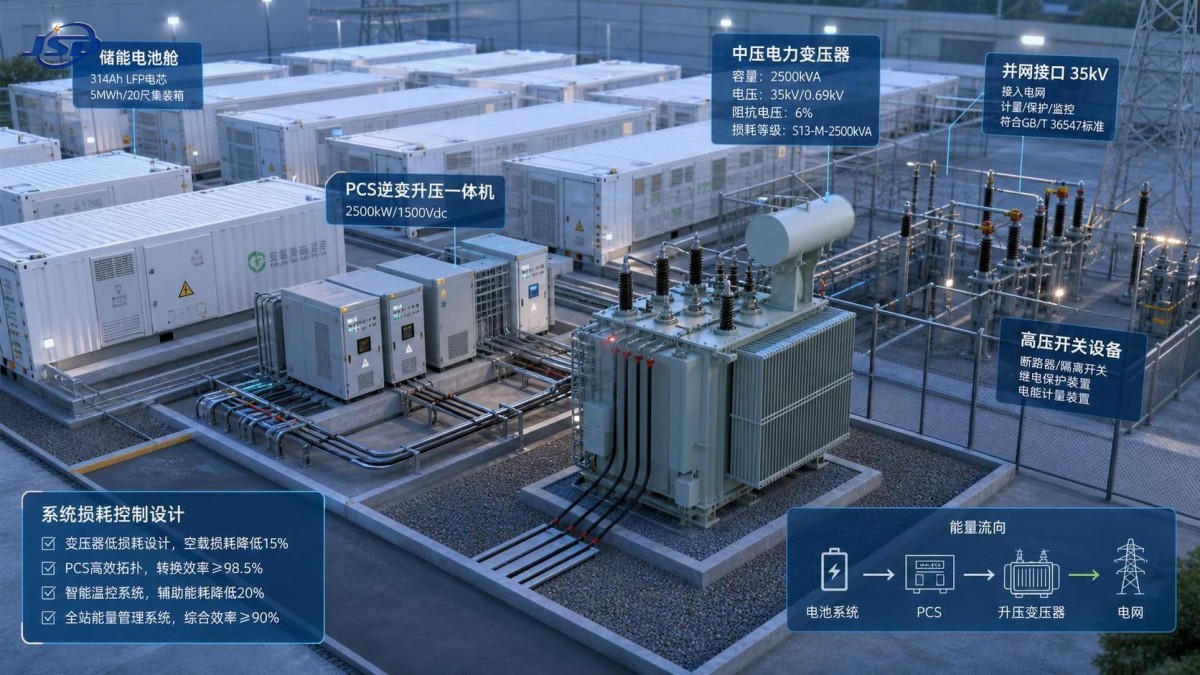
Another source of trouble is assuming the point of interconnection tells the whole story. Internal medium-voltage collection, skid arrangement, cable runs, auxiliary supply, and step-up topology affect losses, protection zones, and maintainability. In utility scale battery energy storage systems, internal architecture can change both performance and operational risk.
Transformer selection is not a side decision
In many reviews, the transformer package is treated as a downstream procurement item. That is risky. The transformer in a battery storage project has to work with inverter output characteristics, expected overload patterns, harmonic content, and switching frequency effects. It also needs to fit the site voltage class, cooling method, insulation requirements, and the project’s maintenance approach.
Voltage matching is only the first layer. Engineers should also evaluate whether the transformer is being exposed to operating conditions that differ from a standard steady industrial load. Short-duration high ramp events, repeated cycling, and ambient temperature variations can influence heating and loss behavior. The transformer specification should therefore be coordinated with the power conversion system, not copied from a conventional feeder project.
On some projects, a medium-voltage unit such as a 13.8kV Distribution Transformer may become part of the broader design conversation when distribution-level interconnection or internal voltage adaptation is involved. The useful point is not the product name itself, but the reminder that transformer choice must be tied to the actual system voltage strategy and operational profile.
Losses on paper and losses in operation are not the same
Round-trip efficiency is often discussed as though it were a single number that can be applied to the entire project. That is rarely enough for design decisions. Battery cell efficiency, inverter conversion losses, transformer losses, cable losses, HVAC demand, standby consumption, and control power all matter. Depending on the use case, auxiliary consumption can become especially important during hot or cold weather.
This matters because storage economics and thermal design are linked. If internal temperatures rise, cooling load rises. If cooling equipment is undersized or poorly zoned, battery performance can drift and equipment aging may accelerate. A technically sound review therefore separates the following questions:
- What are the conversion losses at different load points rather than at one nominal point?
- What is the expected auxiliary load during idle, charging, and discharging?
- How do seasonal temperatures change the energy available for export?
- What part of the loss profile occurs inside the battery enclosure, and what part occurs in external electrical equipment?
Without that breakdown, it becomes difficult to compare layouts or to understand whether a design change is actually improving plant performance.
Safety design has to be built into the layout, not added later
People often talk about battery safety as a compliance topic, but in project execution it is a layout and operations topic just as much as a technical one. Clearance between units, access for emergency response, separation of high-energy equipment, ventilation paths, gas detection arrangements where relevant, drainage strategy, and fire system interfaces all affect the final design.
One frequent oversight is the tension between compact layouts and maintainability. Densely packed equipment may reduce cable length or fit a restricted plot, but it can make isolation, replacement, inspection, and emergency intervention more difficult. The better question is not “Can everything fit?” but “Can people safely operate and maintain it after energization?”
The same applies to auxiliary systems. HVAC, fire suppression interfaces, SCADA cabinets, DC systems, and communication equipment are sometimes pushed to the edge of the drawing set. In practice, they influence reliability as much as the battery blocks do. A utility-scale site should be designed so that loss of a minor subsystem does not create unnecessary plant-wide outage risk.
Controls and protection decide whether the plant is usable
Even when hardware selection is reasonable, storage projects can still struggle because the controls philosophy is incomplete. Grid operators may require specific responses for active power, reactive power, voltage support, ramp limits, and recovery after disturbances. Those requirements must be translated into plant-level control logic, inverter settings, and communication architecture.
Protection deserves the same level of attention. Fault contribution from inverter-based systems differs from conventional generation, which affects relay expectations. The team should verify current limits, protection timing, anti-islanding behavior where applicable, transfer trip interfaces, and the relationship between internal protection and external utility protection. When the line between vendor responsibility and owner responsibility is vague, coordination problems show up late.
It helps to map operating scenarios before final design freeze. Consider planned charging, full discharge, idle state, emergency shutdown, auxiliary supply transfer, restart after outage, and operation during communication loss. If the sequence of actions is unclear on paper, it will be much harder in the field.
Site conditions quietly reshape the design
Projects sometimes inherit a conceptual design from another location and assume it will transfer easily. It usually does not. High altitude, salt contamination, dust, flooding risk, seismic requirements, temperature extremes, and restricted access roads all affect equipment selection and arrangement. Civil design can also impose limits on enclosure placement, drainage, and cable trench routing.
Battery storage sites are especially sensitive to environmental assumptions because thermal behavior, ingress protection, and maintenance access all matter. A design that looks efficient in a mild climate may become difficult to operate in a hot, dusty region. Likewise, a compact arrangement may become impractical if replacement equipment cannot be delivered or lifted safely.
This is another reason transformer and balance-of-plant decisions should not be isolated from site review. A second mention is enough here: whether the project uses a 13.8kV Distribution Transformer or another voltage class, the equipment needs to be assessed in the real environmental context of the project rather than only by electrical rating.
Commissioning problems usually begin in the document set
When a storage project reaches commissioning, many of the worst delays come from incomplete interface definitions created months earlier. Cable schedules may not match vendor terminations. Protection settings may be based on outdated models. SCADA point lists may not reflect the final controller logic. Mechanical support details may conflict with cable bending requirements. None of these problems are dramatic by themselves, but together they slow energization and testing.
A useful discipline is to review the project as a chain of interfaces rather than a set of separate packages. The battery supplier, inverter supplier, transformer package, protection engineer, civil team, and grid interconnection team should all be looking at the same operating assumptions. If one package assumes reactive support at all states of charge and another does not, the mismatch will eventually surface.
For utility scale battery energy storage systems, document quality is not paperwork for its own sake. It is part of physical risk reduction. Clear single-line diagrams, control narratives, protection philosophies, maintenance access plans, and thermal assumptions make the system easier to build, test, and hand over.
A practical way to review design maturity before procurement closes
If you are trying to judge whether the design is truly ready, it helps to test it against a few realistic project questions rather than relying on headline specifications.
Ask whether the operational duty has been defined in enough detail for both electrical and thermal design. Ask whether losses have been evaluated across actual operating modes, not just nominal values. Ask whether transformer selection was coordinated with inverter behavior and site conditions. Ask whether protection and controls have been reviewed from the point of interconnection down to the internal collection system. Ask whether maintenance, replacement, and emergency access are physically workable on the site layout.
These questions sound basic, but they often reveal the gap between a concept design and a buildable one. In many cases, the right fix is not a major redesign. It is clarifying assumptions early enough that each package can be specified correctly.
That is usually the turning point in grid storage projects. Once the team stops treating the battery block as the whole plant and starts reviewing the interfaces around it, design decisions become more defensible. The result is not just a better drawing set. It is a project with fewer surprises when equipment arrives, when protections are tested, and when the plant is expected to behave like a dependable part of the grid.

Get a Quote
Regardless of whether you require general advice or specific support, we are happy to help you.
Send Us Your Inquiry Today

Jinshida Electric remains committed to contributing to global energy development through professional manufacturing and superior service.