





What Should Buyers Compare in a Commercial Energy Storage System?
When procurement teams evaluate a commercial energy storage system, the conversation often begins with budget and delivery time. That is understandable, but it is rarely enough. A system that looks cost-effective on paper can become expensive if it creates safety concerns, underperforms during peak demand, or forces an early replacement cycle. In industrial sites, grid-support projects, and infrastructure applications, the better question is not “Which system costs less today?” but “Which system will remain dependable, efficient, and serviceable over its full operating life?”
For buyers making a selection decision, comparison needs to go deeper than the battery cell alone. The system includes power conversion, thermal management, controls, protection design, integration capability, and the manufacturer’s ability to support the project after delivery. Missing one of these areas can shift risk from the supplier to the buyer.
That is why a structured comparison matters. A careful review of safety, usable capacity, cycle life, operating logic, expandability, and supplier credibility helps procurement professionals avoid hidden trade-offs and build a stronger basis for internal approval.
Start with the application, not the catalog
Many purchasing mistakes happen before technical comparison even starts. The wrong benchmark is often used because the intended application is not clearly defined. A commercial energy storage system for peak shaving at a factory has different priorities from one used for renewable integration, backup power, EV charging support, or voltage stabilization in a distribution network.
Before comparing quotations, buyers should clarify several operating realities:
- Is the system mainly for daily cycling or occasional emergency backup?
- Will the load profile require short bursts of high power or long-duration discharge?
- How important is response speed for the site?
- Is future expansion likely within one to three years?
- What environmental conditions will the system face: heat, dust, humidity, or unstable grid conditions?
These questions shape the technical shortlist. A system that works well in a light commercial building may not be suitable for a manufacturing site with harsh duty cycles. For procurement teams, this step turns a broad market search into a more realistic selection process.
Safety is not a single feature
Buyers often ask whether a battery chemistry is safe, but procurement decisions should go further. Safety in energy storage is the result of chemistry choice, pack structure, battery management logic, electrical protection, thermal control, enclosure design, and manufacturing consistency.
LiFePO4 chemistry is widely favored in commercial applications because of its thermal stability and long service life. Even so, the chemistry alone does not remove project risk. Ask suppliers how the battery management system handles overcharge, over-discharge, overcurrent, cell balancing, temperature anomalies, and fault isolation. A supplier that can explain the protection architecture clearly is usually easier to evaluate than one relying on broad claims.
It is also worth reviewing where the system will be installed and what protective measures are built for that setting. Indoor and outdoor deployments create different requirements. Enclosure rating, ventilation path, wiring accessibility, and separation of high-voltage components all affect both safety and maintenance convenience.
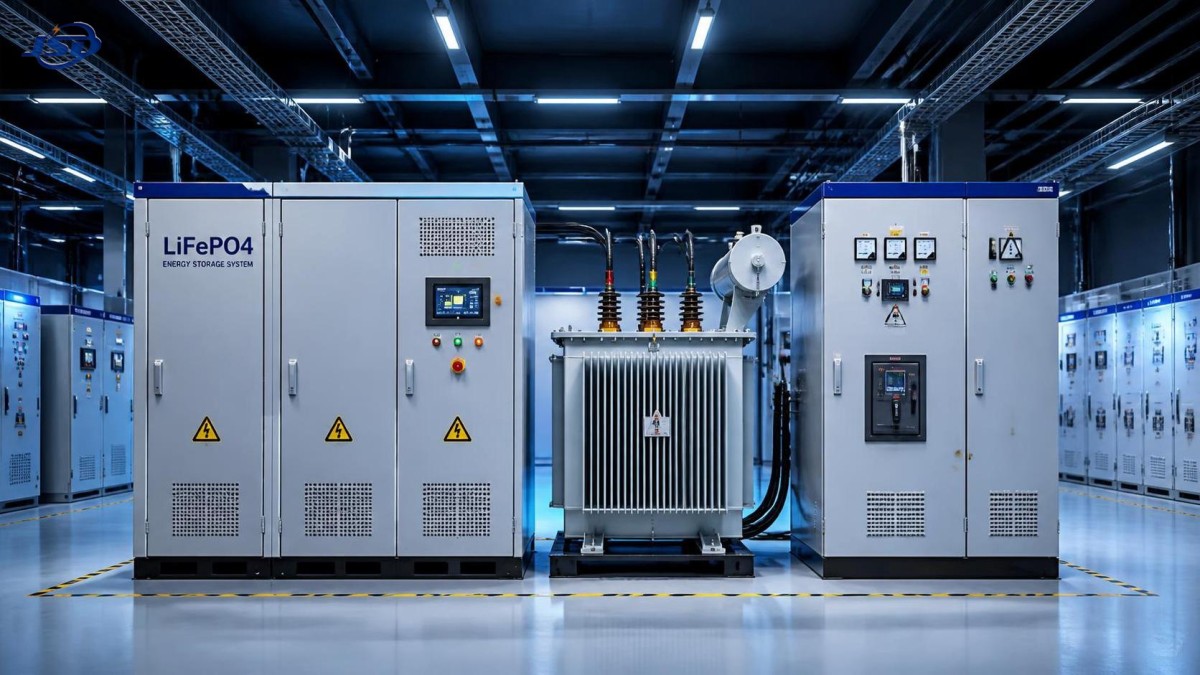
For buyers in power equipment and transformer-related projects, this is especially relevant. Energy storage does not operate in isolation; it interacts with transformers, switchgear, distribution cabinets, and site protection systems. A safe battery system must fit the electrical reality of the wider installation.
Compare usable energy, not only nameplate capacity
Nameplate figures can make two systems appear similar when their real-world performance is not. Procurement teams should compare usable energy, discharge depth assumptions, power-to-energy ratio, and operating window. A system with attractive nominal capacity but restrictive operating limits may deliver less practical value than expected.
Key questions to ask include:
- What is the usable capacity under normal operating conditions?
- At what depth of discharge is the expected life based?
- How much output is available continuously, and for how long?
- Does ambient temperature significantly reduce available performance?
- How does the control strategy prioritize battery protection versus energy availability?
This matters when procurement is tied to return-on-investment calculations. If the system cannot regularly deliver the energy assumed in the financial model, the project’s economics may shift quickly.
Battery life should be read in context
Cycle life is one of the most cited metrics in storage quotations, but it is also one of the most misunderstood. A high cycle count sounds reassuring, yet buyers need to look at the test conditions behind the number. Battery life depends on temperature, charge and discharge rates, depth of discharge, rest periods, and control strategy. Without that context, comparing cycle life across suppliers can be misleading.
For procurement professionals, a better approach is to ask how the supplier defines end-of-life, what operating assumptions support the cycle claim, and how capacity retention is expected to change over time. This is more useful than focusing on one headline number.
In some projects, modular low-voltage building blocks may also be relevant, especially where phased expansion is preferred. For example, a stackable solution such as the 51.2V Stackable LiFePO4 Energy Storage Battery may fit buyers who want installation flexibility and easier capacity growth in commercial settings. The point is not that one format suits every project, but that life expectancy should be evaluated alongside deployment style, maintenance access, and expansion plans.
Integration with the electrical system is where many risks hide
In transformer and distribution-related environments, battery selection cannot be separated from the rest of the power system. Voltage compatibility, inverter or PCS matching, communication protocols, harmonics considerations, protection coordination, and load characteristics all affect whether the storage system will operate smoothly after installation.
Procurement teams should compare suppliers on their ability to support integration, not just product delivery. A capable partner should be able to discuss how the storage system will work with transformers, distribution infrastructure, and site controls. This includes practical topics such as cable interface, commissioning logic, operating modes, and fault response.
Jinshida Electric Power Technology, for example, operates from the broader perspective of power transmission and distribution equipment, which matters in real projects. Energy storage buyers often benefit from working with a manufacturer that understands not only batteries, but also the surrounding electrical architecture that determines system stability and long-term reliability.
Scalability is valuable only if expansion is truly manageable
Many suppliers describe their systems as scalable, but buyers should test what that actually means. Can capacity be expanded without major redesign? Will additional modules require a different inverter or control upgrade? Are there practical limits on parallel connection, rack growth, or site layout? Will future expansion create battery consistency issues if new units are added much later?
A genuinely scalable commercial energy storage system should allow growth with manageable technical and operational impact. This is important for procurement because many commercial and industrial users start with a conservative first phase, then expand after operating results are proven.
Modular products can help here, especially where installation space is tight or project phasing is uncertain. Still, scalability should be assessed as an engineering reality, not a brochure phrase.
Efficiency is more than a headline percentage
Round-trip efficiency is important, but buyers should avoid comparing a single efficiency figure without understanding the conditions. System efficiency can vary depending on charge/discharge rate, PCS quality, thermal management consumption, standby losses, and partial-load operation. In some use cases, auxiliary power draw meaningfully affects total energy performance.
Procurement teams should ask how efficiency behaves during real operating scenarios rather than ideal laboratory points. A slightly lower headline number from a more stable and better-controlled system can be more valuable than an impressive figure that is difficult to reproduce on site.
Maintenance and serviceability deserve early attention
Storage projects are often purchased with strong focus on commissioning, while maintenance considerations are left for later. That can be costly. A system that is difficult to inspect, diagnose, or repair can increase downtime and service expense, especially for remote industrial or infrastructure locations.
Buyers should compare:
- Ease of access to modules and wiring
- Clarity of alarms and diagnostics
- Availability of remote monitoring
- Replaceability of modules or components
- Technical documentation quality
- Responsiveness of after-sales support
Serviceability often separates a dependable long-term asset from a source of recurring operational friction. For procurement staff, this is also a supplier assessment issue. A technically strong product with weak documentation or limited support can still create project risk.
Supplier credibility is part of the technical evaluation
In energy storage procurement, the supplier is not just a seller. The supplier is part of the risk profile. Manufacturing discipline, quality management, engineering communication, and consistency of delivery all affect the project outcome.
That is why buyers should review whether the manufacturer has a serious technical team, stable production capability, and experience in power equipment applications. Jinshida Electric’s positioning as a company focused on transmission and distribution equipment, with emphasis on R&D, manufacturing processes, and quality control, reflects the kind of background procurement teams often look for when reliability matters more than short-term marketing language.
Questions worth asking include:
- Can the supplier explain the design logic in practical terms?
- Do they understand site-level electrical integration?
- Is the quality management approach visible and consistent?
- Will they support pre-sales technical clarification and post-installation issues?
These points may not appear in a simple price comparison sheet, but they often influence the real total cost of ownership.
Common buying mistakes that weaken project value
Some of the most frequent procurement errors are surprisingly avoidable. One is choosing solely on upfront cost while underestimating maintenance burden or lifecycle performance. Another is treating all LiFePO4 systems as equivalent. A third is assuming expansion will be easy later without checking architecture limits in advance.
Another common issue is failing to match the storage system to the operating strategy. If the site needs frequent cycling but the system is optimized mainly for standby use, dissatisfaction is almost guaranteed. Likewise, if transformer, PCS, and battery interfaces are not evaluated together, commissioning delays become much more likely.
Even at the smaller modular end of the market, buyers should avoid rushing. A product like the 51.2V Stackable LiFePO4 Energy Storage Battery can be a sensible option in the right scenario, but only when its voltage level, expansion pathway, and application fit are aligned with the project’s actual operating needs.
A practical comparison framework for procurement teams
If multiple suppliers are under review, it helps to compare them across a balanced scorecard rather than one technical parameter. In practice, buyers can create a decision matrix covering:
- Application fit
- Safety architecture
- Usable energy and power output
- Battery life assumptions
- Integration compatibility with site electrical systems
- Scalability
- Efficiency under expected operating conditions
- Maintenance convenience
- Supplier engineering and service support
This method improves internal communication as well. Instead of defending a purchase based on isolated specifications, procurement can present a clear rationale linked to risk control, lifecycle value, and operational reliability.
In the end, the best commercial energy storage system is not simply the cheapest, the biggest, or the one with the most attractive brochure. It is the one that fits the application, integrates cleanly with the power environment, performs reliably over time, and comes from a supplier capable of standing behind the system when real operating demands begin. For buyers, that kind of comparison is not extra work. It is the work that protects the project.

Get a Quote
Regardless of whether you require general advice or specific support, we are happy to help you.
Send Us Your Inquiry Today

Jinshida Electric remains committed to contributing to global energy development through professional manufacturing and superior service.