





Where utility scale energy storage systems are seeing the fastest adoption
Utility scale energy storage systems are moving fastest in places where the grid can no longer treat variability as an occasional issue. Adoption tends to accelerate when solar output rises at midday, evening demand remains high, transmission expansion takes longer than project development, and local operators need a practical way to stabilize voltage and frequency without waiting for new thermal capacity. In those conditions, storage stops being a future option and becomes part of near-term substation planning, switching design, transformer loading analysis, and interconnection review.
That is why the most active markets are usually not defined by geography alone. They are defined by grid stress patterns. Regions with large renewable buildouts, weak rural transmission corridors, fast-growing industrial loads, islanded or semi-islanded grids, and congested urban feeder networks often move earlier than larger but more balanced systems. Utility scale energy storage systems fit especially well where grid operators need short response times, flexible dispatch windows, and equipment that can be integrated in phases instead of through a single oversized expansion.
Where adoption is moving first
The fastest uptake is often seen in renewable-heavy nodes where curtailment risk is already visible during project planning. When a solar or wind cluster can inject power faster than the local grid can absorb it, storage becomes a buffer between intermittent generation and the transformer capacity available downstream. In these areas, the commercial discussion is not limited to battery containers. It extends to step-up transformers, medium-voltage switchgear, protection coordination, harmonic behavior, grounding method, cable routing, and thermal loading margins across daily cycles.
Another strong adoption zone is the edge of industrial growth corridors. New manufacturing parks, port logistics areas, metal processing plants, and electrified transport hubs may see load ramps that are too irregular for conventional feeder reinforcement schedules. Storage is then used to shave peaks, support ride-through, or keep sensitive processes from seeing brief voltage instability. In transformer terms, this can defer the need for a larger unit only if cycling duty, ambient temperature, and overload expectations are modeled realistically. A common early mistake is to assume the battery alone solves a capacity problem when the actual bottleneck sits in busbar arrangement, transformer cooling class, or cable ampacity under site-specific installation conditions.
Island systems and remote grids also continue to show fast adoption because fuel displacement, reserve support, and black-start capability can matter more there than wholesale market arbitrage. In such networks, utility scale energy storage systems are usually judged by how well they integrate with existing diesel, gas, hydro, or renewable assets under unstable operating conditions. Transformer selection becomes more sensitive because short-circuit behavior, inrush coordination, and transient response may differ significantly from a conventional grid-tied substation with a stronger upstream source.
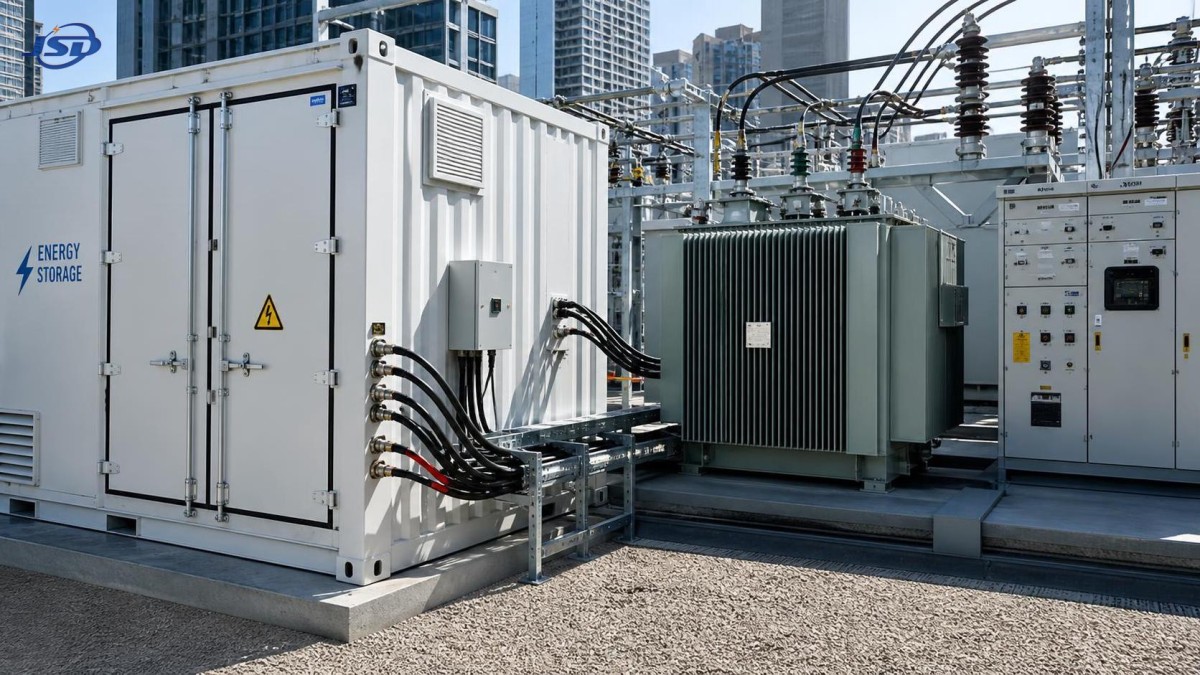
Urban substations facing land constraints form another high-adoption segment. Building new conventional infrastructure inside dense cities is often delayed by footprint limitations, civil permitting, transport restrictions, and outage coordination windows. Storage can be deployed in modular blocks, but that does not eliminate transformer complexity. Compact layouts tighten clearance management, fire separation design, ventilation paths, and maintenance access. In these projects, equipment arrangement can determine whether the storage plant is easy to commission or difficult to service once thermal stress and dust accumulation begin to affect real operating conditions.
Why transformer-related details decide project speed
Storage projects move from concept to site work much faster when power equipment interfaces are resolved early. A battery energy storage plant may appear modular from the outside, yet the utility-facing connection is still an electrical infrastructure project with the same discipline requirements as a substation extension. The transformer is rarely a passive afterthought. Its vector group, impedance, insulation level, tap strategy, cooling design, and overload tolerance all influence how smoothly the plant can charge, discharge, and ride through grid events.
For renewable coupling, one recurring issue is mismatch between inverter behavior and transformer assumptions taken from older generation assets. Inverter-based resources can introduce harmonic components and rapid control actions that change heating patterns inside transformer windings and associated conductors. If that is ignored, a nameplate that looks adequate on paper may prove tight under repeated cycling. Material choices such as conductor grade, core steel quality, insulation system, and enclosure corrosion protection become more relevant when daily charge-discharge profiles are aggressive or when installation occurs in coastal, high-humidity, or dusty environments.
Procurement timing is also affected by transformer format. A large site-built yard with separate transformer bays, multiple feeders, and broad civil scope may be justified for a major transmission-connected installation, but many markets now prefer faster deployment formats that reduce interfaces between civil, electrical, and commissioning teams. In some medium-voltage collection and distribution applications, a compact packaged approach similar to an European-Type Compact Substation can align better with constrained sites, especially where the goal is to simplify delivery sequencing and reduce on-site assembly risk. That does not remove the need for detailed protection studies, but it can shorten coordination around enclosure layout, cable entry, and prefabricated connection points.
Market momentum is often hidden in grid bottlenecks
Some of the fastest adoption is not visible through headline project announcements. It appears in smaller but repeated deployments near substations that experience congestion during specific hours. These projects may be tied to feeder balancing, renewable smoothing, or reserve support rather than a single flagship storage complex. From a supply perspective, this pattern matters because it increases demand for repeatable transformer specifications, standardized auxiliary power arrangements, and equipment packages that can be shipped, installed, and energized without long customization cycles.
Transport and handling constraints often shape these choices. A storage project in a mountainous region, on an island, or inside a dense industrial estate may face strict axle-load limits, narrow access roads, or limited crane positions. Under those conditions, transformer dimensions, oil volume, enclosure segmentation, and skid design can matter as much as electrical performance. Fast-moving markets usually reward equipment that reaches site with fewer field modifications, because every extra welding step, cable re-termination, or foundation correction can push energization into the next weather window or outage slot.
Installation environment adds another layer. Desert sites raise concern over heat rejection, sand ingress, and external insulation contamination. Coastal areas put pressure on anti-corrosion treatment, sealing performance, and long-term reliability of terminals and metalwork. Cold regions may need attention to oil viscosity, heater arrangements, condensation control, and startup behavior after extended low-temperature exposure. Utility scale energy storage systems are often described in standardized blocks, but field conditions quickly separate technically robust deployments from projects that look smooth only at bid stage.
Where misjudgments slow adoption
One frequent misjudgment is treating storage as a software-led asset with ordinary balance-of-plant needs. In practice, power equipment lead times, interface drawings, relay logic approval, and site acceptance testing often determine whether the project reaches commercial operation on schedule. Another is oversimplifying transformer duty by using average load instead of cycle-based thermal analysis. A battery plant may discharge hard during a short evening peak, recharge rapidly during renewable surplus, and remain partially loaded the rest of the day. That pattern can be very different from the assumptions behind traditional network transformer sizing.
There is also a recurring mistake in coordination between civil and electrical packages. Cable trench geometry, drainage, fire barriers, oil containment, earthing mesh continuity, and ventilation pathways are sometimes finalized too late. When that happens, compact sites become difficult to service safely, especially once medium-voltage terminations, control cabling, and auxiliary transformers all compete for the same access corridor. The fastest-adopting markets tend to be those where these interfaces are standardized early enough to avoid redesign during procurement or pre-commissioning.
Maintenance planning can be another hidden barrier. Storage plants are often expected to be low-touch, but the surrounding power equipment still needs inspection discipline. Transformer oil condition, bushing cleanliness, torque checks on bolted connections, thermal imaging, relay setting verification, and enclosure sealing all affect long-term availability. In regions where skilled field support is unevenly distributed, simpler maintenance architecture can influence adoption speed more than a marginal efficiency gain on paper.
Signals that a market is entering a faster adoption phase
Several practical signals usually appear before adoption becomes obvious. Interconnection discussions start to focus on short-duration flexibility instead of only firm generation. Substation expansion plans begin to include space or feeder provisions for future storage tie-ins. Transformer specifications request closer attention to cycling duty, harmonic tolerance, and modular connection arrangements. Project schedules compress, with more emphasis on factory testing, preassembled equipment blocks, and logistics planning rather than extended site fabrication.
- Grid planners begin studying overload relief over a few critical hours instead of only annual peak capacity.
- Renewable projects are reviewed together with storage options during connection design, not after curtailment appears in operation.
- Medium-voltage and high-voltage equipment packages are expected to arrive with clearer interface boundaries, leaving less room for ad hoc site adaptation.
- Transformer questions shift from nominal rating alone to temperature rise, insulation life under cycling, and response to repeated inverter-driven operating profiles.
When these signals appear together, utility scale energy storage systems are usually moving from isolated projects into repeatable infrastructure deployment. The strongest growth tends to cluster where grid flexibility has immediate operational value and where supporting transformer and substation equipment can be delivered with predictable integration risk. In that sense, the fastest adoption is rarely just about batteries. It happens where the surrounding electrical architecture is ready to absorb storage as a working part of the network rather than a standalone add-on.

Get a Quote
Regardless of whether you require general advice or specific support, we are happy to help you.
Send Us Your Inquiry Today

Jinshida Electric remains committed to contributing to global energy development through professional manufacturing and superior service.