





Oil Type Transformer vs. Dry Type: Which Option Fits Your Site and Safety Requirements?
Oil Type Transformer vs. Dry Type: Which Option Fits Your Site and Safety Requirements?
Choosing between an oil type transformer and a dry type transformer is rarely a simple “better versus worse” decision. Both technologies are established, reliable, and widely used across industrial plants, commercial buildings, renewable-energy projects, substations, and infrastructure systems. The right choice depends on where the unit will be installed, how it will be loaded, what the local fire rules require, and how realistically the owner can maintain it over its service life.
For a technical evaluation team, the initial purchase price should not drive the decision alone. A transformer that looks economical on a quotation may create additional civil-work costs, ventilation requirements, fire-separation constraints, or maintenance exposure after installation. On the other hand, selecting a dry type unit purely because it is perceived as “safer” can lead to an oversized, poorly ventilated, or unnecessarily expensive solution.
A practical selection starts with the site, not the transformer catalogue.
The Core Difference: Insulation and Cooling Medium
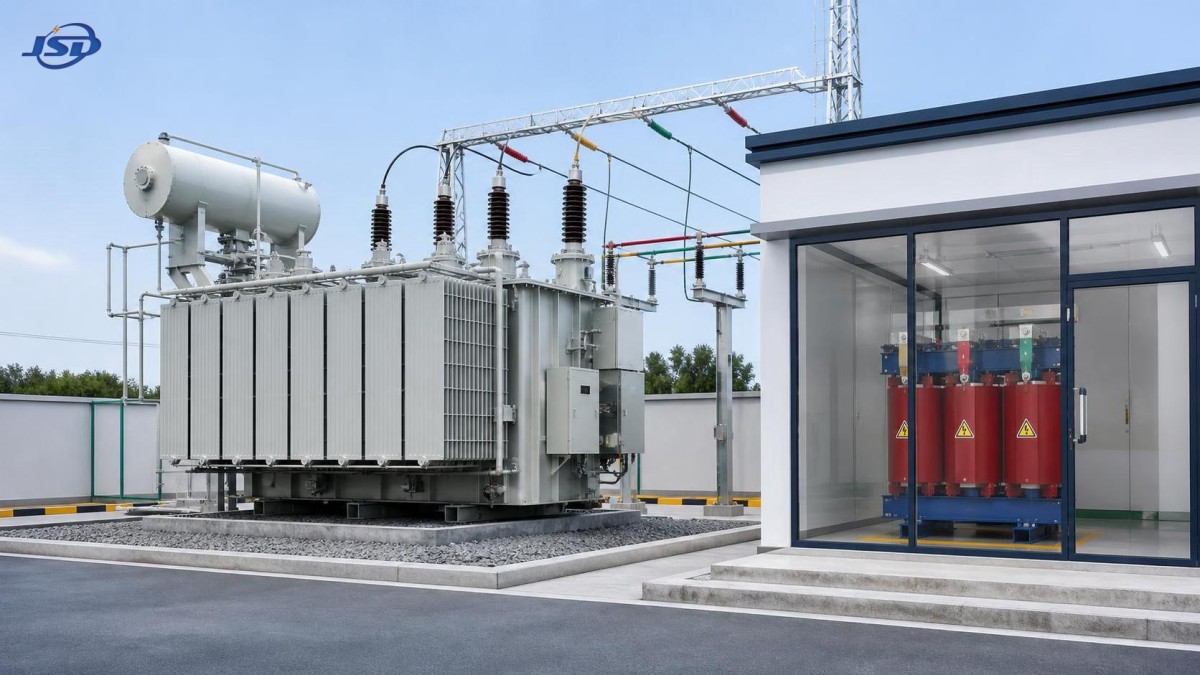
An oil type transformer uses insulating liquid to provide dielectric insulation and transfer heat away from the windings and core. In common configurations, heat moves from the active parts into the insulating oil, then through radiator surfaces to the surrounding air. Depending on rating and duty, cooling may be natural oil/natural air or use forced-air assistance.
A dry type transformer uses solid insulation systems, typically with air as the cooling medium. Cast-resin and vacuum-pressure-impregnated designs are common examples. Because there is no insulating oil tank, dry type transformers avoid the specific risk of oil leakage. That characteristic is valuable in many indoor or environmentally sensitive locations, but it does not mean that every dry transformer is suitable for every harsh environment.
The cooling medium changes much more than the transformer’s appearance. It affects thermal behavior, overload response, enclosure design, inspection practices, acoustic performance, fire-risk planning, and the usable operating environment.
Where an Oil Type Transformer Usually Makes Sense
Oil-filled units remain a strong practical choice for outdoor distribution and power applications. They are especially common where higher ratings, compact footprint, good heat dissipation, and continuous operating reliability are priorities. Utility substations, industrial outdoor yards, mining facilities, manufacturing sites, and photovoltaic plants are typical examples.
The thermal advantage matters when the transformer experiences sustained load, fluctuating demand, or elevated ambient temperatures. Oil transfers heat effectively, allowing designers to manage larger capacities without making the transformer physically disproportionate. This is one reason oil type transformer designs are frequently evaluated for medium-voltage applications and installations where a dry unit would require more space or more demanding ventilation arrangements.
Outdoor use is not automatically easy, however. The tank, bushings, radiators, cable boxes, protection devices, and any auxiliary cooling equipment still need to suit the local environment. Coastal salt contamination, heavy dust, large temperature swings, flooding exposure, and corrosive industrial atmospheres should be considered before specifying a standard outdoor arrangement. The transformer itself may be robust, while a poorly chosen accessory or cable termination becomes the actual weak point.
Oil-filled equipment also requires a credible maintenance plan. This does not necessarily mean constant intervention, but owners should be able to inspect for leaks, monitor condition indicators where applicable, keep radiators clear, and arrange oil testing or diagnostic work according to the project’s maintenance philosophy. A remote site with limited service access deserves a more conservative review of monitoring, protection, and spare-part availability.
Why Dry Type Is Often Chosen for Indoor Installations
Dry type transformers are often preferred when equipment must be installed inside occupied buildings or close to sensitive operations. Commercial complexes, hospitals, data-related facilities, transit structures, schools, high-rise buildings, and enclosed industrial areas may have strict requirements concerning fire separation, access routes, containment, and the consequence of a liquid leak.
The absence of oil simplifies some aspects of indoor risk management. There is no liquid dielectric to contain, no oil pit to design around, and no oil sample program. For projects with limited equipment-room space or difficult access for civil construction, that can be a meaningful advantage.
Still, “dry type” should not be treated as a shortcut around fire engineering. The transformer room must still meet applicable local electrical and building requirements. Cables, switchgear, ventilation openings, protection coordination, emergency access, and the behavior of nearby materials all matter. A dry type transformer can reduce certain risks, but it does not replace a site-specific fire and safety review.
Ventilation is another point that is sometimes underestimated. Dry transformers release heat directly to the room air. If the room is undersized, air paths are blocked, filters are neglected, or ambient temperature rises beyond the design basis, the transformer may operate hotter than expected. In practice, an inadequate transformer room can turn a technically suitable dry unit into a long-term thermal concern.
A Direct Comparison for Technical Evaluation
Fire Safety Is a Site Question, Not a Product Label
Fire safety is often the decisive issue, but it should be assessed with more precision than “oil is unsafe and dry type is safe.” The relevant questions are: Is the transformer inside a building? Is it adjacent to occupied areas? Can a fault affect an escape route or critical process? Is there space for separation, barriers, containment, or a dedicated transformer room? What do local regulations, the insurer, and the owner’s internal engineering rules require?
For an outdoor industrial substation with clear separation from buildings, an oil type transformer may be entirely appropriate. For a basement electrical room below a busy commercial area, the same choice may require more extensive engineering controls and may not be the preferred route. The location changes the answer.
It is also sensible to review fault protection as part of the safety decision. Transformer technology cannot compensate for poorly coordinated protection, inadequate cable design, weak grounding, or delayed fault clearing. The transformer, switchgear, relay settings, and installation layout must be considered as one system.
Load Profile, Harmonics, and Renewable-Energy Duty
Nameplate capacity is only the start of transformer selection. Technical evaluators should understand whether the load is steady, cyclic, seasonal, motor-driven, inverter-fed, or expected to expand. A transformer serving a conventional daytime industrial load behaves differently from one connected to a renewable-energy plant with changing generation patterns and inverter-related harmonics.
For photovoltaic projects, the low-voltage inverter output must be stepped up to the grid connection voltage, while the transformer must also suit outdoor conditions and the project’s harmonic and thermal expectations. A purpose-configured Step-Up Transformer for Photovoltaic Power Stations can be specified from 500kVA to 5000kVA, with high-voltage options of 10kV, 20kV, or 35kV and low-voltage options including 0.315kV, 0.4kV, and 0.69kV. These parameters should be matched to inverter output, grid requirements, vector group, tap range, and the actual site layout rather than selected in isolation.
For example, Dyn11 or Yyn0 vector groups may be relevant depending on the system design, but neither should be chosen simply because it is familiar. Grounding philosophy, protection coordination, harmonic behavior, and utility connection requirements all need review. Where IEC 60076 is specified, it provides an important design and test framework, but the project specification still needs to state the actual electrical and environmental duty.
Life-Cycle Cost: Look Beyond the Purchase Order
The best-value transformer is not necessarily the one with the lowest equipment price. Evaluators should compare the complete installed and operating picture: transformer losses, expected loading, civil work, room ventilation, fire provisions, cable routing, containment needs, inspection work, downtime consequences, and replacement accessibility.
An oil-filled unit may be attractive where its thermal performance reduces space pressure or supports an outdoor layout with straightforward access. A dry type transformer may justify its cost when it reduces building modifications or simplifies installation in a constrained indoor environment. Neither conclusion is universal.
Loss evaluation deserves special attention in continuously operated systems. Core loss is present whenever the transformer is energized, while load loss changes with current. A technically sound comparison uses the same assumed load profile for both options. Comparing one supplier’s low-load-loss design with another supplier’s standard design without aligning the operating assumptions can produce a misleading result.
Questions That Should Be Settled Before Approval
Before finalizing either technology, the project team should be able to answer a few practical questions clearly:
- Will the transformer be installed indoors, outdoors, on a roof, in a container, or in a dedicated substation?
- What are the maximum ambient temperature, contamination level, humidity, altitude, and ventilation conditions?
- Does the site have fire-separation, containment, drainage, and emergency-access requirements?
- Is the loading steady, intermittent, inverter-fed, harmonic-rich, or expected to grow?
- Can the owner perform routine inspections and arrange condition-based maintenance?
- What voltage regulation, tap range, vector group, impedance, and protection requirements are imposed by the network?
- Can the transformer be safely replaced or serviced after the surrounding facility is complete?
These questions often expose the real constraint. It may be a narrow access road, a hot electrical room, a utility-required connection voltage, a lack of drainage, or a maintenance team that cannot support frequent site visits. Good transformer selection is usually less about finding a universally superior design and more about removing the site-specific failure points early.
Making the Final Choice
Choose an oil type transformer when the project is outdoor or suitably separated, the rating and thermal duty favor liquid cooling, and the site can properly address containment, inspection, and fire-risk controls. Choose a dry type transformer when indoor placement, liquid-free installation, building constraints, or local safety requirements make that route more practical—provided the ventilation and environmental conditions are genuinely suitable.
Manufacturing quality matters whichever technology is selected. Reliable winding workmanship, insulation design, thermal margins, quality control, and a clear understanding of the operating application are more useful than broad claims about one transformer type. Jinshida Electric Power Technology Co., Ltd. approaches transmission and distribution projects with that application-led view, combining technical support, controlled manufacturing processes, and quality management for grid, industrial, renewable-energy, and infrastructure requirements.
The sensible next step is to compare both options against the same project data: installation location, load curve, fault level, environmental exposure, safety rules, and maintenance capability. Once those inputs are defined, the oil versus dry type decision usually becomes much clearer.

Get a Quote
Regardless of whether you require general advice or specific support, we are happy to help you.
Send Us Your Inquiry Today

Jinshida Electric remains committed to contributing to global energy development through professional manufacturing and superior service.