





Where Liquid Filled Transformers Fit in Outdoor Substations and Industrial Plants
A transformer decision can become urgent long before the equipment arrives on site. A substation yard may already have civil works underway, cable routes defined, and protection drawings nearing release when someone raises a practical question: will the selected unit tolerate summer heat, rain exposure, dust from nearby production, and the switching duty expected after the plant starts? If that question is answered only by matching voltage and kVA ratings, expensive changes can surface during installation or, worse, after energization.
This is especially common at outdoor substations and industrial facilities where the transformer is expected to serve for many years with limited outage windows. A well-chosen liquid filled transformer can provide robust thermal performance and dependable operation in these demanding environments, but it must be matched to the actual site rather than treated as a generic item on an equipment schedule. The surrounding layout, fire strategy, load behavior, maintenance access, and fluid selection all affect whether the installation remains practical after the project team has left.
The point where an indoor assumption fails
Many project drawings begin with a simple distinction: indoor transformer room or outdoor transformer bay. In reality, the boundary is less simple. A transformer located outdoors may still sit close to process buildings, cooling towers, truck routes, chemical storage, or dusty material-handling areas. It may face direct sun for long periods, wind-driven rain, salt-laden air, low winter temperatures, or a narrow service corridor that makes inspections difficult.
The trouble begins when the transformer is selected from a rating table without translating those conditions into design requirements. The rating may be adequate, yet the radiator arrangement can be difficult to clean, the marshalling cabinet may be exposed to persistent condensation, or the oil containment arrangement may be too small or poorly drained. These are not minor finishing details. They influence availability, safety planning, construction coordination, and the effort needed to keep the transformer in service.
For outdoor substations, liquid-filled units are often a strong fit because the insulating liquid assists both dielectric insulation and heat transfer. This permits compact, high-capacity designs suited to grid connection points, utility interface substations, renewable-energy collection systems, and infrastructure power distribution. In industrial plants, they are commonly considered where substantial loads must be supplied reliably and where an outdoor location avoids consuming valuable indoor production space.
Start with the load profile, not the nameplate alone
The first useful question is not simply “How large should the transformer be?” It is “What will the electrical demand look like over a normal day, during startup, and during an abnormal operating period?” A process plant with large motors, variable-speed drives, welding equipment, furnaces, compressors, or cyclic production lines does not present the same duty as a relatively steady commercial load. Harmonics, inrush current, frequent load swings, and power-factor conditions should be reviewed before finalizing the specification.
A liquid filled transformer may need a rating margin, suitable winding design, or specified impedance based on the behavior of connected equipment. Impedance is particularly important because it affects fault-current contribution and voltage regulation. A lower impedance is not automatically preferable; it may increase available fault current beyond what downstream switchgear can accommodate. Conversely, excessive impedance may worsen voltage dip when heavy motors start. This balance should be reviewed alongside the short-circuit rating of the entire system, rather than assigned as an isolated transformer detail.
Ambient temperature also changes the meaning of a nominal rating. A unit operating in a shaded temperate area has a different cooling challenge from one installed in a hot, enclosed yard beside heat-emitting process equipment. Direct solar gain, restricted airflow around radiators, altitude, and contamination buildup can all reduce the practical cooling margin. Where the application has unusual conditions, these should be stated clearly in the procurement documents instead of left for interpretation after delivery.
Where outdoor installation makes practical sense
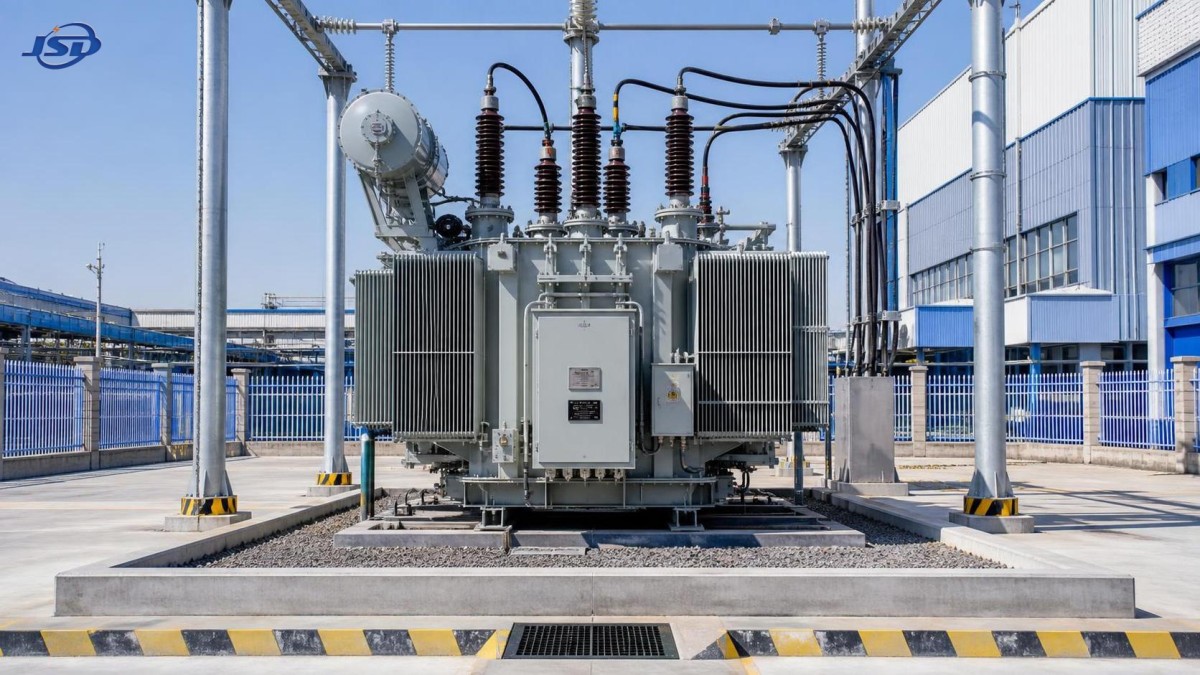
At a grid-connected outdoor substation, the transformer normally sits between transmission or distribution switching equipment and the lower-voltage collection or feeder system. Here, physical separation from occupied buildings is often easier to achieve, and open-air cooling is beneficial. The transformer bay can be arranged with clear access for installation, testing, future replacement, and emergency response. Civil designers can also incorporate foundations, cable trenches, fencing, drainage, and oil-retention features early in the project.
Industrial sites create more varied decisions. An outdoor transformer installation can be a sensible choice when a plant needs to keep electrical equipment away from production areas, when transformer losses and heat should not be released into a building, or when plant expansion may require additional power capacity later. Mining support facilities, water treatment systems, manufacturing complexes, logistics hubs, and large agricultural processing operations often face these layout constraints.
However, “outdoors” should not mean “unprotected.” The location must still account for vehicle impact, unauthorized access, falling objects, flooding, corrosive atmospheres, and exposure to dust. A transformer beside a busy internal road may need physical barriers. A coastal or chemical-processing location may require enhanced attention to corrosion-resistant external components and enclosure details. In flood-prone areas, foundation elevation, cable entry routing, and drainage deserve early review.
Site conditions that should change the specification
A useful way to avoid late-stage surprises is to walk the proposed location with electrical, civil, and operations personnel before the order is released. The discussion should focus on conditions that can be observed and verified, rather than broad statements such as “suitable for outdoor use.”
- Clearances and maintainability: Confirm space for radiator access, control cabinet doors, cable terminations, lifting operations, and removal of serviceable components. A compact footprint is valuable only if technicians can still work safely around it.
- Ground conditions: Review bearing capacity, settlement risk, drainage direction, and the relationship between the foundation and cable trench system. Water collecting beneath or around the transformer creates avoidable long-term problems.
- Containment and drainage: The site should have a deliberate approach to insulating-fluid containment. The arrangement must not allow rainwater to defeat the intended containment volume or carry leaked fluid into the general drainage system.
- Fire separation: Distance to buildings, cable structures, adjacent transformers, and critical process areas should be considered with the project’s fire-protection strategy. If separation is limited, the overall arrangement may need additional protective measures.
- Environmental exposure: Dust, salt, industrial fumes, insects, temperature extremes, and high humidity influence external finishes, cabinet sealing, cooling-surface maintenance, and inspection frequency.
- Noise boundaries: A transformer yard close to offices, residences, control rooms, or quiet plant areas may need noise evaluation during the design stage. Moving the unit a short distance can sometimes be more effective than trying to correct the issue later.
These points may look civil or operational rather than electrical, but they often determine whether a technically sound transformer installation is straightforward to operate. The strongest specifications reflect the whole installation environment, not just primary voltage, secondary voltage, and rated capacity.
Choosing the insulating-fluid approach
When people refer to a liquid filled transformer, they may be thinking of mineral oil by default. Mineral oil remains widely used, but the right insulating fluid should be evaluated according to the project’s installation conditions and operating priorities. Different fluids can have different fire-related characteristics, cooling behavior, environmental considerations, maintenance practices, and cost implications. The decision should be integrated with the site’s fire and environmental design rather than made as a last-minute purchasing preference.
For a conventional outdoor substation with adequate separation, drainage, and access, a standard oil-filled design may align well with established maintenance practices. In a constrained industrial site, close to occupied structures or sensitive drainage areas, project teams may explore alternatives with properties more suited to the applicable risk approach. That evaluation should include the transformer manufacturer, protection engineer, civil designer, insurer where relevant, and the authority responsible for site safety requirements. No fluid choice removes the need for sound containment, inspection, and emergency planning.
It is also important not to assume that a different fluid makes every transformer design interchangeable. Cooling performance, temperature limits, accessory compatibility, and service procedures must be considered as a package. The final technical documentation should identify the selected fluid clearly so that future maintenance staff do not rely on assumptions.
Installation details that frequently cause rework
Problems during commissioning are often linked to interfaces between disciplines. Cable routes may arrive at the transformer from the wrong side. The neutral grounding arrangement may be unclear. Control cables may lack segregation from power circuits. A foundation may be poured before final radiator clearances are checked. These issues are easier to resolve on drawings than on a live project site.
Before installation begins, the team should reconcile the approved transformer outline drawing with the foundation drawing, cable schedule, earthing plan, protection schematic, and lifting plan. The shipping configuration deserves attention as well. Some accessories may be transported separately and installed on site, which affects storage, assembly sequencing, and inspection responsibilities.
During mechanical placement, verify level, anchoring, clear access around cooling equipment, and the condition of bushings, gauges, valves, and external connections. During electrical work, confirm phase identification, vector group compatibility, tap position, earth connections, termination torque requirements, and protection wiring. The commissioning procedure should include the tests required by the project specification and should confirm that alarms, trips, cooling controls, and remote indications behave as intended.
Construction power deserves separate planning. Outdoor substation work may require temporary electricity for tools, lighting, test equipment, dewatering, communications, and auxiliary services before the permanent transformer is energized. Where a diesel source is appropriate for this temporary duty, an Open Type Diesel Generator Set can provide three-phase power in prime ratings from 50kVA to 500kVA, with optional ATS and parallel operation. Its role should be defined carefully: it supports site operations during construction or an outage, while the transformer remains the core component of the permanent distribution arrangement.
Preventive care should be designed into the project
A transformer that is difficult to inspect will usually be inspected less often than intended. That is why operational access should be part of the initial layout review. Personnel need a safe route to read gauges, inspect for leaks, observe cooling equipment, check cabinet condition, and carry out routine testing without stepping over cable trenches or working around obstructions.
Maintenance planning typically includes visual inspection of the tank and fittings, review of temperature and pressure indications where fitted, checks of cooling fans and pumps if applicable, examination of bushings and connections, and insulating-fluid testing according to the asset owner’s maintenance program. Trending is generally more valuable than reacting to a single isolated observation. A change in temperature behavior, dissolved gas results, moisture condition, or oil level should prompt investigation in context with load history and recent operating events.
Outdoor housekeeping matters more than it first appears. Blocked drainage, vegetation around radiators, accumulated dust, loose fencing, damaged labels, and water entering control compartments can complicate otherwise routine maintenance. Assigning these items to a clear site responsibility avoids the common gap between construction completion and long-term operations handover.
Making the final decision with fewer assumptions
The best location for a liquid filled transformer is usually the one where electrical performance, civil practicality, operational access, and risk control support one another. In an outdoor grid substation, that often means a properly spaced transformer bay with drainage, containment, access roads, and coordinated protection interfaces. In an industrial plant, it may mean locating the unit outside the main production building but away from traffic, corrosive discharge points, and areas where future expansion would block maintenance.
Selection becomes more reliable when the project team documents the actual operating profile, environmental exposure, fluid preference, installation constraints, and commissioning responsibilities before procurement. A manufacturer can then develop the equipment around stated conditions instead of being asked to compensate for unknowns later. For power systems serving industrial, infrastructure, grid, or new-energy applications, that discipline is often more valuable than choosing equipment based on a single headline rating.

Get a Quote
Regardless of whether you require general advice or specific support, we are happy to help you.
Send Us Your Inquiry Today

Jinshida Electric remains committed to contributing to global energy development through professional manufacturing and superior service.