





Does a 500 kVA transformer need forced cooling in hot climates?
Does a 500 kVA Transformer Need Forced Cooling in Hot Climates?
A 500 kVA transformer does not automatically need forced cooling simply because it operates in a hot climate. Many units are designed to carry their rated load with natural cooling, provided the ambient temperature, installation arrangement, insulation system, and load duty remain within the conditions stated on the nameplate and applicable design standard.
That said, high ambient temperature removes thermal margin quickly. A transformer that runs comfortably at 60% load in a temperate outdoor location may experience high oil or winding temperatures when installed in direct sun, inside a poorly ventilated enclosure, or near other heat-producing equipment. For operators, the practical question is not merely whether the transformer is rated 500 kVA. It is whether the installed transformer can dissipate the heat created by its actual losses under the site’s worst operating condition.
Forced cooling can be a useful solution, but it should not be treated as a cure for an undersized transformer, blocked air path, overloaded circuit, or neglected maintenance condition. Adding fans without understanding the thermal problem often creates a new dependency: the transformer now needs a reliable fan control system, auxiliary supply, alarm logic, and maintenance plan.
Why Heat Becomes More Critical at 500 kVA
Transformer heating comes primarily from no-load loss in the core and load loss in the windings. Core loss exists whenever the transformer is energized. Winding loss rises significantly as load current increases, so a transformer operating near rated capacity produces far more heat than one carrying a moderate and stable load.
Ambient temperature matters because cooling depends on the temperature difference between the transformer and surrounding air. When outdoor air is already hot, the tank, radiators, cooling ducts, or enclosure have less ability to release heat. Direct solar exposure can make the local surface temperature worse than the reported weather temperature, especially on pole-mounted units, rooftop installations, and compact substations with limited shade.
For an oil-immersed 500 kVA transformer, heat normally moves from winding insulation into the oil, through the tank or radiators, and then into the surrounding air. In a dry-type unit, heat is removed directly through air circulation around windings and core surfaces. The cooling principle is different, but the operational concern is the same: hot air must be able to leave the transformer area rather than recirculate around it.
Operators should also remember that nameplate capacity is not a universal “safe at any temperature” figure. Transformer ratings are associated with defined operating conditions. The actual allowable loading may need review when the site has unusually high average ambient temperature, high daily peaks, altitude effects, restricted ventilation, harmonic loading, or frequent overload cycles.
Natural Cooling Is Often Enough—Under the Right Conditions
Natural cooling is generally sufficient when the transformer was specified for the local climate, has clear air circulation around its cooling surfaces, and does not operate continuously close to its thermal limit. A properly selected oil-filled distribution transformer using natural oil and natural air cooling may not require fans at all. This is common where the load has a meaningful daily variation rather than a constant full-load profile.
The distinction between a daytime peak and a continuous load is important. A 500 kVA unit serving pumps, commercial cooling equipment, or industrial machinery may see sharp afternoon peaks. If those peaks are short and the transformer has time to cool, natural cooling may remain acceptable. A unit that carries 90% to 100% of its rating throughout hot afternoons and evenings deserves closer review, even if it has not yet tripped.
Natural cooling also works best when the installation is honest about space. Radiators need open airflow. Ventilation louvers need to be free of dust, leaves, packaging, and stored materials. A transformer placed in a small masonry room can have a more difficult cooling environment than a similar transformer installed outdoors, even if the room protects it from sunlight.
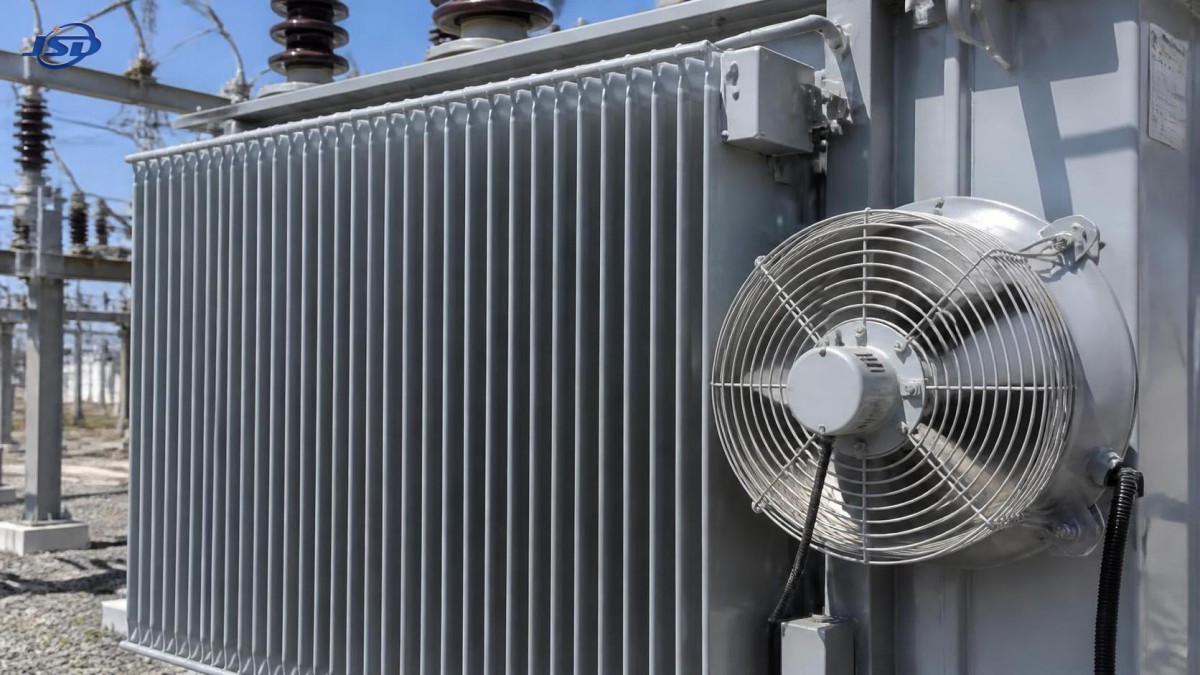
When Forced Cooling Should Be Considered
Forced cooling becomes worth considering when temperature measurements show that natural cooling is no longer providing enough margin, or when the operating profile is expected to change. For oil-immersed designs, this may involve forced-air fans blowing across radiators, often described in cooling designations such as ONAF when the transformer is designed for that arrangement. For dry-type transformers, forced-air cooling typically uses fans to increase airflow through the coil and enclosure.
It is appropriate to investigate a cooling upgrade when one or more of the following conditions are present:
- The transformer carries a high load for long periods during the hottest season.
- Top-oil, winding-temperature, or enclosure-temperature readings trend upward beyond the expected operating range.
- Cooling surfaces are exposed to direct sun and there is no practical way to provide shade or improve natural airflow.
- The transformer is installed in a room, kiosk, or equipment yard where hot air recirculates.
- Future demand is expected to push loading above the original design assumption.
- Harmonics, voltage imbalance, or poor power quality are causing additional heating that ordinary kVA loading does not reveal.
A fan system should be part of the transformer’s approved thermal design. It is not good practice to select fans based only on physical size or to assume that any airflow will safely increase capacity. The manufacturer needs to confirm allowable loading, control temperatures, sensor locations, fan duty, protection requirements, and whether the bushings, leads, taps, and insulation system can support the proposed operating condition.
Check the Installation Before Ordering Fans
In hot-climate troubleshooting, poor installation conditions are often easier and less expensive to correct than adding forced cooling. Start with the basic physical checks. Is there enough open space around the tank or enclosure? Are radiator fins clean? Are ventilation openings located so that hot discharge air cannot be drawn back into the intake side? Has landscaping, a wall, cable tray, or a later equipment addition restricted airflow?
For outdoor transformers, shade can reduce solar heat gain, but any canopy must be designed carefully. A roof placed too close to the tank can trap hot air and make matters worse. The support structure must also maintain safe electrical clearances and allow access for inspection, lifting, oil sampling where applicable, and emergency work.
Indoor installations need particular attention to room ventilation. It is not enough to have louvers in a door if both openings draw from and discharge into the same stagnant area. A useful arrangement creates a real path for cooler air to enter low and warmer air to exit high, without short-circuiting airflow. In dusty agricultural or industrial areas, filters may be necessary, but they need regular inspection because a clogged filter can become the cooling restriction.
Pole-mounted equipment presents a different set of trade-offs. It benefits from open ambient airflow but can receive intense solar radiation and may be difficult to monitor closely. In rural and suburban distribution work, compact oil-immersed units are often selected for practical installation and reliable service. For example, a Pole-Mounted Oil-Immersed Single-Phase Transformer is available in capacities up to 500 kVA and is intended for distribution applications such as agricultural production, civil buildings, and rural or urban networks. Its suitability for a hot site still depends on the final voltage configuration, mounting arrangement, loading pattern, and confirmed cooling duty—not capacity alone.
Use Temperature and Load Records, Not Guesswork
The most useful operator decision is based on trend data collected during the hottest and heaviest-loaded period. Record transformer load, ambient temperature, oil temperature where available, winding-temperature indication where fitted, and fan operating status. A single hot reading after an unusual event is less informative than a pattern observed over several days.
Infrared inspection can help identify abnormal connections, uneven radiator temperatures, or localized heating, but it should be interpreted carefully. Surface temperature is not the same as winding hot-spot temperature. A thermal image is a good screening tool; it does not replace the transformer’s specified temperature limits, internal sensors, electrical tests, or manufacturer guidance.
For an oil-immersed transformer, a rising oil temperature together with normal load may point to reduced cooling performance, low oil level, radiator blockage, fan failure where fans are installed, or an ambient condition that differs from the original design basis. If high temperature occurs only under high current, the issue may instead be loading, harmonic content, loose connections, or a combination of factors.
Do not overlook voltage quality. Harmonic currents can increase eddy-current and stray losses, particularly in conductors and structural parts. A transformer may appear lightly loaded when viewed only through basic kVA readings, while waveform distortion is adding heat. Where non-linear loads such as variable-speed drives, rectifiers, data equipment, or large LED installations are significant, a power-quality assessment is sensible before concluding that ambient heat is the only problem.
Forced Cooling Is Not a Free Capacity Upgrade
A common mistake is to assume that fans convert every naturally cooled transformer into a higher-capacity unit. They do not. A transformer built and rated only for natural cooling should not be operated beyond its approved rating merely because external fans have been installed. The thermal bottleneck may be inside the winding, at a lead connection, in the insulation system, or in a component that does not benefit enough from extra external airflow.
There is also a reliability question. Fans can fail, thermostatic controls can drift, and auxiliary circuits can lose supply. If forced cooling is essential to normal operation, alarms and maintenance responsibilities must be clear. Operators should know what load reduction is required after a fan alarm and how quickly a failed fan bank must be restored. A cooling system that is ignored until the hottest day of the year is not much protection.
In some projects, the better answer is a transformer with a larger natural-cooling rating rather than a smaller unit with permanent fan dependence. This can reduce operating complexity and may provide better resilience during auxiliary-power failures. In other projects, especially where high load is seasonal or space is limited, manufacturer-designed forced cooling is entirely reasonable. The right choice comes from lifecycle operation, not only initial equipment cost.
A Practical Decision for Hot-Climate Operation
Before deciding that a 500 kVA transformer needs forced cooling, verify the nameplate cooling class, rated ambient conditions, current loading profile, temperature records, ventilation path, and power quality. Review the relevant IEC or IEEE/ANSI requirements specified for the equipment, together with the manufacturer’s loading and temperature guidance. These documents matter more than a generic rule based on climate alone.
Jinshida Electric Power Technology Co., Ltd. approaches transformer selection and application with this kind of site-specific view: equipment design, manufacturing quality, insulation performance, installation conditions, and operating data need to work together. For operators, the immediate priority is simpler: keep the cooling path clear, watch the trend rather than one isolated number, and treat a rising temperature as a condition to investigate before it becomes an outage.
In a hot climate, natural cooling may be fully adequate for a properly selected 500 kVA transformer. Forced cooling becomes necessary only when the approved design, real loading, and actual thermal environment show that natural heat dissipation no longer provides a safe operating margin.

Get a Quote
Regardless of whether you require general advice or specific support, we are happy to help you.
Send Us Your Inquiry Today

Jinshida Electric remains committed to contributing to global energy development through professional manufacturing and superior service.