





Cast resin transformer or dry transformer for fire-sensitive sites?
For fire-sensitive sites, the question is rarely just “Which transformer is safer?” Technical evaluators are usually balancing several pressures at once: a strict fire strategy, limited plant-room space, continuous load requirements, environmental exposure, insurance expectations, and the practical reality of maintaining equipment after handover. In that setting, a cast resin transformer is often the preferred dry-type option—but it should not be selected simply because it carries the “dry” label.
The meaningful decision is between transformer designs, insulation systems, and installation arrangements. A cast-resin unit may offer a strong risk profile for an indoor substation beneath an occupied building, while another dry-type design can be appropriate in a clean, well-ventilated technical room. In some projects, an oil-filled transformer remains technically and economically sensible, provided that the installation includes proper separation, containment, and fire protection.
This evaluation guide focuses on how to make that distinction with enough rigor to support a design review, procurement decision, or safety assessment.
Begin with the fire scenario, not the transformer catalogue
“Fire-sensitive” can mean very different things from one project to another. A transformer room inside a hospital, metro station, data center, high-rise residential development, tunnel, or chemical processing facility presents a different risk picture from an outdoor industrial substation. The critical question is not only whether ignition is possible; it is what happens if an electrical fault, external fire, or thermal event occurs.
Technical evaluators should define the credible scenarios early:
- Could a fire in the transformer room affect evacuation routes or occupied spaces?
- Is the transformer located near critical operations that cannot tolerate prolonged shutdown?
- Would smoke, corrosive combustion products, or burning liquid create a secondary hazard?
- Can firefighters access the installation, isolate it, and ventilate the room safely?
- Does the building code require a particular fire resistance rating, compartmentation approach, or detection system?
These questions change the weighting of every selection criterion. A transformer with excellent electrical performance may still be the wrong choice if its installation demands a fire-rated vault that the building layout cannot accommodate. Conversely, a higher-cost dry-type solution may reduce the complexity of civil works, oil containment, fire separation, and ongoing risk management.
What makes a cast resin transformer distinct?
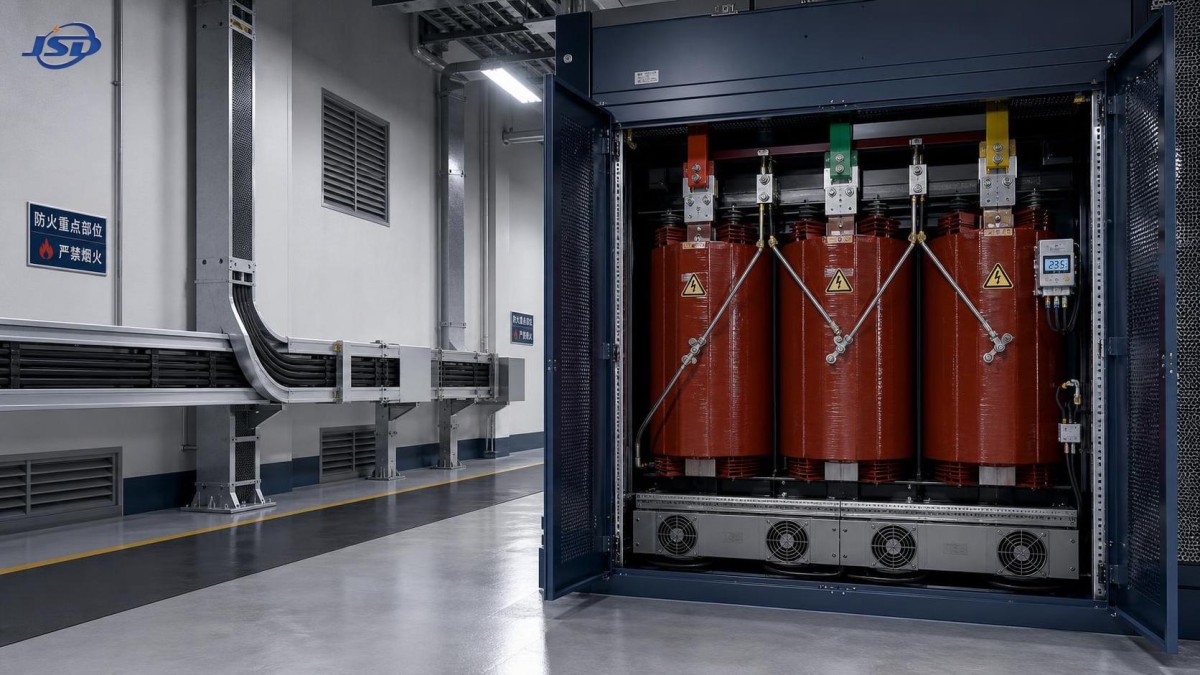
A cast resin transformer uses windings encapsulated in epoxy resin, typically under vacuum, to create a solid insulation system around the conductors. This design differs from ventilated dry-type transformers, whose windings are generally exposed to air and rely more heavily on surrounding cleanliness and airflow for cooling and insulation performance.
The encapsulated winding construction gives cast-resin equipment several characteristics that matter in fire-sensitive environments. There is no insulating oil to spill, burn, or migrate into drainage systems. The solid insulation is also comparatively resistant to humidity, dust accumulation, and many industrial contaminants. For indoor substations, this can be an important advantage where a liquid-filled transformer would introduce additional fire and containment obligations.
However, “resin cast” is not a universal answer to every fire question. The resin system itself must be evaluated through the relevant standards, fire behavior classifications, and manufacturer documentation. Fire performance depends on the insulation formulation, winding design, enclosure, installation room, cable system, protective devices, and the fire strategy of the complete facility. Treating the transformer as an isolated component is a common and costly mistake.
Cast resin versus other dry-type transformers: the practical comparison
Both cast-resin and ventilated dry-type transformers avoid the use of mineral oil, which makes both attractive where liquid fuel load is a central concern. Yet their operating behavior can be quite different.
In a clean commercial building, either design may satisfy the basic electrical duty. In a wastewater facility, coastal installation, mine auxiliary building, or industrial site with dust and intermittent condensation, the cast resin transformer often earns its cost through greater winding protection and more stable lifecycle behavior. Still, enclosure selection, ventilation design, and periodic inspection remain essential. Encapsulation does not eliminate the effects of high ambient temperature, blocked air paths, loose terminations, or poor cable installation.
When oil-immersed equipment should remain in the comparison
Fire-sensitive does not automatically mean oil-immersed transformers are prohibited. Their thermal performance, compactness for certain ratings, efficiency characteristics, and long-established service practices can make them appropriate for outdoor substations or dedicated transformer rooms. The decision becomes more nuanced when fire barriers, oil retention pits, separation distances, fire detection, suppression arrangements, and drainage controls can be properly designed.
For projects that have sufficient outdoor space or a segregated substation building, an 15kV/0.4kV Oil-Immersed Power Distribution Transformer may be evaluated as part of the wider distribution scheme. The key is to assess it as a system-level choice rather than comparing nameplate data alone. If locating the transformer outside removes it from the occupied building envelope, the overall risk and construction cost picture may differ significantly from an indoor installation.
Where an oil-filled unit is considered near a fire-sensitive area, evaluators should verify the insulating liquid type, containment provisions, drainage routing, fire separation, access arrangements, and the consequences of a leak under both normal and emergency conditions. A low transformer purchase price can be outweighed by substantial building, civil, and protection-system requirements.
Three specifications that often decide the outcome
1. Environmental class and climatic duty
A technical specification should state the real installation environment rather than merely saying “indoor.” Is there condensation during seasonal shutdowns? Will construction dust remain after commissioning? Are there corrosive gases, salt-laden air, textile fibers, or conductive particles? What is the expected minimum and maximum ambient temperature?
Cast-resin transformers are frequently selected because their encapsulated windings provide a margin against moisture and contamination. But evaluators should still confirm the required environmental, climatic, and fire behavior classifications under the standards applicable to the project. Those classifications need to match the site conditions, not simply represent a generic premium option.
2. Thermal design under actual load profile
Many transformer selections fail quietly at this stage. The rated kVA may appear adequate, yet the unit experiences elevated temperatures because the room runs hotter than assumed, ventilation is inadequate, harmonics increase losses, or the load remains near peak for long periods. In fire-sensitive sites, excess temperature is more than an efficiency concern; it increases insulation stress and can lead to nuisance trips, reduced service life, or avoidable alarm events.
Review the load curve, expected overload periods, harmonic spectrum, altitude, ambient temperature, and cooling method. If forced-air cooling is proposed, evaluate the operational consequence of fan failure. The design should identify whether the transformer can safely carry the required essential load under natural cooling and how temperature monitoring will initiate alarms, load shedding, or standby transfer.
3. Room integration and ventilation
A cast resin transformer may be safer than a liquid-filled alternative in many buildings, but it still releases heat. Poorly designed ventilation can turn a sound equipment choice into a chronic operating problem. Air inlets and outlets need a clear path; recirculation must be avoided; filters and louvers must be maintainable; and the acoustic treatment must not obstruct cooling airflow.
Do not assume that a transformer enclosure solves room-level safety issues. The enclosure rating must be selected with heat dissipation, access, accidental contact protection, dust ingress, and local regulations in mind. In confined substations, a coordinated review between electrical, mechanical, fire, civil, and architectural disciplines is often more valuable than another round of catalogue comparisons.
Protection and monitoring are part of fire risk control
Transformer construction influences fire behavior, but fault detection and isolation determine how quickly an abnormal event is contained. A well-considered protection scheme should address internal faults, overload, short circuit, earth fault, overtemperature, and ventilation failure where applicable. The available fault level and upstream switching device must be coordinated with the transformer impedance and the overall distribution network.
For critical facilities, winding temperature sensors and temperature relays can provide staged alarm and trip signals. Their value lies in how they are used: an alarm that is not connected to a building management system, remote monitoring platform, or operating procedure offers limited practical protection. Equally, trip logic should be carefully engineered so that it protects the transformer without causing unnecessary loss of critical services.
Consider the cables too. Fire-resistant cabling, correct termination practices, suitable gland plates, segregated routing, and controlled penetration sealing may contribute as much to the installed fire performance as the transformer type itself.
A decision path for technical evaluators
Rather than asking whether cast resin is “better” than dry type, use a sequence that exposes the true project priorities:
- Map the consequence of failure. Identify people, escape routes, essential services, adjacent equipment, and environmental receptors.
- Define the installation envelope. Confirm indoor or outdoor location, room volume, access, ventilation, humidity, contamination, and acoustic limits.
- Set measurable electrical duty. Include voltage, rating, vector group, impedance, losses, load profile, harmonics, fault level, and future capacity.
- Review fire strategy with the building team. Establish compartmentation, detection, suppression where required, smoke management, and emergency isolation.
- Compare lifecycle implications. Include cleaning, inspections, spare parts, outage windows, monitoring, and the cost of associated civil and protection works.
- Request evidence, not broad claims. Ask suppliers for applicable test documentation, insulation system details, temperature-rise information, installation limitations, and maintenance guidance.
This approach avoids a familiar trap: specifying a premium transformer while leaving the highest-risk conditions—poor ventilation, uncertain load growth, uncontrolled dust, or weak protection coordination—unresolved.
Common assumptions worth challenging
“Dry type means maintenance-free.” No transformer is maintenance-free. Dry-type units still need inspection of connections, cooling paths, fans, temperature devices, earthing, enclosure condition, and signs of contamination or overheating.
“Cast resin is always the safest option.” It is often a strong choice for indoor, fire-sensitive applications, but safety depends on the entire installation. A poorly ventilated cast-resin transformer room can still create serious operational and thermal risk.
“The highest rating gives the best margin.” Oversizing can reduce normal loading, but it may also raise procurement cost, increase no-load losses, complicate fault coordination, and create avoidable space constraints. Size for the verified duty cycle and credible future growth.
“Standards approval ends the discussion.” Compliance is essential, yet it does not replace engineering judgment. Site-specific fire strategy, environmental conditions, utility requirements, and operational resilience still need to be addressed.
The balanced conclusion
For many fire-sensitive sites, a cast resin transformer offers a convincing combination of no liquid insulation, protected windings, and suitability for indoor distribution environments. It is particularly compelling where transformers must sit close to occupied areas, where moisture or dust may challenge open-winding designs, or where avoiding oil containment simplifies the building solution.
Yet the best selection is never made by transformer type alone. The final recommendation should connect fire consequences, environmental class, thermal duty, room ventilation, protection coordination, service access, and lifecycle maintenance. When those elements are evaluated together, technical teams can choose a transformer arrangement that supports both safe operation and dependable power distribution—without relying on assumptions that only become visible after commissioning.
Jinshida Electric Power Technology Co., Ltd. supports transmission and distribution projects with an emphasis on practical engineering, consistent manufacturing control, and equipment solutions aligned with real operating conditions. For evaluators, the most productive supplier discussion begins with the site’s risk profile and performance requirements, then works steadily toward a transformer design that fits the whole installation.

Get a Quote
Regardless of whether you require general advice or specific support, we are happy to help you.
Send Us Your Inquiry Today

Jinshida Electric remains committed to contributing to global energy development through professional manufacturing and superior service.