





How to evaluate high voltage transformer manufacturer qualifications
A transformer quotation can look complete on paper: voltage ratings, losses, delivery date, price, and a list of standards. Yet for procurement teams, the real question is more demanding: can this supplier consistently build, test, deliver, and support equipment that will remain dependable under years of electrical, thermal, and environmental stress?
That is why evaluating a high voltage transformer manufacturer should never be treated as a price comparison alone. A transformer is a long-life asset placed at a critical point in the power system. If its insulation system, protection arrangement, test discipline, or documentation is weak, the consequences may include delayed commissioning, costly outage investigations, safety exposure, and difficult warranty discussions.
For utility, industrial, renewable energy, and infrastructure buyers, manufacturer qualification is best approached as a structured risk review. The goal is not simply to find a supplier with certificates; it is to confirm that the supplier’s engineering, factory controls, test capability, and service response match the real demands of the project.
Start with the project duty, not the supplier brochure
Before assessing any manufacturer, define what the transformer must withstand in service. “High voltage” is not a complete technical requirement. Procurement, engineering, and project teams should align on the application conditions that affect design and qualification depth.
- System voltage, frequency, insulation level, and required BIL or LI/AC withstand levels
- Rated power, cooling method, impedance tolerance, vector group, and tap changer requirements
- Installation environment, including altitude, ambient temperature, humidity, pollution level, seismic conditions, and corrosion exposure
- Load profile, overload expectations, harmonic content, motor starting duty, or renewable generation fluctuations
- Applicable national, utility, grid, or owner standards in addition to IEC or IEEE requirements
- Requirements for monitoring, fire protection, transport limitations, and site commissioning support
This step prevents a common mistake: selecting a manufacturer based on a successful reference for a different duty. A supplier experienced with standard distribution transformers may not automatically be qualified for high-impedance industrial units, utility step-up transformers, or installations exposed to severe coastal conditions. Similar capacity does not always mean similar design responsibility.
Certificates matter—but the management system behind them matters more
A credible high voltage transformer manufacturer should be able to provide current, verifiable quality-management documentation and explain how those controls are applied on the shop floor. ISO 9001 is commonly requested because it establishes a framework for document control, traceability, nonconformance handling, supplier management, and corrective action. Depending on the project and destination market, environmental and occupational health and safety management certifications may also be relevant.
However, certificates are only the entry point. During qualification, ask practical questions: How are engineering revisions released? Who approves deviations from approved drawings? How are nonconforming materials quarantined? How are recurring defects investigated? Is calibration status controlled for every critical test instrument?
A useful sign of maturity is when the manufacturer can show a clear quality plan for the proposed transformer rather than offering only general policy documents. That plan should identify inspection stages, hold points, records to be issued, and the responsibilities of the manufacturer, inspector, and purchaser.
Standards should be named, scoped, and contractually understood
IEC 60076 is widely used for power transformer design, testing, and performance requirements, while IEEE standards may apply in projects following North American practice. Local grid codes, utility specifications, and regulations can introduce additional obligations. Buyers should request a compliance matrix that maps each project requirement to the proposed design, test, document, or approved exception.
Be cautious with a broad statement such as “designed according to IEC.” It does not reveal whether all requested test levels, temperature-rise limits, sound limits, accessories, short-circuit requirements, or documentation provisions have been considered. A disciplined compliance matrix exposes gaps early, when they can still be resolved without affecting production or delivery.
Examine manufacturing capability where transformer reliability is actually created
Transformer reliability is built through many controlled details: core steel processing, winding geometry, conductor preparation, insulation placement, clamping pressure, drying, oil treatment, tank sealing, and final assembly. A factory visit or a well-documented remote audit should look beyond the cleanliness of the building and focus on process control.
Ask to see how incoming materials are inspected and traced. Core steel, copper or aluminum conductors, insulating paper, pressboard, bushings, tap changers, transformer oil, gaskets, and protective devices all affect final performance. Critical components should be sourced from controlled suppliers, inspected against defined specifications, and linked to the transformer’s manufacturing record.
The winding and insulation process deserves particular attention. The manufacturer should demonstrate control over conductor dimensions, turn count, insulation thickness, axial and radial supports, lead routing, and clamping. For oil-immersed transformers, vapor-phase drying or another validated drying process may be essential to reduce moisture in active parts. It is reasonable to ask how moisture control is verified, how long components are exposed before oil filling, and how vacuum oil filling is managed.
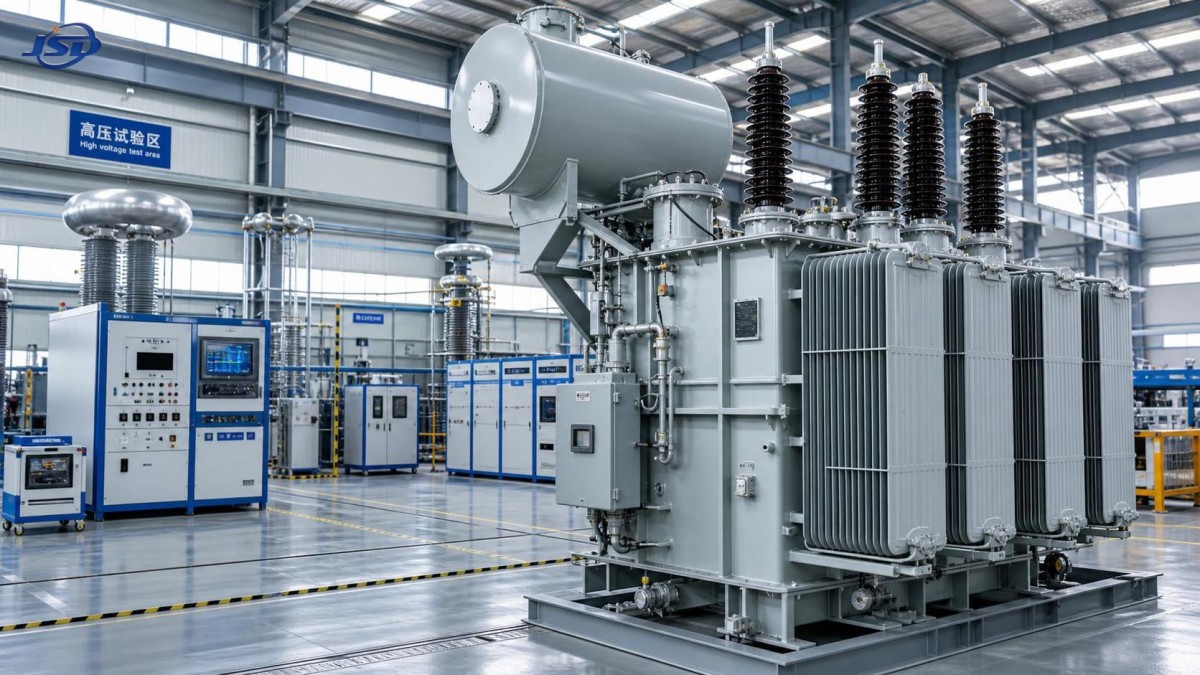
Tank fabrication is another area where appearances can be deceptive. Review welding procedures, leak-testing practices, surface preparation, coating controls, and pressure or vacuum capability where applicable. A well-designed active part can still suffer from shortened service life if moisture ingress, oil leaks, or inadequate corrosion protection are allowed to develop in the field.
Factory acceptance testing is the point where claims become evidence
Testing should be treated as a procurement milestone, not merely a document issued after shipment. The exact test program depends on transformer type, rating, governing standard, and contract specification, but buyers should understand the difference between routine, type, special, and site tests.
Routine tests generally confirm that each manufactured unit meets specified electrical and functional requirements. Depending on the design, these may include winding resistance, voltage ratio and vector group verification, impedance and load-loss measurement, no-load loss and current measurement, insulation resistance, applied-voltage testing, induced-voltage testing, and checks of auxiliary circuits and accessories.
Special or additional tests may be required for particular risks or owner specifications. Examples can include lightning impulse tests, partial discharge measurement, temperature-rise tests, sound-level tests, short-circuit withstand evidence, and tests related to tap changer or control functions. Not every test is appropriate for every transformer, but every exclusion should be understood rather than assumed.
Ask the manufacturer to provide test-bay capability details, calibration records, test procedures, and sample reports with sensitive customer information removed. If a third-party inspector will witness the FAT, agree on notification periods, witness points, acceptance criteria, and the treatment of failed or repeated tests before the purchase order is released.
Questions procurement teams should ask during FAT planning
- Which tests are routine under the applicable standard, and which are additional contractual requirements?
- Will all tests be completed in-house, or will any be subcontracted?
- What happens if a result falls outside tolerance or a test must be repeated?
- Can the buyer review raw test data as well as the final signed report?
- Are test instruments calibrated by recognized laboratories within valid intervals?
- How will the transformer be protected, preserved, and documented after successful testing?
Review engineering strength, especially when the application is not standard
Many projects require more than a catalog configuration. Grid connection transformers may need carefully coordinated insulation levels and tap ranges. Industrial facilities may need resistance to harmonics, frequent load changes, or high starting currents. Solar, wind, battery, and data infrastructure projects can introduce compact layouts, challenging ambient conditions, and strict commissioning schedules.
A capable manufacturer should have engineers who can explain design choices in understandable, project-specific terms. They should be able to provide general arrangement drawings, nameplate data, loss calculations, impedance values, protection and monitoring arrangements, terminal layouts, foundation loads, transport dimensions, and accessory schedules without relying on vague assurances.
For applications where transformation, switching, protection, and low-voltage distribution must work together in limited space, an integrated package may reduce interface risk. For example, a properly specified European-Type Compact Substation can bring these functions into a coordinated enclosure. Even then, buyers should evaluate the transformer manufacturer’s ability to manage internal clearances, compartment ratings, cable interfaces, earthing, protection coordination, and maintainability—not just the enclosure dimensions.
References are useful only when they are comparable
Project references are valuable, but a long reference list alone does not prove suitability. Ask for experience that resembles your own project in voltage class, capacity range, cooling type, environment, end-use sector, and governing standard. A manufacturer should be able to describe the scope supplied, the approximate commissioning period, and the type of service conditions involved, while respecting client confidentiality.
Pay attention to continuity. Has the company manufactured similar equipment recently? Does it retain the engineering and production personnel responsible for that product range? Can it provide evidence of long-term operational support, spare parts coordination, or field troubleshooting? These questions are especially important for projects where a replacement unit cannot be sourced quickly.
Evaluate delivery control as carefully as electrical design
Transformer projects often lose time at the interfaces: drawing approvals, component lead times, FAT scheduling, export packing, transport permits, site storage, and commissioning readiness. A dependable supplier should offer a realistic production schedule with clear milestones instead of an optimistic single delivery date.
Review the manufacturer’s procurement plan for long-lead components such as tap changers, bushings, radiators, control cabinets, and protection devices. Confirm who is responsible for transport design, impact monitoring if required, oil shipment arrangements, preservation during storage, and lifting instructions. For large units, transport limitations may influence tank dimensions, accessory removal, oil handling, and site assembly planning from the beginning.
Documentation should arrive in a sequence that supports the project, not after equipment reaches site. Typical deliverables may include approved drawings, data sheets, quality plans, inspection records, FAT reports, packing lists, manuals, wiring diagrams, recommended spares, and commissioning guidance. Clarify the required language, format, revision process, and submission dates.
After-sales capability is part of manufacturer qualification
A transformer may operate for decades, while the original project team changes several times. The supplier’s support model therefore deserves a place in the evaluation scorecard. Ask whether technical assistance is available for installation, oil filling, testing, energization, fault investigation, and spare parts identification. Understand response channels and escalation procedures, especially for remote sites or critical facilities.
Warranty wording should be specific. It should define the warranty period, what constitutes a defect, required operating conditions, notification steps, repair responsibilities, and the handling of transport or installation-related claims. A broad warranty statement without practical procedures can be difficult to use when time is limited and the plant is waiting to energize.
A procurement scorecard keeps decisions balanced
The lowest purchase price can be attractive, particularly when capital budgets are under pressure. But an evaluation model that assigns weight only to commercial terms can hide serious lifecycle risk. A more balanced scorecard may include technical compliance, quality-system evidence, factory process capability, test facilities, comparable references, delivery planning, documentation quality, service support, and total evaluated cost.
It is also wise to separate “mandatory” requirements from scored preferences. A manufacturer that cannot meet a critical insulation level, required test, approved standard, or delivery constraint should not remain competitive merely because its commercial score is strong. This protects the procurement process from avoidable compromise later.
Choosing a manufacturer that can stand behind the equipment
The best-qualified supplier is rarely the one with the most polished presentation. It is the one that answers technical questions clearly, identifies assumptions early, opens its processes to review, and provides evidence that can be checked. That combination gives buyers confidence not only in the transformer itself, but also in the working relationship that follows.
Jinshida Electric Power Technology Co., Ltd. approaches power transmission and distribution projects with this long-term perspective: combining engineering support, controlled manufacturing processes, and rigorous quality management for reliable power applications. For buyers evaluating a high voltage transformer manufacturer, the most productive next step is to issue a clear technical specification, request a documented compliance response, and use the qualification process to confirm that every critical requirement can be delivered in practice.

Get a Quote
Regardless of whether you require general advice or specific support, we are happy to help you.
Send Us Your Inquiry Today

Jinshida Electric remains committed to contributing to global energy development through professional manufacturing and superior service.