





What to Include in a Wind Farm Substation Transformer Tender Specification
What to Include in a Wind Farm Substation Transformer Tender Specification
A well-defined tender specification is essential when sourcing a substation transformer for wind farms. Procurement teams must balance technical performance, grid compliance, reliability, lifecycle cost, and supplier capability.
This guide outlines the transformer requirements, documentation, testing criteria, and commercial considerations that help protect project schedules, generation availability, and long-term operating costs.
For procurement teams, the central question is not simply whether a transformer meets a stated MVA rating. It is whether it will perform reliably under the wind farm's actual electrical, environmental, and grid conditions.
A weak specification can lead to costly clarification rounds, incompatible protection settings, delayed factory acceptance tests, excessive losses, or disputes over warranty responsibility after commissioning.
A strong tender package translates project risks into measurable requirements. It should allow technically comparable bids while leaving enough scope for suppliers to offer practical, compliant engineering solutions.
Define the Wind Farm Duty and Transformer Scope
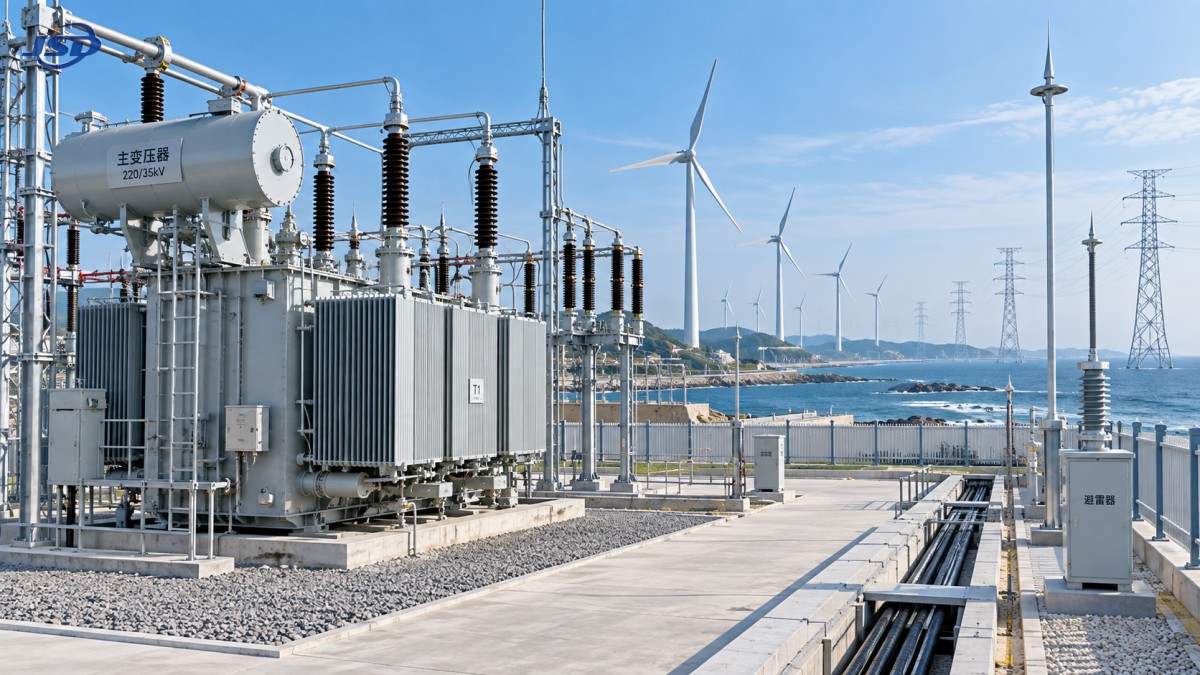
Start by defining the transformer duty clearly. State whether the unit is a main step-up transformer, collector substation transformer, auxiliary transformer, or a replacement transformer for an operating site.
For a substation transformer for wind farms, identify the installed capacity, expected export capacity, phased development plans, and any future battery storage or grid-support equipment.
State the required rated power in MVA, nominal high-voltage and low-voltage levels, system frequency, vector group, impedance range, and cooling class.
Do not rely on generic voltage descriptions such as “high voltage side” or “grid side.” Define the exact nominal voltage, highest system voltage, insulation level, and grounding arrangement.
Specify whether the transformer must support continuous operation at rated output, emergency loading, short-duration overload, or seasonal overload profiles associated with high wind periods.
Wind farms often experience variable generation rather than constant base-load conditions. However, rapid changes in output can still create thermal cycling and voltage-control demands.
Include the expected load profile, annual energy forecast assumptions, power factor range, reactive power requirements, and anticipated curtailment strategy where relevant.
If the project will include energy storage, define the combined operating scenarios. Charging and discharging can alter transformer loading direction, harmonic exposure, and tap-changing duty.
For example, a wind project paired with a 1MW/2MWh Liquid Cooling Container Energy Storage System may require explicit review of bidirectional power flow and control coordination.
State all equipment included in the supplier's scope. This may cover the transformer, on-load tap changer, cooling equipment, marshalling cabinet, monitoring devices, surge arresters, and interface terminals.
Clarify whether civil foundations, fire walls, oil containment, installation supervision, site testing, and commissioning support are included or supplied by separate contractors.
Set Electrical Parameters That Match Grid Connection Requirements
The electrical section should be based on the grid connection agreement and approved system studies, not on an earlier feasibility-stage design assumption.
Require bidders to confirm compliance with the applicable grid code, utility technical specification, interconnection study, and local authority requirements.
Specify transformer impedance carefully because it affects fault current, voltage regulation, parallel operation, protection coordination, and the capability of wind turbines to remain connected during disturbances.
Provide the required positive-sequence impedance and permitted tolerance. If zero-sequence impedance is important for grounding or earth-fault protection, state it separately.
Define the vector group and neutral treatment according to the collection network and utility requirements. This prevents late-stage conflicts involving protection schemes and fault-level calculations.
Include winding connection details, neutral insulation requirements, neutral current transformer interfaces, and whether an earthing transformer or neutral grounding resistor is part of the design.
Tap changer requirements deserve particular attention. State whether the transformer requires an on-load tap changer, off-circuit taps, automatic voltage control, remote setpoint control, or supervisory control integration.
For on-load tap changers, specify tap range, step voltage, rated through-current, mechanical endurance, electrical endurance, diverter-switch technology, and maintenance documentation requirements.
Request bidders to describe their voltage-control logic and recommended control settings. This is important where wind turbine reactive-power controls and transformer tap controls could interact.
Specify insulation coordination values, including lightning impulse withstand voltage, switching impulse withstand voltage where applicable, and power-frequency withstand voltage for each winding and terminal.
State the site altitude, pollution level, lightning exposure, and overhead-line or cable connection arrangement. These factors influence bushings, clearances, arresters, and external insulation design.
Address Renewable-Energy Operating Conditions and Power Quality
Wind generation creates operating conditions that differ from conventional generation plants. The tender should require suppliers to evaluate harmonic, thermal-cycling, and voltage-fluctuation impacts.
Provide harmonic study results where available. At minimum, state the applicable harmonic limits, expected background distortion, converter characteristics, and responsibility for harmonic-loss evaluation.
Require the supplier to calculate additional losses caused by harmonics and to confirm that winding, leads, bushings, and tap changer components remain within allowable temperature limits.
Specify whether the transformer may experience reverse power flow. This is increasingly relevant where auxiliary generation, battery energy storage, or grid services are integrated at the substation.
Include requirements for frequency variation if the project operates in a grid with wider frequency tolerance. Transformer design assumptions should reflect the actual permitted operating range.
Ask bidders to identify any restrictions associated with energization, inrush current, sympathetic inrush, ferroresonance risk, or switching sequence requirements.
For projects with multiple transformers in parallel, specify matching requirements for ratio, impedance, vector group, tap positions, and control philosophy to avoid circulating currents.
Demand an interface schedule listing every electrical connection, terminal rating, cable-box arrangement, phase designation, bushing type, and responsibility boundary.
This interface schedule is particularly valuable for procurement because it exposes omissions before contract award, when changes are less disruptive and commercially easier to manage.
Specify Reliability, Environmental, and Site Conditions
Reliability requirements should be written around the wind farm location. Offshore-adjacent, desert, cold-climate, mountainous, and coastal projects require different design priorities.
State the minimum and maximum ambient temperature, solar radiation, humidity, wind loading, seismic level, altitude, salt contamination, dust exposure, and corrosion category.
For coastal wind farms, require an appropriate corrosion-protection system for radiators, tanks, fasteners, control cabinets, and external accessories.
Define whether the transformer will be installed indoors, outdoors, within a substation enclosure, or near other heat-generating equipment that affects cooling performance.
Specify the required enclosure protection rating for cabinets, heater and anti-condensation provisions, cable-gland requirements, and resistance to local pests or airborne contamination.
Oil containment requirements should be explicit. State oil volume, bund capacity, drainage design interfaces, fire-safety obligations, and whether biodegradable ester fluid is preferred or mandatory.
If ester fluid is required, identify the fluid standard, fire-point requirement, compatibility expectations, and responsibility for confirming transformer materials, accessories, and monitoring equipment suitability.
Require low-maintenance cooling arrangements appropriate to the site. Suppliers should state fan and pump redundancy, alarm points, automatic control stages, and replacement-part availability.
For remote wind farms, request a maintainability review. Access restrictions, crane availability, spare-unit strategy, and expected field-service response times directly affect availability risk.
Ask for a guaranteed service life and design life. These commitments should be supported by insulation-system data, thermal calculations, maintenance intervals, and warranty terms.
Make Losses, Noise, and Lifecycle Cost Comparable
Purchase price alone is a poor basis for selecting a transformer. No-load loss and load loss can create substantial lifetime cost differences across a wind farm's operating life.
State maximum guaranteed no-load losses and load losses at the specified reference temperature. Require bidders to submit guaranteed values rather than only typical design values.
Define the economic evaluation method in the tender. Assign a monetary capitalization factor to each watt of no-load loss and load loss.
This method allows procurement teams to compare a lower-cost, higher-loss offer with a higher-efficiency offer using a consistent lifecycle cost framework.
Include penalties for guaranteed-loss exceedance, test tolerances, and the treatment of measurement uncertainty. Without these terms, loss guarantees may have limited contractual value.
Specify maximum sound-power or sound-pressure limits at defined distances and operating conditions. Wind farm substations near communities may face strict planning conditions.
Require bidders to declare the expected sound contribution from core noise, cooling fans, oil pumps, and tap changer operation.
Noise guarantees should identify the measurement standard, test environment, correction method, acceptance criteria, and actions required if the guaranteed value is exceeded.
Request an estimated maintenance plan covering inspections, oil testing, tap changer servicing, cooling-system checks, and recommended critical spare parts for the first operating years.
Require Appropriate Standards, Drawings, and Technical Documentation
The tender should identify governing standards clearly. Common references include IEC 60076, IEC 60214 for tap changers, IEC 60599 for dissolved gas analysis, and relevant local grid standards.
Do not merely list standards. State the edition to be applied, any project-specific deviations, and which requirement takes precedence if standards conflict.
Require a detailed compliance schedule. Each bidder should mark every tender clause as compliant, partially compliant, or deviating, with a technical explanation for each deviation.
A compliance schedule prevents important qualifications from being hidden in proposal notes. It also gives procurement teams a structured basis for bid evaluation and clarification.
Ask for general arrangement drawings, nameplate data, terminal diagrams, foundation loads, transport dimensions, oil quantity, lifting details, and site assembly requirements.
Include preliminary protection and control drawings showing alarm, trip, monitoring, and communication interfaces. These documents help engineering teams validate compatibility early.
Specify the required digital communications. Common requirements include hardwired alarms, Modbus, IEC 61850, Ethernet interfaces, time synchronization, and cybersecurity expectations for remote monitoring.
Condition monitoring requirements may include oil temperature, winding temperature, oil level, pressure relief, gas relay, moisture monitoring, dissolved gas monitoring, and bushing condition monitoring.
Specify which monitoring devices are mandatory, which are optional, and which data points must be available to the wind farm SCADA system.
Define Factory Testing, Acceptance, and Witnessing Requirements
Testing requirements should be precise enough to protect the buyer while remaining aligned with the transformer design and recognized standards.
Include routine tests such as ratio measurement, winding resistance, impedance measurement, dielectric tests, induced-voltage tests, and no-load and load-loss tests.
Specify additional type, special, or design tests where justified. Examples include short-circuit withstand evidence, temperature-rise testing, lightning impulse testing, sound-level measurement, and zero-sequence impedance testing.
Require a factory acceptance test procedure for approval before testing begins. The procedure should list instruments, test sequence, acceptance criteria, witness points, and reporting format.
State whether the purchaser, owner's engineer, utility representative, or third-party inspector will witness the factory acceptance test and how much notice is required.
Include a clear process for nonconformities. The contract should define retesting obligations, root-cause analysis, corrective actions, cost responsibility, and shipment restrictions.
Require complete certified test reports before shipment. Procurement teams should not accept a shipment release based solely on a verbal factory completion confirmation.
For critical projects, request a quality plan and inspection test plan covering material receipt, core assembly, winding, tank fabrication, painting, final assembly, and final testing.
Evaluate Supplier Capability Beyond the Datasheet
A technically acceptable datasheet does not prove execution capability. Evaluate the supplier's manufacturing capacity, design experience, quality controls, project management, and service organization.
Request references for comparable voltage classes, transformer ratings, wind farm applications, grid conditions, and climatic environments. References should include operating duration and customer contact details where possible.
Ask suppliers to identify the manufacturing location, major subcontracted components, core steel source, tap changer manufacturer, bushing manufacturer, and testing facilities.
Assess lead-time credibility by requiring a milestone schedule. Include design approval, material procurement, manufacturing, routine testing, shipment, site delivery, and commissioning support.
Require the bidder to identify long-lead components and contingency arrangements. This is especially important when project financial close and grid connection dates are fixed.
Warranty terms should cover defects, guaranteed technical values, response time, field support, replacement parts, and the process for resolving a major failure.
For a substation transformer for wind farms, ask how the supplier will support urgent fault diagnosis, oil analysis, remote troubleshooting, and access to field engineers.
Use a weighted technical-commercial evaluation matrix. Typical categories include compliance, losses, reliability, delivery, testing, service capability, warranty, deviations, and evaluated lifecycle cost.
Build Clear Commercial Terms and Risk Allocation
Commercial terms should align with the technical scope. Ambiguity around transport, insurance, unloading, oil filling, assembly, testing, and commissioning can create avoidable claims.
Define the delivery term, transfer of risk, packaging requirements, transport route limitations, maximum shipping weight, preservation measures, and storage conditions before installation.
State the required documentation deliverables and their approval timeline. Delays in drawings, protection data, or interface information can delay civil, cable, and SCADA work.
Include liquidated damages where appropriate for late delivery, excessive losses, unacceptable noise, failed tests, or failure to meet agreed technical guarantees.
Ensure the liability structure is commercially realistic. Excessive penalties may reduce bidder participation or lead suppliers to price risk into the proposal.
Request a priced list of recommended spares, special tools, consumables, and optional monitoring equipment. This makes post-award budget planning more transparent.
Define training requirements for site operators and maintenance teams. Training should cover normal operation, alarm response, tap changer maintenance, oil handling, and emergency procedures.
Finally, state the tender clarification process and bid validity period. A disciplined process reduces the risk of bidders making inconsistent assumptions during evaluation.
Conclusion: Turn Technical Requirements Into Procurement Control
An effective transformer tender specification gives procurement teams a practical control mechanism, not simply a list of electrical ratings and standards.
It should define the wind farm duty, grid interface, environmental conditions, guaranteed losses, testing rules, supplier documentation, lifecycle costs, and contractual responsibilities.
The best specification enables fair bid comparison while identifying project-specific risks early. That improves supplier accountability and reduces costly technical changes after award.
When sourcing a substation transformer for wind farms, prioritize verified performance, grid compatibility, maintainability, and proven delivery capability over a nominally low purchase price.
By converting these priorities into measurable tender clauses, procurement teams can select equipment that supports dependable export capacity and protects the project's long-term energy value.

Get a Quote
Regardless of whether you require general advice or specific support, we are happy to help you.
Send Us Your Inquiry Today

Jinshida Electric remains committed to contributing to global energy development through professional manufacturing and superior service.