





When does a current transformer CT ratio cause billing errors
In revenue metering, CT errors are rarely dramatic. They accumulate quietly in the background and only become visible when an audit, a customer complaint, or a settlement discrepancy forces a closer look. For technical evaluators, the key question is not simply whether a current transformer CT has the “right ratio” on paper. The real issue is when that ratio causes the metering chain to operate outside the conditions assumed by the meter, the utility, or the applicable accuracy class.
A billing error can appear even when the CT itself is not defective. Wrong ratio selection, wrong meter programming, low-load operation, excessive burden, reversed polarity, phase mismatch, saturation under fault or harmonic-rich conditions, and replacement without updating the metering constants can all produce incorrect energy registration. In practice, ratio-related billing problems usually come from a system mismatch rather than from one isolated component failure.
What CT ratio means in billing applications
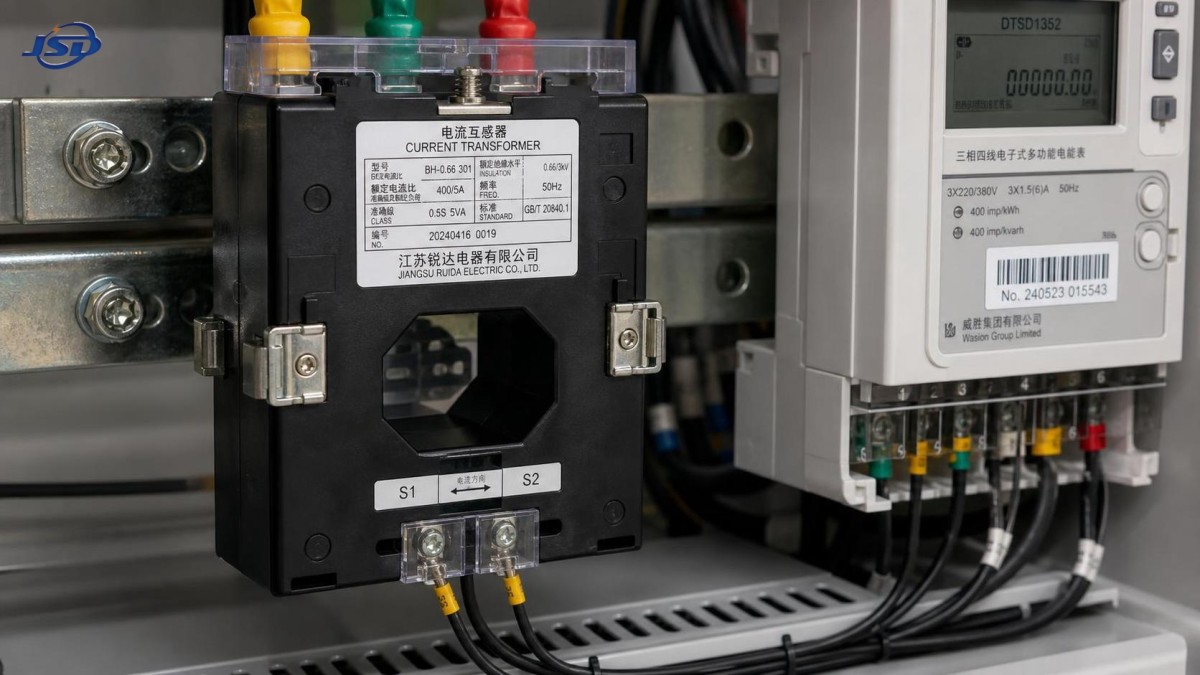
The CT ratio expresses the relationship between primary current and secondary current, such as 200/5 A, 400/5 A, or 1000/1 A. In billing metering, the meter multiplies the measured secondary current by the programmed transformation ratio to calculate primary energy consumption. If that relationship is wrong at any point in the chain, the billing result is wrong.
That sounds straightforward, but the technical risk appears in two different ways:
- The installed CT ratio does not match the actual load range.
- The meter or billing system uses a ratio different from the CT actually installed.
The second case creates immediate and often large percentage errors. A 300/5 CT installed while the meter is configured for 200/5 will understate or overstate current by 50%, depending on the direction of the mismatch. These are usually discovered quickly because the error is too large to ignore.
The first case is more subtle and more common in the field. A CT can be “correct” from a protection or nameplate perspective and still be a poor metering choice if the normal operating current sits too low in the CT’s effective accuracy range.
When an oversized CT ratio starts to distort billing
Oversizing is one of the most frequent causes of metering inaccuracy. It often happens when designers choose a generous CT ratio to accommodate future expansion, occasional peak demand, or fault-related margins. For protection functions, that may be acceptable. For billing, it can be problematic.
Metering CTs are designed to achieve their stated accuracy within specified current ranges and burden conditions. If the actual load operates well below that range for long periods, ratio error and phase angle error can become more significant. This matters especially at low power factor or where energy settlement includes both active and reactive components.
A common field pattern looks like this: a facility was originally expected to draw 70% to 90% of a feeder’s design current, so a relatively high CT ratio was selected. Years later, the actual process load stabilizes at 10% to 20% of that current. The meter still registers energy, but not with the intended billing accuracy. In low-load periods, the secondary current may be so small that the CT operates near the lower edge of its metering performance envelope.
For technical review, the ratio should therefore be checked against real operating current distribution, not only against maximum design current. Peak current is important, but billing accuracy is determined over the entire operating profile.
When an undersized CT ratio creates billing risk
Undersizing is less common in conservative utility designs, but it creates its own problems. If the normal current frequently approaches or exceeds the CT’s rated primary current, the CT can enter a region where thermal stress, magnetic nonlinearity, or saturation risk increases, especially under transient conditions. Once the core cannot reproduce the current waveform accurately, the meter sees a distorted secondary current and billing accuracy degrades.
In modern industrial systems, this risk is not limited to classical overload. Variable frequency drives, rectifiers, furnaces, EV charging clusters, and some renewable integration points can introduce waveform distortion and current peaks that are not well represented by RMS nameplate assumptions. Even if average current seems acceptable, crest factor and harmonic content can push a poorly selected CT toward inaccurate reproduction.
That is one reason technical evaluators increasingly review the broader power conversion environment rather than ratio alone. In installations serving rectification or isolation-heavy processes, upstream current conditions may differ markedly from clean sinusoidal assumptions. Equipment such as an Isolation and Rectifier Special Transformer is selected for specific power conversion duties, but the metering CT associated with such systems must also be reviewed for burden, harmonic environment, and expected load profile if billing precision matters.
The most expensive error: correct CT, wrong meter multiplier
From a billing standpoint, the highest-impact mistakes are often administrative or commissioning-related rather than electrical. A CT may be properly chosen and accurately manufactured, yet the meter is programmed with the wrong ratio after replacement, retrofit, or panel modification.
This usually happens in several situations:
- an old 600/5 CT is replaced by 800/5 during a capacity upgrade, but the meter constant is not changed;
- a 1 A secondary CT is installed in a system still configured for 5 A;
- drawings show one ratio, but as-built installation uses another;
- multi-core CTs are wired from the wrong secondary core, with a different class or purpose than intended for metering.
These errors are operationally serious because the CT may pass basic continuity checks and the meter may display plausible values. Unless someone compares measured secondary current, meter configuration, and actual primary load, the mismatch can remain in service for months.
For revenue applications, ratio verification should always be part of commissioning and any later asset change process. Technical evaluators should not assume that a nameplate match in procurement documents guarantees a metering match in the field.
Accuracy class matters as much as ratio
A CT ratio alone does not define billing suitability. A 400/5 CT built for general indication or protection duty is not automatically appropriate for revenue metering. The accuracy class, rated burden, instrument security factor, thermal limits, and compliance with applicable standards all shape how the CT performs in service.
Relevant standard references depend on market and application. IEC instrument transformer requirements are commonly referenced internationally, while ANSI/IEEE frameworks are used in many other jurisdictions. The exact revenue metering requirements may also be governed by local utility rules, market operator protocols, or legal metrology requirements. Where specific settlement rules apply, those should be treated as primary. If the applicable requirement is not clearly identified during project review, that gap should be marked as 【待核实】 rather than assumed.
In practice, billing errors often emerge because a project team chooses a ratio based on ampacity and leaves the rest of the metering specification underdefined. That is not a safe approach for settlement-grade measurement.
How burden and wiring make a “good” ratio perform badly
Even with the correct ratio and correct meter settings, excessive secondary burden can shift performance enough to affect billing. Burden includes meter input impedance, lead resistance, terminal connections, test switches, and any intermediate devices. Long cable runs or undersized secondary wiring are frequent contributors.
A CT selected near the edge of its rated burden may perform acceptably in factory conditions and poorly in field conditions. This is especially relevant in retrofit projects where the metering point remains the same but the panel layout changes, secondary cable route becomes longer, or additional test equipment is inserted.
For evaluators, the practical lesson is simple: ratio validation is incomplete without burden calculation. A technically correct 200/5 CT can still generate billing error if the installed secondary circuit exceeds the burden assumed by its accuracy class.
Low power factor and phase angle error are often underestimated
Billing disputes are not always caused by ratio error in the narrow sense. In many cases, the ratio is nominally correct, but phase displacement contributes enough error to affect watt-hour or var-hour measurement. At lower power factor, this becomes more sensitive.
Why does that matter? Because technical teams sometimes look only at current magnitude reproduction. But revenue meters calculate energy from both current and voltage relationships over time. If the CT introduces phase angle error outside the acceptable range, the meter’s energy result shifts even if current amplitude seems close enough.
This issue becomes more visible in industrial sites with mixed loads, lightly loaded transformers, or significant reactive compensation switching. A ratio chosen without regard to likely operating power factor can therefore contribute indirectly to billing inaccuracy.
Common field scenarios where CT ratio causes billing errors
Several recurring scenarios deserve attention because they appear across utilities, industrial plants, and commercial facilities:
- Capacity reserved but never used. The CT was sized for future growth, while actual current remained permanently low.
- Partial system expansion. Primary equipment was upgraded, but metering settings were not revised consistently.
- CT replacement after failure. Equivalent physical fit was prioritized over metering equivalence.
- Mixed metering and protection assumptions. One CT ratio was chosen mainly for protection convenience, with billing performance treated as secondary.
- Secondary circuit changes. Added lead length or devices increased burden beyond expectation.
- Nonlinear load growth. Drives, rectifiers, or converters changed the current waveform enough to expose CT limitations.
In such cases, a technical evaluator should avoid asking only “Is the ratio standard?” The better question is “Will this ratio preserve required accuracy under actual operating and installation conditions?”
How to assess whether a CT ratio is suitable for billing
A reliable assessment usually includes five checks.
First, compare ratio to the real load curve. Use measured operating current over time, not design current alone. If the site spends most of its hours at very low current relative to CT rating, accuracy risk increases.
Second, confirm the meter configuration. Verify CT ratio, secondary rating (1 A or 5 A), multiplier, phase mapping, and any software scaling in the meter and upstream billing platform.
Third, review CT class and burden. Confirm that the installed burden stays within the rated value required for the desired accuracy class.
Fourth, check application environment. Look for harmonics, transient loading, low power factor, or converter-heavy operation that may affect metering fidelity.
Fifth, validate as-built documentation. Drawings, labels, test reports, and meter settings should agree. If they do not, billing confidence is already compromised.
Where systems involve specialized conversion equipment, such as another installation using an Isolation and Rectifier Special Transformer, the evaluator should pay closer attention to current waveform quality and metering architecture, not just rated current.
What buyers and specifiers should require from suppliers
For procurement and technical approval, the most useful safeguard is not a generic “high accuracy” statement. It is a complete and application-specific specification. That should typically define:
- primary and secondary ratio;
- metering accuracy class;
- rated burden;
- frequency and insulation requirements;
- intended metering standard reference;
- installation environment and expected load range;
- whether the application includes harmonic-rich or converter-fed loads;
- test documentation and traceability expectations.
For cross-border procurement, technical evaluators should also confirm whether the supplier’s standard test basis matches the destination market’s acceptance rules. A compliant CT under one framework may still require additional review for another market’s revenue metering practice.
The practical threshold: when does the ratio become a billing problem?
The CT ratio becomes a billing problem when it prevents the metering system from maintaining the required accuracy across the actual operating range of the installation. That can happen because the ratio is plainly wrong, because it is technically oversized or undersized for the load profile, or because it is disconnected from meter settings, burden conditions, or waveform reality.
In other words, billing errors begin not at a single universal ampere value, but at the point where the chosen ratio no longer supports settlement-grade measurement in the field conditions that really exist.
For technical evaluators, that is the decision standard that matters. A current transformer CT should not be judged only by whether it fits the busbar or matches the maximum current on a one-line diagram. It should be judged by whether it can deliver verifiable, standards-aligned accuracy over the site’s actual operating life. That is the difference between a metering component that merely works and one that can be trusted when money, compliance, and customer accountability depend on it.

Get a Quote
Regardless of whether you require general advice or specific support, we are happy to help you.
Send Us Your Inquiry Today

Jinshida Electric remains committed to contributing to global energy development through professional manufacturing and superior service.