





Does a copper winding transformer last longer under heavy loads
When transformers run close to rated capacity for long periods, the winding material stops being a minor specification detail and becomes a service-life issue. That is why the question behind a copper winding transformer is not simply whether copper is “better” than aluminum. Buyers usually want to know something more practical: under heavy loads, will copper actually reduce failure risk, slow aging, and justify its higher upfront cost?
The short answer is that copper-wound transformers often do last longer under heavy-load conditions, but not automatically and not in every project. Their advantage comes from a combination of lower electrical resistance, better thermal stability in real operation, and stronger mechanical behavior during load cycling and fault events. At the same time, transformer life is still heavily determined by insulation system design, cooling effectiveness, manufacturing quality, load profile, and site conditions. A poorly designed copper transformer can still age faster than a well-built aluminum one.
For anyone evaluating specifications rather than marketing claims, the real decision should be based on how heavy the load is, how continuous it is, how critical downtime would be, and whether the transformer will face harsh thermal or mechanical stress over many years.
Why heavy load changes the material discussion
Under light or intermittent load, winding material differences may have limited practical impact. Under sustained heavy load, the operating margin becomes narrower. Every source of heat matters more, and every weakness in mechanical support or cooling design shows up faster.
Transformer life is closely tied to temperature, especially the thermal aging of insulation. In most real applications, windings do not fail first because the metal itself “wears out” in a simple way. What degrades is the insulation system around the conductor. Once hotspot temperatures stay elevated for too long, insulation aging accelerates, dielectric strength falls, and long-term reliability drops.
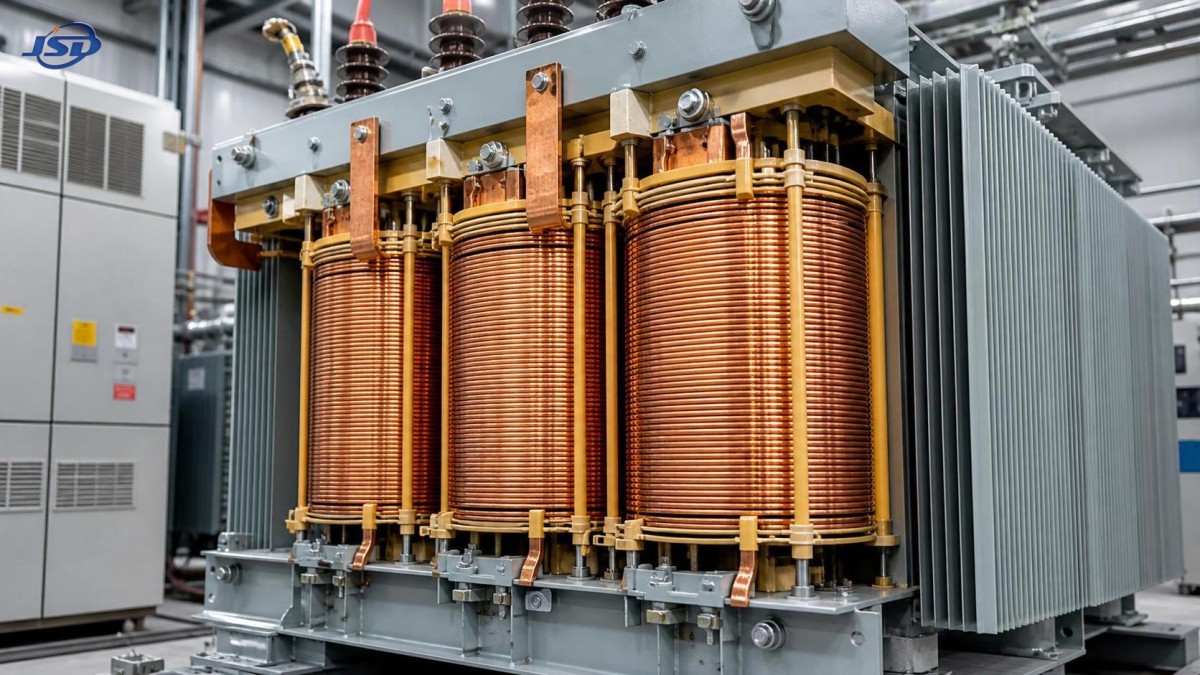
This is where copper usually gains attention. Copper has higher electrical conductivity than aluminum, which means lower resistance for the same conductor cross-section. Lower resistance means lower I²R losses, and lower losses mean less heat generated in the winding under load. In heavy-duty operation, that difference can translate into lower hotspot temperatures or more design margin.
That does not mean every copper unit runs cooler by default. Manufacturers can compensate for aluminum with larger cross-sections and different design choices. But when comparing units of similar design quality and compactness, copper often provides a thermal and efficiency advantage that becomes more relevant as loading rises.
Does lower resistance automatically mean longer life?
Not automatically. It improves the odds, but service life depends on the full thermal system.
A transformer under heavy load must manage:
- winding losses,
- core losses,
- heat transfer through insulation and structural parts,
- cooling medium performance,
- ambient temperature,
- load fluctuation and overload duration.
If the cooling path is weak, or if the design hotspot is too concentrated, copper alone will not protect the unit. This is an important point because buyers sometimes overfocus on winding material and undercheck temperature-rise guarantees, cooling class, and test records.
In practical evaluation, a copper winding transformer tends to have longer life under heavy loads when three conditions are met:
- the transformer is expected to operate near full load for long durations,
- thermal margins are important because ambient conditions are severe or overloads are frequent,
- the design and manufacturing quality are strong enough to convert copper’s material advantage into real operating benefit.
Mechanical strength matters more than many buyers expect
Heavy load is not only a heat issue. It is also a mechanical stress issue. Windings expand and contract through thermal cycling. During short-circuit events or fault conditions, they can experience large electromagnetic forces. Over time, weak mechanical support can lead to winding deformation, loosened clamping, insulation abrasion, and partial discharge risk.
Copper generally offers higher mechanical strength and better resistance to deformation than aluminum in winding applications. That matters in networks where load cycles are frequent, where inrush and fault stresses are significant, or where transformers serve industrial processes that do not tolerate instability.
For information researchers comparing technology paths, this is one of the less obvious reasons copper is often preferred in demanding duty profiles. It is not just about conductivity; it is also about physical robustness over years of electrical and thermal stress.
That said, mechanical durability is still design-dependent. Winding geometry, bracing, clamping, drying process, insulation materials, and factory process control all influence whether theoretical material advantages become actual field reliability.
Where copper usually shows clearer long-term value
The case for copper becomes stronger in applications where transformers are expected to absorb continuous or recurring high load without much rest. Typical examples include:
- industrial plants with stable high power demand,
- data centers and critical facilities with low tolerance for thermal derating,
- renewable integration points with repeated ramping and cycling,
- urban distribution environments where space constraints push compact, high-performance designs,
- infrastructure projects in hot climates or sites with limited cooling margin.
Energy storage is one area where this discussion is becoming more relevant. As grid-side and commercial storage projects expand, power equipment increasingly operates in cycling conditions that combine thermal variation, high utilization, and tight footprint requirements. In containerized systems such as the 1MW/2MWh Liquid Cooling Container Energy Storage System, thermal management is already treated as a system-level issue. The same logic applies to associated transformers and distribution equipment: once load density rises, material selection, heat dissipation, and lifecycle stability become linked decisions rather than separate procurement items.
Common misunderstandings in copper vs. aluminum comparisons
One common mistake is assuming that copper always means dramatically longer life. In reality, the difference may be modest in lightly loaded distribution use, especially where ambient conditions are mild and the transformer is conservatively sized.
Another mistake is treating winding material as a shortcut for quality. It is not. A buyer may choose a copper unit expecting premium performance, but if the core design is inefficient, the insulation system is weak, or manufacturing consistency is poor, long-term durability may still disappoint.
A third misunderstanding is focusing only on purchase price. For heavily loaded applications, the more relevant comparison is lifecycle cost. That includes:
- loss-related energy cost,
- maintenance requirements,
- failure probability,
- replacement timing,
- downtime cost,
- capacity margin for future load growth.
In some projects, aluminum may still be the rational choice if the transformer is oversized enough to manage thermal stress comfortably, budget pressure is high, and the operating pattern does not justify copper’s premium. The right conclusion is not that copper is universally better, but that heavy-load service reduces the room for compromise.
How buyers should evaluate “lasts longer” claims
Manufacturers may describe a transformer as durable, heavy-duty, or suitable for overload conditions, but those terms are too vague for procurement decisions. Better questions include:
- What temperature rise is guaranteed at rated load?
- What insulation class and hotspot assumptions are used?
- Are routine, type, and where relevant special tests available?
- What are the load losses and no-load losses?
- What cooling method is applied, and what margin exists for high ambient operation?
- How is short-circuit mechanical strength addressed?
- Which standards does the unit comply with, such as IEC or IEEE requirements? Exact standard edition should be verified in project documents.
For medium- and high-criticality projects, it is also worth reviewing factory process capability rather than just the datasheet. Drying process control, conductor quality, insulation handling, winding tension management, and final test discipline all affect whether the unit will survive sustained heavy use.
The role of overload profile, not just rated load
“Heavy load” itself needs clarification. A transformer carrying 95% load steadily may age differently from one cycling between 40% and 120% every day. Repeated thermal expansion and contraction can create cumulative stress even if average load seems acceptable.
This is especially important in modern power systems shaped by distributed generation, EV charging, storage dispatch, and industrial process variability. The market is seeing more applications where daily load behavior is less predictable than in traditional distribution service. In those cases, copper’s combination of conductivity and mechanical resilience often becomes more valuable, though the final answer still depends on system design.
For research-oriented readers, this is one reason the copper-versus-aluminum discussion remains active despite decades of familiarity. The operating environment is changing. Equipment that once served relatively stable demand now may face denser, faster, and less forgiving load patterns.
When copper is more likely to be worth the premium
A copper winding transformer is usually easier to justify when the project has one or more of the following characteristics:
- high annual utilization,
- continuous operation near rated capacity,
- high ambient temperature,
- restricted installation space,
- high downtime cost,
- future load growth expected,
- frequent cycling or fault-stress concerns.
In such cases, buyers are not paying only for conductor material. They are buying thermal margin, performance stability, and lower exposure to insulation aging and mechanical distortion risks.
Where budget is the dominant constraint and load conditions are moderate, aluminum designs may still offer acceptable performance if selected carefully. But under sustained heavy loads, the long-term decision increasingly shifts from “Which option is cheaper today?” to “Which option leaves fewer operational surprises over the asset’s life?”
What the market trend suggests
Across industrial, infrastructure, and energy transition projects, the direction of equipment selection is moving toward reliability under stress rather than lowest nominal cost alone. This does not eliminate aluminum from the market, but it does strengthen the case for copper in applications where thermal density, uptime expectations, and lifecycle economics are under closer scrutiny.
That trend is also tied to a broader procurement shift. More buyers now evaluate total operating value, not only initial capex. As power systems become more dynamic and asset performance more visible, specifications that once looked secondary—such as winding material, temperature rise, and mechanical design margin—play a larger role in technical due diligence.
So, does a copper winding transformer last longer under heavy loads? In many real-world cases, yes—provided the transformer is properly designed, well manufactured, correctly cooled, and used in the kind of demanding service where copper’s thermal and mechanical advantages matter. The safer industry view is not to treat copper as a guarantee of long life, but as a strong enabler of it when heavy-load conditions narrow the margin for design weakness.
For buyers comparing options, the most reliable conclusion is this: if the application involves sustained high loading, difficult ambient conditions, cycling stress, or expensive downtime, copper deserves serious consideration not as a premium label, but as a lifecycle risk-reduction choice.

Get a Quote
Regardless of whether you require general advice or specific support, we are happy to help you.
Send Us Your Inquiry Today

Jinshida Electric remains committed to contributing to global energy development through professional manufacturing and superior service.