





Marine Transformer Requirements: How to Meet Space, Vibration, and Salt Mist Challenges
Selecting a marine transformer rarely comes down to voltage and kVA alone. On paper, many units can satisfy the electrical requirement. At sea, that is where the easy part ends. The harder question is whether the transformer will keep performing after months of hull vibration, restricted airflow inside compact rooms, and continuous exposure to salt-laden moisture. For project teams, that difference shows up later as overheating, insulation deterioration, unexpected maintenance, or difficult retrofit work that no one budgeted for.
A good marine transformer specification is really a risk-control exercise. It has to fit the actual installation envelope, tolerate mechanical stress during operation and transit, and resist corrosion without creating service headaches. If one of those three is treated lightly, the project may still pass factory inspection yet become troublesome once installed onboard or offshore.
Space limits are usually more than a footprint problem
Marine electrical rooms are often designed around routing, access, fire separation, and equipment stacking. That means the transformer is not just competing for floor area. It is competing for lifting clearance, cable bending radius, maintenance access, ventilation space, and sometimes shock or vibration isolation hardware. In retrofit projects, the path to the installation point can be even more restrictive than the final location itself.
This is why experienced buyers ask for external dimensions early, but they also ask a second set of questions: What is the total weight? Where are the lifting points? Can bushings, enclosures, or cooling accessories be arranged to suit cable entry from the top or side? Can terminal access be maintained after the unit is pushed against a bulkhead? A compact design that saves 100 mm in width may not help if it forces difficult cable routing or blocks inspection access.
There is also a thermal trade-off. Making a marine transformer smaller often increases heat density. In a land-based plant, you may solve that with more open space or stronger room ventilation. On a vessel, those options are not always available. So the practical approach is not “smallest possible transformer,” but “small enough to install, large enough to cool safely in the real compartment conditions.” That sounds obvious, but it is a common place where projects drift into avoidable compromise.
When suppliers with strong manufacturing control are involved early, layout conflicts can often be reduced before fabrication. Companies focused on transmission and distribution equipment, such as Jinshida Electric Power Technology, typically bring value here not by promising miracles, but by coordinating technical design, manufacturability, and application constraints so the unit works in the space that actually exists.
Vibration is constant, and small weaknesses become large failures
Onboard vibration is not a rare event or an abnormal condition. It is part of daily operation. Main engines, auxiliary machinery, wave impact, propeller effects, and structural resonance all contribute. Over time, even moderate repeated vibration can loosen fasteners, stress conductor joints, damage support structures, and accelerate insulation wear if the internal construction is not robust.
That is why a marine transformer should be evaluated beyond nameplate data. Coil clamping strength, core fastening, lead support, terminal rigidity, enclosure reinforcement, and mounting arrangement matter a great deal. A transformer that performs well in a stationary industrial building may need meaningful design adaptation before it is suitable for offshore platforms or shipboard service.
The mounting base deserves more attention than it usually gets. In some projects, teams focus heavily on the transformer body but leave the skid, fixing method, or vibration isolation decision until late. Then installation teams improvise around steelwork already in place. That is risky. If the support is too rigid, mechanical stress may transfer directly into the equipment. If it is too flexible, movement can affect cable terminations and long-term stability. The right choice depends on the vessel structure, equipment mass, and expected operating environment, so it usually needs coordinated review between electrical, mechanical, and ship design teams.
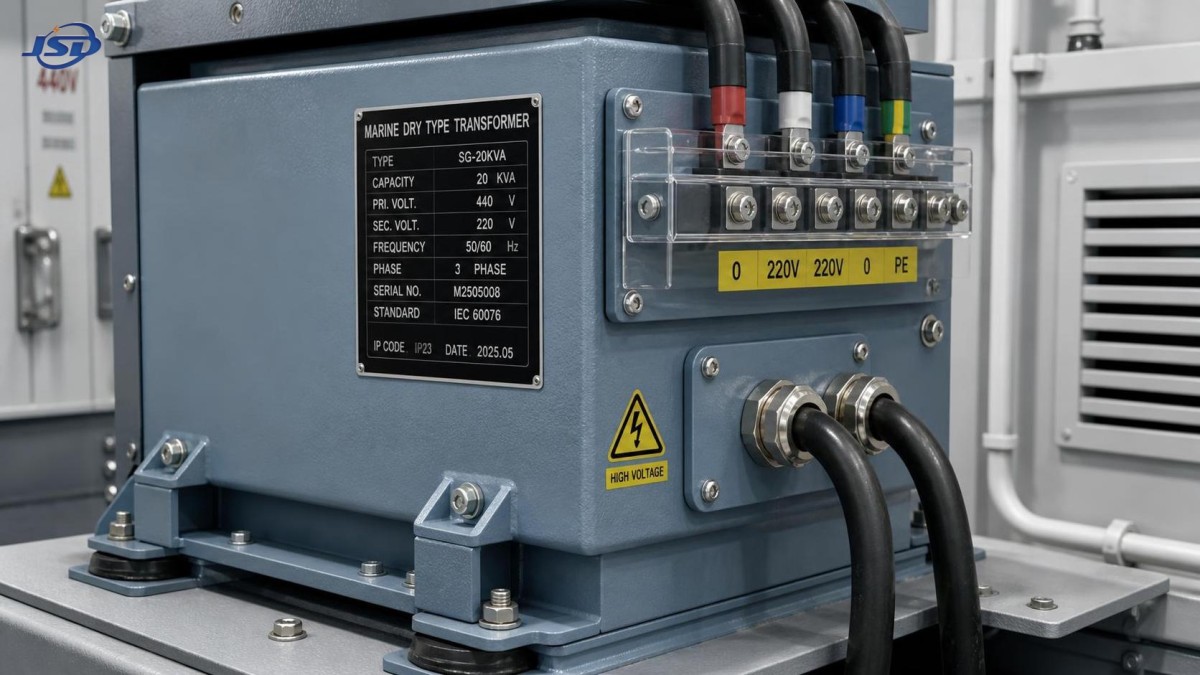
Factory testing can confirm electrical performance, but it does not automatically prove suitability for every marine vibration profile. Project managers should ask what design measures are used to improve mechanical durability and which requirements are verified through the supplier’s quality system, project documentation, or applicable marine approvals where required. If the answer stays at a very general level, that is a sign to go deeper.
Salt mist is not just a surface issue
Salt mist gets underestimated because people tend to think of it as external corrosion only. In reality, marine humidity and salt contamination affect surfaces, connections, coatings, insulation performance, and long-term reliability all at once. Once corrosion begins around terminals, fasteners, or enclosure joints, the damage can spread quietly. By the time it becomes visible during inspection, resistance heating or insulation tracking may already be part of the problem.
Material selection matters here. Enclosure finish, anti-corrosion coating system, hardware material, gasket quality, and protection of exposed conductive parts all influence service life. So does the enclosure design itself. If moisture traps form in corners or around cable entries, a decent coating system can still struggle. This is one reason why “marine grade” should not be accepted as a vague label. It is more useful to ask how the enclosure is protected, how condensation is managed, and how vulnerable points are treated over time.
For transformers installed near open decks, coastal terminals, or offshore process areas, salt mist resistance often becomes a maintenance issue as much as a design issue. If the unit requires frequent cleaning or recoating in order to remain reliable, the lifecycle cost rises quickly. In those settings, a slightly higher upfront equipment standard may save far more than it costs.
Cooling, insulation, and enclosure choices should be discussed together
A marine transformer is often selected by electrical rating first and enclosure type second. In practice, those decisions are linked. If a unit is enclosed tightly for environmental protection, heat dissipation changes. If the room is hot or airflow is limited, insulation temperature margin becomes more important. If maintenance access is poor, service-friendly terminal layout and monitoring options become more valuable.
This is especially relevant where isolation or rectification functions are part of the onboard power architecture. In some systems, a specialized solution such as an Isolation and Rectifier Special Transformer may be considered when the electrical interface and installation constraints justify it. The point is not that one configuration is universally better, but that the transformer type should match the actual operating duty, harmonic conditions, space envelope, and maintenance philosophy of the vessel or platform.
Dry-type designs are often preferred in many marine applications for safety and maintenance reasons, but even then, details matter. Ventilation path, insulation system robustness, ingress protection, and temperature monitoring should be reviewed as part of the application, not added later as accessories without context.
What project managers should verify before freezing the specification
A few checks can prevent most of the painful surprises:
- Confirm transport path and installation path, not just equipment room dimensions.
- Review mounting method and structural support with mechanical stakeholders before fabrication.
- Ask how vibration resistance is achieved in the coil, core, terminals, and enclosure.
- Check anti-corrosion measures at the level of coating, hardware, joints, and cable entry points.
- Evaluate ventilation and thermal conditions based on the real compartment, not ideal ambient assumptions.
- Clarify documentation needs tied to class, project specifications, or owner requirements.
None of these are exotic engineering points. They are ordinary issues that become expensive only when they are left unresolved until procurement or site installation.
A note on standards and approvals
Marine projects often involve class society requirements, owner technical specifications, and national or port-related rules. The exact combination depends on whether the transformer is for a vessel, offshore platform, shore power interface, or a hybrid marine-industrial environment. Because those frameworks vary, it is wise not to assume that a transformer acceptable for one project will automatically satisfy another. Approval scope, test expectations, and documentation depth should be confirmed against the actual contract documents.
That is where disciplined manufacturers tend to stand out. A company with established R&D capability, controlled production processes, and a rigorous quality management approach can usually respond more effectively when project requirements move beyond standard catalog conditions. For marine work, that flexibility is often more valuable than a long list of generic claims.
The best marine transformer choice is usually the one that reduces compromise
There is no single “best” marine transformer in the abstract. The right one is the unit that survives the actual environment without forcing awkward installation, unstable operation, or excessive maintenance. Space, vibration, and salt mist are not separate checklist items; they interact. Tight space affects cooling. Vibration affects connections and supports. Salt mist punishes every weak surface treatment and every poorly protected interface.
If you are comparing options, the most useful question is not only whether the transformer meets the electrical specification, but whether the design has been thought through for the marine context you are building in. That is usually where long-term reliability starts. And if the answer still depends on too many assumptions, the specification probably is not finished yet.

Get a Quote
Regardless of whether you require general advice or specific support, we are happy to help you.
Send Us Your Inquiry Today

Jinshida Electric remains committed to contributing to global energy development through professional manufacturing and superior service.