





Low Voltage Transformer Problems: Common Causes of Overheating and Early Failure
It usually starts with a complaint that sounds simple: the cabinet feels hotter than usual, the transformer hum seems harsher, or protective devices trip without an obvious short circuit. In maintenance work, these signs are easy to dismiss when the equipment is still running. But a low voltage transformer that keeps operating above its normal thermal range rarely “recovers on its own.” Heat builds slowly, insulation ages faster than expected, terminals loosen further, and what looked like a small service issue turns into repeat shutdowns and replacement pressure.
Many people dealing with field maintenance run into the same frustration. A transformer is replaced, tightened, or cleaned, yet the overheating comes back. That usually means the first fix addressed the symptom, not the cause. If you are troubleshooting a low voltage transformer with recurring temperature rise or unexpectedly short service life, the best approach is not to guess based on surface symptoms. It is to work backward from load condition, installation environment, electrical connection quality, and internal condition until the pattern makes sense.
The difficult part is that overheating does not come from one single fault. In real applications, several small issues often overlap: a slightly overloaded feeder, poor airflow inside an enclosure, harmonic-rich loads, dust buildup, and a connection point that is no longer making full contact. None of these always creates an immediate failure, but together they push the transformer into a condition where early aging becomes almost unavoidable.
When the temperature problem is not really “just temperature”
A common mistake in service work is treating heat as an isolated event. Someone checks the external thermometer, sees a hot spot, and focuses only on cooling. But overheating is often the visible result of electrical stress, mechanical looseness, or installation mismatch. If the transformer surface is hotter than expected, it helps to ask a more useful question: what is making losses increase at this moment, in this location, under this load pattern?
In low-voltage distribution systems, excess heat usually shows up in one of four ways. First, the entire unit runs warm because the actual demand is too close to or beyond the transformer’s intended operating range. Second, one area becomes noticeably hotter because of a local resistance point, often at terminals or bus connections. Third, heat rises during certain working hours because the load profile is uneven rather than constant. Fourth, the transformer temperature looks acceptable at first, but internal insulation still ages early because harmonic content and repeated cycling are increasing internal stress.
These differences matter. A global temperature rise suggests loading, ambient conditions, or design selection. A single hot spot points more strongly to connection quality or a local winding issue. Temperature swings tied to operating shifts often suggest process-related load behavior. If you do not separate these patterns, it is easy to spend time on the wrong repair action.
Overload is obvious, but partial overload is easier to miss
Most technicians know that overload causes heating. The more difficult problem is partial overload that does not look dramatic on a quick inspection. A transformer may appear acceptable when checked during an ordinary period, while in actual use it experiences repeated peak demand, unbalanced loading across phases, or extended periods near the upper limit. These conditions can produce cumulative thermal stress without causing immediate protective trips.
One practical habit is to stop relying on a single moment of measurement. If a low voltage transformer overheats mainly in real working conditions, then load should be reviewed across time, not only during a calm service window. Look at whether one phase consistently carries more than the others, whether motor starts occur in clusters, whether seasonal equipment has recently been added, or whether the supply arrangement changed after other modifications in the panel.
Unbalanced phase loading deserves special attention. Even when total load seems acceptable, imbalance can create localized heating and uneven magnetic stress. This becomes more likely in facilities where circuits have been extended gradually over time. After multiple maintenance cycles or production adjustments, the original distribution may no longer reflect the actual load arrangement.
Connections fail quietly before they fail badly
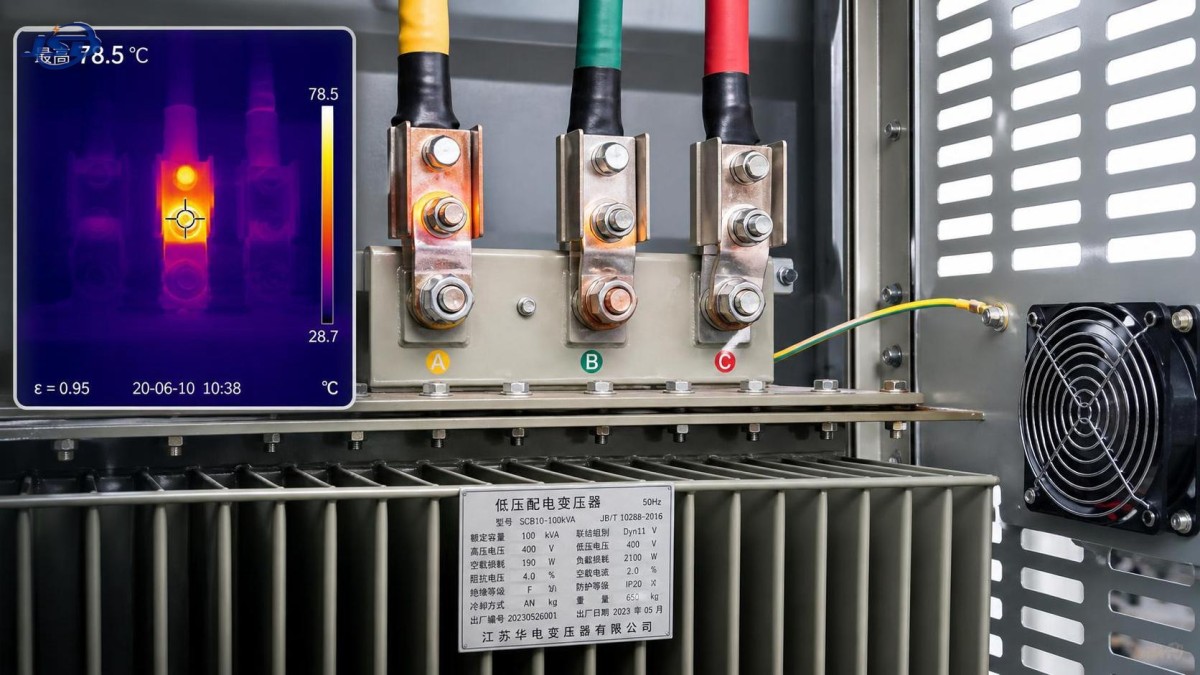
Loose or contaminated connections are among the most common reasons for persistent overheating. A terminal does not have to be completely loose to generate trouble. Slightly reduced contact pressure, oxide buildup, vibration, or improper torque can increase resistance enough to create a hot spot under load. Because the transformer still operates, the problem may remain hidden until insulation nearby hardens, darkens, or cracks.
When checking connections, visual inspection is not enough. A terminal can look acceptable and still overheat. Signs worth comparing include discoloration, insulation brittleness near one lug, asymmetrical temperature between similar terminals, and odor after sustained operation. If thermal imaging is available, it is especially useful here because it reveals whether the heat is concentrated at the joint, spreads into the conductor, or is coming from deeper inside the unit.
Another issue is rework quality after previous maintenance. Connections that have been disturbed several times can be more vulnerable if surfaces were not properly cleaned, hardware was reused carelessly, or tightening sequence was inconsistent. Repeated heating and cooling cycles may also relax connection pressure over time, especially in environments with vibration.
Ventilation problems often hide in the installation layout
Not every overheating problem is electrical. Some come from the way the transformer is installed. A unit placed in a cramped compartment, near another heat source, or in a space with blocked airflow can run hotter even with a normal load. This is easy to overlook in retrofitted rooms and compact distribution areas where extra equipment has been added after the original design.
Dust and oil residue make the problem worse. They do not always cause an immediate fault, but they reduce heat dissipation and can trap heat around surfaces and connection points. In industrial sites, airborne contaminants are often part of daily reality, so a transformer that was thermally acceptable when clean may become marginal after months of operation.
Maintenance teams sometimes focus on the transformer alone and ignore what changed around it. A newly installed cable tray, partition panel, or stacked material nearby can interfere with cooling. Even a door that is routinely kept closed now, though it was once open during operation, can change the temperature pattern inside the room or enclosure.
Power quality issues shorten life even when load current seems reasonable
If current readings do not look extreme but the transformer still runs hot, pay attention to the type of load. Non-linear loads can introduce harmonics that increase losses and heating. This is particularly relevant where variable speed drives, electronic power supplies, charging equipment, or similar systems are part of the network. The transformer may not appear overloaded in the ordinary sense, yet internal stress becomes higher than expected.
Harmonics can also confuse troubleshooting because the symptoms imitate other problems. You may see temperature rise, nuisance tripping, noise changes, or accelerated insulation wear without a simple overload explanation. In these cases, looking only at RMS current is often not enough. It helps to review the connected load composition and, where possible, assess waveform quality rather than assuming all current has the same thermal effect.
Frequent voltage fluctuation can add another layer of stress. Repeated electrical variation, especially when combined with cycling loads, contributes to thermal fatigue. Over time, that means shorter insulation life, weaker dielectric performance, and a higher chance that a transformer begins failing “early” even though no single dramatic fault was ever recorded.
Insulation aging is usually the endpoint, not the starting point
When a transformer fails early, people often say the insulation “went bad,” but insulation rarely deteriorates without reason. It is more accurate to treat insulation damage as the result of earlier conditions: excessive heat, moisture intrusion, contamination, poor ventilation, overloading, or prolonged operation with unresolved hot spots. If the root cause remains, replacing the transformer alone may simply reset the same failure cycle.
This is one reason maintenance records matter. If there have been repeated episodes of unexplained warming, smell, darkened terminal areas, or load expansion without capacity review, these details should be treated as connected rather than separate incidents. In practice, early failure usually leaves small warnings before it becomes a serious outage.
A more reliable troubleshooting path in the field
Instead of jumping directly to replacement, start by separating the problem into external and internal possibilities. External causes include load mismatch, phase imbalance, poor connections, ventilation restrictions, contamination, and ambient heat. Internal causes include winding problems, insulation deterioration, core-related abnormal loss, or damage that no longer shows clearly from outside.
A practical sequence often works better than a broad inspection done all at once. First, compare actual operating load over time and by phase. Second, inspect all accessible connection points for signs of resistive heating. Third, review room and enclosure cooling conditions as they exist during normal operation, not only during maintenance access. Fourth, consider whether the connected load type has changed. Only after these are reviewed does it make sense to move more seriously toward internal fault evaluation.
If replacement or system adjustment becomes necessary, the selection step should be tied to the real operating environment rather than the nameplate alone. In some distribution settings, equipment such as the 10kV/0.4kV Oil-Immersed Power Distribution Transformer may be considered as part of the broader solution path where cooling method, application environment, and load behavior need to be matched more carefully. The useful lesson is not to treat model change as a shortcut, but to make sure the chosen transformer type fits the actual duty conditions.
Signs that point toward replacement instead of another temporary fix
There is a point where repeated tightening, cleaning, and monitoring no longer count as effective maintenance. If overheating returns after proper connection correction, if insulation surfaces show progressive deterioration, if odor or noise changes continue without an external explanation, or if the transformer no longer matches the present load structure, then continuing with temporary corrective work may only increase downtime risk.
This does not mean every warm transformer should be replaced. It means the decision should depend on whether the root cause is removable and whether the existing unit still suits the system it serves. A transformer originally installed for one operating pattern may struggle after years of distribution changes, load additions, and altered site conditions. In that case, maintenance becomes a series of compromises unless the underlying mismatch is addressed.
Reducing repeat faults after the immediate repair
Once the overheating cause is found, preventing recurrence usually comes down to discipline in small things. Recheck torque after appropriate service intervals if the installation is subject to vibration or thermal cycling. Keep ventilation paths clear and avoid letting nearby additions block heat dissipation. Review phase distribution when new circuits are added instead of attaching them wherever space is available. Where non-linear loads are expanding, include power quality review in maintenance planning rather than waiting for unexplained temperature complaints.
It also helps to stop treating transformer temperature as a single maintenance item. Temperature should be read in context with load pattern, environment, and connection condition. That habit makes it much easier to notice whether the problem is changing shape. A low voltage transformer that runs warm only during afternoon peaks is telling a different story from one with a single terminal hot spot or one that gradually gets hotter month by month.
For teams handling after-service support, the most useful mindset is simple: overheating is usually evidence, not the whole problem. If you trace that evidence carefully, many early failures become easier to understand and less likely to repeat. And when replacement is the right step, whether with the same type or with equipment better suited to the application, such as a 10kV/0.4kV Oil-Immersed Power Distribution Transformer, the decision is more grounded and less reactive.

Get a Quote
Regardless of whether you require general advice or specific support, we are happy to help you.
Send Us Your Inquiry Today

Jinshida Electric remains committed to contributing to global energy development through professional manufacturing and superior service.