





Potential Transformer PT Standards: What to Check for Metering and Protection Accuracy
When a team starts checking a potential transformer PT for metering or protection duty, the real question is rarely “what is a PT?” It is usually more practical: will this unit keep measurement and relay logic dependable under the actual burden, fault level, and installation conditions on site? For quality control and safety management teams, that question sits at the center of compliance, billing integrity, and protection dependability. A PT that looks acceptable on a datasheet can still create operational exposure if its accuracy class, thermal limits, insulation coordination, or test evidence do not match the application.
The standards around PTs matter because metering and protection do not fail in the same way. A metering circuit needs stable ratio and phase accuracy within a defined operating window. A protection circuit needs behavior that remains predictable when the system is stressed, including abnormal voltages, transient conditions, or relay-driven burden changes. That is why a basic nameplate review is not enough. The useful check is whether the declared standard, class, burden, and test routine actually correspond to the intended use, not just whether the supplier says the unit is “compliant.”
Start with the application, not the certificate
One of the most common mistakes in procurement and incoming inspection is treating standards as a box-ticking exercise. In practice, the first decision is whether the PT is being used mainly for revenue or internal metering, for protective relaying, or for both. That determines what accuracy characteristics matter most and what evidence should be requested from the manufacturer.
For metering service, attention usually goes to ratio error and phase displacement under defined burden and voltage conditions. For protection service, the concern shifts toward whether the secondary output remains suitable for relay performance across the expected operating range. A PT selected for mixed duty must be checked more carefully, because “dual-purpose” claims often sound simpler than the actual constraints. In some projects, separating metering and protection cores or windings is the cleaner engineering decision, especially where billing, relay sensitivity, and disturbance recording all carry different consequences.
Which standards are usually relevant
Depending on project geography and utility or industrial specifications, PT requirements are commonly referenced against IEC or IEEE/ANSI frameworks. Exact applicability should always be verified against the project documents, but the core point is straightforward: the standard named on the drawing or tender must align with the class designation and test report being offered. Cross-referencing standards loosely can create confusion because class naming, test methods, and interpretation are not always interchangeable.
In many international projects, IEC current editions for instrument transformers are the first place buyers and inspectors look, especially for accuracy classes, dielectric tests, temperature rise, and routine/type test definitions. In North American or ANSI-based specifications, the naming and acceptance language may differ. A supplier saying a PT “meets international standard” is not enough. QC teams should ask which standard, which edition【待核实 if not stated in documents】, and which clauses are being claimed for accuracy and insulation performance.
The practical lesson is simple: do not compare one manufacturer’s IEC metering class directly with another manufacturer’s IEEE protection claim as if they were the same statement. If the project basis is mixed, request a side-by-side technical compliance matrix rather than relying on marketing literature.
Accuracy class is only meaningful with burden and operating condition
Accuracy class is often the first item people check, and it should be. But it is also one of the most misunderstood. A PT accuracy class does not float freely; it is tied to specific conditions such as rated voltage, frequency, burden, and power factor. A unit that achieves the declared class at one burden may not behave the same way when connected to long secondary wiring, multiple meters, transducers, or relay inputs.
For metering applications, the ratio and phase angle error should be verified against the actual connected burden, not only the nominal burden on paper. In retrofit projects, this matters even more. Secondary circuits tend to accumulate extra devices over time, and each addition can move the PT away from the point where the guaranteed accuracy was established.
For protection applications, quality and safety teams should not stop at the class label. They should ask whether the PT’s voltage factor, thermal capability, and transient performance remain suitable for the relay scheme. A protection relay that depends on clean and predictable secondary voltage during system disturbance is only as reliable as the PT behavior feeding it.
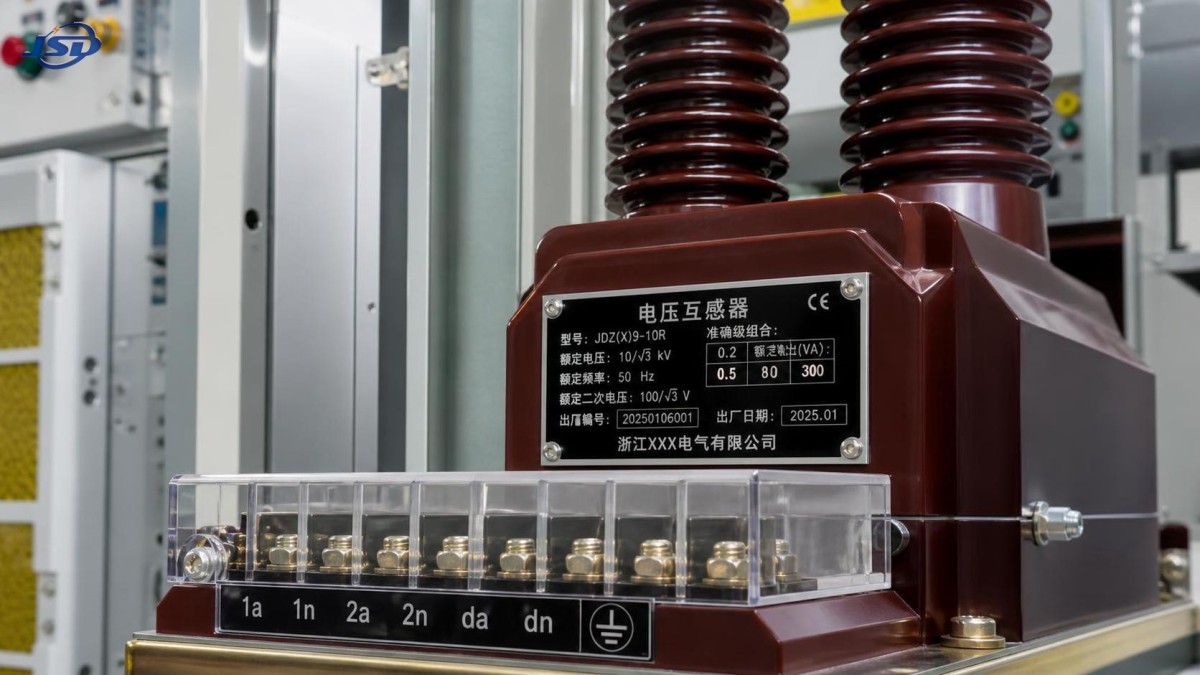
What to verify on the nameplate and in the test file
The nameplate gives the first technical filter, but the test documents decide whether the unit deserves confidence. The following items are usually worth checking before release, receipt, or installation:
- Rated primary and secondary voltage, including any tapped secondary arrangement
- Frequency and system earthing assumptions where relevant
- Accuracy class for each winding and intended duty
- Rated burden and associated power factor
- Voltage factor and permissible duration
- Insulation level, power-frequency withstand, and impulse withstand values
- Thermal limits and temperature rise data
- Terminal marking, polarity, wiring diagram, and grounding instructions
- Routine test reports, and where required, type or special test evidence
That list sounds routine, but the risk sits in the details. For example, a meter-grade winding may satisfy its class at a low burden, while the installed burden is materially higher once cable length and panel devices are included. Or the secondary voltage may be correct at factory ambient conditions, while the project environment introduces temperature effects that narrow the practical margin. Safety managers should also pay close attention to dielectric test records and insulation coordination where switchgear fault exposure or harsh environmental conditions are part of the operating profile.
Metering accuracy: where errors actually enter the system
In metering service, PT errors rarely come from one dramatic defect. More often they accumulate from small mismatches: wrong burden assumptions, secondary lead resistance, terminal loosening, undocumented tap changes, and poor coordination with meters designed around tighter uncertainty expectations. If the PT sits in a billing-relevant chain, these small deviations can become a dispute risk rather than a purely technical issue.
That is why incoming inspection should go beyond checking whether the report says the unit passed. It should confirm that the tested burden and power factor reflect the real installation. If the PT is intended for high-value metering, some operators also review whether the complete measurement chain has been considered, not just the transformer in isolation. A highly accurate PT can still sit in an inaccurate system if downstream assumptions are weak.
There is a useful analogy here from adjacent power equipment: teams evaluating distributed energy packages often look beyond the cell specification and review the full system behavior, which is one reason integrated products such as 51.2V Stackable LiFePO4 Energy Storage Battery solutions are typically assessed on system-level coordination rather than component claims alone. PT selection deserves the same discipline. The class marking matters, but the installed measurement chain matters more.
Protection accuracy: the overlooked source of relay misoperation risk
Protection engineers usually know that current transformers can distort relay performance, but voltage transformers deserve equal scrutiny. A PT feeding protective relays has to provide a secondary signal that stays within expected performance limits during the conditions that matter to the scheme. If the relay logic depends on undervoltage, overvoltage, directional, synchronizing, frequency, or distance-related functions, poor PT behavior can create missed trips, false alarms, or unnecessary shutdowns.
Several checks are especially important here. First, confirm the protection class is explicitly stated for the winding used by the relay, not inferred from a metering class. Second, confirm the voltage factor is suitable for the network and fault-clearing assumptions. Third, review whether the burden used in design reflects all relay and auxiliary device inputs connected in practice. And fourth, where the project is sensitive, ask whether transient performance or ferroresonance risk has been evaluated. Not every application needs a deep transient study, but medium-voltage and high-voltage installations with certain grounding arrangements can justify more caution.
Insulation and safety compliance are not secondary issues
For safety management teams, accuracy often gets more attention than insulation integrity, but a PT that measures well and fails insulation coordination is still a project risk. Dielectric strength, partial discharge limits where specified, creepage distance, enclosure suitability, and short-circuit withstand expectations all belong in the review. These are not only design-office concerns. They affect site safety, maintenance intervals, outage risk, and incident investigation exposure.
Environmental conditions also matter more than many specifications admit. Indoor switchgear panels, coastal installations, chemically aggressive plants, renewable substations with temperature cycling, and infrastructure projects in dusty regions place different stresses on insulation systems and terminal integrity. If the project documents are generic, QC personnel should be careful not to assume the standard base configuration is enough.
Questions worth asking the supplier before approval
A strong supplier discussion is usually more revealing than an extra brochure. The right questions tend to be practical:
- What exact standard and edition is the PT built and tested to?
- Which winding is intended for metering and which for protection?
- At what burden and power factor was the declared accuracy confirmed?
- What is the allowable continuous overvoltage or voltage factor?
- Are routine test reports supplied for each unit or by batch?
- Which type tests are available, and how recent are they?
- What environmental or installation limits should the buyer know about?
- Has the design been used in similar network conditions before?
The purpose of these questions is not administrative pressure. It is to expose whether the supplier understands the application well enough to support it. In most cases, a technically credible manufacturer can answer clearly and consistently. Where answers stay vague, the risk is usually not limited to documentation quality.
Common assumptions that do not always hold up
There are a few industry habits that deserve more skepticism.
First, “higher accuracy class” does not automatically mean “better for every case.” If the burden, thermal behavior, and relay suitability are mismatched, the class label alone does not solve the problem.
Second, passing routine tests does not replace application review. Routine tests confirm manufacturing conformity within a defined scope; they do not prove the PT is correctly selected for the user’s exact system.
Third, not every project benefits from minimizing upfront cost on instrument transformers. PTs often represent a small share of total project value but can have outsized impact on metering disputes, relay dependability, and outage investigations.
Fourth, standard compliance statements should not be treated as globally portable. The same project may involve grid code requirements, utility-approved vendor lists, switchgear integration rules, or certification preferences that go beyond the transformer’s base manufacturing standard.
How QC and safety teams can turn standards into a workable review process
The most effective approach is usually a short verification workflow tied to project risk. Start by classifying the PT by duty: metering, protection, or combined use. Then match the required standard basis from the tender or utility specification. Review the burden calculation using actual field wiring assumptions. Check that the nameplate, drawing, and test report are internally consistent. Finally, hold any unit with unclear winding assignment, incomplete dielectric evidence, or ambiguous accuracy declaration before installation.
That process is more valuable than collecting a large stack of certificates. It helps teams decide whether a potential transformer PT is fit for the real operating context, which is the point of standard review in the first place. In adjacent power projects, from switchgear packages to battery-backed distribution systems using products such as 51.2V Stackable LiFePO4 Energy Storage Battery, buyers increasingly judge equipment by how well the documented performance survives actual integration. Instrument transformers should be reviewed with the same level of discipline.
For most sites, the right question is not whether the PT has a standards label. It is whether the declared accuracy, insulation performance, and test evidence are credible for the burden, protection logic, and operating environment that the system will actually see. That is the check that prevents paperwork compliance from turning into field risk.

Get a Quote
Regardless of whether you require general advice or specific support, we are happy to help you.
Send Us Your Inquiry Today

Jinshida Electric remains committed to contributing to global energy development through professional manufacturing and superior service.