





How should operators handle a dry type power transformer overload?
How Should Operators Handle a Dry Type Power Transformer Overload?
When a dry type power transformer approaches or exceeds its rated load, operators must respond quickly to protect equipment reliability, electrical safety, and service continuity. Understanding the causes of overload, monitoring temperature and load conditions, and following a structured response plan can prevent insulation damage and unplanned downtime. The immediate objective is not simply to bring the current below a nameplate figure. It is to determine whether the condition is temporary and controlled, or whether heat, ventilation, load quality, or an equipment fault is pushing the transformer beyond a safe operating condition.
A dry type transformer has no insulating oil to absorb and transfer heat. Its winding insulation, core, terminals, enclosure, cooling paths, and surrounding air therefore deserve close attention during abnormal loading. A brief demand peak may be manageable under conditions defined by the manufacturer, but repeated or prolonged overload can accelerate insulation ageing, loosen connections through thermal cycling, and eventually create failures that are far more disruptive than a planned load reduction.
Start by Confirming What “Overload” Actually Means
An alarm indicating high current is important, but it is not enough on its own to judge transformer risk. Operators should compare the measured phase currents with the transformer’s rated current, then check whether the loading is balanced across all three phases. One phase can be overloaded while the total apparent load appears acceptable. This commonly occurs where single-phase loads have grown gradually, where distribution circuits were changed without rebalancing, or where a large downstream load has an uneven operating profile.
The next question is duration. A short surge from motor starting, crane movement, welding equipment, or a process sequence is not the same as a sustained overload during a production shift. Review trend data rather than relying on a single reading. If the transformer remains above its normal loading range for long periods, operators should treat it as a capacity, cooling, or power-quality issue requiring corrective action.
Temperature is the other essential part of the picture. Most dry type units use winding temperature sensors, often connected to a controller that provides fan control, alarm, and trip functions. Check the actual winding temperature, the alarm and trip status, ambient temperature, and whether cooling fans are running as intended. Do not reset an alarm merely because the load has briefly fallen. Find out whether the transformer cooled normally and whether the cause is understood.
Conditions that can make a normal load unsafe
A transformer may run hotter than expected even without a large increase in kVA demand. High ambient temperature, blocked air inlets, dust accumulation on windings, failed fans, inadequate clearance around the enclosure, and hot air recirculation can all reduce cooling effectiveness. In indoor electrical rooms, an air-conditioning failure or a closed ventilation louver can change the thermal environment quickly.
Harmonic currents also matter. Variable-speed drives, rectifiers, UPS systems, arc equipment, and other non-linear loads may increase heating in windings and associated conductors. A conventional current reading does not always show the full thermal effect. If a high temperature condition persists while measured load seems modest, power-quality measurements and a review of the transformer’s harmonic capability are sensible next steps.
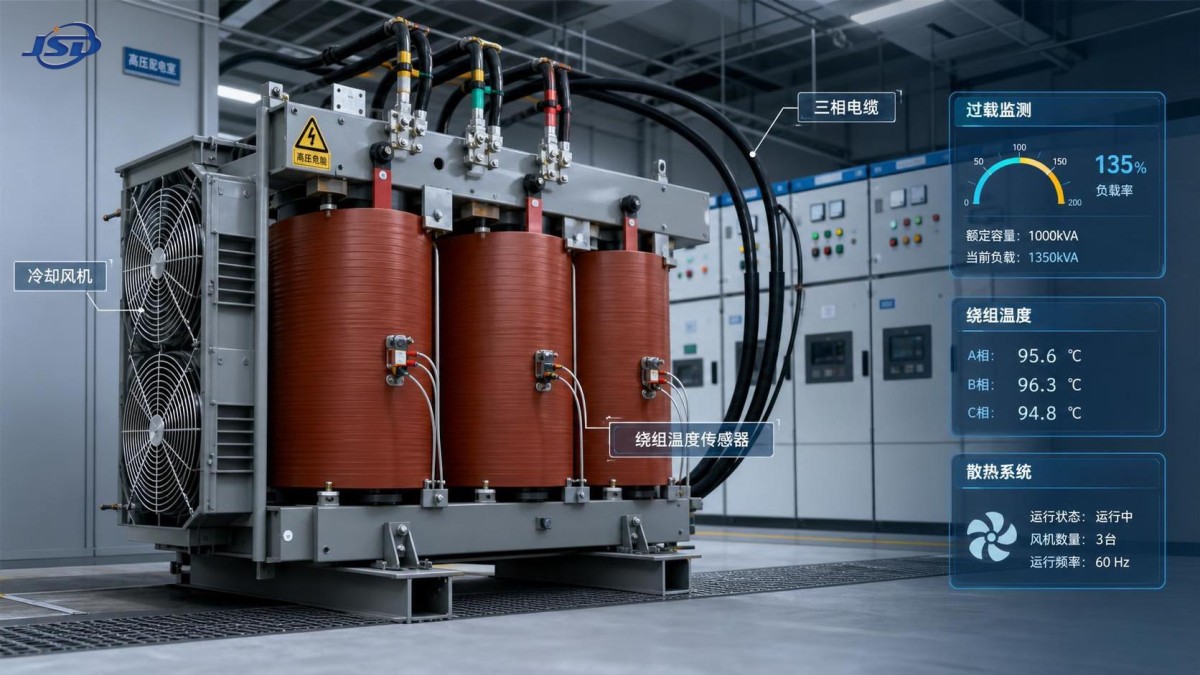
Immediate Actions During an Overload Event
The response should be deliberate. An abrupt shutdown can create its own safety and process risks, especially in industrial facilities, hospitals, data-sensitive operations, or critical infrastructure. However, continuing to operate a transformer with a rising temperature alarm is not a reasonable alternative. The site’s approved operating procedure, protection coordination plan, and manufacturer documentation should govern the final decision.
A practical response sequence is usually as follows:
- Verify the reading through the switchboard meter, transformer monitoring system, and, where safe and permitted, independent measurements.
- Check phase currents, voltage condition, winding temperatures, fan status, alarm history, and room or enclosure ventilation.
- Identify non-essential or deferrable loads that can be shed without creating a secondary hazard.
- Transfer load to a parallel transformer or alternate source only if the switching arrangement and protection settings have been reviewed for that condition.
- Escalate promptly if temperature continues to rise, a fan system does not operate, unusual smell or noise is present, or protective devices have operated.
If there are signs of insulation distress, discoloration, smoke, arcing, damaged cable terminations, or an unexplained trip, isolate the equipment according to site safety rules and do not return it to service based on visual appearance alone. Qualified personnel should inspect the transformer, connections, protective devices, and upstream and downstream circuits before re-energization.
Do Not Assume the Transformer Is the Root Cause
A dry type power transformer overload often starts elsewhere in the electrical system. New machinery may have been added without revisiting the load study. A capacitor bank may be unavailable, increasing current demand for the same useful power. A motor may be operating under abnormal mechanical load. A faulty contactor or control sequence can cause several large loads to start together. In some facilities, temporary power arrangements gradually become permanent, leaving the transformer serving circuits that were never included in the original design basis.
Operators should review recent changes before assuming that the equipment has degraded. Ask what changed in the hours or weeks before the alarm: production schedules, new loads, seasonal ambient conditions, ventilation work, network switching, generator operation, or maintenance bypass arrangements. This type of review is often more useful than repeatedly resetting protective indications.
Look closely at phase imbalance and connections
Phase imbalance deserves special attention because it can overheat one winding or one set of terminations while the overall transformer load appears ordinary. Measure each phase consistently and compare readings over time. If one phase is persistently higher, redistribute single-phase circuits where the installation permits. Loose or deteriorated terminations may also generate localized heat. Thermal inspection can be useful when performed under appropriate load conditions by trained personnel, but it should support—not replace—electrical testing and physical inspection.
The same principle applies to busbars and cable interfaces. A transformer can be correctly sized while its downstream connection system is not. Signs of overheating at joints, insulation sleeves, cable lugs, or panel busbars call for a broader examination of the distribution path.
Cooling, Location, and Enclosure Are Part of the Rating
Transformer ratings are tied to defined operating conditions. Installing a unit in a confined room, beside a heat-producing process, or inside an enclosure with insufficient airflow changes those conditions. For ventilated dry type designs, clear air paths are not optional housekeeping details. Dust filters, louvers, fan guards, and ventilation openings require routine inspection, particularly in cement plants, mining operations, ports, workshops, and other dusty or corrosive environments.
Where a transformer is integrated into a compact distribution arrangement, enclosure selection also influences long-term thermal behavior. For industrial parks, commercial buildings, renewable energy sites, or temporary power installations, a properly configured European-Type Compact Substation can combine high- and low-voltage distribution functions with metering and reactive power compensation in a protected enclosure. Capacity, ventilation design, installation location, and protection level still need to be matched to the actual site conditions rather than selected only by nominal transformer kVA.
Compact substations in the 100 kVA to 2500 kVA range may be configured for different transformer capacities and environmental demands. Material choices such as steel plate, stainless steel, composite panel, or cement board can be relevant in wet, dusty, coastal, or corrosive locations. The important operational point is straightforward: an enclosure that protects against weather but traps heat can create a new reliability problem. Thermal design and site ventilation should be reviewed together.
When Load Shedding Is Not Enough
Repeated overload events usually mean the facility has outgrown the existing arrangement or is operating it differently from the original plan. In that case, operators and engineering teams should move beyond emergency measures and assess the load profile. Useful records include peak demand by time period, load duration, phase currents, transformer temperature trends, harmonic measurements where relevant, ambient conditions, and the status of cooling equipment.
Several remedies may be appropriate, depending on the findings. Loads can be staggered to avoid simultaneous peaks. Circuits can be rebalanced. Reactive power compensation may reduce unnecessary current where poor power factor is part of the problem. Additional transformer capacity, a parallel unit, or separation of large non-linear loads may be justified. The correct answer is not always a larger transformer; oversizing without correcting heat, harmonics, poor connections, or improper protection coordination can leave the underlying issue unresolved.
Before changing capacity or operating transformers in parallel, confirm impedance compatibility, vector group requirements, tap settings, fault-level implications, cable ratings, switchgear capability, and protection coordination. These details should be evaluated by competent electrical engineers against the project’s applicable standards and local requirements.
Build a Better Operating Routine
The most useful overload strategy is prepared before an alarm occurs. Each installation should have a clear record of transformer rating, normal and maximum expected loads, alarm and trip settings, cooling method, fan maintenance requirements, emergency load-shedding priorities, and authorized switching steps. Operators should know which readings indicate a manageable peak and which require immediate escalation.
Routine checks should include cleanliness, airflow, temperature controller indications, fan operation, terminal condition, grounding continuity, and visible enclosure damage. Trend monitoring is especially valuable because a gradual rise in operating temperature at the same load may reveal a failing fan, blocked airflow, increasing harmonic content, or a connection issue before a trip occurs.
Jinshida Electric Power Technology Co., Ltd. approaches transmission and distribution equipment with this practical relationship between product design, manufacturing quality, and field application in mind. Reliable power support for industrial manufacturing, grid construction, renewable energy, and infrastructure depends not only on selecting suitable equipment, but also on giving operators clear operating information and maintaining the conditions assumed in the design.
A Controlled Response Protects More Than the Transformer
When a dry type power transformer overload occurs, reduce risk by verifying the condition, checking temperature and cooling, lowering or transferring load where safely possible, and investigating the cause rather than treating the alarm as an isolated event. Persistent overload should trigger a documented engineering review of demand, load quality, environment, and distribution equipment.
The best next step is to compare actual operating records with the transformer nameplate, manufacturer guidance, protection settings, and the installation’s original load assumptions. That comparison will show whether the event was a temporary operating disturbance or a clear signal that the power distribution system needs adjustment.

Get a Quote
Regardless of whether you require general advice or specific support, we are happy to help you.
Send Us Your Inquiry Today

Jinshida Electric remains committed to contributing to global energy development through professional manufacturing and superior service.