





Is a dry transformer safer than an oil-immersed unit indoors?
For an indoor substation, electrical rooms are rarely judged on purchase price alone. A facility owner is also weighing fire protection requirements, insurer expectations, outage consequences, space constraints, maintenance access, and the comfort of knowing that a fault will not turn into a wider building emergency. In that context, a dry transformer is generally safer than a conventional oil-immersed transformer indoors because it does not contain combustible mineral insulating oil.
That conclusion is useful, but incomplete. “Safer” is not a nameplate characteristic that automatically settles the selection. A properly specified oil-immersed unit, installed in a suitable dedicated transformer room with containment, ventilation, separation, and fire measures, can also operate reliably indoors. The decision should be based on the building’s risk profile and the full installation design—not simply on transformer type.
The short answer: why a dry transformer is usually preferred indoors
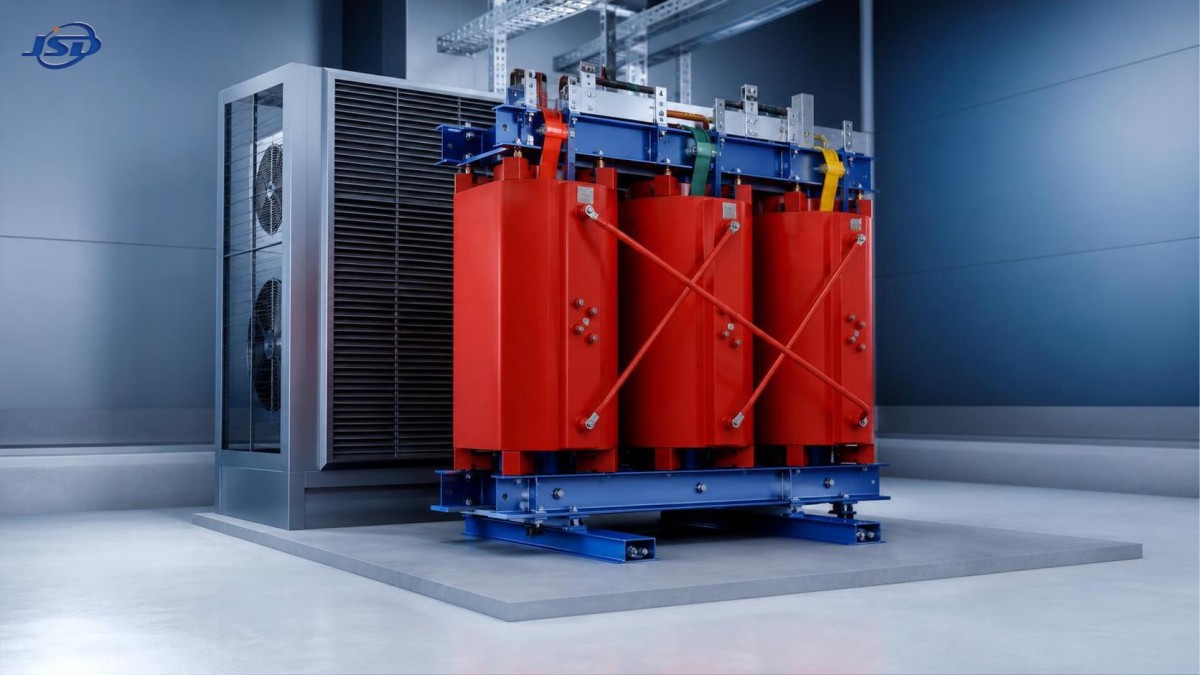
A dry-type transformer uses solid insulation systems and air, rather than liquid dielectric oil, to insulate and cool its windings. Since there is no oil-filled tank, there is no risk of an oil leak feeding a fire or spreading burning liquid across a transformer room. This is the central reason dry-type units are frequently selected for indoor distribution in office towers, hospitals, schools, shopping facilities, transport terminals, and mixed-use developments.
For decision-makers, that advantage can affect more than the equipment itself. It may reduce the complexity of oil containment arrangements, lower the concern around leakage near occupied areas, and make discussions with building designers, fire engineers, and insurers more straightforward. In many projects, a dry transformer also fits more naturally into an indoor electrical room close to the load center, helping shorten low-voltage cable runs.
Yet dry type does not mean risk-free. Transformers still carry high electrical energy, generate heat, and can fail under severe overload, insulation breakdown, poor connections, or inadequate ventilation. A dry transformer needs correctly sized protective devices, clear working space, accessible inspection routes, and a room designed to remove heat. Its fire profile is better in many indoor scenarios, but its safety still depends on disciplined engineering.
Fire risk is the biggest divider—but not the only one
Conventional oil-immersed transformers rely on insulating oil for dielectric strength and cooling. Mineral oil is combustible. If an internal fault creates an arc, the resulting heat and gases can create significant pressure inside the tank; in a worst-case event, oil and fire can become part of the hazard. Indoor applications therefore commonly require measures such as a fire-rated room, oil bund or containment pit, drainage controls, suitable clearances, detection systems, and sometimes fixed fire suppression, depending on local rules and the project risk assessment.
A dry transformer removes the liquid-fuel element from that equation. Cast-resin dry types, in particular, are often selected where fire behavior, low smoke, and environmental containment are sensitive issues. This makes them compelling for occupied buildings and locations where evacuation, continuity of service, or public confidence matters.
Still, it would be misleading to state that every oil-filled transformer is unsuitable indoors. Modern liquid-filled designs can use less-flammable dielectric fluids, including natural ester or vegetable-based fluids, which offer a much higher fire point than standard mineral oil. They can materially improve the fire-risk profile of a liquid-filled installation, although they do not eliminate the need for a carefully engineered indoor arrangement.
A practical comparison for indoor transformer selection
The table is a starting point, not a substitute for an electrical and fire-safety review. The same transformer may be an excellent choice in a factory utility building and a poor choice beneath a hospital ward. Context changes the answer.
Where dry-type transformers make the strongest business case
The case for a dry transformer is strongest when the transformer must sit inside or very near an occupied building and the consequences of a fire event are difficult to accept. Hospitals, data centers, high-rise commercial buildings, airports, rail stations, universities, cultural venues, and large retail facilities often fall into this category. These sites may have limited access for emergency response, valuable equipment nearby, or people who cannot be quickly evacuated.
Dry type is also attractive where environmental exposure from an oil spill would create a serious operational problem. A basement plant room, a room above sensitive production spaces, or an electrical area adjacent to water-sensitive infrastructure can all make the absence of oil feel less like a specification preference and more like a risk-management decision.
There is another practical point: indoor electrical rooms are often space-constrained. A dry transformer can simplify the surrounding civil works because an oil containment pit may not be required. That does not automatically mean the total footprint is smaller; ventilation pathways, required access clearances, acoustic treatment, and enclosure dimensions must still be assessed. But the building coordination burden can be lower.
When an oil-immersed unit may still be the better choice
Oil-immersed transformers remain widely used because they are efficient, durable, and capable of serving demanding distribution duties. In industrial plants, renewable-energy connections, utility substations, mines, petrochemical facilities, and large commercial campuses, a liquid-filled transformer may offer a better fit—particularly when it can be installed outdoors or in a purpose-built transformer chamber.
Efficiency deserves attention because transformer losses continue every hour the unit is energized. Over a long service life, a small difference in loss performance can have a meaningful operating-cost effect. Liquid-filled equipment can also provide robust thermal performance where loads are high, ambient conditions are challenging, or occasional overload capability is valuable.
For example, an 15kV/0.4kV Oil-Immersed Power Distribution Transformer can be configured with FR3 vegetable oil rather than conventional mineral oil for projects that need a more environmentally considerate liquid insulation option. The product range covers 30–5000 kVA applications, operates at 15 kV primary voltage with common 0.4 kV secondary options, and is designed for distribution duties across industry, commerce, renewable energy, and public facilities. Its stated efficiency can exceed 99%, while a copper-coil design can support short-duration overloads up to 150% of rated capacity for no more than two hours, subject to oil-temperature monitoring.
Those characteristics do not make it a default indoor replacement for dry type. They do illustrate why the comparison should not stop at “oil versus no oil.” A project may reasonably choose a less-flammable fluid-filled transformer in a compliant indoor room when capacity, efficiency, resilience, and layout economics point in that direction.
Do not overlook ventilation: the quiet failure point
Many indoor transformer decisions go wrong after the procurement stage, when the room is treated as an architectural leftover rather than part of the thermal design. Both transformer types release losses as heat. If that heat cannot leave the room, winding temperatures rise, insulation ages faster, and overload margin disappears.
Dry-type transformers are particularly dependent on clean, adequate airflow. Dust accumulation on windings and cooling channels can reduce heat dissipation. In humid, corrosive, or dusty industrial environments, enclosure selection and routine inspection become important. If the transformer room is air-conditioned, the HVAC system must be engineered for continuous equipment heat, not only for human comfort.
Oil-immersed units also need ventilation. Radiators must not be blocked, hot air must have an escape path, and the unit needs sufficient clearance for inspection and cooling. A stated minimum distance from walls is not merely an installation detail; it supports thermal performance and maintainability. Where a manufacturer calls for at least 1.5 meters from a wall, that requirement should be integrated into the room layout from the beginning, not negotiated away during construction.
Questions a procurement team should ask before choosing
- Who occupies the building, and what is below or beside the transformer room? Higher occupancy and difficult evacuation generally strengthen the case for dry type.
- What do local electrical, building, fire, and insurance requirements say? Applicable IEC, national, and municipal requirements can determine room construction, clearances, fire ratings, fluid containment, and detection systems.
- What is the actual load profile? Review base load, peak demand, future expansion, harmonics, starting currents, and expected overload periods rather than selecting solely on present kVA demand.
- Can the room reject heat reliably? Confirm natural or forced ventilation calculations, ambient design temperature, intake air cleanliness, and emergency operating conditions.
- What level of continuity is required? Hospitals, data centers, and critical manufacturing operations should consider redundancy, monitoring, maintenance windows, and fault isolation—not just transformer technology.
- What happens if a leak, fire, or failure occurs? A credible response plan should address containment, alarms, access for service personnel, shutdown logic, and restoration time.
The lifecycle-cost view is more useful than the purchase-price view
Dry-type transformers can have a higher initial equipment cost in some ratings, while oil-immersed transformers may require more site works and fire-protection infrastructure when used indoors. The only meaningful comparison is the installed, lifecycle cost: transformer losses, civil works, ventilation, fire measures, inspection needs, expected maintenance, downtime exposure, and replacement access all belong in the calculation.
Consider replacement logistics as well. A transformer in a basement electrical room may need to pass through doors, corridors, lifting routes, and structural openings that will not be available after the building is operational. The most economical transformer on a quotation can become expensive if major building work is needed to remove it ten years later.
For organizations managing multiple sites, standardization can bring value, but it should not become an automatic rule. A dry transformer standard may be sensible for office and public buildings, while high-capacity industrial or renewable-energy sites may justify oil-immersed equipment with the right fluid and protective design. Jinshida Electric Power Technology supports this kind of application-led approach through power transmission and distribution equipment designed around safe operation, energy efficiency, and long-term reliability.
Final decision: safer indoors, but only when the installation supports it
In most occupied indoor environments, a dry transformer is the safer default because it removes combustible insulating oil from the electrical room. That advantage is especially meaningful where people, critical operations, or environmentally sensitive spaces are nearby. It can simplify fire-risk management, though it never removes the need for ventilation, protection coordination, maintenance, and compliance review.
An oil-immersed transformer should not be dismissed simply because the installation is indoors. With a purpose-designed room, suitable clearances, containment, fire precautions, and potentially a high-fire-point natural ester fluid, it can be a sound and efficient solution. The best decision comes from matching transformer technology to building risk, load behavior, thermal conditions, and lifecycle priorities. For business leaders, that is the difference between buying a transformer and designing a dependable power asset.

Get a Quote
Regardless of whether you require general advice or specific support, we are happy to help you.
Send Us Your Inquiry Today

Jinshida Electric remains committed to contributing to global energy development through professional manufacturing and superior service.