





How can a dry type transformer’s noise be reduced on site?
Excessive dry type transformer noise is more than an annoyance. In a plant electrical room, a commercial building, or a utility substation close to occupied space, the steady hum can affect communication, operator comfort, and confidence in the equipment. A transformer is not silent by design, but a noticeable change in sound—or a sound that becomes objectionable only after installation—deserves a structured on-site check.
The practical point is this: not every noisy dry type transformer has a manufacturing defect. Many complaints are caused by the way sound and vibration travel through the floor, cable system, enclosure, walls, or ventilation openings. The most effective remedy depends on identifying whether the sound is normal core noise, load-related winding vibration, fan noise, structural resonance, or a warning sign of a developing fault.
Start by separating normal transformer hum from abnormal noise
A dry type transformer normally produces a low-frequency hum even when it carries little or no load. This is largely associated with magnetostriction in the core steel: the core laminations change dimension slightly as magnetic flux alternates. In systems operating at 50 Hz, the sound commonly has a strong component around twice the supply frequency; in 60 Hz systems, the corresponding component is higher. This basic hum is usually steady and predictable.
Operators should pay more attention when the sound changes character. A loose metallic rattle, intermittent buzzing, crackling, sharp clicking, or a sudden rise in volume is different from ordinary core hum. So is a sound that becomes much stronger only when large nonlinear loads, variable-frequency drives, rectifiers, or welding equipment are in operation. Those conditions may point to harmonics, loose parts, overloaded cooling fans, cable vibration, or electrical discharge. Do not attempt to diagnose the transformer by sound alone, but do treat an unfamiliar sound as a reason to inspect rather than simply add insulation around the room.
Before modifying anything, record when the noise occurs. Note the transformer load, fan operating status, ambient temperature, nearby equipment running at the time, and whether the sound is transmitted through the structure or heard directly at the transformer. A short sound recording from the same distance on different days can also help maintenance teams compare conditions without relying on memory.
Find the transmission path, not just the sound source
One of the most common on-site mistakes is assuming that a loud room means a loud transformer. In reality, a unit can produce acceptable airborne sound while the building amplifies its vibration. Concrete slabs, steel channels, cable trays, hollow wall cavities, raised floors, and poorly secured ventilation ducts can all act as sound bridges. The hum then appears in an office, corridor, or control room some distance away from the transformer itself.
A useful first test is to listen at several points: directly beside the enclosure, on the floor near the base, at the adjacent wall, near the cable entry, and in the occupied area where the complaint is strongest. If the floor or wall is visibly transmitting vibration, the priority is structural isolation. If the noise is strongest at the ventilation grille, airflow and acoustic path design may be the issue. If it is concentrated at a cable tray or busbar support, tightening or redesigning that support can make a surprisingly large difference.
Check the foundation and mounting arrangement
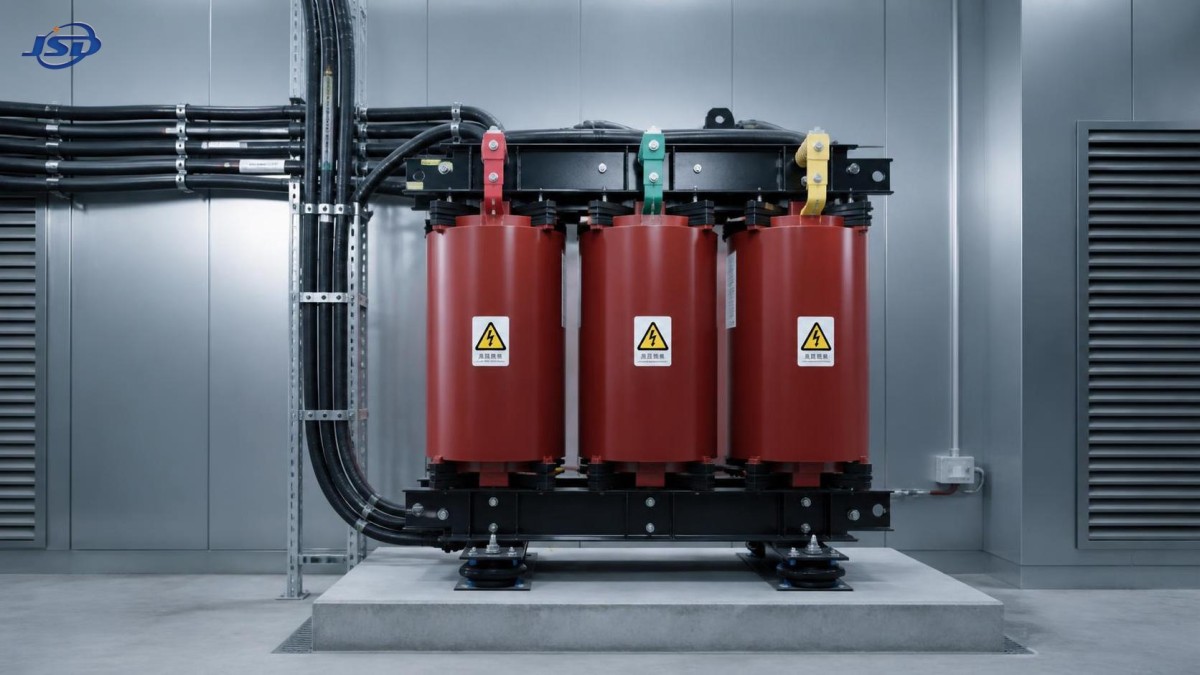
A dry type transformer should sit on a rigid, level, properly designed base. A base that is too light, uneven, or poorly anchored can resonate with the transformer’s natural vibration. This does not necessarily mean that every installation needs thick rubber pads. In some cases, soft mounts selected without calculation can make low-frequency movement worse, especially if they are overloaded, poorly distributed, or incompatible with seismic and stability requirements.
Where structure-borne noise is confirmed, vibration isolators, resilient pads, or spring isolation systems may be appropriate. The choice should account for transformer mass, center of gravity, electrical clearances, cable flexibility, and local installation rules. Any isolation solution must keep the unit stable and must not create a maintenance hazard. It is also important to inspect anchor bolts, base channels, enclosure panels, and wheel locks where fitted. A loose bolt or a steel-on-steel contact often produces a harsher sound than the transformer itself.
Cable connections deserve the same attention. Rigidly connected bus ducts and heavily supported cables can carry vibration into a wall or overhead structure. Flexible connection sections, where technically suitable and permitted by the installation design, can reduce this transfer. The goal is not to make connections loose; it is to prevent the building from becoming an extension of the transformer frame.
Do not solve a noise issue by restricting ventilation
When a transformer room is noisy, it is tempting to seal gaps, cover louvers, or line every opening with dense material. That approach can backfire quickly. Dry type transformers depend on adequate airflow to remove heat. Restricting inlet or outlet paths may lower the perceived noise outside the room while raising winding and enclosure temperatures inside it. Over time, that trade-off can affect insulation life and operating reliability.
A better approach is to review the full ventilation path. Check whether intake and exhaust openings are oversized or undersized for the actual thermal duty, whether air is short-circuiting between openings, and whether grilles are directing sound toward sensitive areas. Acoustic louvers, lined duct sections, sound baffles, or a revised air path can reduce transmitted sound while preserving airflow. Their pressure drop must be considered, particularly on naturally ventilated units.
For fan-cooled transformers, inspect fans separately. A failed bearing, dirty fan blade, loose guard, unbalanced impeller, or unstable fan control can produce noise that operators attribute to the transformer core. Verify that fans start and stop as intended, rotate freely during an isolated inspection, and are not striking guards or wiring. Fan replacement should match the original airflow, voltage, control logic, and temperature class requirements; fitting a quieter but lower-capacity fan is not a sound engineering fix.
Look at load profile, voltage, and harmonics
Noise that changes with loading needs a more careful electrical review. Winding forces increase as current rises, so a higher sound level under heavy load may be expected to a degree. However, a sudden or disproportionate increase can indicate that operating conditions differ from the original design assumptions. Harmonic-rich loads are especially relevant in modern facilities with drives, UPS systems, charging equipment, data processing loads, and power-electronic converters.
Harmonics can increase losses, heating, and audible components beyond the familiar mains-frequency hum. They may also excite mechanical resonance in windings, clamping structures, enclosures, or connected busbars. Measuring current and voltage distortion with suitable power-quality equipment is more useful than guessing from the sound. Compare the results with the transformer’s rating, loading information, and the requirements of the facility’s electrical design. If the transformer was not specified for the actual harmonic spectrum, mitigation may involve load redistribution, filtering, a suitable reactor arrangement, or reassessment of transformer selection.
Supply voltage also matters. Overvoltage can increase core excitation and make a transformer noticeably louder even at light load. Operators should confirm the actual tap setting and incoming voltage before assuming a mechanical defect. Tap changes and internal electrical work must only be performed under the manufacturer’s documented procedure and by qualified personnel with the transformer safely isolated.
Inspect enclosure panels, core clamping, and external hardware safely
Loose enclosure doors, access panels, gland plates, nameplates, cable tray covers, and ventilation screens are simple but often overlooked sources of rattling. During a scheduled outage, inspect for missing fasteners, worn door seals, distorted panels, and contact points where components can vibrate together. Tightening should follow the manufacturer’s recommendations. Over-tightening panels or fasteners can damage threads, distort sheet metal, or transfer vibration in a different direction.
Internal inspection needs greater caution. Core clamps, winding supports, and internal connections are not routine operator adjustment points. A change in internal noise may indicate looseness, but it can also reflect thermal movement, fault stress, or insulation deterioration. Opening covers or attempting mechanical correction without the right procedure can introduce contamination, damage insulation, and compromise safety. If abnormal internal noise persists after external checks, engage a qualified transformer service team and provide the operating record, sound observations, thermal history, and test results available.
When a room treatment is the right answer
Sometimes the transformer is operating normally, yet the installed location is unsuitable for the acoustic environment. This is common where electrical rooms share walls with offices, residential areas, healthcare spaces, classrooms, or control rooms. In such cases, room-level measures can be justified: higher-mass partitions, sealed penetrations, acoustic doors, isolated ceiling systems, and appropriately engineered silencers on ventilation paths.
The sequence matters. Fix loose components and vibration bridges before investing in acoustic finishes. Adding absorbent wall panels may reduce reverberation inside a room, but it will do little against vibration traveling through a concrete slab. Likewise, a heavy acoustic door cannot compensate for an open cable penetration or a louver facing directly toward a quiet workspace.
Consider whether the transformer type suits the project conditions
Noise control is also a specification issue. For future projects, acoustic requirements should be discussed early with transformer capacity, losses, fire strategy, ventilation, installation location, and load profile. A dry type transformer is often selected for indoor use and locations where fire and environmental considerations are central, but no single transformer type is automatically best for every site.
For outdoor distribution, industrial facilities, renewable-energy connections, and applications where the installation arrangement permits oil-filled equipment, project teams may evaluate alternatives such as the 15kV/0.4kV Oil-Immersed Power Distribution Transformer. Its suitability depends on the project’s fire protection approach, environmental requirements, maintenance plan, voltage and capacity needs, and local standards—not on noise alone. For example, the listed design information includes 15 kV input, low-voltage output options, and capacities from 30 to 5000 kVA, but the final configuration still needs to match actual duty conditions.
Manufacturers with experience in transmission and distribution equipment can help distinguish a genuine product issue from an installation problem. Jinshida Electric Power Technology Co., Ltd. supports power equipment applications across grid construction, industrial manufacturing, new energy, and infrastructure projects, where installation details often decide whether an otherwise sound transformer operates quietly in practice. The most useful technical discussion starts with site facts: mounting arrangement, room layout, electrical measurements, duty cycle, and the exact character of the noise.
A practical on-site response sequence
For operators, the safest approach is usually to document first, inspect accessible external items second, and escalate internal or electrical concerns promptly. Record the time and operating condition; check for loose external panels, cable tray hardware, fan guards, and obvious vibration paths; verify that ventilation is unobstructed; then compare the current sound with previous operating behavior. If there is overheating, smell, visible damage, repeated protection operation, crackling, or a rapid change in noise, remove the transformer from service in accordance with site procedures and seek qualified support.
A quieter installation is rarely achieved by one universal treatment. It comes from matching the remedy to the actual path: isolate structure-borne vibration, preserve cooling airflow, correct loose hardware, investigate harmonics when load-related noise appears, and avoid internal adjustments without competent service supervision. That disciplined approach reduces unnecessary work and, more importantly, avoids hiding a condition that should be investigated.

Get a Quote
Regardless of whether you require general advice or specific support, we are happy to help you.
Send Us Your Inquiry Today

Jinshida Electric remains committed to contributing to global energy development through professional manufacturing and superior service.