





How to evaluate distribution transformer manufacturers before ordering
How to Evaluate Distribution Transformer Manufacturers Before Ordering
Selecting the right distribution transformer manufacturers is a procurement decision with consequences well beyond the purchase order. A transformer influences electrical safety, network stability, energy consumption, maintenance planning, and the cost of future expansion. The lowest quoted unit price can look attractive during tender evaluation, yet a poorly specified or inconsistently manufactured transformer may create losses, installation delays, noise complaints, or unplanned replacement costs for years afterward.
For procurement teams, the challenge is not simply finding a supplier that can build a transformer in the required voltage and capacity range. It is determining whether that supplier can translate actual operating conditions into a reliable design, document what it is supplying, manufacture consistently, and remain responsive when technical questions arise. This requires a more disciplined comparison than placing names, ratings, and prices in a spreadsheet.
A practical evaluation starts by separating two questions: Is this transformer technically suitable? and Is this manufacturer capable of delivering that suitability reliably? A strong answer to one does not automatically prove the other.
Start with the operating duty, not the catalogue rating
A distribution transformer is often specified by rated capacity, primary voltage, secondary voltage, vector group, and frequency. Those are essential, but they are only the starting point. Before approaching suppliers, procurement should align with the electrical designer, contractor, and end user on the conditions the unit will actually face: load profile, ambient temperature, altitude, installation location, fault level, harmonic content, expected daily loading, and required service continuity.
For example, a transformer serving a commercial building with variable daytime loads is evaluated differently from one operating continuously in an industrial park. Renewable energy connections may introduce different load patterns and grid considerations. Outdoor installations require attention to enclosure protection, corrosion conditions, oil containment expectations, and access for inspection. In residential areas, operating noise can be a decisive issue even when the electrical rating is straightforward.
A capable manufacturer should ask clarifying questions rather than immediately issuing a generic quotation. If a supplier accepts incomplete specifications without discussing voltage tolerance, tapping requirements, impedance, losses, or applicable standards, buyers should treat that as a warning sign. It may indicate that technical risk is being left for the customer to discover after delivery.
Look beyond factory claims and examine manufacturing control
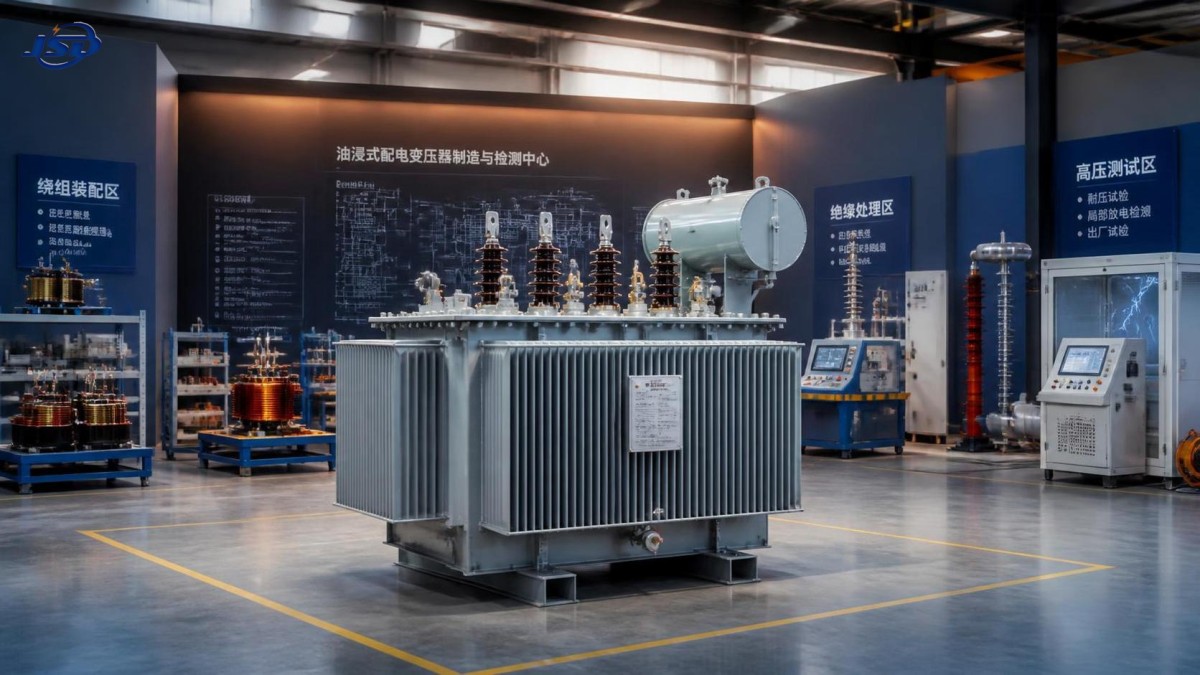
Many distribution transformer manufacturers describe their production as advanced. The useful procurement question is more specific: which production steps are controlled, how are materials verified, and how is consistency maintained from one unit to the next? Transformers depend on numerous interconnected details, including core cutting and stacking, winding geometry, conductor quality, insulation processing, lead connections, tank fabrication, oil treatment, assembly cleanliness, and final testing.
Ask suppliers to explain their quality management process in practical terms. Relevant evidence may include incoming inspection procedures for copper or aluminium conductors, core material traceability, winding checks, drying and oil-handling practices, in-process inspections, and documented final test records. The objective is not to request excessive paperwork; it is to confirm that the factory has repeatable controls rather than relying mainly on final inspection to catch problems.
A factory visit can be useful for significant orders or long-term supply arrangements, but it should be planned around meaningful observations. Look for orderly material identification, separation of work stages, test equipment appropriate to the transformer range, clean assembly areas, and whether employees can explain the process behind the products being quoted. A polished reception area tells very little about winding discipline or insulation handling.
Verify compliance as a project requirement, not a logo exercise
Compliance should be reviewed against the project specification and destination-market requirements. IEC 60076 is a widely used transformer standard, but citing it in a brochure does not by itself establish that every quoted design meets the required clauses, test requirements, or local acceptance conditions. Buyers should request the supplier’s proposed technical datasheet, declared standard basis, test scope, and any required third-party or utility-specific documentation before finalizing the order.
The details matter. Confirm rated power, voltage ratio, frequency, vector group, impedance where specified, tap range and tap changer type, insulation level, temperature-rise limits, cooling method, terminals, accessories, and required nameplate information. If the project calls for a particular loss class, acoustic limit, short-circuit withstand requirement, or local grid standard, include it explicitly in the technical schedule. Do not assume that a supplier’s standard configuration matches your tender requirement.
Testing also needs definition. Routine testing is generally expected for each unit under the relevant specification, while type tests or special tests may be required depending on the project. Procurement teams should distinguish between a test report for a comparable design and test records for the actual units ordered. Both can be valuable, but they are not interchangeable.
Compare lifecycle cost, especially losses
Purchase price is visible immediately; transformer losses are paid gradually through operation. That difference often distorts supplier comparisons. No-load loss remains present whenever the transformer is energized, while load loss changes with loading. The relative importance of each depends on how the transformer will operate, electricity costs, expected service hours, and the evaluation method used by the owner or utility.
Ask every bidder to state guaranteed no-load and load losses using the same reference conditions. A quote that gives only a broad efficiency statement is difficult to evaluate. The buyer should then apply the project’s own loss capitalization method, if one exists, rather than accepting a supplier’s savings claim at face value. Where no formal method is available, the engineering team can still compare loss figures against the expected operating profile and determine whether a higher initial price is justified.
Core technology deserves particular attention where transformers remain energized for long periods. Amorphous alloy cores are commonly considered for energy-saving applications because their magnetic properties can reduce core losses compared with conventional silicon steel designs. Whether that advantage delivers the best commercial outcome depends on duty cycle, local energy pricing, technical requirements, and the buyer’s evaluation horizon.
For projects where continuous operation, lower no-load loss, and noise control are material considerations, an option such as the SBH15 Amorphous Alloy Transformer provides a useful specification reference point. This type of oil-immersed three-phase design can be configured across capacities from 30kVA to 2500kVA, with high-voltage options from 10kV through 35kV and a 0.4kV low-voltage side. However, the appropriate configuration must still be confirmed against the network and site conditions rather than selected solely because of the core material.
Assess engineering responsiveness before the order is placed
The pre-order stage often predicts the post-order experience. Evaluate how the supplier handles deviations, ambiguities, and technical questions. Do they provide a clear data sheet with stated assumptions? Can they explain why a particular vector group, tapping arrangement, cooling method, or terminal layout is recommended? Do they identify missing information that could affect design or delivery?
This is especially important when procurement is managing multiple stakeholders. The contractor may focus on dimensions and delivery dates, the consultant may focus on compliance, and the operator may be concerned with maintenance access and long-term losses. A manufacturer with a competent technical team can help reconcile these requirements early, reducing late-stage revisions that can affect both schedule and cost.
Jinshida Electric Power Technology Co., Ltd. approaches this work through the research, manufacturing, and application of power transmission and distribution equipment. For buyers, the value of that approach lies in whether engineering, manufacturing, and quality teams can work from the same project requirements. In grid construction, industrial manufacturing, new energy, and infrastructure work, reliable power support depends on that coordination as much as on the transformer’s rated capacity.
Do not treat delivery scope as an administrative detail
A technically compliant transformer can still cause site problems if the supply scope is unclear. The purchase order should identify what is included: bushings, cable boxes, surge arresters if required, temperature indicators, pressure-relief devices, oil level gauges, wheels, lifting points, grounding terminals, marshalling arrangements, spare parts, installation documents, and test certificates. Packaging, transport restraints, shipping marks, and delivery terms should also be agreed in a way that matches the destination and handling plan.
Lead time needs the same discipline. Ask for a schedule that distinguishes engineering approval, material procurement, production, testing, packing, and shipment. A short quoted lead time is meaningful only if the supplier can identify the assumptions behind it. Design changes after approval, non-standard accessory requirements, or delayed documentation can affect the actual delivery date even when the main transformer build is progressing normally.
For overseas procurement, clarify who is responsible for export documents, inspection coordination, insurance requirements, and the handover point. These matters may seem separate from transformer quality, but they directly influence project risk and total landed cost.
Use references carefully and ask questions that reveal relevance
Past supply experience matters, but it should be relevant to the order under consideration. A manufacturer may have extensive experience with standard utility transformers while having limited exposure to low-noise urban installations, renewable energy interconnections, or a particular destination-market specification. Ask about comparable applications, not merely total production history.
Useful questions include whether the supplier has delivered similar voltage classes and capacities, how it manages customer drawing approvals, what documentation accompanies shipment, and how technical issues are handled after commissioning. Avoid relying on unverified marketing claims or vague project lists. If references are available, focus on process reliability and technical fit rather than expecting a supplier to disclose confidential customer details.
A procurement decision should be traceable
The most defensible supplier selection is one that shows how technical suitability, manufacturing control, compliance, loss performance, commercial terms, delivery capability, and support were weighed together. This does not require a complicated scoring model for every purchase. It does require a clear record of which requirements were mandatory, which options were commercially preferable, and which supplier assumptions were accepted.
Before issuing the order, review the final technical schedule line by line against the approved quotation. Confirm guaranteed losses, voltage ratio, vector group, tap range, cooling, insulation, accessories, standards, test documentation, drawings, packing, warranty terms, and agreed delivery milestones. Any item left as “standard” should be understood by both sides.
The right distribution transformer manufacturer is not necessarily the one with the lowest starting price or the longest product list. It is the supplier whose design assumptions are transparent, production controls are credible, documentation is complete, and technical response remains dependable from specification through delivery. That is the basis for purchasing equipment that performs predictably in the network it was built to serve.

Get a Quote
Regardless of whether you require general advice or specific support, we are happy to help you.
Send Us Your Inquiry Today

Jinshida Electric remains committed to contributing to global energy development through professional manufacturing and superior service.