





Can a 22 kVA open frame genset handle motor starting loads?
A 22kVA open frame genset can handle some motor starting loads, but it should not be selected by comparing generator kVA with motor nameplate kW alone. Motor-driven loads create a brief but demanding electrical event at startup: current rises sharply, the alternator sees a low-power-factor load, and the engine governor must react before frequency and voltage drift beyond acceptable limits.
For a technical evaluator, the practical answer is therefore conditional. A 22 kVA generator may start a small three-phase motor directly if the system has sufficient alternator excitation capability, limited background load, and a suitable motor-starting method. It is much less likely to start a larger motor using direct-on-line starting, especially where voltage dip limits are tight or other loads must remain energized.
In many industrial, infrastructure, and power-distribution applications, the real concern is not whether the motor eventually turns. It is whether the generator can start it without tripping protective devices, stalling the engine, dropping a control circuit, or causing connected equipment to reset. That distinction should guide the entire selection process.
Start with the real continuous capacity, not the headline rating
A 22 kVA generator is commonly rated at a power factor of 0.8. Under that condition, its approximate active power capacity is:
22 kVA × 0.8 = 17.6 kW
This does not mean that 17.6 kW is always available for a motor. The usable figure depends on whether the genset is rated for prime or standby operation, ambient temperature, altitude, fuel conditions, panel auxiliaries, and the manufacturer’s permitted load profile. Open-frame units also operate with less acoustic enclosure and environmental protection, so installation conditions can have a more visible effect on long-term performance.
As a conservative operating approach, continuous load is often kept below the maximum rated output to preserve response margin. If a 22 kVA open frame genset is already supporting lighting, pumps, battery chargers, welding controls, or a small distribution transformer, its available starting headroom can disappear quickly.
Motor starting is a kVA issue before it becomes a kW issue. During acceleration, the motor may draw high current while producing relatively little useful mechanical output. The generator must supply that temporary current without allowing the terminal voltage to collapse.
Why motor starting places unusual stress on a generator
An induction motor at standstill behaves very differently from a motor running at full speed. With direct-on-line (DOL) starting, locked-rotor current is commonly around five to seven times the full-load current, although the actual value must come from the motor data sheet or nameplate code.
For example, an 11 kW, 400 V, three-phase motor may have a full-load current near 21 A. If its starting current is six times full-load current, the initial demand can approach 126 A. The corresponding starting kVA is approximately:
Starting kVA = √3 × Voltage × Starting Current ÷ 1000
At 400 V and 126 A, that is roughly 87 kVA. The event may last only a few seconds, but it is far above the nominal 22 kVA rating. A robust alternator and a lightly loaded engine may tolerate a portion of this demand for a very short duration; however, it should never be assumed that a 22 kVA set can start this motor DOL reliably.
Even a 5.5 kW motor can be challenging under DOL conditions. Its normal running demand may appear modest, yet its starting kVA can still exceed 40 kVA depending on efficiency, power factor, and locked-rotor current. This is why an apparently “small” motor can create a disproportionate generator-sizing problem.
The question to ask: how much voltage dip is acceptable?
Motor starting capability is not simply a pass-or-fail number. It depends on the voltage dip that the application can tolerate. A site with only a single pump may accept a noticeable temporary dip if the pump reaches speed promptly. A system feeding PLCs, instrumentation, variable-speed drives, contactors, communications equipment, or sensitive auxiliary circuits may not.
When generator voltage falls during a start, motor torque falls approximately with the square of voltage. A 20% voltage reduction does not produce a 20% torque reduction; it can reduce available torque far more severely. If the driven equipment has high breakaway torque, such as a loaded conveyor, compressor, crusher, positive-displacement pump, or fan with a difficult starting condition, the motor may remain in its high-current state for too long. That turns a short transient into a generator overload event.
Frequency response matters as well. The engine must provide extra mechanical torque as electrical load rises. If frequency dips sharply, controls may malfunction, the motor may accelerate more slowly, and the genset can enter an unstable recovery cycle. The alternator, automatic voltage regulator (AVR), excitation system, engine governor, flywheel inertia, and load characteristics all contribute to the outcome.
Assess the motor and driven equipment as a pair
Technical evaluations sometimes focus only on motor kW. That is incomplete. Two motors with the same rated output can present very different starting demands because the mechanical load is different.
- Centrifugal pumps and fans: Usually have lower torque demand during startup when discharge conditions and fan characteristics are favorable. They are often better candidates for reduced-voltage starting.
- Conveyors: May start loaded, particularly after an unplanned stop. Breakaway torque can be significantly higher than normal running torque.
- Air compressors: Require careful review of unloading arrangements, receiver pressure, and restart logic. A compressor restarting against pressure can be a difficult load.
- Refrigeration compressors: Starting performance can be affected by pressure equalization, restart timing, and motor design.
- Submersible pumps: Long cables introduce voltage drop, while the pump may need significant torque to overcome static conditions.
- High-inertia machinery: Mixers, large fans, crushers, and certain process machines may draw elevated current for longer because their acceleration time is extended.
For each load, obtain the motor’s rated voltage, full-load current, locked-rotor current or code letter, starting method, expected acceleration time, and the condition under which it will start. A pump starting against a closed valve and a pump starting into an established process line should not automatically be treated as the same case.
What a 22 kVA open-frame generator can usually support
There is no universal motor-size limit because generator designs and application conditions vary. Still, a 22 kVA open frame genset is generally more comfortable with small motors, particularly where no significant load is already connected and the motor has an appropriate starting method.
For direct-on-line starting, small motors in the approximate 2.2 kW to 4 kW range are often more manageable than larger units, provided cable runs are reasonable and the driven load is not unusually hard to start. Motors around 5.5 kW may be possible in selected configurations, but this should be verified against the genset manufacturer’s motor-starting curves rather than assumed. An 7.5 kW or 11 kW motor usually calls for a reduced-current starting strategy, a larger generator, or both.
These ranges are not design rules. A premium alternator with strong excitation response may perform better than a basic unit of the same kVA rating, while high ambient temperature, altitude, weak fuel delivery, long feeder cables, or simultaneous auxiliary loads can reduce practical capability. Always use the specific generator’s transient performance data.
Starting method can change the decision
Where the generator size is constrained, the starting method is often more valuable than simply adding a few kVA of nominal capacity.
Direct-on-line starting
DOL is simple, economical, and suitable when the motor is small relative to the genset. Its drawback is the highest inrush current. It can be acceptable for a lightly loaded small pump or fan, but it is usually the least forgiving option for a 22 kVA unit.
Star-delta starting
Star-delta starting reduces line current during the initial phase, though it also reduces starting torque. It works best when the motor and driven equipment can accelerate with reduced torque. Transition between star and delta must be considered carefully because it can cause a secondary transient.
Soft starter
A soft starter controls voltage ramp-up and can reduce inrush substantially. It is useful for pumps, fans, and conveyors where torque can be managed during acceleration. However, settings matter. Starting with too little voltage may prolong acceleration, keeping current elevated for longer and producing more heat in both motor and generator. A soft starter should be commissioned around actual load behavior, not left at generic factory settings.
Variable frequency drive
A VFD can provide the smoothest motor acceleration and much lower starting current, often making it an effective solution where generator capacity is limited. It also introduces harmonics and may require attention to generator reactance, AVR stability, cable lengths, EMC practices, and input filtering. The generator should be assessed for nonlinear load compatibility, not merely for motor kW.
Check the whole electrical path
A motor may be close to the generator, or it may be supplied through a distribution panel, transfer switch, protective device, and transformer. Every part of this path influences voltage at the motor terminals. Long cables and undersized conductors add voltage drop just when the motor needs maximum torque. Poorly coordinated breakers may trip on inrush before the generator has an opportunity to recover.
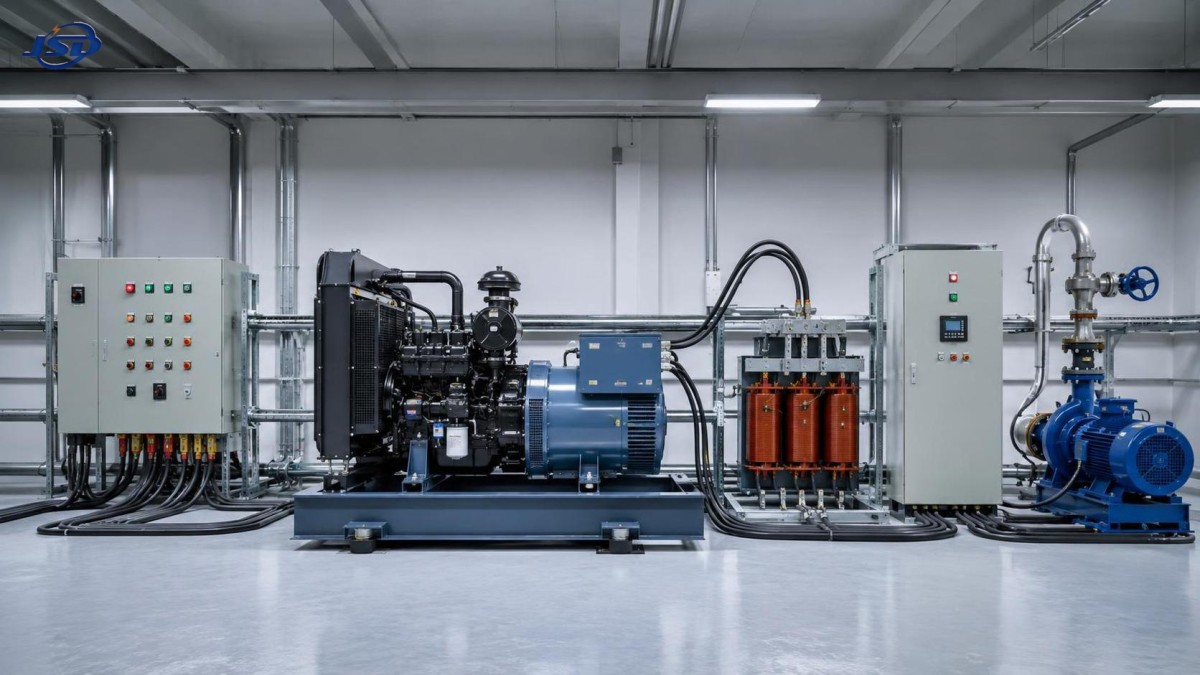
Where a transformer is part of the system, its impedance and magnetizing inrush should also be included in the sequence analysis. Energizing a transformer immediately before starting a motor can create two overlapping transients. A practical control scheme may stagger these events: energize the transformer, allow voltage to stabilize, then initiate the motor start after a deliberate time delay.
This sequencing principle is particularly valuable in compact infrastructure systems. Rather than oversizing every source, designers can prevent avoidable overlap between pumps, fans, compressors, and transformer energization.
When storage support is more appropriate than a larger generator
Some commercial and industrial sites experience occasional high starting demand but do not need a larger generator continuously. In those cases, an energy storage system can be evaluated as part of a hybrid power architecture. It may support peak demand, improve generator loading behavior, provide backup continuity, or coordinate with photovoltaic generation and microgrid controls.
For larger site-level applications, the 500kW/1MWh Air Cooling Container Energy Storage System combines LiFePO4 batteries, PCS, BMS, optional EMS functions, and outdoor-oriented containerized installation in a 20-foot format. Its scale is far beyond a 22 kVA genset, but the selection principle is relevant: difficult transient loads are often best handled through coordinated source control rather than expecting one small generator to solve every peak event.
For a small standalone installation, a larger genset may still be the simplest answer. For a site with recurring peaks, renewable integration, or resilience requirements, a hybrid study can reveal a more balanced lifecycle solution.
A practical acceptance test before final selection
Before approving a 22 kVA open frame genset for motor duty, request more than a standard rating sheet. Ask for alternator subtransient reactance, AVR and excitation characteristics, engine load-step response, permitted overload profile, and motor-starting capability at the intended voltage and frequency. Confirm whether the published rating is prime, standby, or limited-time emergency rating.
Then build a short operating matrix. List the base load present before the motor starts, the largest motor, its starting method, expected start duration, cable length, transformer involvement, and the maximum allowable voltage and frequency dip for connected equipment. Include the possibility of automatic restart after a power interruption, because several motors restarting together can be more severe than normal operation.
A site test is valuable when the margin is narrow. Record generator terminal voltage, motor terminal voltage, current, frequency, and start duration under realistic mechanical conditions. If the genset recovers only when the equipment is unloaded or the fuel tank is full and ambient conditions are mild, the design does not have enough margin for dependable service.
Selection conclusion
A 22kVA open frame genset can reliably support motor starting loads when the motor is modest in size, the starting current is controlled, background loads are low, and the alternator-engine package has verified transient capability. It should not be treated as a universal solution for direct-on-line motor starts simply because the motor’s running kW appears below 17.6 kW.
The safest decision is based on locked-rotor kVA, acceleration time, permitted voltage dip, starting method, cable and transformer losses, and load sequencing. For small pumps and fans, the 22 kVA class may be a sensible, efficient choice. For hard-starting or high-inertia machinery, moving to soft-starting, VFD control, a larger generator, or a coordinated storage-supported system is usually the more dependable engineering path.

Get a Quote
Regardless of whether you require general advice or specific support, we are happy to help you.
Send Us Your Inquiry Today

Jinshida Electric remains committed to contributing to global energy development through professional manufacturing and superior service.