





How U.S. DOE efficiency rules affect distribution transformer manufacturers
A transformer quotation can meet a project’s voltage and capacity requirements yet still be unsuitable for the U.S. market. DOE efficiency rules affect which designs distribution transformer manufacturers can supply, how they demonstrate performance, and when a redesigned product must enter production. For buyers comparing suppliers, the immediate task is to establish whether the transformer is covered, which efficiency requirements apply to its manufacture date, and whether the offered design has supporting compliance documentation.
The DOE’s 2024 amended distribution transformer standards require compliance beginning April 23, 2029. Until that transition, existing applicable requirements remain relevant. The amendments do not impose a universal requirement to use one core material; they establish efficiency levels that influence core design, winding losses, material sourcing, testing, and production planning. A purchase order that crosses the transition date therefore needs more than a general promise of “DOE compliance.”
Start with the transformer’s regulatory classification
DOE requirements apply to covered distribution transformers, not automatically to every transformer or every packaged substation. The governing provisions are found in 10 CFR Part 431, Subpart K, with certification obligations addressed under 10 CFR Part 429. A supplier should identify the applicable product definition and efficiency table before selecting a compliant design.
The federal definition generally concerns transformers with an input voltage of 34.5 kV or less, an output voltage of 600 V or less, and a frequency of 60 Hz, within specified capacity ranges. Liquid-immersed and dry-type equipment have different coverage details. Certain special-purpose transformers are excluded, but an exclusion must follow the regulatory definition rather than a supplier’s commercial description.
For example, calling equipment “industrial,” “temporary,” or “custom-built” does not, by itself, remove a covered transformer from DOE requirements. Likewise, placing a transformer inside a mobile package does not establish an exemption. Classification depends on the transformer’s actual specifications and applicable definitions.
A useful supplier response identifies the category, applicable minimum efficiency, test basis, and responsible compliance entity. A quotation that gives only an efficiency percentage leaves important questions unanswered.
The 2029 transition changes purchasing and production decisions
The compliance date is not simply a delivery deadline. The amended requirements apply to covered equipment manufactured on or after the applicable compliance date. Buyers should not assume that placing an order before April 23, 2029 automatically permits manufacture to the earlier standard afterward.
Long procurement cycles make this distinction important. A project may approve drawings under an existing design, then experience a construction delay that pushes transformer manufacture beyond the transition. The manufacturer may need to revise the core, enclosure dimensions, mass, or other characteristics to meet the amended requirements.
Contracts spanning the transition should state which standard applies, how manufacture dates will be documented, and what happens if a schedule change requires redesign. Drawing approval, production release, shipment, and site acceptance are different milestones; treating them as interchangeable creates avoidable disputes.
DOE efficiency standards are not a blanket order to replace every transformer already operating in the field. Existing installed equipment presents a different question from newly manufactured equipment. Replacement and expansion purchases still need their own coverage assessment, particularly when an owner wants a new unit to match an older installation.
Where the rules reach into transformer manufacturing
Core material becomes a design decision, not a compliance label
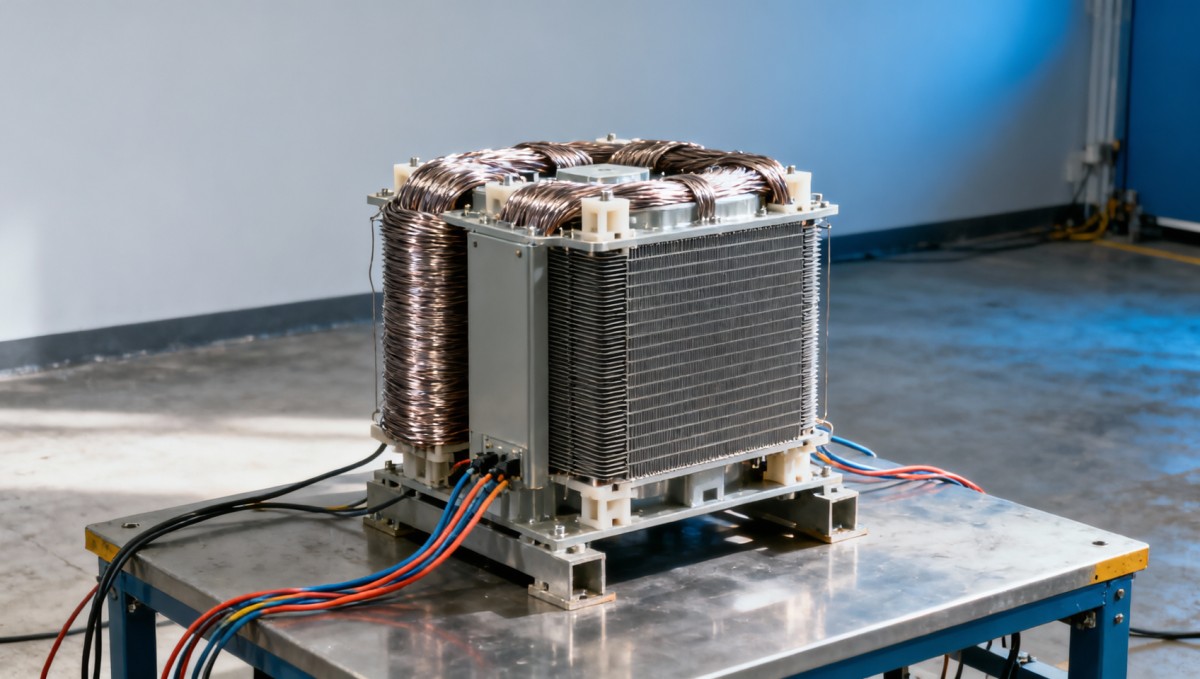
Higher efficiency requirements put pressure on both no-load and load losses. Manufacturers may evaluate improved grades of grain-oriented electrical steel, amorphous metal, revised core geometry, different flux density, or changes to conductor sizing. The workable combination depends on the transformer category and required efficiency level.
Neither “amorphous core” nor “premium steel” proves compliance on its own. The finished design must achieve the applicable efficiency under the prescribed test conditions. Conversely, buyers should not reject a material solely because they assume the DOE mandates a different one.
Material substitutions can also affect core dimensions, handling methods, assembly equipment, and production yield. A supplier’s transition plan should therefore address manufacturing capability as well as electromagnetic calculations. A theoretical low-loss design is not equivalent to a qualified production design.
Loss reduction can change physical and electrical characteristics
Increasing conductor cross-section may reduce winding resistance but require changes to the winding window and overall layout. Core redesign can affect tank dimensions or shipping mass. Impedance, temperature rise, sound performance, and inrush behavior still need to meet the project specification rather than being assumed unchanged.
These interactions matter when a replacement transformer must fit an existing foundation, cable arrangement, or transport envelope. Ask for confirmed dimensions and interface drawings for the compliant design—not drawings from a previous model carrying the same kVA rating.
Production controls must preserve the tested design
Core processing, joint assembly, conductor dimensions, and material consistency influence losses. Manufacturers need controls that keep production units aligned with their compliance representations. An undocumented substitution made to overcome a material shortage can undermine the basis of an earlier efficiency claim.
Supplier evaluations should examine how design revisions, purchased materials, test equipment calibration, and nonconforming results are controlled. This is especially relevant when a supplier proposes a new design shortly before the compliance transition or transfers production between facilities.
Read efficiency evidence against the DOE test basis
A statement such as “99% efficient” is not enough to compare offers. Efficiency depends on loading, power factor, temperature corrections, and the treatment of measured losses. DOE uses prescribed methods and reference conditions, so commercial claims must be traceable to that framework.
Under the DOE framework, liquid-immersed distribution transformer efficiency is evaluated at 50% of nameplate-rated load, while dry-type distribution transformer efficiency is evaluated at 35%. Applicable reference temperatures and other test details must also be followed. A full-load efficiency figure cannot simply substitute for the required regulatory value.
For a technical review, request evidence that connects the proposed unit to its represented basic model and applicable compliance method. Depending on the manufacturer’s approach, that may involve testing and an allowable alternative efficiency determination method. Do not assume every catalog variant requires an entirely separate physical compliance test, or that one unrelated test report covers an entire product range.
- Identify the offered configuration: rating, phase, voltage, construction, and relevant insulation classification.
- Establish the requirement: applicable minimum efficiency and the standard applicable to its manufacture date.
- Examine the supporting basis: measured losses, required corrections, or documentation supporting the permitted determination method.
- Confirm regulatory responsibility: who handles DOE certification reporting and record retention for the equipment placed on the U.S. market.
DOE certification is a regulatory reporting obligation, not a general third-party product approval. An IEC test report, an ISO quality certificate, or an independent safety listing serves a different purpose. None should be accepted as a substitute for evidence addressing DOE efficiency compliance.
A mobile substation needs two separate reviews
Temporary power equipment illustrates how an otherwise suitable package can create a standards mismatch. The Mobile Temporary Compact Substation integrates a transformer, high- and low-voltage switchgear, protection devices, and controls in a trailer-mounted or skid-mounted arrangement. Its listed range is 500–1250 kVA, with three-phase construction, ONAN cooling, and 50 Hz or 60 Hz options.
Those features can support construction, mining, emergency restoration, and temporary infrastructure applications. However, the listed IEC 62271 and GB/T 17467 standards do not establish DOE efficiency compliance. Neither does the package’s rapid-deployment function.
The published voltage options include 10, 11, 20, 33, and 35 kV on the high-voltage side, with a 0.4 kV low-voltage side. A U.S. project must confirm the actual configuration: a listed 35 kV rating must not be treated as interchangeable with 34.5 kV, and a 50 Hz option does not establish suitability for a 60 Hz installation. Equipment outside DOE coverage may still be unsuitable for the intended network.
The practical review therefore has two tracks. First, classify the transformer and establish its efficiency obligations. Second, verify package suitability, including utility voltage compatibility, protection coordination, grounding, enclosure requirements, and site acceptance criteria. Passing one review does not resolve the other.
Compare commercial offers without hiding transition risk
Efficiency-driven redesign can affect material consumption, tooling, testing workload, and production scheduling. These pressures may influence quotations and lead times, but the rules do not establish a fixed price increase or a universal delivery delay. Ask each manufacturer which parts of its offer are already validated and which depend on pending design or production work.
Energy-cost comparisons also need more than the minimum efficiency percentage. Two compliant transformers can have different combinations of no-load and load losses. An energized unit serving a light, intermittent load may favor lower no-load losses; a heavily loaded installation gives winding losses greater weight.
Use the expected operating profile, energized hours, and electricity cost to evaluate those differences. Separate the regulatory pass/fail decision from the economic comparison: compliance establishes eligibility, while operating losses help distinguish lifecycle value. Avoid calculating savings from unmatched test conditions or from a generic percentage applied to every operating hour.
Before releasing an order, resolve three documentary gaps: an undefined DOE product category, an efficiency claim without its prescribed measurement basis, or a manufacture schedule that crosses the compliance date without an agreed design. Each gap calls for a specific supplier response. Closing them before drawing approval is more useful than adding a broad “all applicable standards” clause after the equipment has entered production.
Hot News
- 00
0000-00
How U.S. DOE efficiency rules affect distribution transformer manufacturers - 00
0000-00
How american type pad mounted transformer seismic qualification affects installation in California utility grids? - 00
0000-00
Do european compact substation transformer EMC compliance tests include conducted emissions up to 30MHz?
0000-00
Contact Us

Get a Quote
Regardless of whether you require general advice or specific support, we are happy to help you.
Send Us Your Inquiry Today

Jinshida Electric remains committed to contributing to global energy development through professional manufacturing and superior service.