





What Defines an Energy Saving Transformer and How Much Can It Cut Operating Costs?
Operating cost in a transformer starts with losses that exist even when the connected load is low. That is the first practical definition of an energy saving transformer: it is a unit designed to reduce core loss during idle periods and control winding loss when current rises, without creating new reliability problems elsewhere in the system. In procurement terms, the label only matters if the design choices behind it match the actual duty cycle, installation environment, and maintenance conditions on site.
An ordinary comparison based only on rated capacity can hide the real difference. Two transformers with the same kVA rating may behave very differently over a year because one uses a lower-loss core material, tighter lamination processing, better conductor design, and a thermal structure that keeps resistance growth under control as temperature increases. When the transformer operates for long hours with variable loading, those details influence the electricity bill more directly than the nameplate alone.
What usually defines an energy saving transformer
In technical discussions, the term generally points to a transformer with reduced no-load loss, reduced load loss, or both. No-load loss comes mainly from the magnetic core and appears whenever the transformer is energized. Load loss is tied to current in the windings and includes copper loss, stray loss, and the thermal effects that increase resistance under operating temperature. A credible energy saving design addresses both, but the weighting depends on how the transformer is used.
For a lightly loaded distribution network that remains energized around the clock, low no-load loss may have greater financial relevance. In a facility with strong daytime demand and sustained loading near rated current, load loss can become the bigger cost driver. This is why an energy saving transformer cannot be judged in isolation from the load profile. A specification that looks efficient in a catalog may be financially weak if it is optimized for the wrong operating pattern.
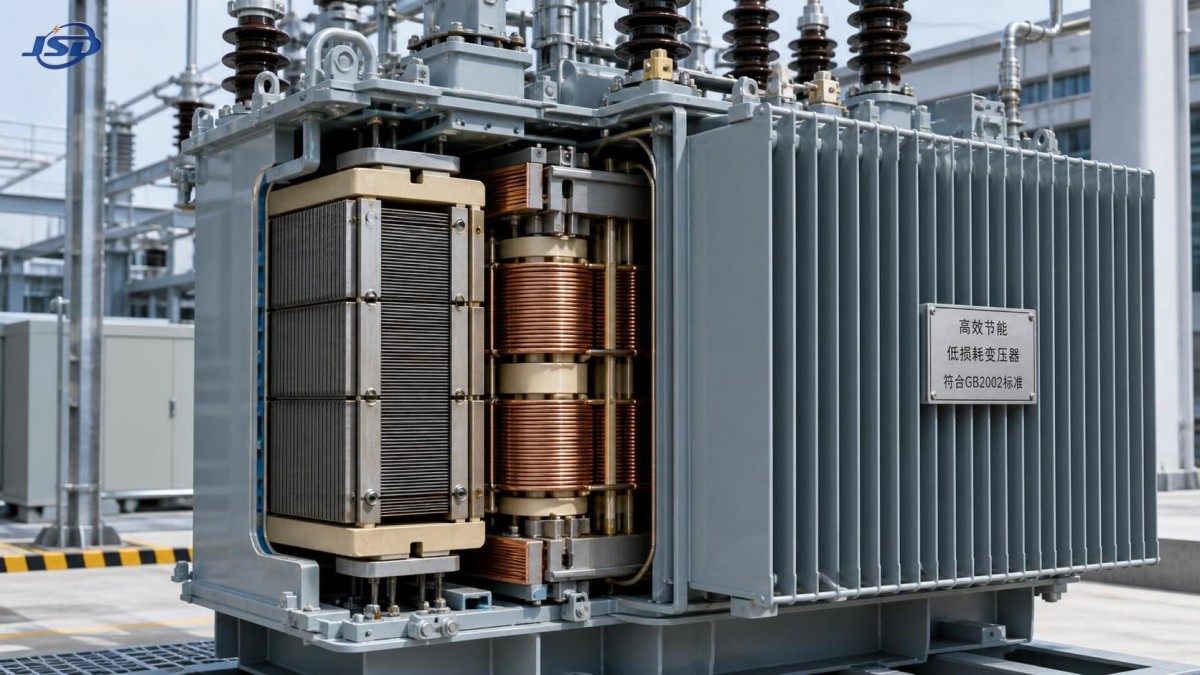
Core material is one of the clearest differentiators. Manufacturers may use cold-rolled grain-oriented silicon steel with improved magnetic properties, or in some applications an amorphous alloy core where very low no-load loss is the priority. Each option changes not only losses, but also procurement cost, mechanical handling characteristics, noise behavior, and repair considerations. Winding design matters just as much. Conductor cross-section, winding arrangement, insulation spacing, and control of leakage flux all influence load loss and long-term heating.
Processing quality also belongs in the definition. Burr control during core cutting, step-lap joint accuracy, clamping pressure, vacuum drying, insulation curing, oil treatment, and sealing quality affect whether the promised loss values remain stable after transportation and commissioning. A transformer sold as energy saving but assembled with weak process control may produce acceptable factory numbers and still underperform after months of field operation.
How much can it cut operating costs?
There is no honest universal percentage. The cost reduction depends on five variables that change from project to project: annual energized hours, average loading, peak loading duration, local electricity tariff structure, and the difference in losses between the shortlisted models. Without those inputs, any fixed savings claim is marketing, not engineering.
A more reliable way to estimate operating cost is to separate losses into annual energy terms. No-load loss is multiplied by the full energized time because it exists whenever voltage is applied. Load loss must be adjusted by the actual load factor, and ideally by the square of the load profile rather than a simple average. This distinction matters. A transformer serving intermittent motor loads, HVAC cycling, or mixed commercial demand can have the same monthly energy throughput as another site while producing very different winding losses.
Suppose one unit has lower core loss but only slightly better winding loss. It may cut operating cost noticeably in a substation that is energized continuously with modest average demand. If another unit offers stronger improvement in winding loss, it may be better suited to a plant with long high-load intervals. Neither is automatically the “best” energy saving transformer unless lifecycle cost is calculated against the expected operating pattern.
There is also the question of secondary cost, which is often ignored in early purchasing discussions. Lower losses reduce internal heat. Lower heat can ease stress on insulation, oil, bushings, and connections. In some conditions that may support longer stable operation and reduce the frequency of thermal-related intervention. The financial effect is indirect and should be treated cautiously, but it can influence downtime exposure, especially where shutdown windows are limited.
Another overlooked factor is reactive power behavior in the wider electrical system. Transformer efficiency does not replace power factor correction, harmonic management, or load balancing. If the network has poor power quality, the expected operating cost benefit can shrink because extra heating and stray losses may appear outside the clean test condition used for nameplate data.
Where cost evaluations often go wrong
A common mistake is comparing purchase price alone. The lower-capital option may carry higher annual losses for the entire service period. Even when electricity prices are stable, that can change the real ownership cost. If tariffs include demand components, peak-period rates, or penalties linked to system inefficiency, the picture becomes even more complicated.
Another error is using rated load as if it were normal load. Transformers are frequently selected with margin for future expansion, redundancy, or startup current. That is reasonable, but it changes the economics. An oversized transformer may spend most of its life in a low-load state where no-load loss dominates. In such a case, spending attention on core-loss performance can be more valuable than focusing only on full-load efficiency.
There is also a tendency to treat factory loss data as the whole story. Transport vibration, poor unloading practice, moisture ingress during storage, damaged radiators, loose terminations, and contaminated oil can all move field performance away from expectation. For oil-immersed units, handling angle limits, sealing checks, and oil testing after arrival are not administrative details. They are part of preserving the economics that justified the purchase.
Specification details that deserve close reading
When reviewing bids, the technical schedule should distinguish clearly between no-load loss, load loss at the reference temperature, impedance, cooling method, insulation class, tapping arrangement, and allowable temperature rise. Ambiguous wording around “maximum efficiency” can be misleading because efficiency peaks at a certain load point that may have little relation to the site’s normal operation.
Noise can also matter financially, though indirectly. A lower-loss core design may alter magnetic behavior and acoustic output. If the transformer is installed near occupied buildings or sensitive process areas, mitigation measures such as barriers, enclosures, or relocation can add cost after purchase. The cheapest technical compliance path is usually identified before order placement, not after site complaints begin.
For outdoor or harsh industrial service, the enclosure, coating system, corrosion resistance of fittings, gasket quality, and sealing arrangement influence whether the transformer stays dry and thermally stable. Efficiency claims lose value quickly if moisture ingress degrades insulation or if poor cooling performance pushes operating temperature upward.
In medium-voltage distribution work, a practical reference point may be a 10kV/0.4kV Oil-Immersed Power Distribution Transformer, where the real purchase question is not the product type by itself but whether the loss balance, cooling behavior, tap range, and site conditions are aligned. In some projects, oil-immersed construction is favored because of thermal performance and overload tolerance; in others, installation constraints may shift the evaluation toward different designs.
Installation and maintenance affect the savings more than many tenders admit
An energy saving transformer can lose part of its expected advantage through poor installation practice. Long or undersized low-voltage cable runs introduce extra system loss that may exceed the difference between two transformer models. Weak ventilation in an indoor room raises operating temperature. Unbalanced three-phase loading increases current in individual windings. Harmonic-rich loads from drives, rectifiers, or non-linear equipment can increase eddy and stray losses. These are site issues, but they directly affect the operating cost attributed to the transformer.
Commissioning records should therefore include insulation resistance, ratio verification, connection checks, oil condition where applicable, grounding continuity, tap position confirmation, and thermal observations after energization. None of these tests is decorative paperwork. They establish whether the transformer is operating in the condition assumed by the lifecycle cost model.
Maintenance should stay focused on conditions that change losses or threaten heat removal: oil level, oil quality, leaks, radiator cleanliness, fan operation where fitted, terminal tightness, and evidence of abnormal hot spots. If infrared inspection is available, it can help identify connection resistance or uneven loading before the issue becomes a prolonged energy penalty.
How to compare offers without reducing the decision to slogans
The most defensible approach is to request guaranteed loss values, reference standards used for testing, tolerances, material descriptions where relevant, and a clear statement of temperature basis for load loss. Then map those values against the expected annual load curve. If the load curve is uncertain because expansion is planned, use at least two operating scenarios rather than one optimistic estimate.
Commercial evaluation should include transport method, packing protection, storage limitations, installation requirements, and spare parts that affect uptime. A transformer that arrives with better paper specifications but higher site risk is not automatically the lower-cost option. The gap between factory performance and field performance is often created at the boundaries between manufacturing, logistics, civil work, electrical installation, and commissioning.
Lead time and interchangeability also matter. If a design uses less common dimensions, fittings, or accessories, replacement planning may become more difficult later. That does not invalidate the efficiency advantage, but it belongs in the same cost discussion because operating cost is only one part of asset ownership.
In the end, an energy saving transformer is defined less by a label than by verifiable loss characteristics, disciplined manufacturing, and suitability for the real network it will serve. Operating cost can be cut meaningfully when those factors match the load profile and site conditions. When they do not, the claimed savings remain theoretical while the electricity meter keeps recording the difference.

Get a Quote
Regardless of whether you require general advice or specific support, we are happy to help you.
Send Us Your Inquiry Today

Jinshida Electric remains committed to contributing to global energy development through professional manufacturing and superior service.