





How to compare loss capitalization across power transformer manufacturers
The lowest transformer purchase price does not always deliver the lowest lifetime cost. For financial approvers comparing power transformer manufacturers, loss capitalization turns expected energy losses into a monetary value—and can change which bid represents the better investment.
The difficulty is not the arithmetic. It is ensuring that every proposal uses the same electricity price, loading assumptions, operating life, and discount rate. A polished efficiency claim is not enough when one supplier quotes typical losses and another guarantees maximum values under specified test conditions.
A defensible comparison separates technical compliance from financial evaluation, applies one buyer-controlled model, and connects the resulting decision to enforceable contract terms.
What loss capitalization adds to the purchase price
A transformer consumes energy even when it supplies little or no useful load. Loss capitalization estimates the present value of those future energy costs and adds it to the acquisition cost for bid evaluation.
The familiar calculation is:
Evaluated cost = Comparable acquisition cost + (A × P0) + (B × Pk)
- P0: guaranteed no-load loss, expressed in kW.
- Pk: guaranteed load loss at rated current and an agreed reference temperature, expressed in kW.
- A: capitalized lifetime cost per kW of no-load loss.
- B: capitalized lifetime cost per kW of rated load loss.
If losses are quoted in watts, convert them to kilowatts before applying factors expressed in currency per kW. This small unit check can prevent a very large evaluation error.
“Comparable acquisition cost” should cover the same scope across suppliers: equipment, freight, applicable duties, installation obligations, commissioning, and required accessories. Otherwise, a precise loss calculation may simply decorate an unfair price comparison.
This evaluated cost is a procurement metric, not automatically the amount capitalized on the accounting balance sheet. Accounting treatment remains subject to the organization’s policies and applicable rules.
Build the factors around how the transformer will actually operate
No-load losses arise mainly in the magnetic core whenever the transformer is energized. Load losses include winding resistance losses and additional stray losses; for planning purposes, they generally vary approximately with the square of current.
That distinction matters financially. A lightly loaded transformer operating continuously may justify particular attention to core losses. A heavily loaded industrial unit may make reductions in load losses more valuable.
No-load losses: pay attention to energized hours
For constant annual assumptions, a simplified no-load capitalization factor is:
A = Annual energized hours × Energy price × Present-value annuity factor
The annuity factor is [1 − (1 + r)−n] ÷ r, where r is the annual discount rate and n is the evaluation period in years.
Use 8,760 hours only when the equipment is expected to remain energized throughout a normal year. A seasonal facility or a switched standby transformer needs a different assumption.
Load losses: average loading is not enough
Under a simplified model:
B = Annual energized hours × Energy price × Mean squared per-unit loading × Present-value annuity factor
Per-unit loading represents actual current divided by rated current, commonly approximated using apparent-power loading at near-rated voltage. The mean of squared loading is not the square of average loading.
For example, operating half the time at 30% load and half at 90% gives average loading of 60%. However, the mean squared loading is (0.3² + 0.9²) ÷ 2 = 0.45, not 0.6² = 0.36. Using the latter would understate the load-loss component by 20%.
Where interval data are available, calculate losses and energy prices by interval. Time-of-use tariffs, seasonal production, and future load growth can make a single annual average misleading. For nonlinear loads, ask engineering to assess harmonic-related losses rather than relying solely on the square-law approximation.
Keep the financial assumptions internally consistent: use nominal discount rates with nominal energy-price forecasts, or real discount rates with constant-price forecasts. Include demand charges only where incremental transformer losses would actually affect billed demand.
A lower-loss bid can recover its premium—but check the margin
Consider two technically compliant offers for the same transformer duty. The following figures are illustrative, not supplier quotations. Assume the buyer has adopted rounded capitalization factors of A = $12,000/kW and B = $3,000/kW.
Those factors are broadly consistent with continuous energization, electricity near $0.12/kWh, a 20-year evaluation period, a 6% discount rate, and mean squared loading of approximately 0.25. Actual procurement factors should come from the project’s own model.
Manufacturer B costs $15,000 more upfront but reduces capitalized losses by $16,200. Its evaluated advantage is therefore $1,200.
That is a narrow margin, not an overwhelming victory. A modest change in electricity prices, utilization, or acquisition scope could reverse the ranking. If both capitalization factors fell by 10%, the loss benefit would fall to $14,580, slightly below the purchase premium.
The approval question is consequently more useful than “Which transformer is more efficient?” It is: “Is the efficiency premium justified under assumptions we can reasonably defend?”
Normalize proposals from power transformer manufacturers before ranking them
Financial reviewers should not have to interpret incompatible technical schedules. Ask procurement and engineering to produce one comparison sheet with exceptions clearly marked.
- Equivalent duty: match rated capacity, voltage ratio, frequency, cooling arrangement, impedance requirements, insulation level, and relevant service conditions.
- Equivalent loss definitions: distinguish no-load loss, rated load loss, total loss, and cooling auxiliary consumption. Confirm what each quoted number includes.
- Common measurement basis: specify voltage, frequency, tap position, reference temperature, and the applicable test standard and edition.
- Guaranteed rather than typical values: use contractual guarantees for ranking, not indicative catalog data or an unexplained “best efficiency” figure.
- Consistent commercial boundaries: reconcile delivery terms, currency, taxes, accessories, testing, and commissioning responsibilities.
Temperature correction deserves particular attention because winding resistance changes with temperature. Load-loss figures stated at different reference temperatures are not directly comparable. Have the manufacturer provide properly corrected values under the agreed standard; do not apply a blanket resistance correction to every component of load loss.
Different transformer sizes also require care. An oversized unit may have lower percentage loading but higher continuous core losses. Compare alternatives against the same demand forecast and required capacity margin, rather than assuming that more kVA automatically means better lifecycle economics.
Apply the same discipline to distribution equipment
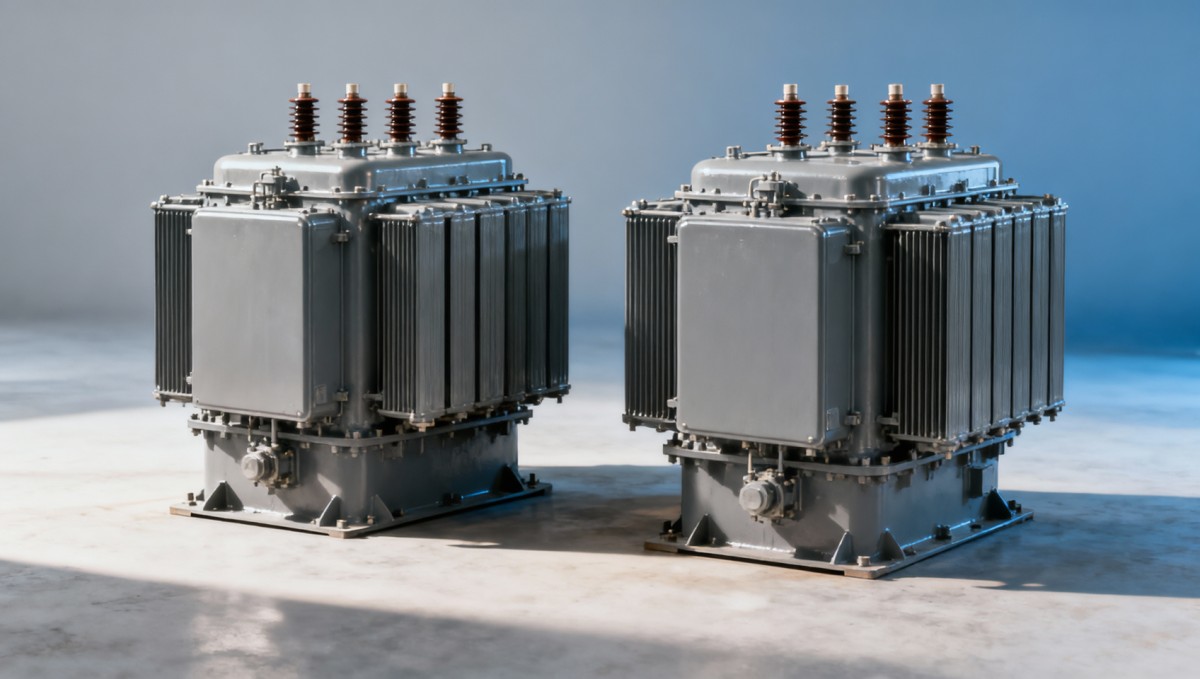
The method also applies when reviewing a distribution-network package rather than a large substation transformer. Jinshida Electric Power Technology Co., Ltd.’s 13.8kV Distribution Transformer is offered in the 30–2,500 kVA range, with low-voltage options including 0.4 kV and 0.480 kV and project-dependent 50 or 60 Hz configurations.
For industrial facilities or building distribution, request a project-specific schedule confirming the selected rating, voltage, frequency, connection group, and guaranteed losses. Customizable loss requirements are useful only when the resulting price and guarantees are evaluated together. Core construction and winding design can explain a loss-performance proposal, but they do not replace measured, contractually defined values.
Make uncertainty visible in the approval paper
A single lifecycle-cost number can look more certain than the operating forecast behind it. Present a base case alongside realistic downside and upside scenarios, concentrating on variables that could change the award decision.
Do not equate technical life with the investment holding period. A long-lived transformer installed at a site facing closure in ten years should not automatically receive decades of energy savings in the business case. Any residual value or redeployment benefit needs its own justification.
Keep reliability, maintenance, delivery risk, and spare-parts support visible but separate from loss capitalization. Monetize them where evidence supports doing so; otherwise, record them as explicit decision criteria. This avoids both ignoring operational risk and burying speculative benefits inside the energy model.
Turn the financial assumptions into contractual protection
The expected savings are only as credible as the guarantees supporting them. Before award, agree how losses will be tested, reported, and handled if measured results exceed contractual values.
The contract should identify the applicable test procedures, reference conditions, reporting requirements, and any purchaser witnessing or independent verification rights. It should also state how standards-based tolerances interact with the guaranteed limits and commercial remedies. A permitted test tolerance should not quietly become an unpriced allowance for higher lifetime energy costs.
Possible safeguards include:
- Defined acceptance thresholds for no-load loss, load loss, and any specified total-loss limit.
- Agreed excess-loss adjustments using stated factors and rules, without double-counting the same loss.
- Rejection, correction, or replacement provisions for deviations beyond agreed limits.
- Documented retesting and dispute procedures if results are challenged.
- Controlled design substitutions so material or manufacturing changes do not bypass the approved guarantees.
A financial adjustment does not necessarily make a materially noncompliant transformer acceptable. Engineering acceptance and commercial compensation serve different purposes and should remain distinct.
Approve the economics, not just the lowest number
A sound recommendation identifies the technically acceptable bidders, their normalized acquisition costs, guaranteed losses, buyer-issued capitalization factors, and sensitivity results. It also records the contractual protections behind the preferred offer.
When comparing power transformer manufacturers, the strongest choice is not automatically the lowest-priced unit or the one with the smallest loss figure. It is the compliant offer whose purchase premium, operating savings, and delivery obligations hold together under scrutiny.
That gives financial approvers something more valuable than an efficiency claim: a transparent investment case that colleagues can challenge, understand, and confidently authorize.

Get a Quote
Regardless of whether you require general advice or specific support, we are happy to help you.
Send Us Your Inquiry Today

Jinshida Electric remains committed to contributing to global energy development through professional manufacturing and superior service.