





How transport route limits affect power transformer supply
How transport route limits affect power transformer supply
A power transformer can meet every electrical specification and still miss its installation deadline if it cannot reach the site. Bridge load limits, tunnel clearances, tight turning radii, and transport permit requirements can reshape power transformer supply, affecting equipment dimensions, delivery schedules, and total project costs.
For project managers, these are design inputs—not details to leave until dispatch. A route restriction discovered before drawing approval may be manageable through equipment configuration or transport planning. The same restriction discovered after manufacturing can mean rework, storage, or a different delivery route. The practical task is to connect electrical selection, transport engineering, and site readiness early enough that each can influence the others.
The route sets a second specification for the transformer
Electrical specifications define what the transformer must do. The transport envelope defines how it can reach its operating position. Both must be satisfied, but they describe different conditions: operating weight is not necessarily shipping weight, and an installed general arrangement drawing is not a transport drawing.
A useful route assessment considers the complete loaded vehicle, including trailer height, supports, packaging, securing equipment, and any projections. Checking the tank dimensions alone can miss the actual clearance problem.
- Bridges and culverts: Approval depends on the loaded vehicle configuration, axle loads, axle spacing, and the structure—not simply the transformer’s total mass.
- Tunnels, overhead structures, and utilities: Loaded height and width need verification, with appropriate clearance allowances. Utility crossings may require separate coordination.
- Junctions and entrances: Long trailers need swept-path checks. A road can be wide enough for straight travel but unsuitable at a turn.
- Gradients and uneven surfaces: Ground clearance, vehicle articulation, traction, and load stability may become limiting factors.
- Ports and transfer points: Crane capacity, handling arrangements, storage space, and onward transport access can constrain the shipment before it reaches the road route.
The shortest route is therefore not automatically the preferred route. A longer journey may avoid a bridge assessment, a difficult transfer, or temporary works. That comparison requires a competent heavy-haul provider and, where necessary, structural or civil engineering review.
Use route findings before the design is frozen
The manufacturer needs a usable constraint, not a warning that “access is difficult.” Provide the verified maximum shipping envelope, transport mass restrictions, handling limitations, and site interface requirements. These limits should identify their assumptions, including the proposed trailer configuration and any components shipped separately.
For larger oil-immersed transformers, a manufacturer-approved shipping arrangement may involve removing radiators, bushings, conservators, or other external equipment. This can reduce dimensions, but it transfers work to the installation site. Assembly, controlled storage, oil processing, leak checks, and electrical testing must then be included in the scope and schedule.
Reducing shipping mass by changing the oil condition is not a decision for the haulage team alone. The manufacturer must define the permitted shipping condition, insulation protection, sealing arrangements, monitoring, and storage limits. A lighter shipment is not an improvement if it creates an uncontrolled moisture risk.
Nor should a transformer be laid on its side or tilted to clear an obstruction without explicit engineering approval. Internal supports and the active assembly are designed for defined handling conditions.
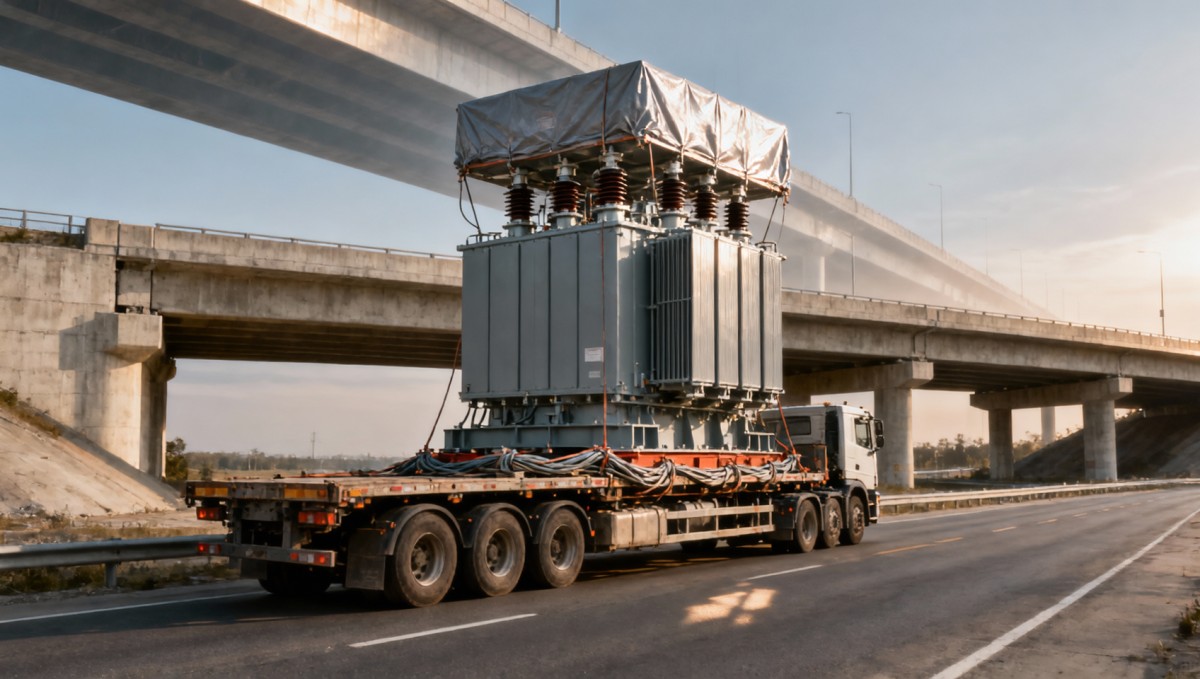
The transport drawing should show shipping dimensions, mass, center of gravity, lifting and jacking points, support locations, and separately packed components. Any later design change affecting these details needs a logistics review. Even a small projection can invalidate a clearance assessment.
When smaller units help—and when they do not
A restricted route sometimes prompts a proposal to replace one large transformer with several smaller units. That can simplify individual deliveries, but it changes the electrical and civil design. Protection coordination, fault levels, parallel operation, cable routes, losses, spare capacity, and maintenance access all need reassessment. More units do not automatically produce a cheaper or more resilient installation.
For distribution projects, however, smaller equipment may already fit the intended network architecture. Jinshida Electric’s Pole-Mounted Oil-Immersed Single-Phase Transformer is intended for applications such as suburban networks, agricultural supply, and rural distribution. Its listed range spans 5–500 kVA, with voltage options requiring confirmation for the selected configuration. The compact pole-mounted format can be relevant where access and installation space are limited.
That is a distribution-level option, not a substitute for a high-capacity substation transformer. Selection must still follow demand, voltage, phase arrangement, utility requirements, and protection design. Transport planning also needs the actual unit’s certified dimensions and shipping mass; a capacity rating alone cannot establish vehicle or lifting requirements.
Build the delivery schedule around approvals, not just factory completion
“Ready for dispatch” and “ready for energization” are different milestones. Between them may sit permit approvals, escort availability, port handling, restricted travel windows, unloading, assembly, oil treatment, and commissioning. A factory completion date is only one input to the project schedule.
Oversize and overweight transport rules vary by jurisdiction. Some movements may require route-specific approval, bridge review, police or private escorts, or coordination with road and utility operators. Exact requirements and approval periods must be confirmed locally rather than assumed from a previous shipment.
A workable programme links these activities through explicit release points:
- Before design approval: Establish a feasible route and preliminary shipping arrangement.
- Before transport booking: Confirm shipping data and identify outstanding permits, engineering reviews, and temporary works.
- Before factory release: Verify the route remains available and that unloading equipment, crews, and site access are ready.
- Before energization: Complete the required receiving inspections, reassembly, processing, and tests.
Route surveys also have a practical shelf life. Roadworks, resurfacing, temporary barriers, or changes around a site entrance can undermine an earlier assessment. Rechecking critical restrictions before movement is particularly important when manufacturing and delivery are separated by a long interval.
The final approach can be harder than the highway journey
Reaching the site gate does not complete delivery. The unloading area must accommodate the transport vehicle and the selected handling method. Crane access requires suitable ground conditions and working space; skidding or jacking requires engineered supports and a prepared transfer path.
Check temporary roads, buried services, trenches, drainage structures, and foundation edges against the expected loads. Apparently firm ground is not evidence of adequate bearing capacity. Likewise, an entrance that works on a plan may become unusable after fencing, cable installation, or adjacent construction narrows the approach.
Delivery sequencing matters here. Installing permanent barriers or completing surrounding equipment too early can remove the space needed for transformer positioning. The civil contractor, lifting contractor, and electrical installation team should agree on what must remain open until the unit is in place.
Compare the installed outcome, not the haulage quotation
A low transport price can conceal costs elsewhere. Removing accessories may lower haulage requirements but increase field assembly. An alternative port may reduce road restrictions while adding handling and storage. A specialized trailer may cost more but avoid temporary road modifications. These options should be compared on total delivered-and-installed cost and schedule exposure.
The commercial scope should identify responsibility for route surveys, permits, temporary works, unloading, oil handling, packaging disposal, supervision, and transport damage assessment. Delivery terms alone may not describe every technical interface. Unassigned tasks tend to appear when the shipment is already waiting.
Receiving inspection is another interface worth defining early. Depending on transformer size and manufacturer requirements, it may include visual inspection, review of shock-recorder data, checking seals or shipping pressure, and specified electrical or oil tests. Acceptance criteria and escalation procedures should be agreed before departure—not improvised after an abnormal reading.
Make transport feasibility part of the supply review
Jinshida Electric Power Technology Co., Ltd. develops and manufactures power transmission and distribution equipment for grid, industrial, renewable-energy, and infrastructure applications. For projects with access restrictions, useful manufacturer coordination means connecting electrical requirements with controlled shipping drawings, handling instructions, and installation requirements. Those documents make technical and quality-management capabilities relevant to the delivery plan.
Before approving power transformer supply, ask the manufacturer, logistics provider, and site team to work from the same drawing revision and constraint register. Confirm the complete shipping envelope, loaded-vehicle feasibility, approval status, unloading method, and remaining site work. Record who owns each unresolved item and when it must close.
If the route is still uncertain, the delivery commitment is uncertain too. Resolve the limiting bridge, clearance, turn, or handling operation while configuration choices remain available—not after the transformer is waiting at the factory gate.

Get a Quote
Regardless of whether you require general advice or specific support, we are happy to help you.
Send Us Your Inquiry Today

Jinshida Electric remains committed to contributing to global energy development through professional manufacturing and superior service.