






A damaged transformer bushing can turn routine maintenance into an extended outage, especially when the correct replacement is difficult to identify, approve, or source.
Yes, a power transformer supplier may provide replacement bushings, but availability alone does not establish compatibility. Maintenance teams need documented specifications, installation requirements, and delivery commitments.
The strongest answer is a traceable replacement proposal supported by drawings and technical review. Matching the transformer voltage or copying visible dimensions is insufficient.
This guide explains what to request, how to assess compatibility, and which support arrangements help after-sales maintenance teams restore equipment safely and reduce future delays.
What should a supplier provide before you approve a replacement?
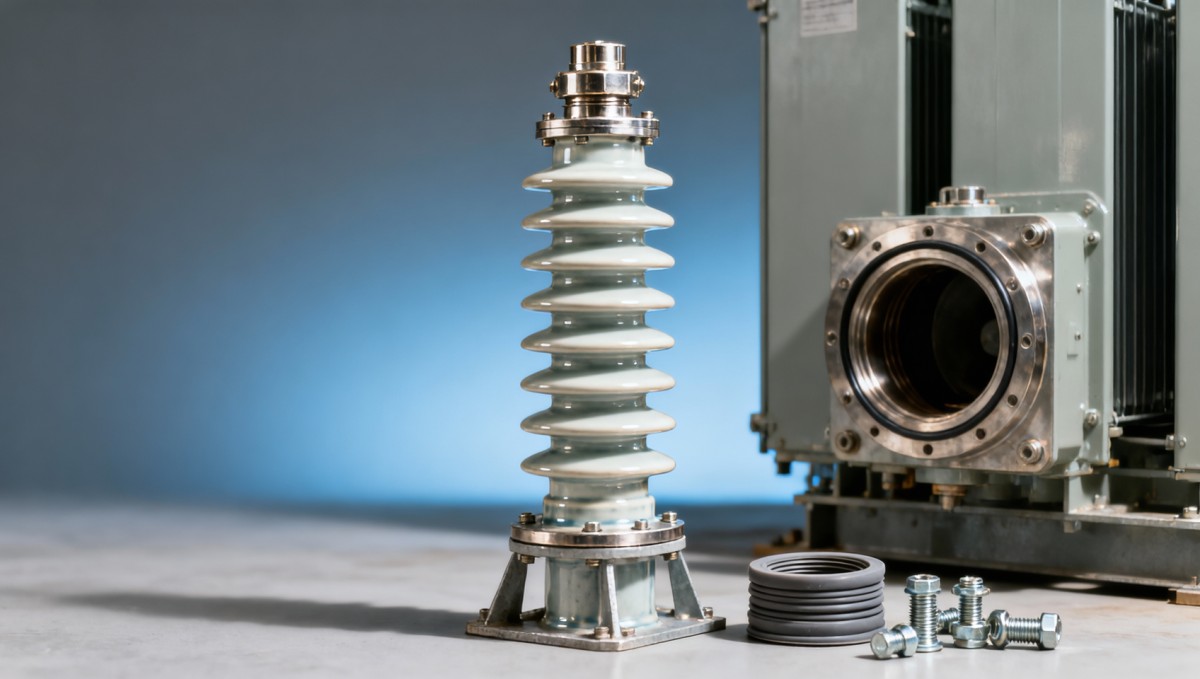
A useful quotation identifies the proposed bushing, its manufacturer, and its relationship to the installed component. Ask whether it is original, equivalent, or an engineered adaptation.
An original replacement still requires verification against the transformer serial number and current configuration. Previous repairs or design revisions can make historical records incomplete.
An equivalent replacement needs a documented comparison covering electrical ratings, mechanical interfaces, insulation conditions, and service environment. A verbal assurance does not resolve these questions.
For adaptations, establish who approves the design and which additional parts or checks are necessary. Changes to terminals or mounting arrangements can affect installation planning.
- Component identification: Original and proposed part numbers, manufacturer details, revision status, and the transformer models or serial numbers covered by the proposal.
- Technical evidence: A dimensioned drawing, relevant ratings, applicable standards, and available routine test reports or other agreed documentation for the supplied bushing.
- Installation scope: Required gaskets, terminal hardware, connectors, handling instructions, tightening guidance, and any oil handling or sealing requirements applicable to the transformer.
- Commercial commitment: Confirmed stock status, dispatch date, shipping terms, warranty conditions, and responsibility for resolving a mismatch discovered before or during installation.
Which specifications determine whether the bushing will fit and operate correctly?
Build the compatibility check around the actual installation. Transformer nameplate information establishes context, while the bushing drawing and equipment records define the replacement interface.
Electrical suitability includes the applicable equipment voltage class, insulation withstand levels, continuous current, and service conditions. A matching nominal system voltage does not establish equivalence.
Mechanical suitability includes dimensions inside and outside the tank. An external fit can conceal inadequate internal clearance, incorrect conductor engagement, or an incompatible sealing arrangement.
Relevant standards may include IEC 60137 or applicable IEEE bushing standards, depending on the equipment specification. Confirm the required standard and edition in writing.
Transformer compliance with IEC 60076 does not, by itself, demonstrate that a proposed replacement bushing meets every requirement for the specific installation being maintained.
What information should maintenance teams send with the enquiry?
A complete enquiry reduces clarification cycles and gives the supplier a realistic basis for technical review. Prepare one identification package before contacting potential replacement sources.
Photograph the transformer nameplate, bushing markings, terminal arrangement, mounting flange, and surrounding installation. Capture readable markings without approaching energized equipment or removing protective barriers.
Include existing drawings and maintenance records wherever available. Measurements taken from photographs can support identification, but perspective and scale make them unreliable for final approval.
- Equipment details: Transformer manufacturer, serial number, year, rated power, voltage ratio, connection group, installation location, and the affected phase or neutral position.
- Bushing details: Manufacturer, type designation, serial number where available, ratings, drawing reference, and photographs showing markings and the complete mounting arrangement.
- Failure information: Visible damage, leakage location, overheating evidence, protection events, recent test results, and whether the transformer remains energized or has been isolated.
- Site constraints: Required restoration date, access limitations, lifting arrangements, available maintenance personnel, delivery destination, and any restrictions affecting field installation or testing.
If identification remains uncertain, request a supplier drawing for controlled comparison during an authorized outage. Do not treat an uncertain measurement as a confirmed dimension.
Record missing information explicitly. A quotation based on assumptions should identify those assumptions and remain conditional until the responsible technical team verifies the outstanding details.
Can you use an equivalent bushing when the original is unavailable?
An equivalent bushing can be acceptable when qualified reviewers confirm its suitability. Interchangeability depends on the complete application, including insulation design, connections, mounting, and environment.
Ask the supplier to show differences against the original drawing. A comparison should identify deviations explicitly, including any changes requiring additional hardware or installation work.
Changing between insulation technologies requires specific review. Porcelain or composite housings describe external construction, while internal insulation design introduces separate compatibility and maintenance considerations.
Capacitance and dissipation factor measurements apply to relevant condenser bushings, following manufacturer instructions. They are not universal acceptance checks for every type of transformer bushing.
Similarly, a larger current rating or longer creepage distance does not automatically make a replacement suitable. Dimensions, clearances, terminal loading, and installation conditions still govern.
Where an original manufacturer no longer supplies parts, retain the approved replacement drawing and assessment. This creates a reliable reference for subsequent maintenance and procurement.
Will replacing the bushing solve the failure?
Before ordering, consider whether the damaged bushing is the primary failure or evidence of another problem. Replacing it without investigation can leave the cause unresolved.
Possible contributors include loose connections, excessive mechanical loading, contamination, damaged seals, abnormal electrical stress, or deterioration elsewhere in the transformer. Findings should guide the investigation.
Cracking, flashover, significant leakage, or signs of overheating warrant prompt assessment under site procedures. Continued operation requires a competent decision based on the actual condition.
Ask whether internal inspection or additional transformer testing is necessary, especially after a protection operation or suspected internal fault. The appropriate scope depends on evidence.
For liquid-filled equipment, establish whether replacement requires lowering the fluid level, controlling moisture exposure, or restoring specific filling conditions. Follow the applicable manufacturer’s procedure.
Assign installation to qualified personnel using approved isolation, grounding, lifting, and testing procedures. The required work sequence varies with transformer design and bushing construction.
How do you confirm delivery time and a complete installation package?
Ask your power transformer supplier to distinguish physical stock from factory availability. A catalogue listing does not confirm that the approved configuration is ready for dispatch.
Request separate dates for technical approval, manufacturing completion, testing, dispatch, and expected arrival. Identify which dates remain estimates and which depend on customer information.
The replacement package should include specified seals and hardware, or clearly identify items supplied separately. Missing installation accessories can delay restoration after the main component arrives.
Confirm packaging, transport orientation, handling restrictions, and receiving inspection requirements. Damage discovered after transport can invalidate an otherwise accurate outage plan and require another shipment.
Evaluate total restoration cost alongside purchase price: engineering, freight, installation, oil handling, testing, and downtime. A lower component price may carry additional site work.
For critical assets, agree on technical contact availability during the planned outage. Clarify warranty responsibility if the supplier provides parts while another contractor performs installation.
What changes for wind power transformer maintenance?
Wind projects can combine difficult access, outdoor contamination, and restricted maintenance windows. Offshore logistics may make a second visit substantially harder than obtaining complete documentation beforehand.
Jinshida Electric Power Technology Co., Ltd. develops and manufactures transmission and distribution equipment for applications including renewable energy, industrial facilities, and infrastructure projects worldwide today.
Its Transformer for Wind Power Generation covers 630–5000 kVA, with listed high-voltage options of 10, 20, or 35 kV and a 0.69 kV low-voltage rating.
The listed range includes three-phase, copper-wound outdoor configurations, 50 or 60 Hz options, ONAN or ONAF cooling, and IEC 60076 as the stated transformer standard.
These specifications help identify the equipment family, but replacement bushings must be checked against the individual unit’s records. Product range information cannot establish part interchangeability.
Maintenance teams should confirm replacement availability, drawings, accessories, and delivery arrangements directly with Jinshida Electric. The supplied product information does not establish particular bushing stock commitments.
How should you approve the purchase and prepare for future failures?
Approve the purchase when the technical comparison is accepted, delivery supports the outage plan, and installation responsibilities are clear. Resolve remaining assumptions before releasing the order.
At receipt, compare identification and visible condition with approved documents. Complete installation and return-to-service checks according to manufacturer instructions, equipment requirements, and applicable site procedures.
Archive the installed part number, drawing revision, test records, and installation date. Update equipment records so future enquiries begin with verified information rather than identification guesses.
For critical transformers, assess spare holdings using outage consequences, supplier lead time, fleet commonality, and storage requirements. A shared spare needs confirmed compatibility across each intended unit.
A capable power transformer supplier should support a documented replacement decision. The practical test is whether your team can verify compatibility and plan installation confidently.
Before the next failure, build an approved parts record and confirm supply arrangements. That preparation can shorten procurement delays and make the eventual maintenance outage more predictable.
