





Is a 22 kVA open frame genset enough for a small workshop?
A 22kVA open frame genset can be enough for a small workshop, but only when the workshop has a controlled load profile and does not start several motor-driven machines at the same time. It is usually suitable for essential lighting, hand tools, small compressors, ventilation, office loads, and one moderate machine operating at a time. It is often too small for workshops that combine welding, large air compressors, pumps, electric heaters, and multiple production machines during the same shift.
The purchase decision should not be based on the total number of appliances in the building. The more useful question is: what must run simultaneously, what has the highest starting demand, and what happens if grid power fails during production? A generator that appears adequate on a nameplate calculation can still struggle when a motor starts, a welder strikes an arc, or a compressor cycles on unexpectedly.
What 22 kVA means in practical workshop use
Generator capacity is commonly stated in kVA, while workshop equipment may be rated in kW, horsepower, amps, or sometimes only voltage and current. These figures are related, but they are not interchangeable without understanding the type of load.
A 22 kVA generator will normally provide less usable active power than 22 kW because electrical equipment has a power factor. For a typical mixed workshop load, it is prudent to treat the available continuous working power as lower than the headline kVA rating. The exact usable output depends on the generator's specified power factor, alternator design, ambient conditions, and whether the listed rating is prime or standby duty.
This distinction matters because generators should not be selected to operate continuously at their absolute limit. A unit running with little reserve may experience voltage dip, frequency variation, overheating, excessive fuel use, or shortened service life. It may also leave no capacity for a tool that is switched on later in the day.
For a basic workshop with LED lighting, a few computers, extraction fans, battery chargers, hand tools, and a small compressor that does not start under heavy load, a 22 kVA unit may offer a practical operating margin. For a fabrication shop where a compressor, welding machine, cutting equipment, and extraction system regularly overlap, the same unit can become a source of interruptions rather than a solution.
The load list is more important than the workshop size
Floor area does not determine generator capacity. A compact workshop with one high-demand machine can need more generation capacity than a larger space used mainly for assembly, maintenance, or storage.
Start with an equipment list and separate it into three groups: loads that must remain live, loads that may run together, and loads that can be manually sequenced. This produces a more realistic basis for selecting a genset than simply adding every nameplate rating.
The largest motor is often the first item to examine. An induction motor can draw substantially more current during starting than while running. A compressor that runs comfortably after it is up to speed may cause the generator voltage to dip when it restarts. If lights dim, electronic controls reset, or a motor fails to accelerate promptly, the issue is often starting demand rather than the normal running load.
Soft starters, variable-speed drives, and staged starting can reduce the burden on a generator, but they do not automatically make every load suitable for a smaller unit. Drive-based equipment may introduce harmonic currents, and some electronically controlled machines are sensitive to poor voltage or frequency stability. The equipment supplier should be able to identify startup current, allowable voltage variation, and whether the machine has special generator requirements.
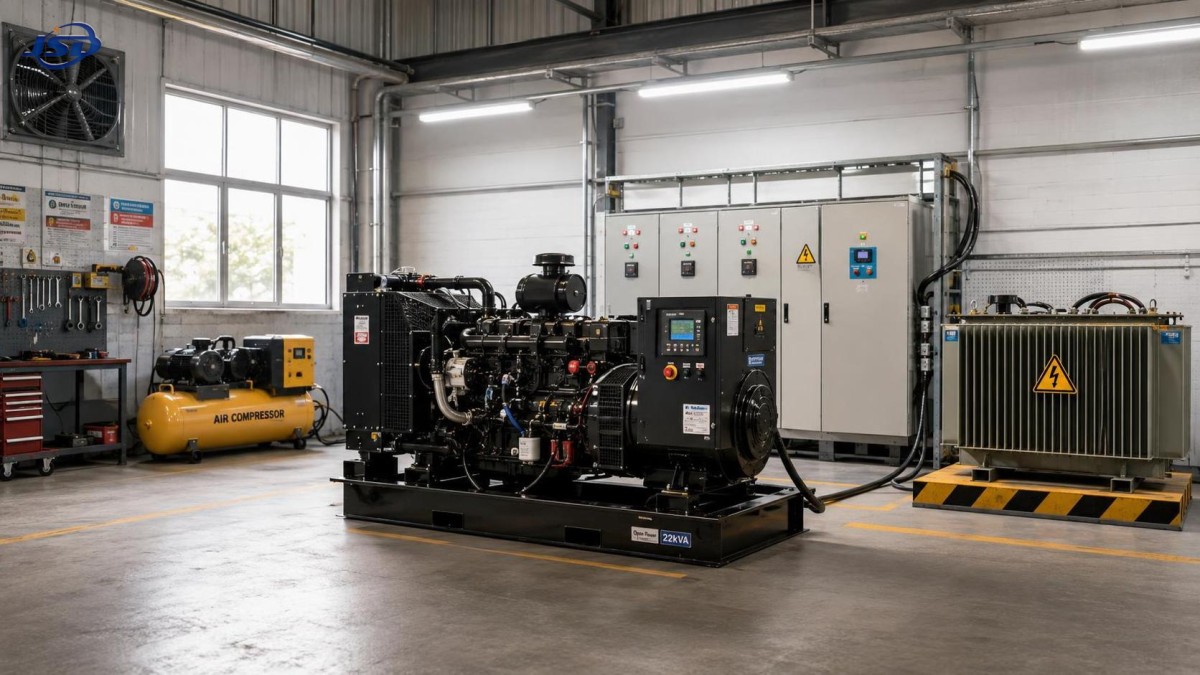
When a 22 kVA open frame genset is a sensible choice
An open frame generator is generally most appropriate where low initial cost, easy access for servicing, and portable or semi-permanent use matter more than low noise. It can work well as a backup source for a workshop that can pause nonessential processes during an outage, or as a primary source at a temporary site with a predictable and limited load.
A 22 kVA model is more likely to be sufficient under conditions such as these:
- The workshop mainly uses lighting, small power tools, chargers, extraction, and one modest motor load at a time.
- Large loads can be scheduled so that they do not start together.
- Welding is occasional and other heavy equipment can be switched off while it is in use.
- The generator is intended for essential backup circuits rather than the entire distribution board.
- The working environment has suitable ventilation, weather protection, access clearance, and a safe location away from staff and combustible materials.
- Noise is acceptable at the proposed installation location or the generator will be operated only during limited hours.
This last point deserves attention. “Open frame” describes a practical construction style, not a complete installation solution. It normally offers less acoustic attenuation and less environmental protection than an enclosed canopy unit. A generator placed near workstations, neighbors, offices, or loading areas can create an operational issue even when its electrical capacity is correct. Exhaust routing, heat dissipation, rain protection, fuel storage, vibration control, and cable protection need to be addressed before commissioning.
Situations where the answer is probably no
A 22 kVA generator is unlikely to be a comfortable choice if the workshop depends on several motor loads, larger welding equipment, electrically heated processes, or machinery that cannot tolerate a short voltage disturbance. It may also be undersized if it must start a large compressor while supporting extraction fans, refrigeration, lighting, and other production loads.
Welding deserves a separate check. Welder input demand varies with process, output setting, duty cycle, and power factor. A machine's maximum input rating is more relevant than its output current alone. A small inverter welder used intermittently may be compatible with a 22 kVA supply when other loads are controlled. A workshop that expects continuous welding while a compressor and extraction system operate is a different application and should be assessed as a combined load.
Electric heaters, ovens, and resistance heating are less complicated from a starting-current perspective, but they consume substantial continuous power. They can quickly use the reserve needed for motors and leave the generator operating too close to its limit. Similarly, a generator that only supports a workshop after all nonessential circuits have been shed should not be presented as a full-site backup system.
Do not confuse generator capacity with power quality
Capacity answers whether the generator can supply the load. Power quality answers whether the connected equipment can operate reliably while it does so. Workshops with variable-frequency drives, CNC controls, rectifiers, battery charging systems, or sensitive instrumentation need to consider both.
Rectifier loads convert AC to DC and can affect current waveform and voltage stability. In heavier industrial processes such as electroplating, electrolysis, chemical processing, mining, or dedicated power-electronic systems, the generator alone is rarely the entire design question. Isolation, voltage transformation, grounding arrangement, harmonic behavior, and the rectifier's input characteristics must be considered together.
For these applications, an Isolation and Rectifier Special Transformer may be relevant on the process-power side of the system. Such transformers are designed to provide electrical isolation and voltage transformation for rectifier equipment, with configurations tailored to industrial supply conditions. They do not increase the capacity of a 22 kVA generator, and their stated capacity range begins well above this small genset size. Their relevance is therefore a signal that the workshop may have moved into a more specialized power-system design, where a larger generator and coordinated transformer-rectifier selection are likely to be more appropriate.
This is a common point of confusion: installing additional electrical equipment cannot compensate for an undersized source. Protective devices, transformers, automatic transfer switches, and distribution panels must all be correctly selected, but none of them creates spare generator capacity.
A practical way to size the generator before ordering
Use the following sequence before making a final selection.
- List every expected load. Record rated input power, voltage, phase, starting method, and whether the load is continuous, intermittent, or emergency-only.
- Identify the simultaneous operating condition. Build the calculation around the busiest realistic operating period, not the quietest one.
- Find the largest starting demand. Check compressors, pumps, extraction motors, saws, refrigeration units, and any equipment started under load.
- Separate essential and nonessential circuits. A smaller generator can be viable if noncritical heating, large machinery, and convenience loads are intentionally excluded during generator operation.
- Allow operating reserve. Select a capacity that can absorb normal changes in demand without constant high-load operation.
- Check the generator duty rating. Backup use, temporary prime power, and long-hour daily operation place different demands on the equipment.
- Review the installation as a system. Confirm cable sizing, earthing, transfer arrangement, breaker coordination, ventilation, fuel handling, and the required single-phase or three-phase output.
For three-phase workshops, load balance is also important. A generator can be stressed by an uneven distribution of single-phase loads even when the total calculated demand seems acceptable. Spread lighting, socket circuits, and single-phase equipment across phases where possible. A qualified electrical designer or generator supplier can convert the actual equipment schedule into a starting and running load assessment.
Primary power and emergency power are different decisions
A generator used occasionally during utility outages can tolerate a more restricted operating plan. Staff may stop production machinery, run lighting and essential ventilation, protect work in progress, and restart selected equipment in sequence. Under this approach, a 22 kVA open frame genset can provide useful resilience to a small operation.
Primary power changes the threshold. If the generator will run for long daily periods, the decision should account for fuel logistics, maintenance intervals, noise exposure, operator procedures, and the cost of downtime caused by a single source failure. A unit that is barely large enough electrically may not be the most economical or durable choice operationally.
There is also a difference between keeping the workshop safe and keeping it productive. Emergency power may only need to support lighting, security, a small pump, communications, and controlled shutdown. Production continuity may require compressors, extraction, machine controls, material handling, and process equipment. State which objective applies before comparing genset sizes.
The purchase decision in one sentence
Choose a 22 kVA open frame genset when the workshop has a measured, managed load profile with modest simultaneous demand and no large motor or process equipment that must run together. Move to a larger or more specialized power solution when production depends on heavy starting loads, continuous welding, heat-based processes, sensitive electronics, or industrial rectifier systems.
The most useful next step is to prepare a one-page load schedule from actual equipment nameplates and define what must remain operating during a power interruption. That exercise usually makes the answer clear before a generator is purchased, installed, and asked to support a workload it was never sized to carry.

Get a Quote
Regardless of whether you require general advice or specific support, we are happy to help you.
Send Us Your Inquiry Today

Jinshida Electric remains committed to contributing to global energy development through professional manufacturing and superior service.