





How to assess a 400 kVA diesel generator manufacturer's capacity
How to Assess a 400 kVA Diesel Generator Manufacturer’s Capacity
Selecting a 400 kVA diesel generator manufacturer is rarely a simple exercise in comparing quotations. For a procurement team, the stated power rating is only one part of the decision. The more difficult questions are often hidden behind the proposal: Can the supplier build consistently to the required configuration? Will the generator perform under site conditions? Can drawings, testing records, spares, and technical responses arrive when the project schedule demands them?
A 400 kVA diesel generator may serve as standby power for a hospital wing, a data and communications facility, a commercial complex, a manufacturing line, or an infrastructure project. In these settings, a generator failure is not merely an equipment issue. It can interrupt operations, delay commissioning, expose the owner to penalties, and create avoidable safety risks. A sound assessment therefore looks at the manufacturer’s real delivery capacity—not only its catalog or sales presentation.
The following framework helps buyers evaluate suppliers with a practical focus on performance, cost control, and long-term support.
Start by confirming what “400 kVA” means for the project
Before assessing a manufacturer, make sure the requested rating is properly defined. A 400 kVA set at a power factor of 0.8 corresponds to approximately 320 kW. Yet this number alone does not establish whether the unit is correctly sized for the installation.
Ask whether the required rating is for prime power, standby power, or continuous-duty use. Prime-rated operation allows variable loads over extended periods, while standby use is intended for emergency operation during utility outages. Treating these ratings as interchangeable can lead to an undersized engine, excessive fuel consumption, shortened equipment life, or disputes after installation.
Load behavior matters as much as total load. Large motors, elevators, pumps, chillers, welding equipment, rectifiers, and nonlinear electronic loads can create transient demand that a basic rating calculation may overlook. A capable manufacturer should be willing to review the load list, starting sequence, expected load steps, site voltage, frequency, and ambient conditions. If the discussion never moves beyond “400 kVA is available,” the supplier may be selling a standard package rather than engineering a project-ready solution.
Look beyond the assembly area: evaluate manufacturing depth
Not every company that sells generator sets manufactures them to the same extent. Some suppliers integrate engines, alternators, controllers, and enclosures sourced from third parties; others have stronger in-house capabilities for canopy fabrication, control-panel wiring, base-frame construction, system integration, and testing. Either model can work, but buyers should understand where responsibility lies.
A meaningful factory assessment should cover the full production path:
- Incoming inspection of engines, alternators, breakers, batteries, controllers, and fuel-system components;
- Fabrication and corrosion protection of the skid, tank, exhaust components, and acoustic enclosure;
- Electrical assembly practices, cable identification, terminal quality, grounding, and panel workmanship;
- Document control for bills of materials, drawings, revisions, and customer-specific configurations;
- Load testing capability and the process used to record test results before shipment;
- Final inspection, packing protection, and dispatch coordination.
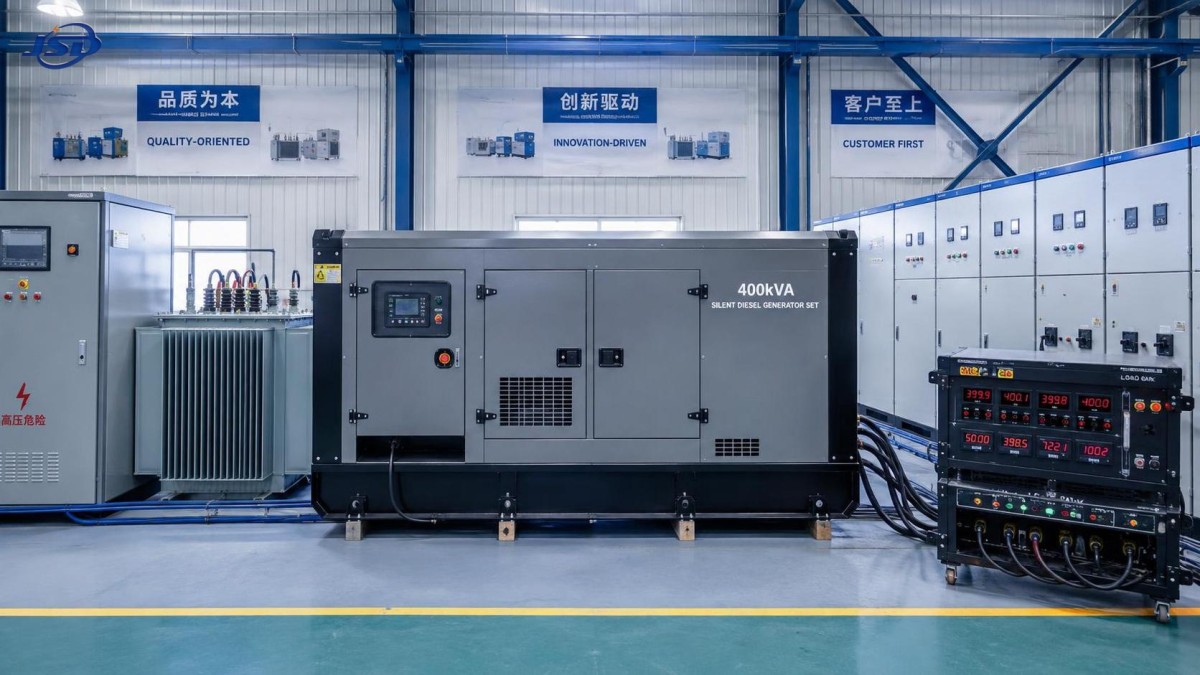
A factory visit is ideal for high-value or schedule-sensitive projects, but remote evaluation can still be effective. Request recent production photos or videos that show serial-number traceability, test arrangements, control panels, canopy assembly, and packing methods. Generic marketing images are not enough. The evidence should help a buyer see whether the manufacturer can repeatedly deliver comparable units—not just assemble a sample for inspection.
Quality control is visible in the details
Generator reliability is often decided by small details that are easy to miss during quotation review. Poor cable routing, undersized terminals, inconsistent welding, unprotected connectors, inadequate vibration isolation, or weak door seals may not prevent a unit from starting during a brief test. Over time, however, these details can contribute to faults, corrosion, water ingress, excessive noise, and difficult maintenance.
Ask the supplier to explain its inspection points from component receipt through final acceptance. A useful quality plan should identify what is checked, how it is measured, who signs off, and how nonconforming items are handled. For example, the manufacturer should be able to describe checks for fluid leaks, battery charging, engine protection alarms, voltage and frequency stability, insulation condition, emergency stop operation, breaker function, and controller indications.
Factory acceptance testing deserves particular attention. The buyer should clarify whether the generator will be tested at no load only or under a suitable load bank. A no-load run confirms basic starting and control functions, but it does not fully demonstrate performance under demand. For critical installations, the testing scope should address load steps, protective shutdowns, output stability, and documentation of measured values.
For projects tied to power distribution systems, coordination is equally important. The generator’s breaker settings, automatic transfer switch logic, earthing arrangement, cable termination requirements, and protection philosophy must fit the wider electrical design. Suppliers with experience in transmission and distribution equipment integration tend to recognize that the generator is part of a larger power system, not an isolated machine.
Check the engineering response before placing the order
The pre-order stage is often the best predictor of post-order service. Send a concise but realistic technical inquiry and observe how the manufacturer responds. Do they ask clarifying questions? Are deviations openly identified? Are drawings and data sheets internally consistent? A supplier that answers quickly but vaguely may create more work once production begins.
At a minimum, a technically credible quotation for a 400 kVA set should address engine and alternator configuration, voltage and frequency, rated speed, duty rating, fuel tank arrangement, cooling method, controller functions, breaker type, enclosure requirements, noise expectations, and optional ATS or remote monitoring. If the unit will operate outdoors, the manufacturer should also discuss weather protection, ventilation, access for service, exhaust routing, and site temperature or altitude limitations.
One practical reference point is a Silent Canopy Diesel Generator Set configured within a 50 kVA–500 kVA prime-power range. For buyers considering a 400 kVA application in a noise-sensitive area, the enclosure design can be as important as the engine selection. A powder-coated galvanized-steel canopy, IP54 protection, enclosed water cooling, intelligent LCD control, and a stated 65–75 dB noise level at 7 m are the kinds of specifications that should be reviewed against the actual installation plan rather than accepted in isolation.
For example, a hospital, hotel, school, office building, residential community, or communication station may have strict expectations around noise, access, and emergency continuity. In such cases, procurement should ask how acoustic performance is measured, whether intake and exhaust paths affect the stated level, and what maintenance access remains once the unit is positioned on site.
Delivery capacity is more than a promised lead time
Buyers often focus on the delivery date shown on the quotation, but delivery reliability depends on component availability, production planning, engineering approvals, test scheduling, packing, and logistics preparation. A manufacturer with a realistic plan will be able to explain the sequence between deposit, drawing confirmation, material release, assembly, testing, inspection, and shipment.
Ask direct questions: Which key components are routinely stocked and which are ordered for each project? What is the procedure if an engine, alternator, controller, or breaker is delayed? Who approves technical changes? How is the final delivery date communicated if the customer’s drawings are revised? Clear answers do not eliminate supply-chain risk, but they reveal whether the supplier manages it professionally.
Packaging also deserves attention, especially for export shipments or remote construction sites. The manufacturer should protect the control cabinet, batteries, exterior surfaces, and loose accessories from moisture, vibration, and handling damage. Shipping documents, operation manuals, wiring diagrams, test reports, spare-parts lists, and commissioning guidance should be included in the agreed deliverables—not treated as optional paperwork at the end.
Compare total ownership cost, not only generator price
The lowest initial offer can become the most expensive option when fuel use, maintenance access, spare parts, downtime, or commissioning changes are considered. Procurement teams should compare suppliers on a like-for-like basis and identify omissions before evaluating price.
When comparing bids, build a normalization sheet. List each technical and commercial item line by line, including rating basis, enclosure, controller, breaker, ATS, tank capacity, test requirement, documentation, delivery terms, and after-sales support. This process often exposes why one price is lower—and whether the difference is acceptable for the project.
Assess service readiness with realistic scenarios
After-sales service should be tested through practical questions rather than broad assurances. If a controller alarm appears during commissioning, who reviews the fault information? If the generator starts but does not transfer load, what remote support is available? If a replacement part is needed, how is it identified and supplied? The supplier’s answers should show a defined technical process, not simply a sales contact number.
For international procurement, request English manuals, wiring diagrams, operation and maintenance instructions, and a clear contact path for technical escalation. Remote monitoring, when specified, can support preventative attention by allowing operators to review operating status and alarms. However, it should complement—not replace—local maintenance routines, fuel management, periodic load testing, and trained site personnel.
Jinshida Electric Power Technology Co., Ltd. approaches power equipment as part of a broader transmission and distribution environment. For buyers, this perspective is valuable when a generator must work alongside switchgear, transformers, ATS panels, protection devices, and site distribution networks. The aim is not merely to deliver a diesel set, but to support a stable and workable power arrangement for industrial, infrastructure, new-energy, and grid-related applications.
A short decision checklist for the final supplier review
Before issuing a purchase order, confirm that the selected 400 kVA diesel generator manufacturer can provide a technically matched rating, documented component configuration, controlled manufacturing process, relevant load-test evidence, realistic production plan, complete scope definition, and accessible support after shipment. Review all commercial assumptions alongside the technical proposal, especially items that can affect installation cost or lead time.
The strongest supplier is not necessarily the one with the most polished brochure or the lowest quote. It is the one that can explain how the equipment will be built, tested, delivered, integrated, and maintained—without avoiding the difficult project questions. That level of clarity gives procurement teams a firmer basis for controlling cost today and reducing operational uncertainty long after the generator has been installed.

Get a Quote
Regardless of whether you require general advice or specific support, we are happy to help you.
Send Us Your Inquiry Today

Jinshida Electric remains committed to contributing to global energy development through professional manufacturing and superior service.