





How to compare power transformer manufacturers for high-voltage projects
Start with the project duty, not the nameplate
When technical evaluators compare power transformer manufacturers for a high-voltage project, the first mistake is often treating the transformer as a standalone item. A quotation may list the same voltage ratio, MVA rating, impedance range, cooling method, and basic standards as a competing offer, yet the two units may behave very differently over a 25- to 40-year service life.
The real question is not simply whether a manufacturer can build a transformer to the requested rating. It is whether that manufacturer can translate the actual operating duty into a design that remains reliable under the project’s electrical, environmental, logistical, and maintenance constraints.
For a grid interconnection transformer, this may mean surviving repeated system faults, voltage fluctuations, and strict utility acceptance procedures. For an industrial plant, the concern may be harmonic loading, frequent process starts, contamination, limited outage windows, or the need to coordinate with an existing protection system. Renewable energy projects add another layer: variable generation, remote locations, aggressive weather exposure, and pressure to commission within a narrow construction schedule.
Price is relevant, but it is not an adequate technical filter. A lower initial purchase price can lose significance quickly if the unit has inadequate thermal margin, limited monitoring provisions, difficult access to spare parts, or a delivery schedule that delays energization of the wider project.
Define the electrical operating envelope before requesting bids
A robust comparison begins with a complete duty specification. Many procurement packages state nominal voltage, rated capacity, vector group, impedance, and cooling class, but leave critical operating conditions open to interpretation. That creates a situation in which suppliers price different assumptions while appearing to quote the same equipment.
Technical teams should define the conditions that materially influence transformer design and life expectancy:
- System voltage range, frequency, grounding method, and insulation coordination requirements.
- Maximum and expected continuous load, seasonal loading profile, overload duty, and future expansion allowance.
- Short-circuit levels at each terminal, fault-clearing time, and through-fault withstand expectations.
- Ambient temperature range, altitude, humidity, pollution severity, seismic requirements, wind exposure, and site accessibility.
- Harmonic content, converter loads, solar or wind generation characteristics, and expected power-quality conditions.
- Tap changer duty, voltage-regulation philosophy, parallel-operation requirements, and protection interface.
- Applicable customer specifications and the edition of IEC, IEEE, ANSI, or local grid standards that governs acceptance.
These inputs should be converted into contractual requirements rather than left as informal design notes. For example, “high ambient temperature” is not sufficient. The tender should state the design ambient, maximum temperature, average temperature where relevant, and whether the supplier must provide a temperature-rise guarantee under that condition. Likewise, “suitable for renewable energy” is not a meaningful requirement unless the expected load profile, harmonics, voltage variation, and site conditions are defined.
Comparing bids becomes much more defensible once every supplier is responding to the same duty envelope. It also reduces the likelihood of discovering late in the engineering phase that an apparently standard design needs costly modifications.
Assess design capability through evidence, not brochure language
Most established power transformer manufacturers can describe their products as reliable, efficient, and compliant. The differentiator is the evidence behind those claims. Technical evaluation should focus on whether the supplier can explain its design decisions, identify critical margins, and demonstrate repeatable engineering control.
Ask for a design review that goes beyond a nameplate data sheet. The manufacturer should be able to discuss insulation structure, conductor selection, winding arrangement, short-circuit mechanical strength, cooling circuit design, dielectric coordination, core-loss approach, and tank pressure capability. For larger or more critical units, the discussion should also address electromagnetic forces during faults, hot-spot calculation assumptions, transport limitations, and the basis for sound-level predictions.
Thermal design deserves particular scrutiny. A transformer can meet its rated temperature-rise limit in a factory test while having little resilience to high ambient conditions, obstructed cooling, dirty radiators, cyclic loading, or degraded auxiliary power. Evaluators should distinguish between compliance with a minimum temperature-rise criterion and a design that has practical operating margin. The manufacturer’s stated loss figures, cooling equipment arrangement, thermal model, and loading guidance should be reviewed together.
Short-circuit withstand is another area where quotations can look comparable while underlying design confidence differs. The requested impedance affects fault current, voltage regulation, parallel operation, losses, and mechanical stress. A supplier that simply accepts a requested impedance without checking system implications is not adding technical value. A credible manufacturer should flag unusual combinations of impedance, voltage ratio, tap range, capacity, and fault level before production begins.
For projects involving rectifiers, arc furnaces, variable-speed drives, battery systems, or inverter-based generation, harmonic duty requires a separate assessment. Additional eddy-current losses, stray losses, heating in leads and structural parts, and neutral loading can change the practical capability of the transformer. Do not assume that a standard utility transformer is automatically suitable for a converter-heavy industrial or renewable application.
Factory discipline is as important as design drawings
A technically sound drawing package does not guarantee a sound transformer. Manufacturing quality depends on the supplier’s control of materials, winding processes, drying, assembly, welding, oil handling, and final testing. These are not cosmetic details; they influence insulation moisture, partial discharge behavior, leakage risk, mechanical strength, and long-term reliability.
During supplier assessment, request visibility into the production and quality system rather than relying only on certificates. ISO 9001 certification may indicate a documented quality-management framework, but it does not by itself prove that a factory can consistently manufacture a high-voltage transformer for a demanding project.
Useful questions include:
- How are core steel, copper or aluminum conductors, insulation paper, bushings, tap changers, and insulating oil qualified and traced?
- What process controls prevent winding deformation and insulation damage during assembly?
- How is active-part moisture managed before tanking, and what records are retained for drying and oil processing?
- Which operations are performed in-house, and which critical components are sourced externally?
- What nonconformity process applies when test results, dimensions, or material records deviate from requirements?
- Can the manufacturer provide reference data for similar voltage class, capacity, climate, and application duty?
A factory audit is particularly valuable for high-consequence transformers or first-time supplier relationships. It should examine production flow, test-bay capacity, material storage, cleanliness, documentation practices, and the supplier’s ability to manage peak workload. A well-presented assembly area is less important than whether the factory can show traceable process records and respond clearly to technical questions.
Make testing a decision gate, not a final formality
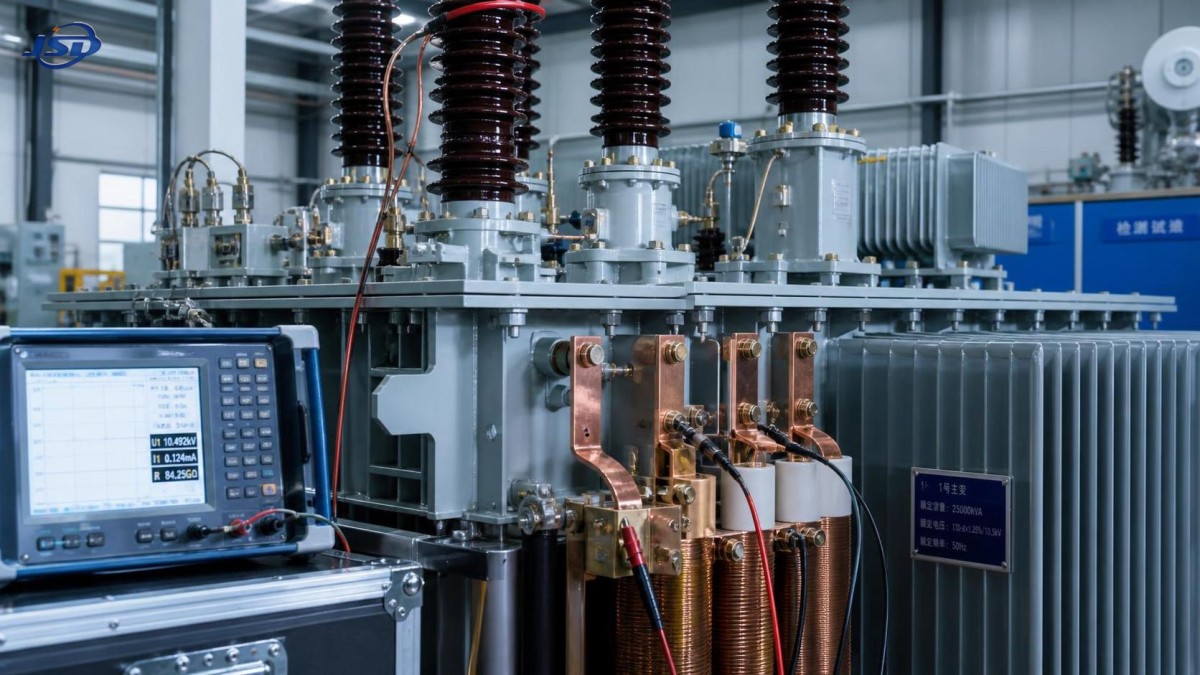
Testing is where technical assumptions become measurable. The purchaser should define routine, type, special, and witness-test requirements early, with clear acceptance criteria and reporting expectations. The applicable standard must be confirmed against the project contract because test scope and terminology can vary by governing standard, utility requirement, and transformer type.
Routine tests typically confirm core electrical characteristics and insulation performance. For critical high-voltage projects, evaluators may also consider specified tests such as lightning impulse testing, switching impulse testing where applicable, induced-voltage testing with partial discharge measurement, short-circuit capability evidence, sound-level measurement, temperature-rise testing, and oil analysis. The right scope depends on voltage class, project risk, and the consequences of an in-service failure.
Do not treat a test certificate as a pass/fail document only. Review the underlying results. Compare measured losses with guaranteed values, impedance with the permitted tolerance, ratio and vector group with system requirements, and partial discharge readings with the agreed criteria. Ask how any repeated tests, unusual waveforms, or deviations were handled. If a transformer fails a test and is reworked, the corrective action and retest evidence should be documented.
The manufacturer’s test-bay capability also matters. A supplier may outsource certain high-voltage tests, which is not automatically unacceptable, but responsibilities, schedule risk, calibration traceability, and witness access should be clear. Where the project has strict utility acceptance conditions, confirm that the proposed test arrangement satisfies the utility before the purchase order is released.
Compare the full supply package, not only the main transformer
High-voltage transformer performance is influenced by accessories and interfaces. Bushings, on-load tap changers, cooling fans and pumps, protection relays, oil preservation systems, marshalling kiosks, monitoring devices, cable boxes, and control wiring should be included in the technical comparison. A strong main tank combined with poorly selected auxiliaries can still create maintenance problems and forced outages.
Review the proposed component brands, technical ratings, service history, local availability, and compatibility with the owner’s maintenance practices. An on-load tap changer, for example, may become the most maintenance-intensive element of a grid transformer. Its duty rating, oil compartment arrangement, diagnostic access, spare-parts lead time, and service support warrant their own review.
Consider the site architecture as well. In medium-voltage distribution projects, the transformer may be supplied as part of a compact, integrated arrangement rather than as an isolated piece of equipment. A European-Type Compact Substation can be a relevant reference approach for industrial parks, commercial buildings, ports, renewable installations, or temporary supply applications where switchgear, transformer, metering, and low-voltage distribution must work within a constrained footprint.
That example does not remove the need for engineering review. For compact substations with ratings up to 35 kV and transformer capacities in the 100 kVA to 2500 kVA range, assess enclosure ingress protection, ventilation, internal arc considerations, busbar temperature rise, corrosion resistance, cable-entry arrangement, access for maintenance, and the suitability of the enclosure material for the local climate. A compact solution may reduce civil work and field installation effort, but it can also make thermal management and future expansion more constrained.
Delivery reliability should be tested against the real project schedule
Transformer lead time is not only a factory production issue. It includes engineering approval, procurement of critical components, manufacturing slots, testing, packing, transport, site delivery, installation support, and commissioning readiness. A supplier that offers an attractive headline delivery date but has not identified long-lead bushings, tap changers, radiators, or transport permits may introduce more project risk than a manufacturer with a slightly longer but well-supported schedule.
Request a milestone schedule that identifies design submission dates, approval windows, material release points, factory inspection, test dates, shipping readiness, and document delivery. Check whether the proposed schedule includes reasonable time for purchaser review. Late drawing approval is frequently attributed to the customer, but it can also result from incomplete or poorly coordinated supplier documentation.
Logistics must be reviewed early for high-voltage units. Transport weight, dimensions, axle loads, route restrictions, lifting points, oil shipment method, site assembly needs, and storage limitations can affect both cost and schedule. For remote renewable sites or congested urban infrastructure projects, these issues may determine the feasible transformer configuration before electrical design is finalized.
Evaluate lifecycle support as a technical requirement
A transformer purchase decision extends beyond factory acceptance. Technical evaluators should confirm what happens after energization, especially when the site has limited maintenance resources or when an outage has high commercial consequences.
Review the supplier’s commissioning scope, field-service coverage, response process, training approach, recommended spares, documentation quality, and ability to support diagnostics. The supplied operation and maintenance manuals should be specific to the ordered unit, not generic marketing literature. They should identify inspection intervals, oil-management guidance, alarm settings, tap-changer maintenance requirements, cooler maintenance, and troubleshooting paths.
For important assets, monitoring provisions should be considered during design rather than added later. Depending on the project, this could include oil and winding temperature monitoring, dissolved-gas monitoring, moisture measurement, bushing monitoring, tap-changer condition monitoring, or cooling-system alarms. The appropriate system depends on asset criticality and the owner’s capability to act on the data. More sensors do not improve reliability if alarm ownership, data interpretation, and maintenance response are unclear.
Use a weighted comparison that exposes tradeoffs
A bid tabulation based only on price and compliance checkboxes tends to hide meaningful differences. A weighted technical-commercial matrix is more useful when it separates mandatory requirements from comparative strengths. Mandatory conditions might include voltage class, capacity, standards, fault withstand, losses, test scope, site environment, and delivery deadline. Suppliers that cannot meet these should not be rescued by a low commercial score.
The weighting should reflect the project. A utility transformer for a critical substation may prioritize proven design references, test capability, and lifecycle service. A fast-track industrial expansion may assign additional weight to engineering responsiveness, compact integration, and site-delivery certainty. A renewable plant may place greater emphasis on environmental resilience, remote diagnostics, and transport practicality.
One final caution: a long reference list is useful only when it is comparable. Ask whether the reference units operate at a similar voltage class, capacity, load profile, climate, and service duration. A manufacturer with many small distribution-transformer deliveries may still need to demonstrate its capability for a large high-voltage, on-load tap-changing project. The strongest selection decision is one where the technical record, factory capability, testing plan, delivery logic, and support model all point in the same direction.

Get a Quote
Regardless of whether you require general advice or specific support, we are happy to help you.
Send Us Your Inquiry Today

Jinshida Electric remains committed to contributing to global energy development through professional manufacturing and superior service.