





How to size an energy storage system for peak shaving
Sizing an Energy Storage System for Peak Shaving: What Actually Matters
Sizing an energy storage system for peak shaving sounds straightforward until you look at a real load profile. On paper, the goal is simple: reduce the highest demand seen by the utility or avoid pushing a transformer beyond a practical operating limit. In practice, the answer depends on when the peaks occur, how long they last, whether they repeat every day or only under certain production conditions, and how much operational risk the site can tolerate if the battery is unavailable or partially charged.
For technical evaluation teams, the most common mistake is starting from battery capacity alone. Peak shaving is not just an energy problem measured in kWh. It is a combined power, duration, network, and equipment coordination problem. In industrial plants, substations, and grid-side installations, the storage system has to work with the transformer, switchgear, protection settings, and the site’s actual load behavior. If those pieces are not aligned, a system that looks right in a proposal can underperform in operation.
Companies focused on transmission and distribution equipment, such as Jinshida Electric Power Technology Co., Ltd., tend to view this issue from the broader power-system side rather than from the battery side alone. That matters, because peak shaving decisions are rarely isolated. They often sit inside a wider question: should the owner oversize the transformer, add storage, change operating schedules, or use a combination of all three?
Start with the peak you are actually trying to shave
Not every peak is worth designing around. Some are short spikes caused by motor starting or switching events. Others are broad plateaus that last one to three hours during production overlap, HVAC loading, EV charging, or feeder congestion. The distinction is critical. A short spike may be handled better through power quality equipment, soft-start strategies, or operational sequencing. A broad plateau is where an energy storage system usually makes more sense.
So the first job is to define the target peak in operational terms:
- What demand threshold must not be exceeded?
- How often does the exceedance happen?
- How long does the overload period last?
- Is it seasonal, shift-based, or driven by one process line?
- Does the utility bill use 15-minute, 30-minute, or another demand interval?
That last point is often overlooked. If the billing demand is based on a 15-minute average, the battery does not need to neutralize every second of a brief transient. But if the transformer thermal limit or feeder constraint is the real issue, then short-duration peaks may still matter. The sizing logic changes depending on whether the driver is tariff reduction, asset deferral, or network reliability.
Power rating usually sets the floor; discharge duration shapes the budget
A practical way to begin is to separate power from energy. If a facility peaks at 4.8 MW and the acceptable cap is 4.0 MW, the storage system must be able to deliver roughly 0.8 MW at the required moment. That gives you a starting point for PCS and battery power rating. Then you ask how long that support must be sustained. If the site stays above the threshold for 30 minutes, the theoretical discharge energy is about 400 kWh. If it stays there for two hours, the picture changes completely.
But theoretical energy is not installed energy. Technical evaluators usually need to account for reserve margin, conversion losses, battery operating window, aging, and minimum state-of-charge constraints. A battery designed to deliver a daily peak-shaving duty cannot normally be sized at exactly the calculated usable energy and expected to perform the same way after years of cycling. Even without assigning fixed percentages, it is fair to say a prudent design leaves room for degradation and dispatch uncertainty.
This is one reason many projects settle on a larger battery than a simple spreadsheet suggests. Not because the math was wrong, but because the operating envelope was too narrow.
The load profile tells you whether one battery can do the job
A single “daily peak” is the easy case. Real sites often have two or three peaks: one in the morning when production ramps up, another after lunch, and a third when chillers, compressors, or charging loads overlap. If the battery is discharged too deeply during the first event, it may not recover in time for the second. That is not a sizing error in the narrow sense; it is a dispatch strategy problem that turns into a sizing problem once you model the full day.
This is where interval data becomes more valuable than monthly bills. A month of maximum demand charges can tell you the financial pain point, but it cannot tell you whether the storage system will face one long shave event or several staggered ones. For industrial users, at least several weeks of 15-minute or finer load data is usually much more useful for evaluation than annual peak summaries alone. If production is seasonal, the assessment should include representative high-load periods rather than average days.
Do not size storage without checking transformer and network constraints
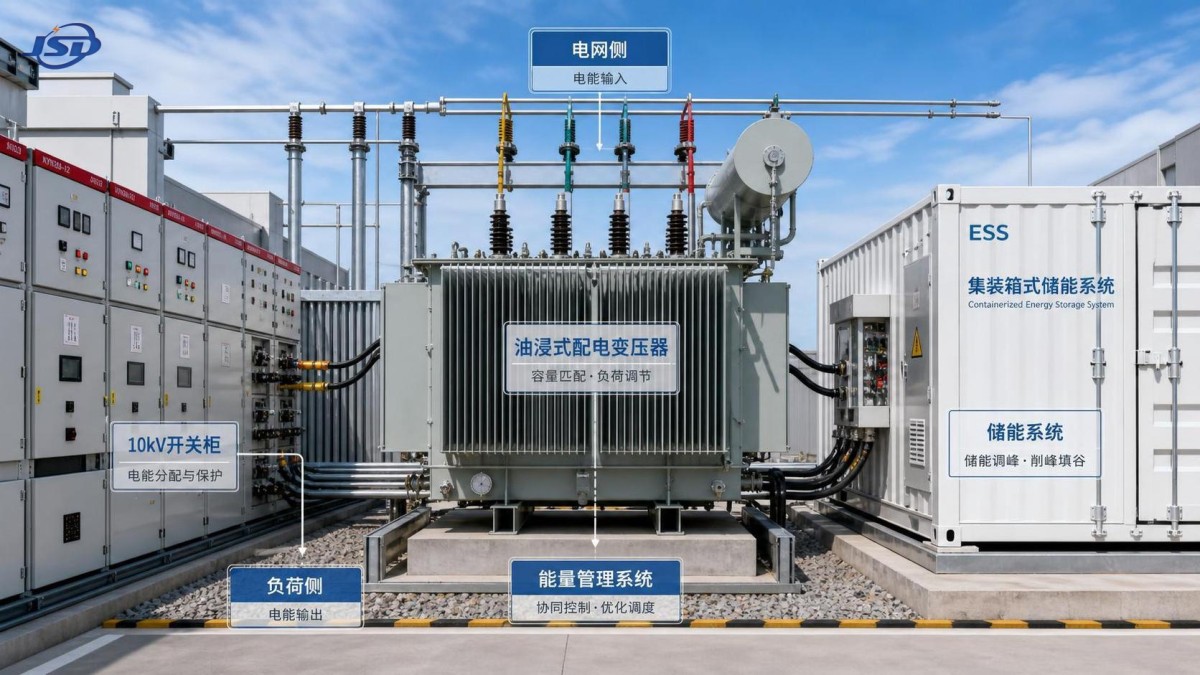
Peak shaving is often discussed as if the battery sits at the meter and nothing else matters. In actual power systems, the transformer is frequently the bottleneck or at least part of the decision. A site may be considering storage because the existing transformer is running near practical capacity during peak shifts, because a planned load expansion would require substation upgrades, or because a utility interconnection limit cannot be raised quickly.
That means the evaluator should ask a few uncomfortable but necessary questions. Is the problem driven by thermal loading, voltage drop, short-time overload, or billing demand? Is the transformer aging profile already a concern? Will battery charging create a new valley-to-peak issue overnight? Can the low-voltage side and protection scheme handle bidirectional power flow and fast response from the storage inverter?
In some distribution projects, storage is not a substitute for sound transformer selection; it is a complement to it. Where a substation or plant is being newly built or expanded, evaluators often compare storage deployment with transformer reinforcement. In that context, equipment such as the 30kV/0.4kV Oil-Immersed Power Distribution Transformer becomes part of the wider optimization discussion, especially when balancing capital expenditure, future load growth, and acceptable operating headroom.
Cycle frequency changes the economics more than people expect
A battery used for peak shaving once or twice a week is a different asset from one dispatched every working day. The required throughput, degradation path, and control strategy are not the same. If the load peak is irregular, a smaller battery may be justified because the value comes from clipping a limited number of high-cost intervals. If the peak is daily and predictable, the project may support a larger system because utilization is high and the operating logic is simpler.
There is also a hidden trade-off here. A system sized aggressively to remove nearly all peaks may cycle deeper and more often. That may look good in the first-year simulation but can narrow the margin for future load growth or battery aging. A more conservative design that trims only the upper portion of the peak can be easier to sustain operationally. Technical teams evaluating long-term value usually notice this quickly: the “best” shave target is not always the maximum possible one.
Control logic and charging windows deserve more attention
Battery sizing is often presented as a hardware exercise, but the EMS logic can make or break peak shaving performance. If the system charges during a period that later becomes a secondary demand peak, the site may simply move the problem to another hour. If it waits too long to discharge, the billing interval may already be compromised. If the dispatch relies on weather, production plans, or operator intervention, uncertainty rises.
For that reason, it is worth testing at least three control scenarios during evaluation:
- Rule-based shaving against a fixed demand cap
- Time-of-use charging with forecast-based discharge
- Multi-objective operation where peak shaving shares priority with backup power or renewable smoothing
The third scenario is common in new energy and infrastructure projects. The battery may not belong exclusively to peak shaving. If backup reserve or PV ramp control is required, then part of the capacity is effectively unavailable for demand reduction during certain hours. That needs to be reflected in sizing, not treated as an afterthought.
Safety margin is not just a battery issue
Technical evaluators usually know to ask about battery chemistry, thermal management, and fire protection. They should also look at operating margin across the whole electrical path: transformer loading, inverter overload capability, cable ampacity, harmonics, fault levels, and coordination with protection devices. A system that can theoretically shave 1 MW is not necessarily a system that should be dispatched at 1 MW continuously under site conditions.
This system-level view is especially relevant in industrial manufacturing and grid-side environments, where power reliability is not negotiable. Suppliers with experience in transmission and distribution applications tend to approach the issue with more attention to equipment interaction, installation practice, and long-term serviceability. That broader perspective is often more useful than selecting a battery from a catalog and trying to fit the network around it later.
A practical evaluation path
If the goal is a defensible sizing decision rather than a rough estimate, the evaluation path is usually quite grounded:
- Collect interval load data and identify the actual peak pattern.
- Define the limit to be protected: tariff demand, transformer capacity, feeder limit, or a combination.
- Estimate required discharge power from the gap between actual and target demand.
- Estimate usable discharge duration from the time spent above that threshold.
- Check whether multiple daily peaks require recharge between events.
- Apply realistic operating margin for losses, availability, state-of-charge limits, and aging.
- Verify integration with transformer, protection, switchgear, and site operating strategy.
At this stage, some projects discover that storage is the right answer; others find that a hybrid approach is stronger. A modest battery combined with transformer reinforcement or load scheduling can be more robust than forcing one asset to solve everything. In distribution systems serving new loads, the comparison may include whether to deploy storage now and phase equipment upgrades later, or proceed directly with network reinforcement using equipment aligned to the site voltage architecture, such as a 30kV/0.4kV Oil-Immersed Power Distribution Transformer.
The key point is that peak shaving sizing should end with an operational decision, not just a battery number. If the chosen system can reliably hit the target demand cap, fit the transformer and network constraints, and still leave room for normal uncertainty, it is probably sized well. If it only works under perfect dispatch assumptions, it is probably too small, no matter how attractive the model looks.

Get a Quote
Regardless of whether you require general advice or specific support, we are happy to help you.
Send Us Your Inquiry Today

Jinshida Electric remains committed to contributing to global energy development through professional manufacturing and superior service.