





How to Specify Outdoor Current Transformers for Coastal, Polluted, and Wet Sites
How to Specify Outdoor Current Transformers for Coastal, Polluted, and Wet Sites
Selecting an outdoor current transformer for coastal, polluted, and wet environments requires more than matching voltage and current ratings. Technical evaluators must assess insulation performance, corrosion resistance, sealing design, creepage distance, and long-term measurement reliability under severe exposure conditions.
The core search intent is practical specification guidance: readers need to identify which technical requirements prevent flashover, corrosion, moisture ingress, measurement drift, and premature replacement in exposed electrical installations.
For technical evaluators, the most important question is not whether an outdoor current transformer can operate initially. It is whether it will remain accurate, safe, and maintainable after years of salt spray, condensation, dust, rain, and thermal cycling.
Start With the Environmental Duty, Not the Nameplate Rating
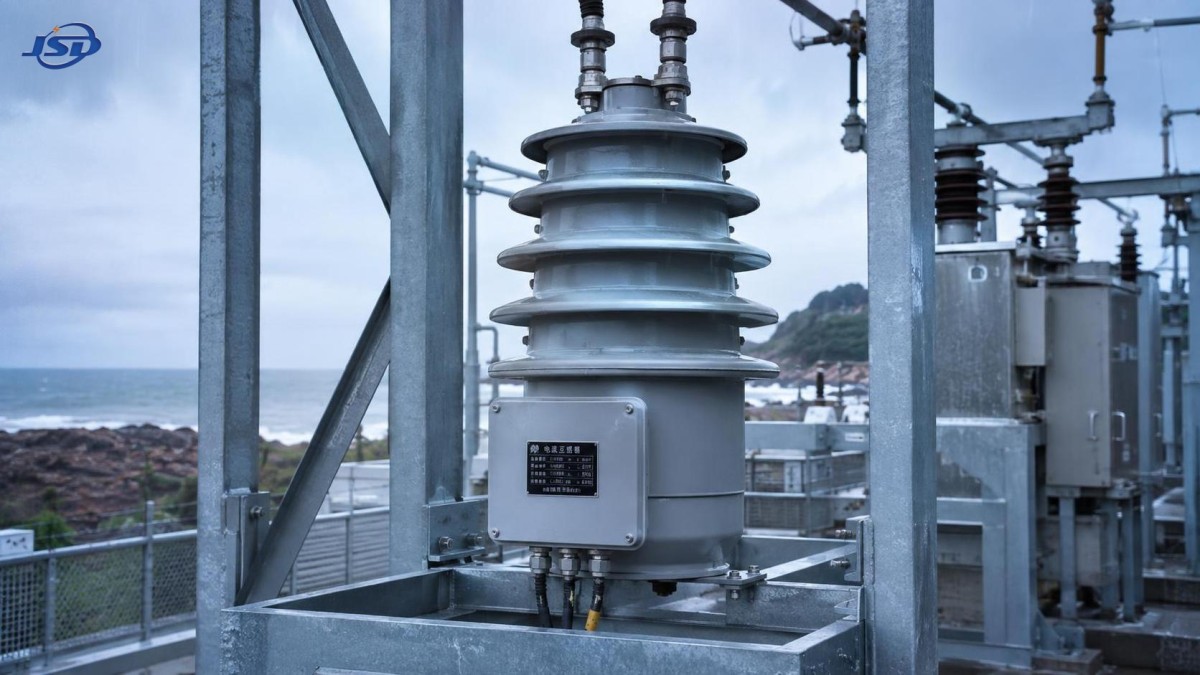
An outdoor current transformer should be specified against its actual installation environment before selecting the ratio, burden, accuracy class, or insulation level. Site exposure determines which design features are essential rather than optional.
Coastal locations combine salt-laden air, high humidity, wind-driven rain, ultraviolet exposure, and corrosion. These factors can attack metallic hardware, contaminate insulation surfaces, and create conductive paths that increase flashover risk.
Polluted industrial sites present different but equally serious threats. Cement dust, coal dust, chemical vapors, fertilizer particles, smoke, and metallic contaminants can accumulate on external insulation and retain moisture during rain or fog.
Wet sites may include substations in tropical climates, tunnels, ports, water-treatment facilities, flood-prone areas, hydroelectric plants, and renewable projects where daily condensation cycles occur inside outdoor enclosures.
Technical evaluators should request documented site conditions, including altitude, maximum and minimum temperature, humidity range, rainfall intensity, prevailing wind direction, pollution severity, salt exposure, and expected maintenance intervals.
Do not assume that an IP rating alone defines environmental suitability. Ingress protection addresses enclosure penetration, while long-term insulation behavior and corrosion resistance require additional material, geometry, coating, and testing considerations.
A robust procurement specification distinguishes between sheltered outdoor equipment and fully exposed equipment. A transformer under a canopy may need less severe protection than one installed near a shoreline without physical shielding.
For coastal projects, record the distance from the sea, topography, wind patterns, and washing frequency. Salt deposition can remain significant several kilometers inland when prevailing winds carry marine aerosols.
For polluted locations, identify whether the contamination is inert, conductive, acidic, alkaline, oily, or hygroscopic. Hygroscopic deposits are especially important because they absorb moisture and reduce surface insulation resistance.
Specify Creepage Distance According to Pollution Severity
Creepage distance is one of the most important selection criteria for an outdoor current transformer. It is the shortest path along an insulating surface between conductive parts at different potentials.
When contamination and moisture settle on an insulator, the surface can become partially conductive. A sufficiently long creepage path reduces leakage current and lowers the probability of tracking or flashover.
Technical evaluators should align creepage distance with the applicable system voltage, insulation material, pollution level, and governing standard. Generic “outdoor use” statements are not an adequate substitute for a stated requirement.
IEC pollution classifications are commonly used to define environmental severity. Light pollution may suit clean rural locations, while heavy and very heavy pollution classifications are often appropriate for coastal and industrial areas.
Ask suppliers to provide the total creepage distance in millimeters, the specific creepage distance in millimeters per kilovolt, and the basis used to determine those values.
The evaluation should also consider the shed profile, not only the published creepage figure. Properly shaped sheds help limit contamination bridging, improve rain washing, and reduce the formation of continuous wet films.
Alternating shed geometry, sufficient spacing, and well-designed under-rib profiles can improve performance in severe service. Poor geometry can make a nominally long creepage path less effective in practice.
Composite insulation often provides strong hydrophobic performance when correctly designed and manufactured. Water tends to bead instead of forming a continuous conductive film, which can reduce surface leakage under wet contamination.
However, material selection should be supported by evidence. Request aging data, ultraviolet resistance information, hydrophobicity retention details, and relevant routine or type-test documentation for the proposed insulation system.
Porcelain can also perform reliably in harsh environments, particularly where robust mechanical strength and established maintenance practices are priorities. Its surface condition, glaze quality, and cleaning strategy still require careful evaluation.
Control Corrosion at Every Exposed Interface
Corrosion is often the first visible sign of poor environmental design, but its consequences extend beyond appearance. It can weaken mounting hardware, degrade grounding continuity, damage terminal connections, and compromise enclosure sealing.
For coastal duty, specify corrosion-resistant metals and coatings for all exposed components. This includes base frames, bolts, washers, terminal pads, cable glands, hinges, fasteners, earth terminals, and nameplates.
Hot-dip galvanized steel may be suitable for many outdoor installations, but coating thickness, cut edges, welding areas, and field-drilled holes must be considered. Damaged surfaces need defined repair methods.
Stainless steel can offer better resistance in highly saline environments, but grades matter. Material compatibility should also be reviewed to avoid galvanic corrosion where dissimilar metals remain electrically connected in wet conditions.
Aluminum and copper interfaces require particular attention. Correct plating, compatible connectors, joint compounds where permitted, and controlled fastening torque help reduce oxidation, heating, and electrochemical degradation over time.
Specify whether terminals require tin plating, silver plating, or another protective treatment. The required contact surface must be compatible with the conductor material and the expected electrical loading.
Paint systems should not be evaluated by color alone. Request coating type, dry-film thickness, surface preparation method, adhesion performance, salt-spray testing, and repair instructions for transport or installation damage.
Sealing surfaces deserve equal scrutiny. A corrosion-resistant enclosure is ineffective if flange joints, gland plates, inspection covers, and bolted interfaces create water traps or permit capillary water ingress.
Drainage must be designed into the assembly. Horizontal surfaces, recessed fasteners, unsealed seams, and inaccessible pockets can retain saltwater or condensation, accelerating corrosion where inspections are difficult.
Evaluate Sealing, Condensation, and Internal Moisture Risk
Water entering an outdoor current transformer enclosure can affect insulation resistance, terminal condition, secondary circuits, and measurement reliability. Moisture control therefore requires a complete system-level review.
First, define the expected exposure: rainfall, washdown, direct spray, immersion risk, condensation, floodwater, or repeated temperature cycling. Each condition may require a different protection strategy and enclosure construction.
An appropriate IP rating should be selected for the physical installation. Yet a higher rating does not automatically solve condensation, because sealed enclosures can trap humid air during assembly or service.
Daily temperature changes cause internal pressure variations. Warm air expands and escapes through small gaps, then cooler air draws moisture inward. This “breathing” effect can create condensation even without obvious leakage.
Ask whether the design uses pressure-equalization vents, breathable membranes, anti-condensation heaters, desiccants, drainage paths, or sealed compartments. The best option depends on enclosure volume and maintenance access.
Secondary terminal boxes deserve special attention because they contain low-voltage wiring used for protection, metering, and monitoring. Moisture at these terminals can cause nuisance signals, corrosion, and insulation failure.
Specify gasket material, gasket compression method, cable-gland type, cable entry orientation, and terminal-box drainage. Bottom-entry glands may help prevent water tracking, provided bending radius and installation access remain practical.
For exposed installations, request confirmation that terminal-box covers remain secure under vibration, wind, and repeated maintenance. Captive hardware and clear torque requirements reduce the chance of resealing errors.
Where the current transformer is installed within a packaged distribution solution, coordination between enclosure and instrument transformer protection is essential. The European-Type Compact Substation can be configured with enclosed, insulated structures and enclosure materials suited to outdoor projects.
Protect Measurement Accuracy and Protection Performance
Environmental durability matters because a current transformer is not merely a mechanical component. It supplies the current signal used by meters, relays, energy-management systems, and protective devices.
Specify the primary current rating according to expected load, fault level, and future expansion. Avoid selecting a ratio solely from normal operating current when fault studies or protection coordination require different performance.
For metering circuits, define the required accuracy class and rated burden. The actual connected burden includes meters, relays, transducers, wiring resistance, terminal blocks, and any future monitoring equipment.
For protection circuits, define the applicable protection class, accuracy limit factor, knee-point requirements where relevant, and fault-current performance. Protective relays can misoperate if the transformer saturates before expected fault conditions.
Environmental conditions can indirectly affect accuracy. Corroded terminals, damp secondary boxes, loose connections, and deteriorated insulation may introduce unreliable signals or increase circuit resistance over the equipment lifetime.
Ask for separate secondary cores where metering and protection functions have different accuracy requirements. Combining incompatible duties on one core can create avoidable compromises in performance and testing flexibility.
Secondary terminal markings must be permanent, legible, and resistant to ultraviolet exposure and corrosion. Clear polarity identification is essential for revenue metering, differential protection, directional protection, and commissioning tests.
The specification should state short-time thermal current, dynamic current withstand, rated continuous thermal current factor, and system fault duration. These values must reflect the actual network study, not generic catalog assumptions.
For renewable energy sites, consider reverse power flow, fluctuating generation, harmonic content, and remote monitoring requirements. Modern metering and protection arrangements often place additional demands on core selection and wiring design.
Ask for Test Evidence That Matches the Site Risk
Technical evaluators should not rely exclusively on declarations of compliance. Request test reports, drawings, material details, quality records, and clear confirmation of which requirements apply to the offered outdoor current transformer.
Routine test documentation should confirm ratio, polarity, insulation performance, winding resistance where applicable, and accuracy verification. Type-test evidence should support dielectric withstand, temperature rise, short-circuit behavior, and mechanical performance.
For severe coastal service, salt-mist or salt-spray test evidence can be valuable for exposed metallic parts and coatings. Verify test duration, acceptance criteria, test standard, and whether tested materials match production materials.
Pollution performance should be supported by creepage calculations and insulation design documentation. Where the application is exceptionally severe, discuss whether artificial pollution tests or additional site-specific qualification is appropriate.
Ingress protection claims should identify the protected assembly, not merely a component inside it. A sealed terminal box does not guarantee the same protection level for the complete installed current transformer arrangement.
Factory quality controls should include incoming material inspection, traceability, dimensional checks, sealing verification, torque control, and final inspection. These controls matter because small assembly defects can become major field failures.
Review the supplier’s handling of nonconforming products and corrective actions. Consistent production quality is especially important for large projects where multiple units must perform identically across different outdoor locations.
Certification can support confidence, but it does not replace engineering review. ISO-based quality management, IEC alignment, and relevant regional approvals should be treated as supporting evidence within the complete technical evaluation.
Turn Site Conditions Into a Clear Procurement Specification
A practical specification should convert environmental risks into measurable requirements. This gives suppliers a common basis for quotation and allows evaluators to compare technically equivalent offers instead of marketing descriptions.
Begin with system data: highest voltage, frequency, nominal current, maximum continuous current, short-circuit current, fault duration, insulation level, grounding arrangement, and required metering or protection functions.
Then state environmental data: installation altitude, ambient temperature range, humidity, pollution classification, coastal distance, salt exposure, rainfall, wind, solar radiation, flood risk, and expected service life.
Define insulation requirements explicitly, including minimum creepage distance, shed material, insulation type, withstand levels, and requirements for ultraviolet resistance, tracking resistance, and wet pollution performance where needed.
Define corrosion requirements separately. Include acceptable structural materials, coating systems, stainless-steel grades where applicable, terminal plating, fastener treatment, grounding provisions, and restrictions on incompatible metal combinations.
For moisture protection, specify enclosure IP rating, terminal-box configuration, gasket requirements, cable entries, drainage, anti-condensation provisions, and whether the transformer will be installed in a protected outdoor compartment.
State all electrical requirements clearly: transformation ratio, number of cores, accuracy class, rated burden, protection class, short-time thermal current, dynamic withstand current, thermal factor, and secondary terminal arrangement.
Require submitted drawings that show overall dimensions, mounting points, terminal orientation, clearances, cable-entry directions, weight, lifting provisions, and access requirements. Poor physical integration can delay installation even when electrical ratings are correct.
Finally, define documentation deliverables. These should include drawings, datasheets, test certificates, installation instructions, maintenance guidance, spare-parts recommendations, warranty terms, and identification labels suitable for the installation environment.
Use a Risk-Based Evaluation Method Before Awarding the Order
The lowest initial price may not represent the lowest project cost. Premature outdoor transformer failures can create outage risk, relay unavailability, inaccurate metering, emergency labor costs, and difficult access work.
Score quotations using weighted criteria rather than a simple compliance checklist. Environmental suitability, electrical performance, test evidence, manufacturing controls, delivery reliability, service support, and lifecycle cost should each receive defined importance.
Separate mandatory requirements from preferred features. Minimum creepage distance, insulation level, accuracy class, short-circuit withstand, and corrosion protection should be treated as non-negotiable compliance items for severe sites.
Clarify exceptions early. If a supplier proposes an alternative insulation material, reduced enclosure protection, different terminal arrangement, or lower coating grade, require a documented engineering justification before commercial comparison.
Consider maintenance realities. In remote substations, offshore-adjacent facilities, ports, solar plants, and industrial compounds, periodic cleaning or replacement may be expensive and operationally disruptive.
A design that tolerates longer cleaning intervals and retains accuracy under contamination can provide substantial lifecycle value. This is particularly true where personnel access requires outages, permits, lifting equipment, or specialized safety procedures.
Installation practices must also support the selected design. Keep secondary boxes properly sealed, use compatible cable glands, maintain required clearances, apply specified torque values, and protect exposed surfaces after field modifications.
Commissioning should include insulation checks, ratio and polarity verification, secondary-circuit continuity testing, grounding inspection, terminal torque confirmation, and review of protection and metering connections before energization.
Conclusion: Specify for the Exposure You Actually Have
For coastal, polluted, and wet sites, a reliable outdoor current transformer must be selected as an environmental and electrical system, not as a standard catalog component with a matching current ratio.
The strongest specifications address pollution severity, creepage distance, insulation geometry, corrosion resistance, sealing, condensation control, secondary-terminal protection, accuracy requirements, fault performance, and verifiable test evidence.
Technical evaluators should prioritize measurable site-based requirements, supplier documentation, and lifecycle risk. This approach reduces ambiguity during procurement and improves the likelihood of stable metering and protection performance throughout service.
When those requirements are defined before supplier selection, outdoor installations can remain safe, accurate, and durable despite salt spray, industrial contamination, persistent rain, high humidity, and demanding maintenance conditions.

Get a Quote
Regardless of whether you require general advice or specific support, we are happy to help you.
Send Us Your Inquiry Today

Jinshida Electric remains committed to contributing to global energy development through professional manufacturing and superior service.