





How much load margin should a 400 kVA open frame diesel generator have?
A 400 kVA open frame diesel generator should not normally be selected to run at 400 kVA continuously. The practical margin depends on whether the set is prime-rated or standby-rated, how the load behaves during motor starts and step changes, and whether site conditions reduce the published rating. For a conventional 0.8 power-factor set, 400 kVA corresponds to approximately 320 kW. A sound initial target is to keep the expected sustained operating load near 60–80% of the applicable generator rating, while confirming that the highest coincident demand, starting event, and site derating case remain within both engine and alternator limits.
That does not mean every installation needs a fixed 20%, 25%, or 30% reserve. A generator with a stable resistive load may operate satisfactorily closer to rated output than one serving multiple large motors, variable-speed drives, a UPS system, or an intermittently loaded process. The correct margin is therefore a result of load analysis, not a percentage applied mechanically to nameplate capacity.
Start with the rating basis, not the 400 kVA label
The same physical generator package may carry different ratings for standby, prime power, and continuous-duty applications. These ratings are not interchangeable.
- Standby power is intended for emergency operation during utility failure and is typically subject to annual operating-hour and load-profile limits set by the manufacturer.
- Prime power applies where the generator is the normal source for variable loads over extended hours. Its permissible average loading and overload provisions must be checked in the specific data sheet.
- Continuous-duty ratings, where offered, apply to constant operation at a defined output and are more restrictive than a standby label may suggest.
A 400 kVA standby rating should not automatically be treated as 400 kVA available for a permanent, around-the-clock production load. Conversely, a prime-rated 400 kVA set may have an operating envelope defined by average load, maximum load, and allowable duration at higher output. The manufacturer’s rating conditions, including ambient temperature, altitude, humidity, fuel specification, and cooling arrangement, establish the actual starting point for margin calculations.
The kVA figure also needs to be separated from usable kW. At a nominal 0.8 power factor:
400 kVA × 0.8 = 320 kW
If the connected system operates at 0.9 or 0.95 power factor, the engine may become the limiting element before the alternator reaches its kVA limit. If the system power factor is low, the alternator excitation system and stator current may become the limiting elements even when measured kW appears acceptable. Selection must therefore track peak kW, peak kVA, and power factor together.
A useful operating envelope for initial evaluation
For many 400 kVA open frame diesel generator applications, a sustained load range of roughly 240–320 kVA is a sensible area to examine first. This is 60–80% of the nominal rating. It leaves capacity for moderate operational variation, while avoiding prolonged very light loading. But this range is an evaluation starting point, not a substitute for a load study.
The lower bound matters as much as the upper bound. Oversizing is often viewed as conservative, but a diesel engine repeatedly operated at too little load may not reach an effective combustion condition. Consequences can include carbon deposits, oil dilution, exhaust fouling, and wet stacking. The precise minimum acceptable load is engine-specific; it should not be assumed from a generic rule. Where a site has a small normal load but a very large intermittent load, a load bank, staged generation, or another operating strategy may be more defensible than a single oversized set running lightly for long periods.
Why running kW rarely tells the whole story
The most common sizing error is to add the nameplate kW of connected equipment and compare the result only with 320 kW. That approach misses the short-duration events that govern generator performance. Diesel generator sets are dynamic systems: the engine must deliver mechanical torque, the governor must respond to speed changes, and the alternator and automatic voltage regulator must support the electrical transient.
A motor that runs at 30 kW may demand several times its normal current when started direct-on-line. The starting kVA can cause a voltage dip severe enough to drop contactors, interrupt controls, or prevent another motor from starting. The issue becomes more pronounced where the largest motor starts while other loads are already connected.
For each significant motor, record:
- rated kW or horsepower;
- running current and starting method;
- locked-rotor current or starting kVA, where available;
- acceleration time and driven equipment inertia;
- whether starts can be sequenced;
- the load already online at the time of starting.
Direct-on-line starting creates the highest electrical demand. Star-delta, autotransformer, soft starter, and variable-frequency drive arrangements can reduce starting current, but they introduce different considerations. Soft starters may still produce substantial current over a longer acceleration interval. VFDs reduce motor-starting stress but may contribute harmonic current and may behave differently during generator voltage or frequency excursions. Manufacturer compatibility information for the drive, generator alternator, and control system is more valuable than assuming that any electronic starter solves the sizing issue.
Evaluate the load as a time sequence
A proper margin calculation uses a load profile rather than one “total load” number. The load schedule should identify what is running before transfer, what starts immediately after the generator reaches voltage and frequency, what can be delayed, and what is likely to operate together during the highest-demand condition.
Consider a facility with a 400 kVA set. Its normal emergency load may be 180 kW at 0.9 power factor, equivalent to 200 kVA. That appears comfortably below the nominal rating. If a 75 kW fire pump, chilled-water pump, or compressor must start direct-on-line while the 200 kVA base load is online, the starting event—not the 200 kVA running condition—may define the generator size. By contrast, if the base load is 260 kVA and a 60 kVA pump starts through a VFD after a controlled delay, the same generator may be acceptable, subject to verified transient performance.
Load sequencing can produce more usable capacity than simply increasing the generator rating. Noncritical HVAC, large process heaters, battery chargers, and secondary pumps can be delayed until essential loads stabilize. Automatic transfer switch timing, generator warm-up logic, and control-system interlocks must support that sequence. A load-shedding scheme is only a real margin if it is engineered, tested, and maintained; it should not exist merely as an assumption in a sizing worksheet.
Open frame installation changes the derating question
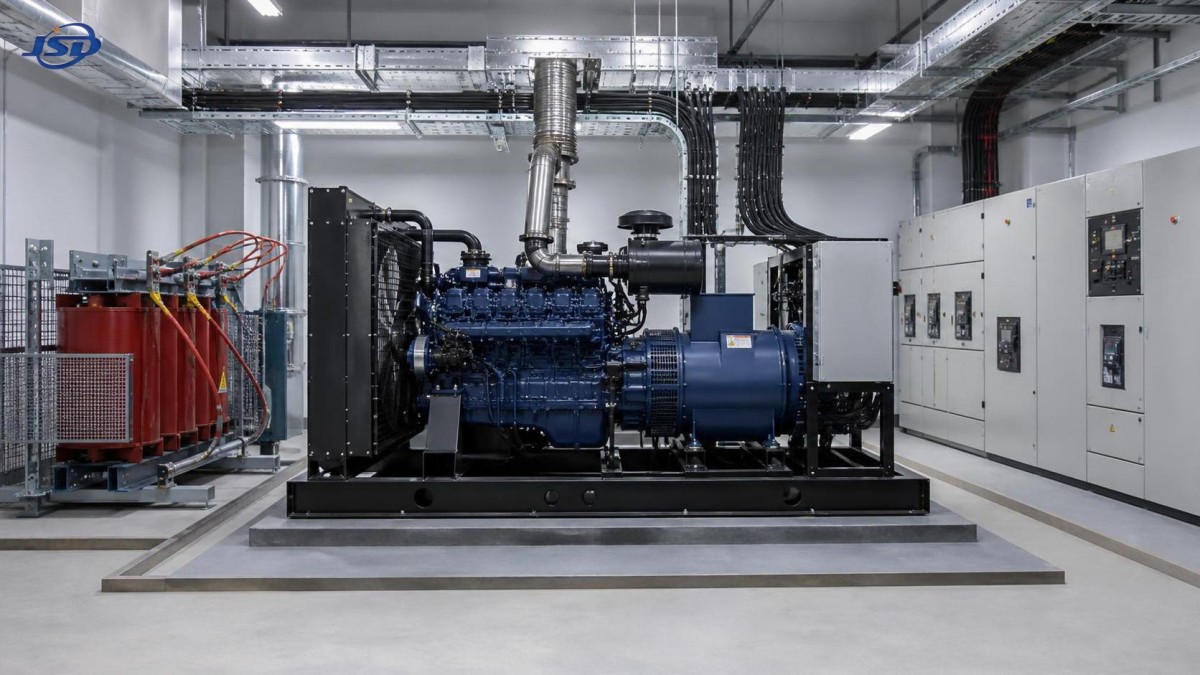
An open frame diesel generator is generally intended for installation in a purpose-designed room, plant area, or weather-protected enclosure. Unlike a packaged weatherproof or sound-attenuated set, its delivered capability is highly dependent on the installation environment. The rating printed on the generator is normally based on specified reference conditions. High ambient temperature, elevation, inadequate ventilation, restricted radiator airflow, and excessive recirculation of hot discharge air can reduce available engine power.
At higher altitude, reduced air density affects combustion air availability. High ambient temperature lowers air density and reduces the cooling system’s heat-rejection margin. A generator room may be nominally ventilated yet still recirculate hot air if inlet and discharge openings are badly positioned. In that situation, a set selected with only a narrow nameplate margin can overload as room temperature rises, even if connected electrical load has not changed.
Technical review should use the engine and alternator derating curves provided for the exact model. It should also verify the radiator configuration, combustion-air path, ventilation fan duty, allowable room temperature, and exhaust backpressure. A nominal 400 kVA package may have a lower site-available capacity after these conditions are applied. Margin must be calculated against that corrected rating, not against the catalogue headline figure.
Nonlinear loads require alternator-focused checks
Data processing equipment, rectifier battery chargers, UPS inputs, LED lighting drivers, welding equipment, and variable-speed drives can distort current waveforms. Their impact is not fully represented by kW and fundamental-frequency power factor. Harmonic currents can increase alternator heating, affect voltage waveform quality, and place additional duty on the automatic voltage regulator.
The relevant questions are the proportion of nonlinear load, expected total harmonic current distortion, load-step behavior, and the generator manufacturer’s alternator and AVR capability. A 400 kVA open frame diesel generator serving a mostly linear pumping load may need a different margin from one serving a high proportion of UPS or drive-based load, even if both show the same average kW on a meter.
Protection coordination also deserves attention. The generator’s subtransient and transient fault-current capability is much lower and shorter in duration than that of a utility source. Circuit-breaker settings, selective coordination, and downstream protective-device performance must be reviewed under generator supply. An oversized transformer or distribution board does not create additional generator fault capacity.
Where standby generation feeds a medium-voltage to low-voltage distribution system, transformer characteristics influence the generator-side assessment. Transformer inrush can create a severe energization transient, particularly if the generator closes onto a de-energized transformer and downstream loads are restored simultaneously. Winding configuration, impedance, transformer capacity, residual flux, and the transfer sequence all affect the result. Equipment such as a 35kV Three-Phase Cast Resin Dry-Type Distribution Transformer may be relevant in a 35 kV/0.4 kV distribution architecture, but its 30–2500 kVA capacity range should not be confused with the generator’s available starting or fault-duty capability. The generator, transformer, switching sequence, and protection design must be reviewed as one system.
Future capacity should be treated as a defined load, not a vague reserve
Future expansion is a valid reason to preserve margin, but it should be translated into likely kW, kVA, motor-starting demand, and operating timing. Reserving 25% capacity for an undefined expansion can lead to chronic light-load operation. A planned 50 kW process line with VFD-controlled motors is not equivalent to a planned 50 kW direct-on-line compressor, even though both are described as “50 kW future load.”
If expansion is uncertain, alternatives may include a second generator designed for parallel operation, a modular load arrangement, or provisions in the switchgear and control system for future generation. These options add design complexity, but they can avoid forcing one engine to operate far below its intended loading range for years.
A defensible margin decision
The appropriate load margin for a 400 kVA generator is the difference between corrected site-available capacity and the most demanding credible operating case—not simply the difference between 400 kVA and normal metered demand. The final evaluation should document:
- the applicable prime, standby, or continuous rating;
- site derating for temperature, altitude, and installation conditions;
- maximum steady kW, kVA, and power factor;
- largest individual and coincident load steps;
- motor-starting method and restoration sequence;
- nonlinear-load and harmonic considerations;
- minimum-load operation during low-demand periods;
- transformer energization, protection, and fault-current constraints;
- defined future additions rather than an arbitrary reserve percentage.
For a stable load with limited starts and no material site derating, maintaining roughly 20–40% headroom below the applicable rating is often operationally sensible. For installations with large motor starts, high ambient conditions, nonlinear loads, or major planned additions, the required margin may be larger—or the better solution may be load sequencing, reduced-voltage starting, parallel generation, or a revised distribution strategy. The right decision is the one that keeps the engine, alternator, controls, and downstream electrical system within their verified limits throughout the actual operating sequence.

Get a Quote
Regardless of whether you require general advice or specific support, we are happy to help you.
Send Us Your Inquiry Today

Jinshida Electric remains committed to contributing to global energy development through professional manufacturing and superior service.