





How ambient temperature affects an industrial open frame diesel generator
Ambient temperature affects an industrial open frame diesel generator long before an alarm appears on the control panel. High heat reduces the cooling system's ability to reject engine heat and can limit available output. Low temperature makes starting harder, thickens lubricating oil, reduces battery performance, and may prevent the engine from reaching stable operating speed quickly enough for the connected load.
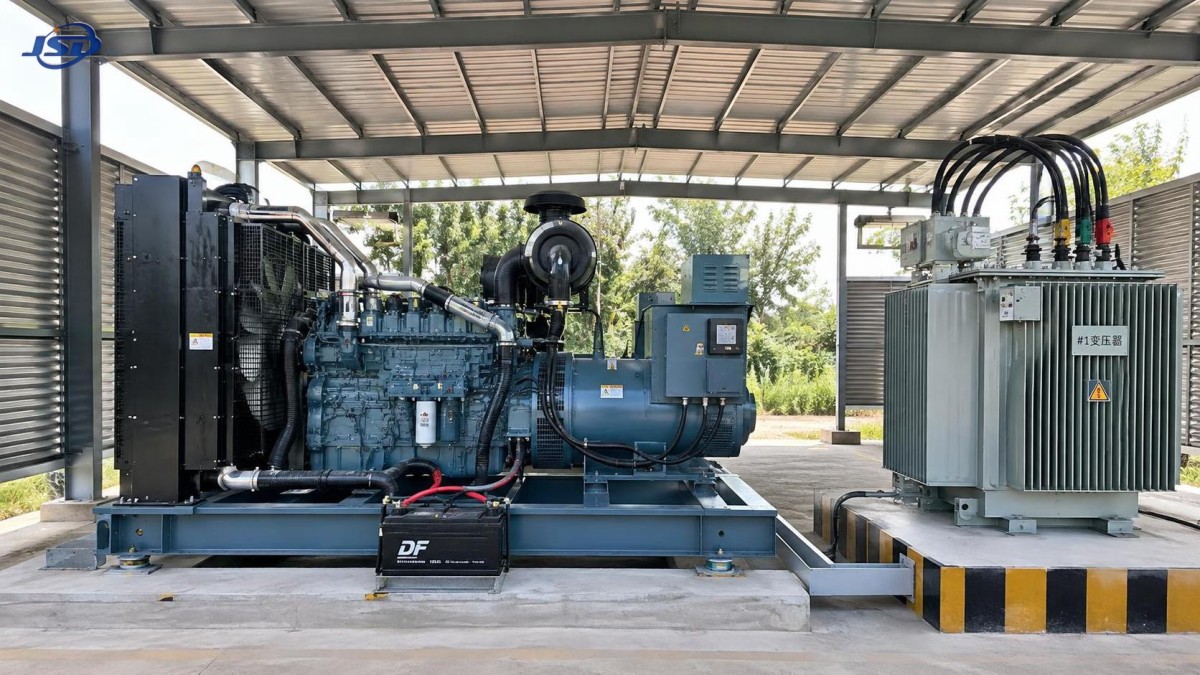
For an operator, the practical question is not whether temperature matters. It is whether the generator can carry its intended load, start reliably, and remain within its rated operating limits at the actual site temperature. An open-frame unit deserves particular attention because its engine, alternator, radiator, battery, and control equipment are directly exposed to surrounding air, solar gain, dust, moisture, and wind conditions.
Rated output is tied to site conditions
A generator nameplate rating should be read together with the environmental conditions under which that rating applies. Engine power depends on the quantity and density of air entering the cylinders. As ambient temperature rises, intake air becomes less dense. Less oxygen is available for combustion, so the engine may be unable to produce the same mechanical power without increasing smoke, exhaust temperature, or fuel consumption.
The alternator is affected as well. Its windings, insulation system, bearings, and voltage regulator all operate at higher temperatures when the incoming cooling air is hot. Even if the engine continues to run, the alternator may reach its allowable temperature rise sooner under a heavy electrical load. A set that appears correctly sized in mild conditions can therefore become marginal during a hot afternoon, especially where the load is continuous rather than occasional.
This does not mean every installation requires a large automatic reduction in loading. The allowable load depends on the manufacturer's environmental rating, the engine and radiator configuration, altitude, airflow around the machine, and the load profile. However, operators should avoid treating a nominal kW figure as an unconditional site capacity. The relevant capacity is the output the set can sustain at the highest realistic ambient temperature, with the intended auxiliaries and connected load.
Heat is often compounded by site layout. A generator placed close to a wall, inside a partially enclosed service yard, beside other heat-producing equipment, or under direct sun may draw air that is materially hotter than the local weather report. Hot radiator discharge can also recirculate into the engine intake or radiator inlet. In that condition, cleaning the radiator may help, but it will not solve a basic airflow problem.
What to check during hot-weather operation
- Compare actual coolant temperature, oil temperature, exhaust condition, and load percentage with the limits stated in the generator documentation.
- Inspect the radiator core, fan guard, air filter inlet, and alternator air passages for dust, lint, leaves, packaging film, or oil residue.
- Confirm that radiator discharge air cannot loop back to the intake side of the set.
- Review whether process equipment creates a high starting current or a step load during the hottest part of the day.
- Check fuel storage conditions. High ambient temperature can increase condensation cycling in poorly managed tanks and may accelerate fuel degradation over longer storage periods.
Cold weather changes the starting sequence
In low ambient temperatures, the first risk is often failed or delayed starting rather than overload. Diesel fuel does not vaporize in the same way as gasoline, and cold metal surfaces absorb heat from compression. When the engine block, cylinder head, intake air, and lubricating oil are cold, the engine needs more cranking energy and more favorable combustion conditions to fire consistently.
Battery performance is central to this process. A battery may show an acceptable open-circuit voltage yet deliver insufficient cranking current in cold weather. Loose terminals, undersized battery cables, corroded connections, or a weak charging circuit become more visible when temperatures fall. Repeated unsuccessful start attempts can then drain the battery further and create a preventable outage.
Lubricating oil viscosity also rises in the cold. If the oil grade is unsuitable for the expected temperature range, cranking resistance increases and oil circulation after starting may be slower. The same issue applies to fuel: depending on the fuel specification and temperature, waxing or restricted flow can interfere with filters and fuel delivery. Operators should follow the engine maker's approved fuel and oil recommendations for the local climate rather than assuming one service fluid is appropriate all year.
Cold starting aids should be treated as functional equipment, not optional accessories. Block heaters, battery heaters, jacket-water heaters, fuel conditioning equipment, and automatic chargers each require periodic inspection. A heater circuit that has tripped, a thermostat that has failed, or a disconnected charger may remain unnoticed until the generator is needed during a cold event.
Open-frame construction makes exposure management essential
An industrial open frame diesel generator is often selected for accessible maintenance, temporary deployment, integration into an equipment room, or installation within a purpose-designed enclosure. Those advantages come with a responsibility to control the surrounding environment. The open frame itself does not provide weather protection, sound attenuation, dust filtration, or controlled ventilation.
Direct sunlight is a common source of avoidable thermal stress. The engine and alternator may sit in still air while dark painted surfaces absorb heat. A properly designed shade structure can reduce solar loading, but it must not block cooling airflow or trap exhaust heat. Any cover added after installation should preserve service access, exhaust clearance, combustion-air supply, and radiator discharge paths.
Rain and humidity create different concerns. Water entry into control panels, battery compartments, cable terminations, and alternator windings can lead to insulation deterioration or intermittent electrical faults. An open-frame unit intended for outdoor duty should be placed on a stable, drained foundation and protected by a suitable enclosure or canopy designed for that generator configuration. A makeshift tarp is particularly risky when it restricts ventilation or directs condensation toward electrical components.
Dusty locations require a maintenance response that reflects the operating environment. A clogged radiator or air filter raises engine stress; conductive dust or moisture on electrical parts can affect insulation resistance. Cleaning intervals should be determined by observed contamination and operating hours, while following the manufacturer's approved methods. High-pressure washing around electrical equipment, connectors, control modules, and alternator openings can create more problems than it removes.
Load behavior matters as much as thermometer readings
Ambient temperature does not act alone. A generator operating at a steady moderate load may tolerate difficult weather better than one repeatedly exposed to large motor starts, welding loads, compressors, crushers, or rapidly changing process demand. Heat reduces performance margin, while sudden load changes consume it.
For this reason, operators should record more than average kW. Note peak demand, the sequence in which loads are applied, motor starting methods, power factor where relevant, and the duration of high-load operation. A unit that trips or overheats only during a certain shift may be responding to a load event combined with elevated ambient temperature, rather than suffering from a purely mechanical fault.
When the generator supports a facility with variable demand, reducing the peak imposed on the diesel set can be more effective than simply selecting a larger engine. For example, a battery energy storage system can supply short-duration peaks, support load shifting, or reduce the need to run a generator at its upper limit during adverse weather. In applications that require a coordinated backup and demand-management approach, an outdoor system such as the 125kW/261kWh Commercial & Industrial Energy Storage System may be evaluated alongside the generator. Its suitability still depends on the facility load profile, transfer arrangement, protection coordination, operating temperature, and control strategy.
This approach is not a substitute for correcting inadequate ventilation, poor maintenance, or an undersized generator. It is a way to manage a known peak demand where the electrical system has been designed to coordinate generator, storage, and critical loads safely.
Use temperature limits as operating limits, not paperwork
Generator documentation typically identifies ambient operating limits and may state correction factors for temperature and altitude. These values should be part of the operating plan, particularly for remote sites, seasonal operations, and facilities that cannot tolerate an unplanned stop. The same review should include the control panel, battery charger, automatic transfer equipment, fuel system components, and any enclosure ventilation equipment. The generator may be rated for a given condition while an associated component has a narrower range.
Ambient temperature measurements should be taken where the generator actually draws air, not only at an office weather station or at a shaded point far from the installation. In an enclosed or semi-enclosed space, measure near the radiator inlet and engine intake during the highest expected load. This helps distinguish a genuinely hot climate from an installation that is recirculating its own heat.
For sites with critical loads, it is sensible to include seasonal tests in the maintenance program. A no-load start test confirms only part of the system. A controlled test under representative load, carried out within safe operating procedures, can reveal cooling limitations, voltage or frequency instability, weak batteries, transfer issues, and excessive temperature rise before an emergency occurs.
A practical seasonal inspection routine
When a temperature-related issue needs investigation
Repeated high coolant temperature, reduced frequency under a familiar load, excessive black smoke, repeated battery-related start failures, frequent alarm resets, or an unusual rise in fuel use should not be dismissed as normal weather effects. Temperature may be exposing an underlying issue such as a blocked cooling system, worn fan belt, poor electrical connection, fuel restriction, incorrect service fluid, insufficient ventilation, or a load greater than the set can carry under site conditions.
The useful investigation sequence is straightforward: verify the actual ambient air at the generator inlet, confirm the load and load sequence, inspect airflow and service condition, then compare the observed behavior with the manufacturer's environmental and loading guidance. This avoids replacing components based only on symptoms.
A well-maintained generator can operate reliably across a broad range of conditions, but only when the installation respects the machine's thermal and starting requirements. Ambient temperature should therefore be considered during daily operation, seasonal maintenance, and any decision to add load. That discipline protects output stability when the generator is needed most.

Get a Quote
Regardless of whether you require general advice or specific support, we are happy to help you.
Send Us Your Inquiry Today

Jinshida Electric remains committed to contributing to global energy development through professional manufacturing and superior service.