





Can a power transformer supplier provide traceable test documentation?
Yes. A capable power transformer supplier should be able to provide traceable test documentation for each transformer delivered, not merely a generic certificate or a summary test sheet. The records should connect the approved design, purchased materials, manufacturing stages, routine-test results, serial number, and final release decision. That chain is what makes a document package useful during inspection, commissioning, an incident review, or a later audit.
The important distinction is between having documents and having documents that are genuinely traceable. A folder full of PDFs may look complete, yet still fail to show whether the test result belongs to the actual unit installed at site. Traceability means a reviewer can start with the transformer nameplate or serial number and work backward to verify what was built, what was tested, who approved it, and whether any nonconformance was closed properly.
What Traceable Documentation Should Mean From a Power Transformer Supplier
For a distribution or power transformer, the documentation trail normally begins before final assembly. It should link key materials and components to the unit being manufactured. Depending on the transformer design and contract scope, this may include core steel identification, winding conductor records, insulation materials, bushings, tap changers, radiators, instruments, protective devices, and transformer oil or insulating fluid certificates.
A useful package then follows the transformer through production. It identifies the manufacturing order, approved technical specification, drawings or data sheets, inspection points, test instruments used, test dates, and authorized signatures. If the supplier uses electronic quality records, a document number and revision history should still be visible. A result without a unit serial number, date, test reference, and responsible approval is difficult to defend later.
In practical terms, the documentation should answer four questions quickly:
- Is this record tied to the exact transformer being accepted?
- Was the test performed against the agreed standard and project specification?
- Were the instruments, procedures, and acceptance criteria controlled?
- Were deviations recorded, evaluated, and formally released?
If any one of these questions cannot be answered from the supplied records, the package may be informative, but it is not fully traceable.
Routine Tests Are Necessary, but They Are Not the Entire Story
Many buyers first ask for a routine test report. That is the right starting point, but it should not be the finish line. Routine tests generally demonstrate that the completed transformer met the relevant production test requirements before shipment. The exact test scope depends on the transformer type, voltage class, governing standard, and purchase specification. For transformers specified to IEC requirements, IEC 60076 is commonly referenced, but the contract must identify the applicable edition, any customer additions, and the agreed acceptance criteria.
A well-prepared routine test report typically identifies the transformer rating, rated voltage, vector group, impedance requirement, cooling arrangement, serial number, and test date. It should also show measured values rather than only a statement such as “passed.” Results may include winding resistance, voltage ratio and phase displacement, impedance and load loss, no-load loss and current, insulation resistance where specified, applied-voltage tests, induced-voltage tests, and checks on auxiliary circuits or protective devices where relevant.
Measured values matter because they allow comparison with the approved technical schedule and with future condition assessments. For example, a winding-resistance record is far more valuable when it identifies the tap position, winding temperature or correction basis, and test connection. A simple “acceptable” entry does not provide enough technical context for later troubleshooting.
Type tests and special tests need separate attention. They are not automatically repeated on every unit. Temperature-rise testing, lightning impulse testing, short-circuit withstand evidence, sound-level testing, or zero-sequence impedance testing may be required by the purchaser, applicable standard, utility practice, or project risk profile. A supplier should clearly state whether the evidence is unit-specific, design-based, witnessed, or taken from an equivalent tested design. Treating an old type-test report as proof that every delivered transformer received that test is a common and avoidable mistake.
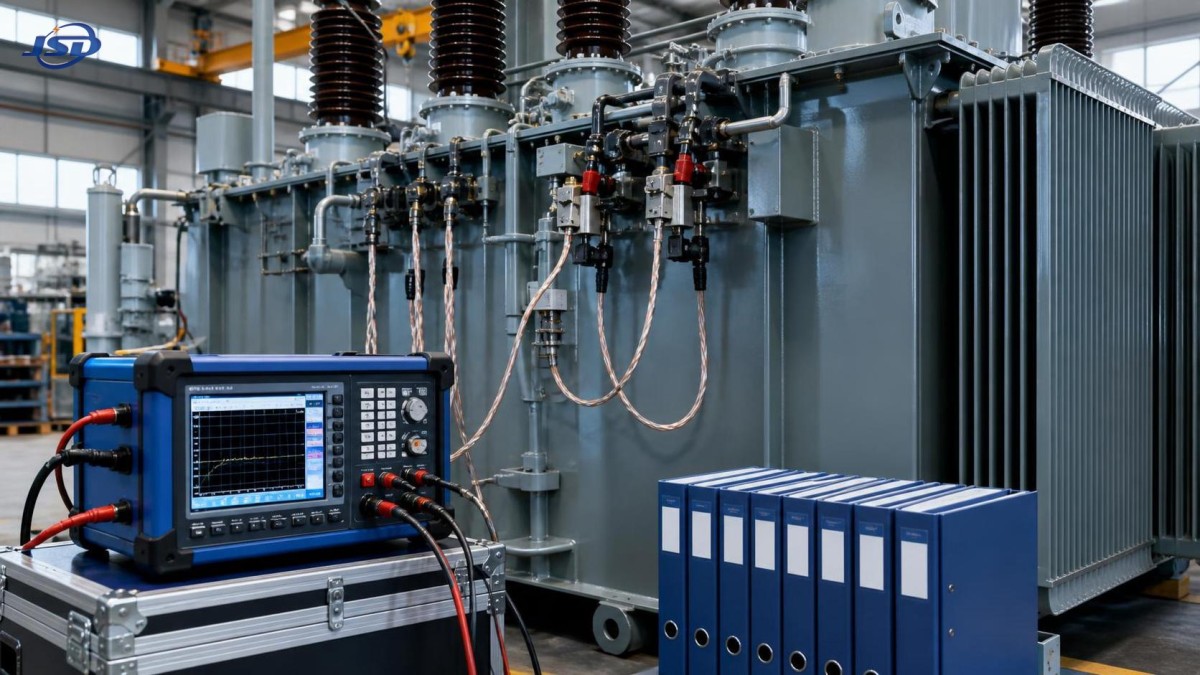
Documents That Usually Belong in the Acceptance File
The right documentation set is driven by the purchase order and the criticality of the installation. A compact industrial transformer and a grid-connected unit should not automatically receive the same inspection burden. Still, for most controlled projects, the following records form a sensible baseline:
- Approved datasheet, nameplate data, outline drawing, and wiring diagram.
- Material or component certificates for items identified as critical in the specification.
- In-process inspection records, including winding, core, tank, painting, and assembly checks when contractually required.
- Routine test reports referenced to the transformer serial number.
- Calibration status or traceability information for significant test equipment, available on request or included in the quality file.
- Nonconformance reports and documented disposition for any accepted deviation.
- Final inspection and release record, packing list, operating manual, and warranty documentation.
The goal is not to demand every internal factory form. Excessive paperwork can obscure the critical evidence and slow release. Instead, identify the records needed to prove compliance and preserve safe operation. For a transformer feeding essential processes, fire pumps, data facilities, renewable-energy equipment, or public infrastructure, more detailed records and third-party witnessing may be justified. For a low-risk replacement transformer, a disciplined routine-test package and a clear final inspection record may be enough.
How to Check Whether the Records Are Reliable
A quick review often reveals weak traceability. Start by comparing the serial number across the nameplate drawing, routine test report, packing list, and final inspection release. They should match exactly. Then compare the rated power, voltages, vector group, impedance, tap range, frequency, and cooling designation against the approved specification. Small inconsistencies are not always technical failures, but they should never be left unexplained.
Next, look for document control. A credible record normally carries a report number, issue date, revision status, tester and reviewer identification, and a defined acceptance basis. Handwritten corrections are not automatically unacceptable, but they should be legible, dated, and approved. Blank fields, copied measurement tables, unsigned test sheets, or reports issued long before the unit was manufactured deserve a direct question.
One overlooked point is the relationship between the test report and the test method. A value can appear reasonable yet be meaningless if the configuration is unclear. Loss measurements, for instance, need the specified voltage and frequency basis. Insulation tests need the relevant test voltage, duration, and connection. Resistance values need the tap position and temperature context. The more significant the transformer’s role in the system, the less acceptable it is to rely on unexplained pass/fail statements.
Factory acceptance testing can add confidence, particularly where the customer or an appointed inspector witnesses the agreed tests. A factory acceptance test is not a substitute for a proper quality system, nor is it necessary for every order. It is most useful where a failure would create major shutdown, safety, schedule, or replacement risk. The inspection and test plan should be agreed before manufacturing, including hold points, witness points, report format, and what happens if a result falls outside tolerance.
Do Not Confuse Certification With Product Traceability
Company-level certifications and product-level evidence serve different purposes. A quality-management certificate may indicate that a factory operates within a documented management system. It does not prove that a particular transformer passed the required routine tests. Similarly, a material certificate may confirm a batch characteristic but does not replace final electrical test results on the completed unit.
Compliance claims also need careful reading. A declaration that equipment is “IEC compliant” is too broad unless the supplier identifies the relevant standard sections, design conditions, test scope, and exceptions. Local grid codes, utility requirements, fire-safety requirements, and transport rules may create additional obligations. The purchase specification should set the hierarchy of documents when requirements conflict.
This is where experienced reviewers tend to be more demanding than first-time buyers. They do not ask only, “Do you have ISO certification?” They ask, “Can you show the serial-number link from incoming inspection through factory testing and final release?” That question goes to the heart of traceability.
Traceability Also Matters at the Site Boundary
Factory documentation cannot compensate for poor storage, lifting, assembly, or commissioning. Once the transformer leaves the factory, custody and condition need their own record. The receiving inspection should note visible damage, impact indicators where used, oil level or gas pressure as applicable, accessories received, and nameplate confirmation. Any discrepancy should be photographed and reported before installation proceeds.
Commissioning records should be retained alongside the manufacturer’s test package. Site checks may include insulation condition, ratio confirmation, winding resistance comparison, functional checks of alarms and trips, grounding verification, and protection coordination, based on the project design and applicable procedures. These tests do not invalidate factory results. They establish a second, equally important baseline after transport and installation.
The same principle applies when a transformer is part of a wider resilience plan. A standby source, such as an Open Type Diesel Generator Set, may support industrial, commercial, agricultural, or construction loads during supply interruptions. Its records should be controlled separately, while the interface points deserve attention: voltage compatibility, phase sequence, grounding arrangement, transfer equipment, protection settings, and the commissioning evidence for the complete system. A good document package follows the electrical system boundary rather than treating each piece of equipment as an isolated purchase.
Questions to Settle Before Placing the Order
The best time to secure traceable documentation is before the order is released. Asking for it after shipment often creates delay because the factory may need to retrieve records, clarify revisions, or recreate a package from several internal systems.
State the required documentation in the technical specification or inspection and test plan. Identify which tests are routine, type, or special; whether witnessing is required; the language and number of copies; electronic file format; document submission timing; and acceptance responsibility. Ask whether reports will be issued under the final serial number or a manufacturing order number that can be cross-referenced. For critical equipment, request a sample redacted test dossier during supplier qualification. It gives a clearer picture than a sales presentation.
Jinshida Electric Power Technology Co., Ltd. applies its technical team, manufacturing processes, and quality management focus to power transmission and distribution equipment used in grid construction, industrial manufacturing, new-energy, and infrastructure projects. When evaluating any manufacturer with this kind of stated quality commitment, the practical measure remains the same: documentation should be accurate, accessible, serial-number-specific, and aligned with the agreed inspection process.
FAQ
Is a factory test certificate enough for transformer acceptance?
Not by itself. It may confirm that tests were completed, but acceptance normally requires the detailed routine-test report, correct unit identification, compliance with the approved specification, and any contractual inspection records.
Can a supplier provide calibration certificates for its test equipment?
A competent supplier should be able to provide evidence that relevant test equipment is under calibration control. Whether every certificate must be included in the delivery dossier should be defined in the contract.
Should all transformers receive type tests?
No. Type tests are generally design-validation tests rather than production tests for every unit. Confirm which type-test evidence is acceptable for the project and whether the design is genuinely equivalent.
What is the most serious documentation red flag?
A routine test report that cannot be tied unambiguously to the delivered transformer by serial number, rating, and manufacturing record is a major red flag.
Traceable test documentation is therefore not an administrative extra. It is evidence that supports release decisions, safe commissioning, maintenance planning, warranty discussions, and post-event investigation. When selecting a power transformer supplier, ask for a defined, serial-number-linked documentation package early, verify it against the approved specification, and preserve it with the site commissioning records. That approach is far more reliable than relying on broad compliance claims after the transformer has already arrived.

Get a Quote
Regardless of whether you require general advice or specific support, we are happy to help you.
Send Us Your Inquiry Today

Jinshida Electric remains committed to contributing to global energy development through professional manufacturing and superior service.