





How electrical distribution transformer manufacturers meet IEC standards
For quality control and safety managers, choosing electrical distribution transformer manufacturers that fully comply with IEC standards is not a paperwork exercise. It is a risk-control decision that affects fire safety, insulation integrity, operating stability, maintenance planning, and project acceptance. In practice, many transformer failures do not come from dramatic design errors. They come from weaker control points: inconsistent raw materials, poorly managed process tolerances, incomplete routine testing, unclear temperature-rise margins, or a mismatch between declared compliance and actual operating conditions. That is why IEC compliance should be evaluated as a manufacturing system, not just a certificate.
When buyers review suppliers for grid, industrial, renewable, or infrastructure applications, the key question is not whether a manufacturer “knows IEC.” The real question is whether its design, production, testing, traceability, and release processes are disciplined enough to consistently produce transformers that meet IEC requirements unit after unit.
IEC compliance begins long before final testing
Among electrical distribution transformer manufacturers, the strongest indicator of real IEC alignment is design control at the earliest stage. A compliant transformer is not created at the end of the line by passing a test report. It is created when the manufacturer translates IEC requirements into design margins, material specifications, thermal calculations, dielectric coordination, short-circuit withstand capability, and process instructions.
For distribution transformers, manufacturers commonly work with IEC 60076 series requirements, including core expectations around temperature rise, dielectric performance, losses, insulation levels, routine tests, type tests, and special tests depending on the application. Dry-type transformers may also involve IEC 60076-11, while application-specific requirements can introduce additional expectations for environmental class, climatic conditions, and fire behavior. Buyers should be cautious if a supplier only references “IEC standard” in broad terms without identifying the applicable parts and test scope.
From a quality perspective, early-stage compliance means the manufacturer has documented control over:
- rated voltage, insulation level, and tapping design;
- conductor sizing and current density limits;
- thermal class and cooling assumptions;
- core material grade and loss performance;
- clearance and creepage distances;
- short-circuit mechanical strength assumptions;
- site-specific constraints such as altitude, humidity, pollution level, and installation type.
If these items are not frozen and reviewed before production, even a factory with good test capability may struggle to deliver repeatable compliance.
Material control is often where compliance becomes credible—or questionable
For safety managers, one of the most practical ways to assess IEC readiness is to look at incoming material control. Transformer performance is highly sensitive to variation in conductor quality, insulation materials, resin systems, steel core properties, bushings, tap changers, and terminals. A manufacturer may provide a compliant prototype, but if procurement substitutes materials without engineering revalidation, the compliance risk rises quickly.
Reliable manufacturers typically establish incoming inspection based on approved vendor lists, material certifications, dimensional checks, and sample verification. For example, copper or aluminum conductor purity, insulation paper consistency, core lamination grade, and epoxy resin batch stability can directly influence dielectric strength, partial discharge behavior, temperature rise, and long-term aging.
This matters even more in dry-type products used in indoor substations, public buildings, renewable stations, and fire-sensitive environments. In these cases, the interaction between conductor winding, insulation system, resin casting quality, and ventilation conditions determines whether the transformer remains stable under thermal cycling. A product such as the 35kV Three-Phase Cast Resin Dry-Type Distribution Transformer would typically be evaluated not only for nominal ratings, but also for insulation system consistency, crack resistance, partial discharge control, and behavior under site-specific loading patterns.
Routine tests are necessary, but they are not enough on their own
One common misunderstanding in procurement reviews is to treat routine test completion as full proof of IEC conformity. Routine tests are essential, but they only confirm certain parameters of each manufactured unit. They do not replace design verification, type testing, process qualification, or a functioning quality management system.
Depending on transformer type and applicable IEC sections, routine tests may include measurement of winding resistance, voltage ratio and phase displacement, short-circuit impedance and load loss, no-load loss and current, applied voltage withstand, induced voltage withstand, and checks for accessories or functional items as required. These are foundational, but they answer a limited question: did this unit meet specified measured values at test stage?
For quality and safety teams, the deeper question is whether the factory has evidence that the design itself is robust under expected service conditions. That is where type tests and, in some cases, special tests become important. A manufacturer that cannot clearly distinguish between routine, type, and special tests often creates confusion during project audits.
It is also worth checking whether the test reports correspond to the same design family, rating range, insulation class, and cooling configuration as the transformer being purchased. Using an unrelated historical type test to support a modified design is a known weak point in supplier documentation.
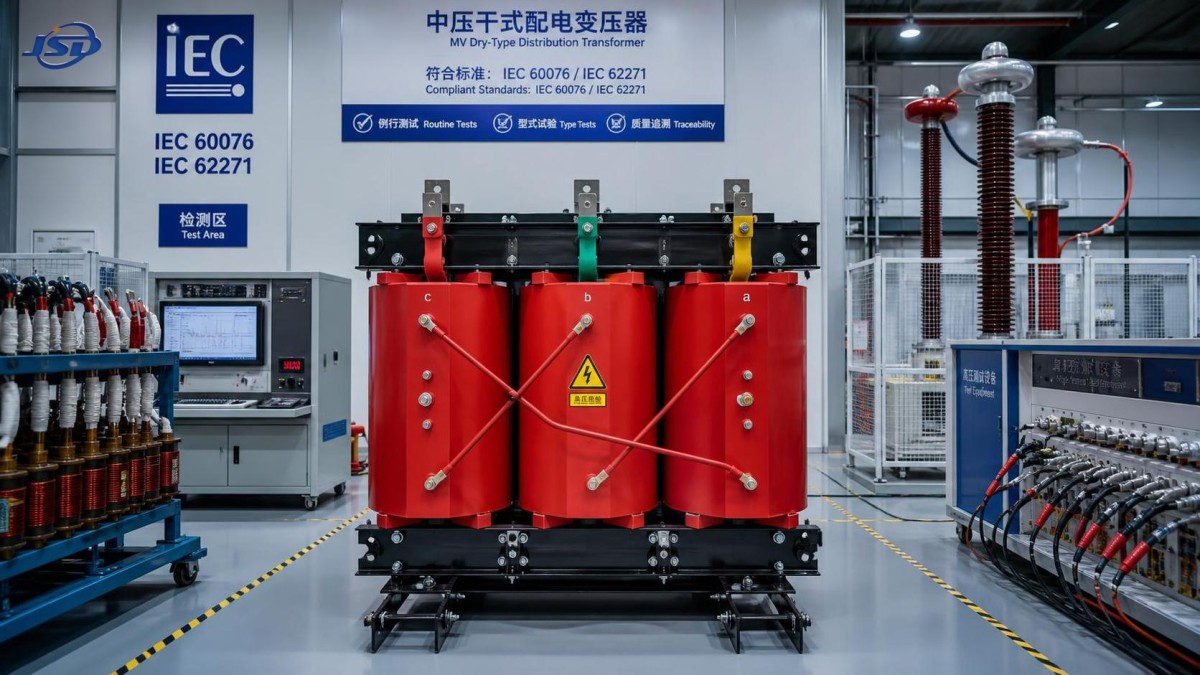
Process discipline is what turns a compliant design into a compliant product
Even well-engineered designs can fail in production if process control is weak. For electrical distribution transformer manufacturers, IEC compliance is closely tied to manufacturing discipline in winding, core assembly, insulation placement, drying, resin casting, curing, lead connection, enclosure integration, and final inspection.
Quality managers should pay attention to whether the factory has defined process checkpoints with measurable acceptance criteria. In real production environments, problems often emerge from issues such as:
- uneven winding tension that affects mechanical stability under fault conditions;
- poor insulation placement that reduces dielectric margins;
- contamination during assembly that increases partial discharge risk;
- insufficient drying or curing that compromises insulation reliability;
- inadequate torque control on terminals and structural fasteners;
- weak dimensional control leading to clearance inconsistencies.
Factories with mature compliance systems usually rely on work instructions linked to controlled drawings, operator qualification records, calibrated tools, in-process inspections, and hold points before key transitions. For dry-type transformers in particular, resin degassing, mold handling, cure profile management, and post-cure inspection are not minor details. They directly affect long-term crack resistance and dielectric stability.
Traceability is a major differentiator in audit-ready manufacturing
From the standpoint of project safety and post-delivery accountability, traceability is often more important than promotional claims about manufacturing scale. When a nonconformance occurs, the ability to identify which material batch, which operator station, which test equipment, and which process record is linked to a specific transformer can determine whether the issue is isolated or systemic.
Leading manufacturers build traceability into the production flow through serial number control, batch linkage for major raw materials, test record retention, nonconformance reporting, corrective action records, and change management. This is especially relevant for export projects where client representatives, EPC contractors, third-party inspectors, or utility owners may request file reviews months after shipment.
For safety managers, traceability also supports root-cause analysis when field issues appear. Without it, a supplier may only be able to offer general explanations instead of evidence-based corrective action.
IEC compliance is not identical to market access compliance
Another practical point for buyers is that IEC standards and market-entry requirements are related but not identical. IEC defines technical standards widely used for design and testing, but some countries, utilities, or project owners impose additional local specifications, witness testing rules, environmental requirements, or certification demands. A manufacturer may be IEC-capable yet still fall short of a particular tender requirement.
This is where experienced electrical distribution transformer manufacturers separate themselves from lower-maturity suppliers. They do not treat IEC as a generic label. They map IEC requirements against customer specifications, local grid codes, installation conditions, transportation limits, and inspection procedures before releasing the design.
For quality teams managing international procurement, supplier review should include:
- which IEC standards and editions are being claimed;
- whether test evidence is from accredited or credible laboratories;
- whether the tested design matches the offered design;
- what deviations, if any, have been accepted by the customer;
- what local or utility-specific requirements sit beyond IEC.
How strong manufacturers manage safety margins instead of aiming at minimum pass values
Factories focused only on passing inspection tend to design too close to threshold values. That creates risk in real service, where ambient temperatures fluctuate, harmonic content may rise, ventilation may be poor, and loading may not follow laboratory assumptions. Manufacturers with better long-term performance usually engineer practical safety margins into thermal behavior, dielectric performance, mechanical strength, and loss control.
For a safety or quality professional, this is a critical distinction. A transformer that merely satisfies nominal acceptance criteria under ideal test conditions may still become problematic in dense industrial plants, solar collection systems, data-related facilities, or constrained indoor substations. In contrast, a manufacturer that builds conservative margins into insulation coordination, winding hot-spot control, and mechanical rigidity is better aligned with lifecycle safety.
That does not mean overspecifying every transformer. It means understanding which applications justify higher margins. Hospitals, tunnels, transport hubs, petrochemical support systems, and public buildings often justify stricter scrutiny than ordinary low-risk installations.
What to ask during supplier qualification
For buyers in quality and safety roles, supplier qualification should move beyond brochure-level questions. Useful discussions usually focus on evidence. Ask how the manufacturer controls design changes after type testing. Ask how nonconforming coils or resin castings are segregated and dispositioned. Ask what percentage of production requires rework and how that trend is monitored. Ask whether test instruments are calibrated internally or externally and at what interval. Ask how customer complaints are linked back into corrective and preventive action.
It is also reasonable to ask for the logic behind material substitutions. If one approved insulation or resin system becomes unavailable, does the factory conduct engineering review and validation before use? In volatile supply markets, this issue has become more important than many buyers expected.
During an audit, document consistency often reveals the true maturity level. Drawings, bills of materials, test reports, inspection records, and quality procedures should align. If values, model references, or revision controls do not match, the compliance claim should be examined carefully.
Dry-type and cast resin units require application-specific judgment
Not every IEC-compliant transformer is equally suitable for every environment. This is especially true for dry-type and cast resin designs. They are often chosen for indoor safety, lower fire risk, and reduced maintenance compared with oil-filled alternatives, but performance still depends heavily on ventilation, contamination level, overload profile, altitude, enclosure design, and installation spacing.
When evaluating products such as the 35kV Three-Phase Cast Resin Dry-Type Distribution Transformer, quality managers should examine whether the manufacturer has addressed partial discharge control, thermal class consistency, environmental protection needs, and installation constraints relevant to medium-voltage indoor systems. A good supplier will discuss these limits clearly rather than implying universal suitability.
What compliance leadership looks like in practice
The best manufacturers do not present IEC standards as a one-time approval milestone. They use them as a framework for continuous control: design review, supplier qualification, process validation, training, testing, traceability, corrective action, and customer-specific adaptation. That approach matters because transformer quality is cumulative. Every weak control point reduces the reliability margin of the final unit.
For companies selecting suppliers in global projects, especially where operating continuity and personnel safety are critical, the most dependable choice is rarely the one with the broadest claims. It is the one that can show how IEC requirements are embedded into the factory’s daily decisions. For quality control and safety managers, that is the practical standard that matters: not whether compliance is declared, but whether it is consistently manufactured.

Get a Quote
Regardless of whether you require general advice or specific support, we are happy to help you.
Send Us Your Inquiry Today

Jinshida Electric remains committed to contributing to global energy development through professional manufacturing and superior service.