





What Efficiency Standards Should Low Loss Distribution Transformers Meet?
When a transformer specification reaches the approval stage, the phrase “low loss” is often treated as a purchasing preference rather than a verifiable requirement. That creates a problem in facilities where transformers run continuously: a unit may have an efficient core on paper but still be unsuitable if its declared losses are incomplete, its test evidence is unclear, its temperature rise is excessive, or its applicable regional efficiency rules have not been checked.
The practical answer is that low loss distribution transformers should meet the mandatory efficiency requirements of the country or project, while also complying with the relevant transformer design, testing, insulation, and safety standards. For many international projects, IEC 60076 provides the central technical framework. However, IEC 60076 conformity alone does not automatically prove that a transformer meets a specific energy-efficiency tier. Loss values, test methods, loading assumptions, and regional regulations must be reviewed separately.
Efficiency compliance starts with the correct standard, not a single “low loss” claim
A distribution transformer has two principal loss categories. No-load loss, also called core loss, occurs whenever the transformer is energized, even when little or no load is connected. Load loss, commonly associated with winding resistance and stray losses, rises as current increases. A low loss design must manage both, but their importance changes with the operating profile.
For an energized transformer serving a lightly loaded network, core loss can dominate annual energy consumption because it is present around the clock. In a heavily loaded industrial installation, load loss and thermal behavior become more significant. Quality documentation should therefore never present one loss figure without identifying whether it is no-load loss, load loss at rated current, or a calculated total at a stated loading point.
The standards that apply depend on the destination market, voltage class, procurement specification, and project contract. A useful review normally separates three layers:
- General transformer standards: These establish requirements for ratings, dielectric performance, temperature rise, insulation, impedance, tolerances, and routine testing.
- Energy-efficiency requirements: These may set maximum permitted no-load and load losses, minimum efficiency values, or defined efficiency classes for particular transformer categories.
- Project-specific requirements: Utilities, industrial owners, and infrastructure contractors may impose loss capitalization formulas, sound limits, voltage regulation requirements, or stricter tender loss limits.
IEC 60076 is widely used for power and distribution transformer design and testing. It addresses the technical integrity of the transformer, including how relevant losses are measured and reported. Where energy performance is a key procurement issue, IEC 60076-20 is particularly relevant because it addresses energy efficiency for distribution transformers. The purchaser should still confirm that the required efficiency level, transformer type, rated power range, and voltage arrangement match the actual unit being supplied.
Do not confuse declared losses with guaranteed compliance
A nameplate or quotation may state that a transformer has “reduced losses,” but this statement is not enough for acceptance. A defensible evaluation needs declared values tied to defined test conditions. The manufacturer should identify the rated capacity, rated voltage, frequency, vector group, cooling method, tapping position used for the test, and reference temperature for load loss.
Load loss changes with conductor temperature. Comparing one supplier’s loss figure at one reference temperature with another supplier’s figure at a different temperature can lead to an incorrect decision. The same issue appears when bid documents do not state whether auxiliary losses are included or how losses are corrected. The test report should make the basis visible rather than leaving it implied.
Loss limits should be written as guaranteed contractual values, not merely “typical” values. The acceptance condition should state what happens if measured values exceed the guaranteed limit. In many technical specifications, losses are evaluated independently because a very low core loss does not offset an unusually high load loss unless the project’s loss-evaluation method explicitly allows that tradeoff.
The operating scene determines which efficiency figure deserves more weight
Consider an urban distribution substation that remains energized overnight while its daytime demand varies. The transformer may spend substantial time below rated load. In that situation, reducing no-load loss is often especially valuable because the core remains magnetized for the full operating period. By contrast, a transformer feeding a stable industrial process may operate closer to its rated capacity, increasing the importance of winding loss, cooling margin, and temperature rise.
This is why an efficiency assessment should begin with the expected load profile rather than only with rated kVA. Review at least the anticipated average loading, peak loading, seasonal variation, expected energization hours, harmonic content, and whether the transformer will be paralleled with another unit. These factors do not replace a mandatory efficiency requirement, but they help determine whether the selected loss balance is appropriate.
Harmonics deserve particular attention in industrial and renewable-energy-connected systems. Nonlinear loads can increase additional heating in windings, connections, and structural parts. A transformer that satisfies basic loss limits under sinusoidal test conditions may require further design review when harmonic currents are expected. The correct response is not to assume a generic derating factor; it is to define the expected harmonic environment and obtain a design assessment consistent with the intended duty.
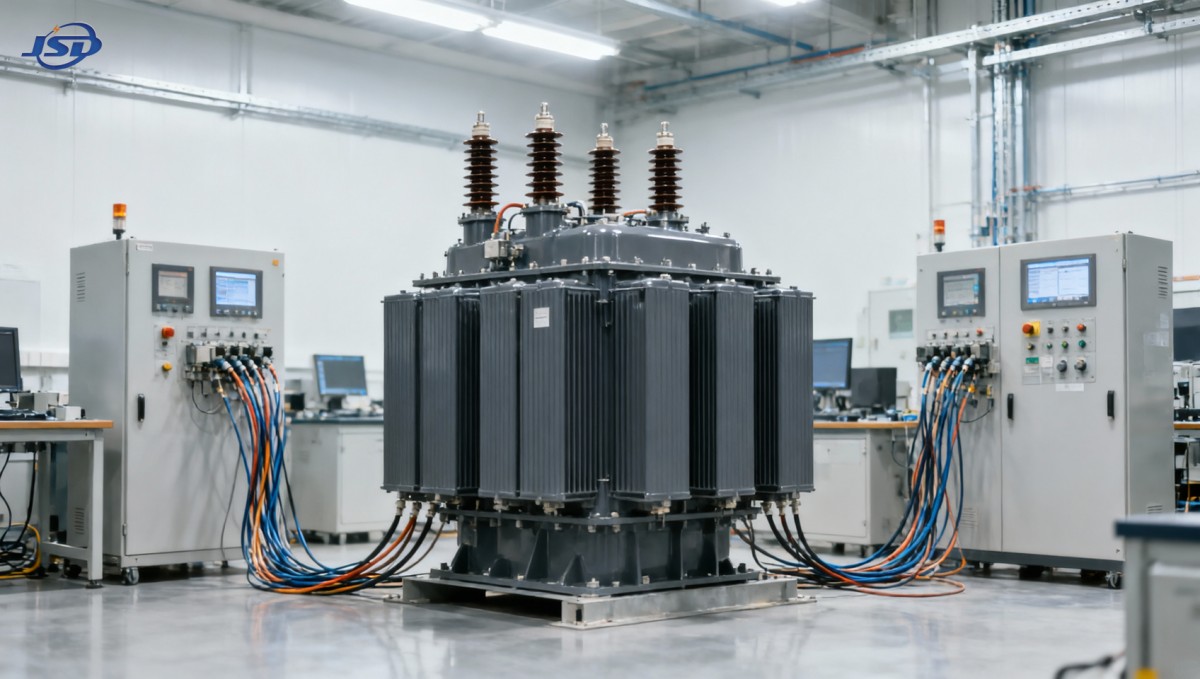
How to review IEC-based transformer compliance in an incoming inspection process
Incoming inspection should connect documentation to the actual transformer delivered. A certificate bearing a standard number is useful only when the model, rating, serial number, and tested configuration can be traced. A disciplined process prevents a common gap: reviewing a general product document while accepting a unit with different losses, tap settings, or accessories.
- Confirm the transformer category. Check whether the unit is oil-immersed or dry-type, its rated power, high- and low-voltage ratings, frequency, phase arrangement, cooling method, and installation location. Efficiency provisions may vary by category.
- Match the governing documents. Compare purchase-order requirements, drawings, data sheets, local regulations, and the offered standard. Resolve conflicts before shipment or site installation.
- Review routine test reports. Verify ratio, polarity or vector group, winding resistance where specified, impedance voltage, no-load current and no-load loss, load loss, insulation tests, and oil-related tests where applicable.
- Check loss values against guarantees. Ensure that measured values are associated with rated conditions and that correction methods are documented. Do not accept an unexplained calculation in place of a test value.
- Inspect visible construction and markings. Check nameplate data, terminal identification, earthing points, oil level indication, pressure-relief devices where fitted, cooling surfaces, gasket condition, and warning labels.
- Preserve traceability. Keep test reports, drawings, serial-number records, inspection findings, and any approved deviations together. This is essential if losses, noise, or overheating are questioned later.
Safety-related checks should not be separated from efficiency review. Losses become heat, and heat affects insulation life, oil condition, pressure behavior, and clearances. A transformer with acceptable energy figures but inadequate protection, incorrect grounding provisions, damaged bushings, or unsuitable installation clearances cannot be treated as an acceptable low loss unit.
Material choices can reduce loss, but they also require complete performance verification
Amorphous alloy cores are commonly selected where very low no-load losses are important. Their magnetic properties can reduce hysteresis and eddy-current losses compared with conventional core materials, especially during continuous energization. Yet core material alone is not a complete efficiency standard. Winding design, conductor quality, core assembly, insulation system, tank construction, cooling, and manufacturing consistency all affect the final measured result.
For applications where continuous operation and low no-load loss are priorities, an SBH15 Amorphous Alloy Transformer may be assessed against the same disciplined criteria: confirmed ratings, IEC 60076 conformity, documented loss values, thermal suitability, noise limits, and site conditions. Its amorphous alloy core, copper windings, oil-immersed insulation structure, and ONAN cooling arrangement should be evaluated in relation to the project specification rather than treated as automatic proof of compliance.
Noise is one area where efficiency-related design decisions can create a practical installation issue. Core magnetostriction and structural vibration contribute to transformer sound. A unit intended for residential areas, commercial buildings, or locations with strict noise requirements should have a declared sound level that is evaluated alongside its loss values. It is not enough to select an efficient core if site noise limits cannot be met after installation.
Regional rules may impose requirements beyond IEC technical conformity
IEC standards are frequently used across international projects, but national or regional law may prescribe mandatory efficiency thresholds for transformers placed on a market. These rules can differ in scope, definitions, testing conditions, and covered ratings. A procurement team should identify the destination market early, especially when equipment is manufactured in one country and installed in another.
For example, a specification may refer to an IEC test basis while the delivery destination requires compliance with a separate local energy-performance regulation. Neither requirement should be assumed to replace the other. The supplier should provide clear documentation showing which requirement is being met and whether the offered configuration falls within its scope.
Where a project uses utility-specific loss limits, compare them line by line with the regulatory minimum. Utility requirements may be stricter or may use a loss capitalization method that assigns a financial value to no-load and load losses. That method can favor a different design than a simple maximum-loss table. The review team should use the exact formula in the tender documents and should not substitute a generic efficiency percentage.
Warning signs that require clarification before acceptance
- The quotation lists one total-loss figure but does not split no-load and load loss.
- Loss values are stated without rated voltage, frequency, tap position, or temperature basis.
- The standard is cited broadly, but no relevant test report or conformity record is available for the supplied rating.
- The offered transformer has a different cooling class, winding material, vector group, or voltage range from the approved data sheet.
- Energy efficiency is emphasized while temperature rise, impedance, short-circuit capability, and dielectric test results are missing.
- The installation environment includes harmonic loads, high ambient temperature, restricted ventilation, or noise-sensitive boundaries that were not considered in the design review.
The right standard for low loss distribution transformers is therefore not simply the one printed on a brochure or nameplate. It is the combination of applicable efficiency regulation, recognized transformer technical standards, contractual loss guarantees, verified test evidence, and site-specific safety requirements. When these elements align, energy efficiency becomes a measurable part of reliable power distribution rather than an unsupported product description.
Hot News
- 00
0000-00
How U.S. DOE efficiency rules affect distribution transformer manufacturers - 00
0000-00
How american type pad mounted transformer seismic qualification affects installation in California utility grids? - 00
0000-00
Do european compact substation transformer EMC compliance tests include conducted emissions up to 30MHz?
0000-00
Contact Us

Get a Quote
Regardless of whether you require general advice or specific support, we are happy to help you.
Send Us Your Inquiry Today

Jinshida Electric remains committed to contributing to global energy development through professional manufacturing and superior service.