





What affects lead times from power distribution transformer manufacturers
It usually becomes urgent at the worst possible moment. A project team has aligned installation crews, civil work is nearly done, and energization dates are already being discussed. Then one basic question starts causing trouble: why is the delivery window from power distribution transformer manufacturers longer than expected, or why does it keep moving? For anyone coordinating equipment purchases, that delay is rarely isolated. It can affect switchgear sequencing, site readiness, temporary power plans, budget timing, and even internal reporting.
A common mistake is to treat lead time as a fixed number printed on a quotation. In practice, it is more like the visible end of several moving parts. If you are comparing suppliers, planning a tender, or trying to understand current market behavior, it helps to know which variables are actually shaping the schedule. That makes it easier to judge whether a date is realistic, whether a specification is adding avoidable delay, and where a buyer still has room to influence the outcome.
Lead time is not only a factory issue
When buyers first ask about timing, the answer often sounds simple: production starts after order confirmation, then testing, then shipment. But that neat sequence hides the fact that lead time begins much earlier. It is affected by how complete the technical documents are, how many design clarifications are needed, whether special materials are required, and how the manufacturer balances production slots across multiple orders.
This is why two transformers with similar ratings may not move through the factory at the same speed. One may use standard design practices and familiar accessory configurations. Another may trigger several rounds of engineering review because of altitude requirements, cooling concerns, enclosure preferences, installation environment, or local utility expectations. The actual manufacturing time may be only part of the total wait.
Raw material availability still shapes delivery windows
Among the strongest influences on timing are the materials that cannot easily be substituted at short notice. Electrical steel, copper or aluminum conductors, insulating materials, bushings, tap changers, and certain protection accessories can all affect the schedule. Even when a transformer manufacturer has good production discipline, lead times tend to stretch if a key input is constrained, especially when many projects are buying at once.
For buyers, the practical point is not to ask only, “How long is your lead time?” A more useful conversation is, “Which components are standard in your current production plan, and which items are likely to extend delivery?” That question often reveals more than the headline date on a quotation.
Market conditions also matter. In some periods, manufacturers may have stable stock positions for core materials but face long waits on specialty accessories. In other periods, the bottleneck may be the conductor supply or logistics of imported components. This is one reason experienced buyers usually compare not just total lead time, but also the assumptions behind it.
Technical specifications can quietly add weeks
One of the most underestimated causes of delay is specification complexity. Many people assume that once power rating and voltage class are known, the rest is routine. In reality, every non-standard feature can trigger additional engineering and procurement steps. Examples include unusual impedance requirements, custom protection arrangements, specific terminal layouts, noise restrictions, special coatings, seismic considerations, parallel operation constraints, and site conditions such as high ambient temperature or corrosive atmosphere.
None of these requirements are wrong. The issue is that they often enter the process late, after commercial discussions have already shaped expectations. When the technical package changes after quotation or after order placement, the lead time may shift even if the supplier is acting responsibly.
This is especially relevant when evaluating a familiar product category such as a 20kV/0.4kV Oil-Immersed Power Distribution Transformer. On paper, the category may seem straightforward. Yet details like vector group, loss requirements, cable box arrangement, protection accessories, and installation conditions can still determine whether the unit fits a standard production flow or requires extra preparation.
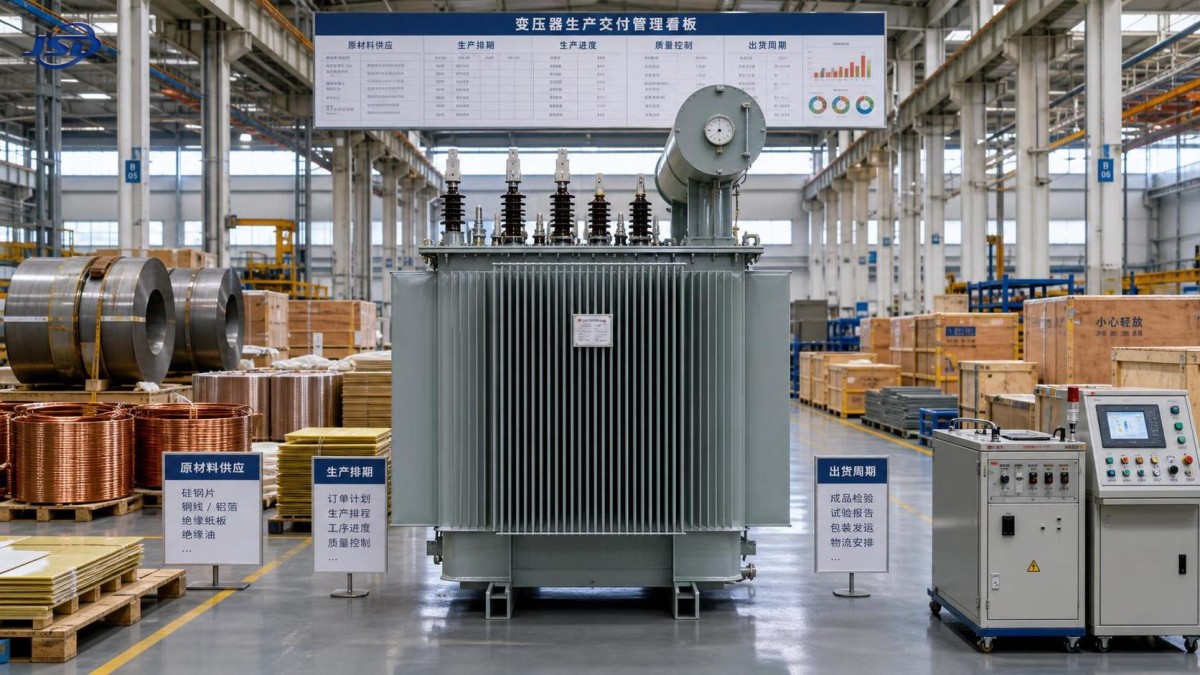
Factory loading often matters more than plant size
Buyers sometimes assume that a larger facility always means a shorter wait. That is not necessarily true. What matters is how current orders are distributed across winding, core assembly, tank fabrication, drying, testing, and finishing stages. A manufacturer may have strong capacity overall but still face congestion at one critical step. Another may have a smaller operation yet maintain smoother scheduling because its order mix is more balanced.
This is where asking the right questions becomes important. Instead of relying on broad statements about annual output or workshop area, it is often more useful to ask whether your required rating and configuration align with current production routines. Some power distribution transformer manufacturers are especially efficient with repeat designs and common voltage classes. Others may be better suited to customized builds but with correspondingly longer lead times.
In trend terms, this means the market does not move in a single direction for all products at once. Delivery pressure can be uneven. Standard units may remain manageable while customized projects slow down. Or the opposite can happen if standard-volume demand suddenly rises in utility or industrial channels.
Engineering approval cycles are a hidden bottleneck
Not every delay comes from manufacturing. A surprising amount of time can be lost before production is allowed to begin. If drawings, nameplate details, accessory lists, or terminal arrangements need customer approval, even small gaps in communication can hold the process. One unanswered email or one unclear revision request can create several days of drift, and repeated cycles can extend far beyond that.
This tends to happen when procurement, engineering, and site teams are not working from the same final requirement set. The supplier submits documents based on one interpretation, the user reviews them from another, and the order pauses while everyone rechecks basics that should have been settled earlier.
A practical way to reduce this risk is to freeze the core technical points before expecting a firm delivery date. If a project is still deciding between installation methods, protection options, or cable directions, it is safer to treat early lead times as provisional.
Testing and quality control are part of the schedule, not an extra
When the project calendar is tight, there is a temptation to think of testing as a final formality that can be compressed. That assumption creates problems. Routine tests, inspection preparation, document review, and packing checks are not optional add-ons if the goal is dependable delivery. They are built into the timeline for a reason.
Serious buyers usually prefer clarity here. If a manufacturer offers a very short lead time, it is reasonable to ask how design release, production, testing, and dispatch are sequenced. The point is not to challenge the supplier unnecessarily, but to understand whether the date reflects a controlled process or a best-case estimate.
In the current market, one useful sign is consistency. Manufacturers that explain their testing and release process clearly are often easier to work with than those that only repeat an attractive delivery promise. A short quoted lead time has little value if it regularly shifts after order confirmation.
Shipping conditions can change the real arrival date
Even after a unit is completed, the delivery story is not over. Packing method, transport route, port availability, inland haulage restrictions, and documentation readiness can all affect when the transformer actually reaches site. This matters especially for larger units, remote destinations, or projects with strict site access windows.
For that reason, buyers should separate manufacturing completion from delivered-to-site timing when comparing offers. Some suppliers quote from ex-works completion, while internal project teams may be thinking in terms of arrival and handover. That mismatch leads to frustration later, even if the factory completed the unit on time.
Where project timing is sensitive, it is often worth clarifying logistics assumptions early: dispatch method, packaging scope, document package, and whether any local transport constraints are likely to affect the final leg.
Current buying trends are pushing lead-time questions upstream
One noticeable shift in the market is that lead time is no longer treated as a detail to settle near the end of supplier selection. It has become part of the initial screening process. Buyers are increasingly trying to distinguish between standard and custom configurations earlier, reserve production windows sooner, and reduce late-stage specification changes.
That trend makes sense. As project schedules become tighter and coordination across equipment packages becomes more complex, a buyer often benefits more from a realistic and stable schedule than from an optimistic one that later moves. This is also why many sourcing teams now ask for more detail on design assumptions, accessory lead times, and approval milestones during the quotation stage.
Another market pattern is the preference for products that fit proven application ranges without unnecessary customization. For example, if a project requirement can be met with a standard configuration approach rather than a heavily modified one, that usually gives more flexibility in production planning. A familiar product class such as the 20kV/0.4kV Oil-Immersed Power Distribution Transformer may move more predictably when the technical scope stays aligned with common manufacturing practice.
When a quoted date looks too good, pause before accepting it
It is understandable to favor the shortest lead time when project pressure is high. Still, a very aggressive schedule deserves a closer look. Is the date based on standard materials already available? Does it assume immediate approval of all drawings? Are any accessories excluded or left “to be confirmed”? Is transport included in the timeline or treated separately?
These questions are not about distrust. They are about reducing avoidable surprises. In many buying situations, the best choice is not the supplier with the fastest first answer, but the one whose timeline is easiest to verify.
This is also where comparisons become more useful if they are structured around the same scope. If one quotation assumes standard terminals and another assumes a customized arrangement, the lead times are not directly comparable. Without scope alignment, the market can appear more inconsistent than it really is.
What usually helps buyers shorten delays without forcing the factory
In practice, lead-time control often improves when the buyer focuses on a few specific actions. One is preparing a cleaner technical package before requesting final dates. Another is limiting design changes after order release unless they are genuinely necessary. A third is confirming approval responsibilities early, so documents do not sit unattended between departments.
It also helps to discuss substitutes only where they are technically acceptable. If a requested accessory is creating a long delay, a practical conversation about equivalent options may save time. The same applies to cosmetic preferences or non-essential customizations that add work but not real operational value.
Perhaps the most useful habit is to ask power distribution transformer manufacturers not just for a delivery promise, but for the logic behind it. Once you understand whether the long pole is materials, engineering, capacity, testing, or shipping, the timeline becomes easier to manage. Some factors can be improved through earlier decisions. Others simply need to be recognized and planned around.
For buyers tracking market trends, that is the main takeaway: lead times are shaped by a chain of decisions, constraints, and approvals, not by factory output alone. The more clearly that chain is understood at the beginning, the less likely it is to create trouble later when the project can least afford it.

Get a Quote
Regardless of whether you require general advice or specific support, we are happy to help you.
Send Us Your Inquiry Today

Jinshida Electric remains committed to contributing to global energy development through professional manufacturing and superior service.