





What industrial transformer manufacturers should provide in bids
What Industrial Transformer Manufacturers Should Provide in Bids
In transformer procurement, the cheapest bid is rarely the safest choice. Project managers usually find that out when the “missing details” start showing up late: unclear loss data, vague accessories, test scope that is narrower than expected, packaging not suited for the route, or a delivery promise that looks fine on paper but has no manufacturing logic behind it. By then, the commercial comparison is over, and the technical risk has already moved into the project.
That is why strong bids from industrial transformer manufacturers should do more than quote price and basic rating. A useful bid helps the buyer judge whether the unit can be manufactured correctly, delivered on time, installed without surprises, and operated reliably under the actual site conditions. In practice, the bid package itself often tells you as much about the manufacturer as the transformer design does.
For grid, industrial, renewable energy, and infrastructure work, the burden on a transformer is rarely just “step voltage up or down.” Ambient temperature, altitude, load profile, harmonics, duty cycle, installation space, and local compliance requirements all matter. Manufacturers with real project experience usually reflect those realities in their quotations. They ask better questions, and their bids tend to be more complete.
The bid should define the transformer, not just name it
A line item like “power transformer, oil-immersed, 30kV/0.4kV” is not enough for procurement review. At minimum, the bidder should state rated power, primary and secondary voltage, frequency, vector group, impedance, tap changer arrangement, cooling method, insulation class where applicable, and installation type. If the project documents include unusual conditions such as high altitude, coastal corrosion, seismic exposure, heavy harmonic loads, or frequent overload operation, the bid should explicitly address them rather than assume standard service conditions.
This is also where experienced manufacturers separate themselves from traders who are just passing along a factory template. The better bid will show what is included in the base scope and what is optional: temperature indicators, pressure relief devices, Buchholz relay where relevant, marshalling box, cable boxes, surge arresters, wheels, neutral grounding provisions, and spare accessories. If those boundaries are not clear, bid comparison gets distorted quickly.
Losses, efficiency, and thermal performance need to be stated plainly
Many projects talk about energy efficiency, but in bid reviews the discussion still gets reduced to purchase price. That is short-sighted, especially for units expected to run continuously for years. The manufacturer should provide no-load loss, load loss at the specified temperature reference, and where required, total losses or efficiency information at defined loading points. If the project is sensitive to operating cost, these values matter far more than a small gap in ex-works price.
Just as important, the bidder should state the standard under which those values are declared. Different projects reference different national or utility requirements, and a number pulled out of context is not very useful. If there are tolerances, they should be transparent. If a lower-loss design changes dimensions, oil volume, or lead time, that trade-off should also be visible in the bid.
For example, a distribution project considering an 30kV/0.4kV Oil-Immersed Power Distribution Transformer may be focused not only on basic voltage conversion, but also on whether the quoted losses align with local utility expectations and whether the thermal design is suitable for the site’s loading pattern. A serious manufacturer will not leave that to guesswork.
Compliance documents should be specific, not decorative
One of the most common problems in transformer bids is broad language like “complies with international standards” without naming which ones. That is not enough for a project decision. The bid should reference the exact design, manufacturing, and testing standards being applied, and if local requirements differ, the manufacturer should identify any deviations up front.
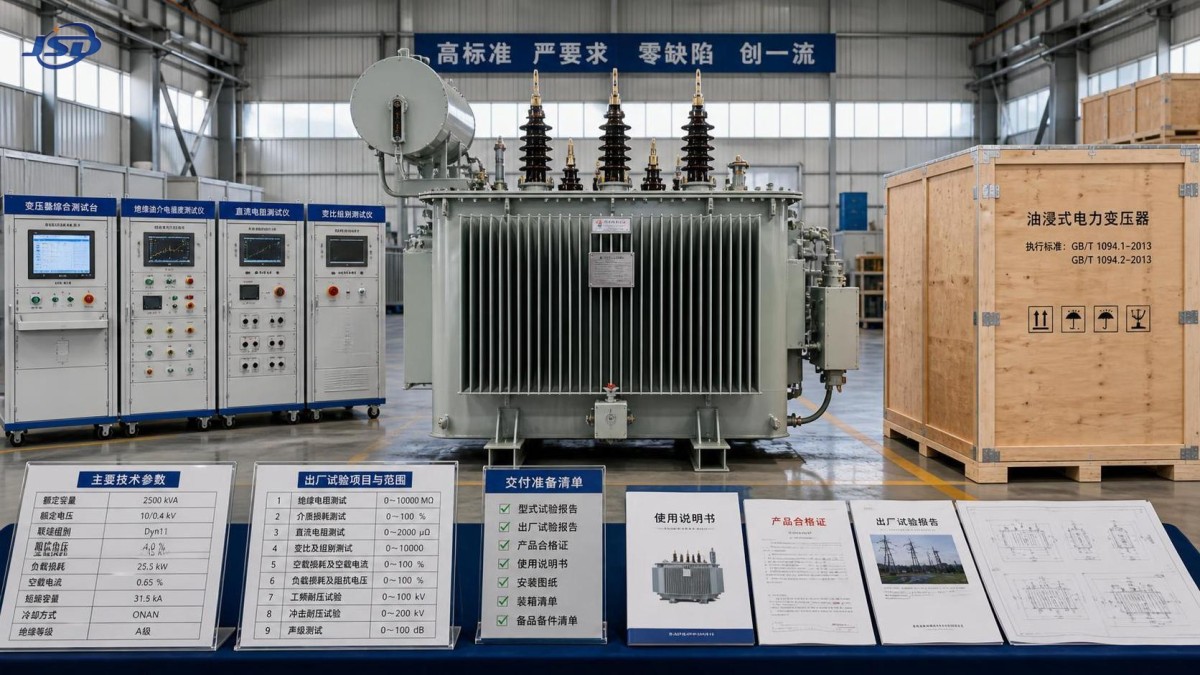
This does not mean stuffing the offer with paperwork for appearance’s sake. It means the bid should tell the buyer what compliance can be demonstrated during review, factory test, shipment, and commissioning. Depending on the project, that may include nameplate details, routine test documents, drawings, quality records, material declarations, coating information, and packing specifications. If a bidder says documents will be “provided later,” that is worth probing. Sometimes it is harmless. Sometimes it signals that engineering is still unresolved.
Testing scope is where vague bids become expensive
Every buyer expects routine testing. The issue is whether both sides mean the same thing by that. A good bid should clearly state which factory tests are included, which witness tests are available if requested, and what the reporting format will be. For some projects, special tests may be necessary depending on system design, utility practice, or employer specifications. If they are excluded, that should not be hidden in small print.
This matters because testing is not just a technical formality. It affects scheduling, travel coordination, document approval cycles, and release for shipment. If a manufacturer cannot explain its testing workflow, project managers should be cautious. Reliable industrial transformer manufacturers usually know how long test preparation takes, when customer witness can be accommodated, and which documents can be issued immediately after test completion.
Delivery schedules should reflect production reality
Lead time promises are easy to make and harder to keep. In transformer projects, delay often starts with missing technical approvals, long-lead raw materials, or unclear accessory sourcing. So the bid should do more than say “delivery in 45 days” or “as soon as possible.” It should outline what that lead time assumes: drawing approval timing, final specification freeze, accessory confirmation, testing sequence, and shipping terms.
This is one area where a manufacturer’s internal discipline shows. Companies that invest in technical teams, controlled manufacturing processes, and structured quality management tend to quote delivery more realistically because they understand the dependencies. Jinshida Electric Power Technology Co., Ltd., for example, positions itself around R&D capability, manufacturing control, and stable support for grid, industrial, new energy, and infrastructure applications. In bid review terms, that kind of operating model matters only if it translates into something concrete: better technical clarification, cleaner documentation, and fewer surprises between order placement and dispatch.
Packaging, transport, and site readiness belong in the bid conversation
A transformer can leave the factory in good condition and still arrive as a problem if the transport plan is weak. Bids should mention shipping condition, oil handling if applicable, protection against moisture and impact, lifting points, storage recommendations, and any constraints on unloading or installation. This is especially relevant for remote projects, humid climates, and sites where the transformer may sit before energization.
Project managers should also look for dimensional drawings and weight information early. Not because drawings are a procurement formality, but because civil interfaces often get overlooked until late. Foundation size, access route, crane capacity, and cable termination arrangement can all become practical blockers. When manufacturers provide those details early, coordination gets easier for everyone.
After-sales support should be measurable
Almost every supplier says it offers service support. The better question is: support for what, by whom, and within what timeframe? A strong bid should indicate warranty scope, technical response process, commissioning support if required, spare parts availability, and document handover after delivery. If remote guidance is the default, that is fine, but it should be stated clearly. If on-site attendance is possible, the commercial and scheduling conditions should be visible.
For project managers, this is less about sales language and more about risk control. If a unit fails an installation check, shows abnormal oil level behavior, or raises test result questions during commissioning, the response quality matters. A manufacturer that has built its reputation on long-term reliability should be able to explain how post-delivery support works without resorting to generic promises.
What often gets missed during bid comparison
There are a few points buyers tend to discover late:
- Quoted accessories are not equivalent across bidders, even when the transformer rating is the same.
- Test scope differs, which makes one low bid look cheaper than it really is.
- Loss values are declared, but not against the same standard or temperature basis.
- Lead time excludes approval cycles or shipping preparation.
- Document packages are promised, but not itemized.
These are not minor clerical issues. They affect total project cost, energization date, and long-term operating confidence. Even for a familiar configuration, such as a second 30kV/0.4kV Oil-Immersed Power Distribution Transformer in a standard industrial setup, bid gaps can still cause friction if the commercial and technical scope are not aligned.
A practical way to review bids
A workable review method is to score bids across five dimensions: technical completeness, compliance clarity, testing transparency, delivery credibility, and service commitment. Price still matters, of course, but only after the technical baseline is normalized. If one bidder includes confirmed accessories, documented testing, and realistic scheduling while another quotes loosely, they are not offering the same thing.
It also helps to send clarification questions before final award rather than assume details can be cleaned up later. In transformer procurement, “later” often lands in production, where changes cost more and schedules become harder to recover.
The best bids from industrial transformer manufacturers usually feel less polished in a marketing sense and more useful in an engineering sense. They answer the awkward questions early. They define what is included. They show how the unit will be built, tested, delivered, and supported. That kind of bid may not always be the lowest on the opening sheet, but it is often the one that creates the fewest problems once the project leaves the meeting room and reaches the site.

Get a Quote
Regardless of whether you require general advice or specific support, we are happy to help you.
Send Us Your Inquiry Today

Jinshida Electric remains committed to contributing to global energy development through professional manufacturing and superior service.