





When can a distribution transformer supplier support phased projects?
When Can a Distribution Transformer Supplier Support Phased Projects?
A phased power project rarely follows the neat procurement sequence shown in an early schedule. Civil works move, tenant loads change, an industrial line is added, or a renewable-energy connection becomes operational before the rest of the site is ready. In these situations, a reliable distribution transformer supplier is not simply a source of compliant equipment. The supplier needs to help the project team preserve a workable electrical plan while deliveries, ratings, installation conditions, and commissioning dates evolve.
That support becomes realistic when the supplier has enough engineering discipline to control design changes, enough manufacturing visibility to reserve practical production windows, and enough commercial flexibility to treat the project as a sequence rather than a single purchase order. These conditions sound obvious, but they are often where phased projects become difficult. A transformer delivered on time but built to an outdated connection group, tap range, or cooling arrangement can still hold up energization.
For project managers, the useful question is not “Can the supplier split the shipment?” Almost every supplier can make that promise. The better question is whether the supplier can maintain technical consistency and delivery certainty from the first energized section through the final expansion.
Phasing works when the electrical architecture is defined early enough
A supplier can support staged deployment most effectively when the project has a stable master electrical concept, even if the exact quantity of transformers is not final. The team should know the incoming voltage, intended low-voltage distribution arrangement, fault-level assumptions, earthing philosophy, operating duty, and likely future load blocks. This is particularly important where separate transformers will later operate in parallel or feed closely linked sections of a network.
In a factory expansion, for example, phase one may energize utilities, lighting, and an initial production line. Phase two may add high-demand motors, process heating, or automated equipment. The first transformer should not be selected only for today’s connected load. Its impedance, vector group, voltage regulation, protection interface, and allowance for temporary loading need to fit the eventual distribution arrangement. Buying an apparently economical first unit without considering the later system is a familiar route to redesign.
The same principle applies to commercial campuses, hospitals, data centers, mining facilities, and renewable-energy projects. Their build schedules differ, but the electrical risk is similar: early equipment choices can quietly restrict later options. A capable distribution transformer supplier will ask about the final scheme before confirming the first release, rather than treating every phase as unrelated equipment.
The supplier must be able to freeze the right details, not every detail
Phased procurement needs a sensible distinction between information that must be fixed now and information that can remain open. Core technical characteristics usually need early confirmation because they affect transformer design, materials, testing, and accessories. These include rated capacity, high- and low-voltage levels, frequency, vector group, impedance, tap requirements, insulation class, enclosure requirements, and applicable standards.
Other items may have more room to move. Cable-entry direction, accessory placement, some monitoring options, paint or enclosure details, and shipping sequence can often be finalized later, provided the change is made before the relevant production stage. The exact cut-off depends on the product design and factory process. Project teams should ask for written design-freeze milestones rather than assuming that “flexibility” applies until dispatch.
This is where technical documentation matters more than polished sales language. A supplier should be able to issue drawings, datasheets, loss data, terminal information, and testing requirements in a controlled revision process. Each phase needs a clear record of what was approved and what has changed. If the phase-two transformer is expected to match phase one, “similar specification” is not enough; the matching requirements should be explicitly stated.
Production capacity only helps when it is visible and managed
A phased project benefits from production capacity, but capacity is not merely a headline number. What matters is whether the manufacturer can explain how engineering approval, winding, core assembly, casting or insulation processing, testing, packing, and shipment fit around the requested delivery windows. The project manager does not need every shop-floor detail, but does need credible milestones and early notice when a change could affect them.
For dry-type transformers, material and process control deserve particular attention. Winding conductors, grain-oriented silicon steel, epoxy-resin systems, insulation materials, enclosure components, and temperature-control equipment may all influence lead time. A supplier that regularly handles phased work should be able to identify which items are standard, which are project-specific, and when material commitments need to be made. This is more useful than receiving a generic assurance that the factory has “strong capacity.”
Jinshida Electric Power Technology Co., Ltd. approaches power equipment supply through R&D, manufacturing, and application support for transmission and distribution projects. For phased work, that combination matters because technical decisions and manufacturing decisions cannot be separated. A rigorous quality-management process is also relevant here: each delivered batch must remain traceable to its approved drawings, test requirements, and inspection records.
Choose equipment that suits the installation sequence, not just the voltage level
The transformer type should reflect where and how each phase will be installed. Indoor substations, constrained commercial buildings, hospitals, data facilities, and facilities with strict fire-performance expectations may favor dry-type equipment. In those settings, avoiding oil-leakage risk and using non-flammable insulation can simplify some practical aspects of installation, although the full fire strategy and local code requirements still need project-specific review.
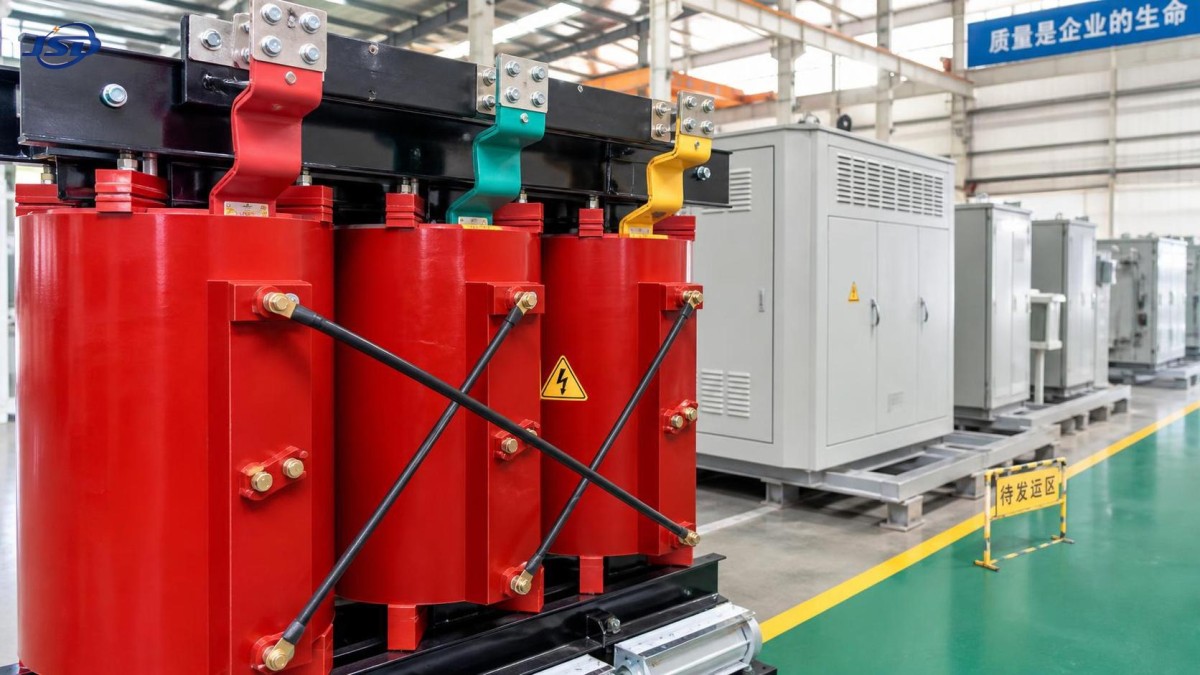
For a 33 kV distribution stage feeding a 0.4 kV network, an option such as the 33kV Cast Resin Dry-Type Distribution Transformer can be considered where the project calls for indoor-capable dry-type construction and a capacity range aligned with the planned load blocks. The SCB10-12 configuration is available with 33 kV input and 0.4 kV output arrangements, rated capacities from 30 to 2500 kVA, and a stated 6% short-circuit impedance. Those figures are not a substitute for system coordination. They need checking against the actual utility supply, protection study, voltage-drop allowance, harmonic environment, and downstream fault-duty calculation.
Its stated F1-class fire performance, 175 kV lightning-impulse capability, temperature protection and control options, and forced-air overload capability of up to 120% of rated load may be relevant in a phased scheme. Yet temporary overload should never become the default capacity plan. It can be useful during a controlled transition, but continuous growth should be addressed through correctly sized permanent equipment. This distinction is easy to miss when the pressure to energize phase one is high.
Delivery planning should be linked to site readiness
A transformer arriving early is not always a success. If the substation room remains wet, cable trenches are incomplete, lifting access has disappeared behind later civil works, or ventilation has not been commissioned, early delivery creates storage and damage risk. Dry-type units should be protected from moisture, dust, impact, and unauthorized access while waiting for installation. The supplier’s logistics support is valuable only if it is coordinated with the actual site condition.
A practical release plan typically separates several dates: technical approval, manufacturing release, factory test, shipment readiness, site acceptance, installation, cable termination, protection testing, and energization. These dates should not be compressed into one promised “delivery date.” They are managed by different parties, and a delay in any one of them can affect the next phase.
For remote sites or projects involving several contractors, packaging dimensions, unit weight, transport route restrictions, lifting points, and unloading equipment should be reviewed early. A transformer may meet the electrical specification and still become a site problem if it cannot be moved into the electrical room after the building envelope is closed.
What to confirm before placing a phased order
- A master single-line diagram showing the intended end-state network, not only the first energization stage.
- Which technical parameters must remain identical across phases, especially vector group, impedance, voltage ratio, tap arrangement, and cooling method.
- The applicable IEC 60076 series, GB standards, local utility requirements, and project-specific test documentation requirements.
- A documented change-control process, including the last date for modifying accessories or delivery sequence.
- Site constraints for installation, ventilation, access, transport, storage, and commissioning.
- Responsibilities for factory acceptance testing, inspection attendance, shipping release, and site energization support.
These questions are not administrative overhead. They expose whether the supplier understands the project as a developing electrical system. A supplier that answers them clearly is more likely to identify a conflict before equipment is built, when correction is still manageable.
Warning signs that phased support may be weak
Be cautious when a supplier provides a price quickly but avoids reviewing the future network, offers no clear drawing-approval route, or treats a technical revision as a commercial matter only. Another warning sign is an unexplained difference between batches. Minor physical variations may be acceptable, but changes affecting electrical compatibility, protection coordination, losses, or interface dimensions should be disclosed and assessed.
It is also risky to assume that a larger transformer automatically protects the project from uncertainty. Oversizing can alter fault levels, operating losses, upstream protection settings, physical dimensions, and capital cost. Conversely, aggressively minimizing phase-one capacity may force a disruptive replacement later. Good phased planning is not about always buying larger equipment; it is about making the first installation compatible with the agreed development path.
The most useful supplier relationship starts before the first release
A distribution transformer supplier can genuinely support phased projects when it can work from a stable long-term electrical plan, preserve critical technical consistency, reserve and communicate realistic production milestones, and adapt delivery around site readiness without losing document control. This requires cooperation between the project electrical engineer, procurement team, civil contractor, commissioning team, and manufacturer.
The best time to test that capability is before ordering phase one. Share the anticipated final network, ask which decisions must be frozen now, and request a clear path for later releases. If the answers are specific, technically grounded, and tied to manufacturing reality, the project has a far better chance of expanding without turning each new transformer into a fresh engineering problem.

Get a Quote
Regardless of whether you require general advice or specific support, we are happy to help you.
Send Us Your Inquiry Today

Jinshida Electric remains committed to contributing to global energy development through professional manufacturing and superior service.