





What to verify before approving a distribution transformer manufacturer
A transformer approval can look routine until the installation schedule starts to depend on it. A quotation arrives, the catalogue lists familiar ratings, and the supplier confirms that it can build to the requested voltage and capacity. Yet the difficult questions often appear later: are the drawings controlled, was the insulation system validated for the actual environment, can the factory trace a failed component, and will the supplier respond when a protection setting or site condition changes?
For power distribution work, an unsuitable transformer is not simply a purchasing inconvenience. It can create energization delays, repeated site visits, overheating concerns, restricted access for maintenance, or a safety exposure for people working near the equipment. The safest approval process is therefore not based on price, appearance, or a certificate file alone. It is a structured effort to determine whether the manufacturer can repeatedly deliver the specified design and demonstrate that it has been tested.
Start by separating the requirement from the quotation
Before comparing suppliers, assemble a clear technical requirement. Many approval problems begin when a general transformer description is treated as a complete specification. “Distribution transformer, 1,000 kVA” does not tell a manufacturer enough about the duty, and it does not give the buyer enough criteria for acceptance.
Confirm the electrical basis first: primary and secondary voltage, frequency, vector group where relevant, impedance requirement, tap range, insulation level, neutral arrangement, and expected load profile. Then record the operating context. Indoor equipment in a controlled electrical room has different needs from a unit placed beside a dusty processing line, near a coastal port, or at a renewable-energy collection point with frequent load variation.
Environmental conditions deserve the same attention as the rating plate. Ask whether the transformer will face high ambient temperature, restricted ventilation, altitude, moisture, salt-laden air, corrosive gases, vibration, or limited access for lifting and inspection. These conditions influence cooling, enclosure selection, insulation design, protective coatings, terminal arrangement, and maintenance planning. If they are not stated in the purchase requirement, they may be treated as exclusions later.
It is also useful to identify the documents that must be approved before manufacture begins. A practical document set normally includes a general arrangement drawing, nameplate data, connection diagram, technical data sheet, loss information where specified, bill of major components, test plan, and quality plan. The goal is not to request paperwork for its own sake. It is to make sure the unit being built is the same unit that was evaluated.
Look beyond a polished factory presentation
A capable distribution transformer manufacturer should be able to explain its process in enough detail that a reviewer can follow the product from incoming material to final test. A broad statement about quality management is less useful than evidence of control at the points where defects are difficult to detect after assembly.
During a factory assessment, ask to see how core steel, conductor material, insulation components, bushings, tap changers, temperature devices, and protection accessories are received and released for use. Material identity and traceability matter because a transformer may contain similar-looking components with different electrical or thermal characteristics. The manufacturer should have a method to prevent unapproved substitutions, especially when lead times are tight.
Pay close attention to winding and insulation operations. These stages affect dielectric reliability, short-circuit withstand capability, and long-term thermal performance. Useful discussion points include conductor preparation, winding tension control, insulation placement, brazing or connection methods, drying process control, and the handling of assemblies before final enclosure or tanking. You do not need to prescribe every production detail, but the supplier should be able to show that critical work is performed under defined instructions and verified at suitable hold points.
Ask a simple but revealing question: “If a routine test value is outside the permitted range, what happens next?” A reliable answer should describe segregation, investigation, corrective action, retesting, and approval before release. If the response is limited to “we will fix it,” request the actual nonconformance process. Approval should depend on a system that prevents recurrence, not on confidence in a verbal assurance.
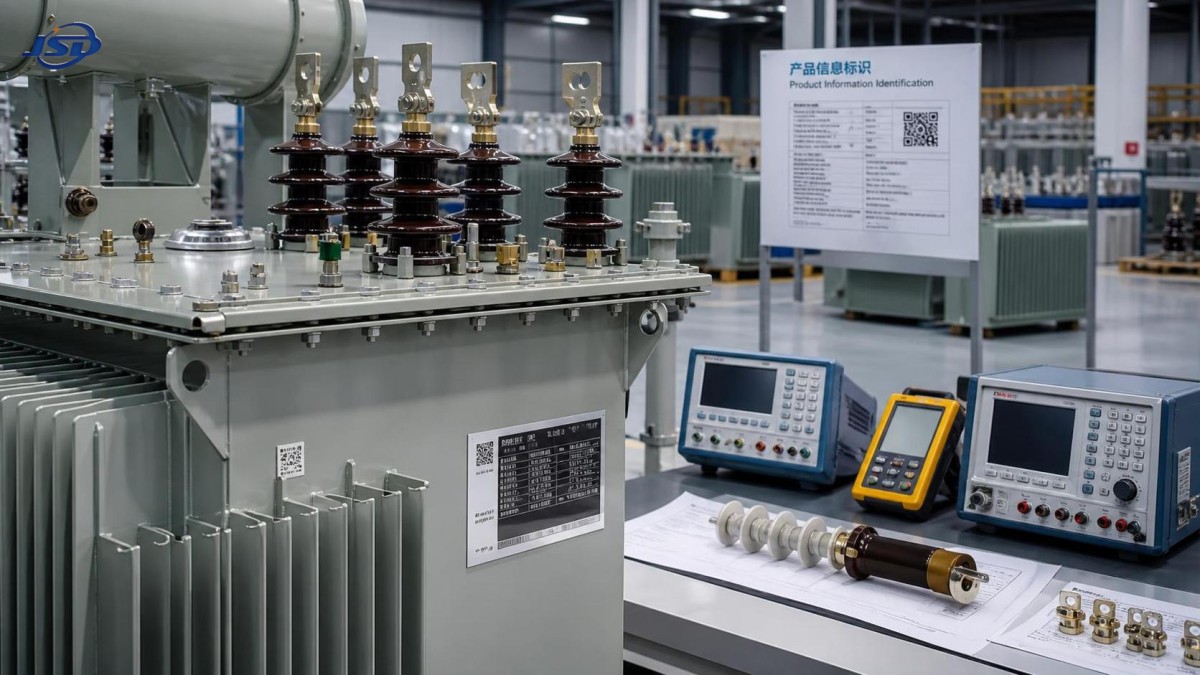
Read certifications as supporting evidence, not as the decision
Certificates can confirm that a management system or product framework has been assessed, but they do not automatically prove that every supplied transformer meets the purchase specification. Verify the certificate scope, issuing body, validity, and the manufacturing location it covers. If a certificate applies to a different facility, product family, or production activity, it may have limited value for the proposed order.
Technical compliance should be reviewed against the actual standards named in the specification. Depending on the project and market, the equipment may need to align with applicable IEC, IEEE, ANSI, EN, GB, or other required standards. The important question is not whether a supplier lists many standards in a brochure. It is whether the proposed design, test sequence, components, and documentation correspond to the standards and edition required for the project.
Where type-test evidence is requested, establish whether the document is relevant to the proposed design. Check the rating, voltage class, insulation arrangement, cooling method, construction, and test laboratory details. A report for a different configuration may still provide useful background, but it should not be treated as direct proof without a technical comparison. If deviations are acceptable, record them formally rather than leaving them in email discussions.
Make the test plan part of the approval gate
Testing is where design claims become inspectable evidence. A supplier should provide a test schedule early enough for the purchaser to review witness points and document requirements. Routine tests are generally expected for each unit according to the applicable standard and contract, while type, special, or additional tests may be project-specific.
Request a clear list of tests proposed for the transformer and confirm the acceptance basis for each. Depending on the design and specification, this may include ratio verification, polarity or vector group confirmation, winding resistance, insulation resistance, applied voltage testing, induced voltage testing, impedance measurement, no-load and load loss measurement, temperature-related checks, and functional checks for accessories. The exact scope should be governed by the governing standard and the purchase specification rather than copied from another project.
Review test reports for more than a pass statement. They should identify the serial number or traceable unit reference, test equipment status where required, measured values, tolerances, dates, and authorized sign-off. A report that cannot be connected clearly to the delivered unit has little value during a later investigation.
Witness testing can be appropriate for critical installations, first orders, unusual designs, or equipment with high consequences of failure. The witness should receive the approved drawings and test plan in advance. At the factory, verify the nameplate information, visible construction, accessories, terminal markings, grounding points, test setup, and final records. If a test is repeated, ask why. A repeat is not automatically unacceptable, but the reason and final disposition should be documented.
Check whether the design can be installed and kept safe
Technical compliance on paper does not guarantee a safe site outcome. Review the interfaces around the transformer: cable entry direction, phase identification, clearances, lifting provisions, earthing terminals, access to tap settings, protection device locations, and the space required for inspection or replacement. A manufacturer that asks for site constraints early is often easier to work with than one that only offers a standard outline drawing after production has started.
For compact distribution installations, the transformer may be supplied as part of a larger packaged arrangement. In that situation, approval must cover the interfaces between high-voltage switching, low-voltage distribution, metering, compensation equipment, busbars, enclosure, and transformer—not only the transformer itself. Ratings must be coordinated, internal segregation must be understood, and the protection degree must match the actual exposure.
For example, a proposed European-Type Compact Substation can be considered where a project needs an integrated high- and low-voltage distribution arrangement for locations such as industrial parks, commercial buildings, ports, public areas, residential developments, or solar and wind projects. Available configurations may cover transformer capacities from 100 kVA to 2500 kVA, with a maximum operating voltage of 35 kV and rated AC frequency of 50 Hz or 60 Hz. The purchaser should still verify the selected enclosure material, ingress-protection requirement, busbar rating, ventilation arrangement, and access design against the site conditions rather than approving the package by product category alone.
An enclosure described as fully enclosed or insulated can support safer operation, but it does not remove the need to examine cable terminations, interlocks, drainage, condensation control, warning labels, and maintenance access. For outdoor or aggressive locations, ask how corrosion resistance, dust ingress, water ingress, and thermal ventilation are addressed. Where special environments are involved, such as extreme climates or areas requiring explosion-related precautions, obtain a design-specific technical review before release.
Compare cost in terms of controllable risk
The lowest quoted price may reflect a genuinely efficient production process, but it may also result from omitted tests, lower-grade accessories, limited documentation, or assumptions that do not match the project. A fair comparison needs a common technical basis. Ask each bidder to identify exclusions, deviations, optional items, delivery scope, spare parts, commissioning support, and warranty conditions in a way that can be compared line by line.
Pay attention to changes that affect lifecycle work. A slightly cheaper unit may become costly if its terminal layout complicates cable installation, if access requires extensive shutdown work, or if replacement parts cannot be identified from the records. Similarly, a supplier that provides complete as-built drawings, test documentation, packing details, lifting instructions, and clear service contacts may reduce uncertainty during commissioning and future maintenance.
Lead time should be assessed with the same discipline. Ask which items are long-lead, whether major components are made in-house or externally sourced, and how design changes are controlled after the production slot is reserved. A credible schedule includes time for drawing approval, material release, manufacturing, testing, inspection, packing, and transport preparation. Promises without these milestones are difficult to manage when the site programme changes.
Use an approval file that can withstand a later question
Before issuing approval, bring the evidence together in one controlled record. It should show the final agreed specification, approved drawings, declared deviations, certificate verification, applicable test requirements, inspection arrangements, document deliverables, and named contacts for technical clarification. Keep revision numbers visible. An approval based on an old drawing is a common source of avoidable disputes.
It helps to pause before release and ask several practical questions. Does the offered unit match the electrical system, not merely the requested capacity? Have environmental and installation constraints been addressed? Are critical components and production controls traceable? Is the proposed test evidence sufficient for this order? Can the delivered equipment be installed, earthed, accessed, and maintained safely? Are any exceptions formally accepted by the responsible technical authority?
If any answer remains uncertain, approval can be conditional rather than rushed. Request a revised drawing, an additional technical calculation where appropriate, a clarified test scope, or a documented deviation response. This is usually easier than trying to resolve an ambiguity after the equipment has been dispatched.
The most dependable decision is rarely based on one document or one factory visit. It comes from connecting the specification, manufacturing controls, test evidence, installation interfaces, and commercial scope into a single traceable review. When that discipline is applied consistently, selecting a distribution transformer manufacturer becomes a controlled engineering decision rather than a judgement based on catalogue claims or initial price alone.

Get a Quote
Regardless of whether you require general advice or specific support, we are happy to help you.
Send Us Your Inquiry Today

Jinshida Electric remains committed to contributing to global energy development through professional manufacturing and superior service.