





Can a Substation Transformer Factory Meet Your Project Delivery Schedule?
Can a Substation Transformer Factory Meet Your Project Delivery Schedule?
Can your electrical substation transformer factory keep pace with your project schedule without compromising quality? For project managers, on-time delivery depends on more than a promised shipping date. Design approvals, material availability, production capacity, testing, and logistics all influence when equipment reaches the site—and when it can actually be energized.
A supplier offering the shortest lead time is not necessarily offering the lowest schedule risk. The better choice is a manufacturer that can explain what its delivery commitment includes, demonstrate how the order will move through production, and identify decisions that must be made by your engineering team. Those details matter more than a confident answer to “Can you deliver on time?”
Start with the energization date, not the shipping date
“Delivery” can mean ready for collection, handed to a carrier, unloaded at the project site, or installed and ready for commissioning. These are different milestones. Before comparing suppliers, establish the contractual delivery point, the applicable Incoterm and named place, and who owns each activity after factory release.
Work backward from the required energization date. Allow for receiving inspection, positioning, cable termination, protection checks, site testing, and any utility acceptance requirements. Then account for transport, customs clearance where relevant, packing, factory acceptance testing, manufacturing, material procurement, and drawing approval. Some activities can overlap; others cannot.
This exercise often reveals that the real constraint is not transformer assembly. It may be an unresolved cable-entry arrangement, a utility review, or the availability of a crane and access route. A factory cannot recover time lost outside its scope unless those dependencies are visible early.
Ask when the quoted lead time starts. Purchase-order placement, receipt of an advance payment, approval of drawings, and technical specification freeze are not interchangeable starting points. Record the trigger explicitly, together with the assumptions supporting it.
Freeze the interfaces that can stop production
A transformer capacity rating is not a complete manufacturing specification. Rated voltages, frequency, vector group, impedance, tapping requirements, cooling arrangement, losses, insulation requirements, and installation conditions all affect the design. Some choices also influence upstream protection, fault levels, and downstream equipment compatibility.
For a packaged substation, the approval boundary is wider. The manufacturer needs agreed high- and low-voltage arrangements, metering requirements, protection interfaces, earthing connections, cable access, enclosure dimensions, and maintenance clearances. An apparently minor change to outgoing feeders can affect the low-voltage board, busbars, enclosure layout, and production drawings.
Separate decisions that must be frozen before procurement from those that can remain open temporarily. Winding design and major switchgear selection usually demand earlier agreement than labels or certain finishing details. The supplier should identify these boundaries rather than treating every unresolved item as equally urgent.
Assign one person to consolidate drawing comments from consultants, contractors, operations teams, and the utility. Conflicting instructions arriving through separate channels create revision cycles. A controlled comment register, with owners and required response dates, is often more useful than frequent meetings without recorded decisions.
Ask for evidence behind the production promise
A factory tour can show manufacturing capability, but it does not establish that capacity is available for your order. Delivery readiness depends on the current workload, allocated resources, purchased components, and access to testing facilities. Ask for an order-specific milestone plan rather than a general statement about annual output.
The following questions help distinguish a supported commitment from an optimistic estimate:
- Which components are already available, and which require confirmed supplier delivery dates?
- Is the manufacturing slot reserved, or does reservation depend on technical approval?
- Which operations or shared facilities could become bottlenecks for this configuration?
- Who manufactures the transformer, switchgear, enclosure, and control assemblies, and who coordinates their schedules?
- What happens if an incoming component fails inspection or a finished unit requires rework?
Outsourcing is not automatically a weakness. It becomes a risk when responsibility is unclear or subcontractor dates are not integrated into the main schedule. A capable supplier should retain control over interface quality, acceptance criteria, and escalation even when some components come from specialist manufacturers.
Look for dated evidence at agreed checkpoints: released drawings, purchase-order acknowledgments for critical components, inspection records, and a confirmed test slot. These do not guarantee completion, but they show whether the plan is progressing. Photographs alone rarely establish percentage completion or readiness for shipment.
A compact substation can simplify delivery—but changes the coordination burden
For industrial parks, commercial buildings, or renewable energy projects, a factory-integrated package can reduce the number of assemblies that must be coordinated on site. Jinshida Electric’s European-Type Compact Substation brings transformer and high-/low-voltage distribution functions into a coordinated arrangement, with metering and reactive power compensation available according to the project configuration.
The listed transformer capacity range is 100 kVA to 2500 kVA, with 50 Hz or 60 Hz configurations. Enclosure material options include steel plate, composite panel, stainless steel, and cement board. These options support different applications, but they should not be treated as interchangeable choices with identical manufacturing times or environmental performance.
For a coastal port, corrosion protection and material selection deserve early review. For a constrained commercial site, footprint, access doors, ventilation, and cable approach may be more decisive. Special environmental requirements can add engineering and procurement work; establish their schedule impact before accepting a delivery promise.
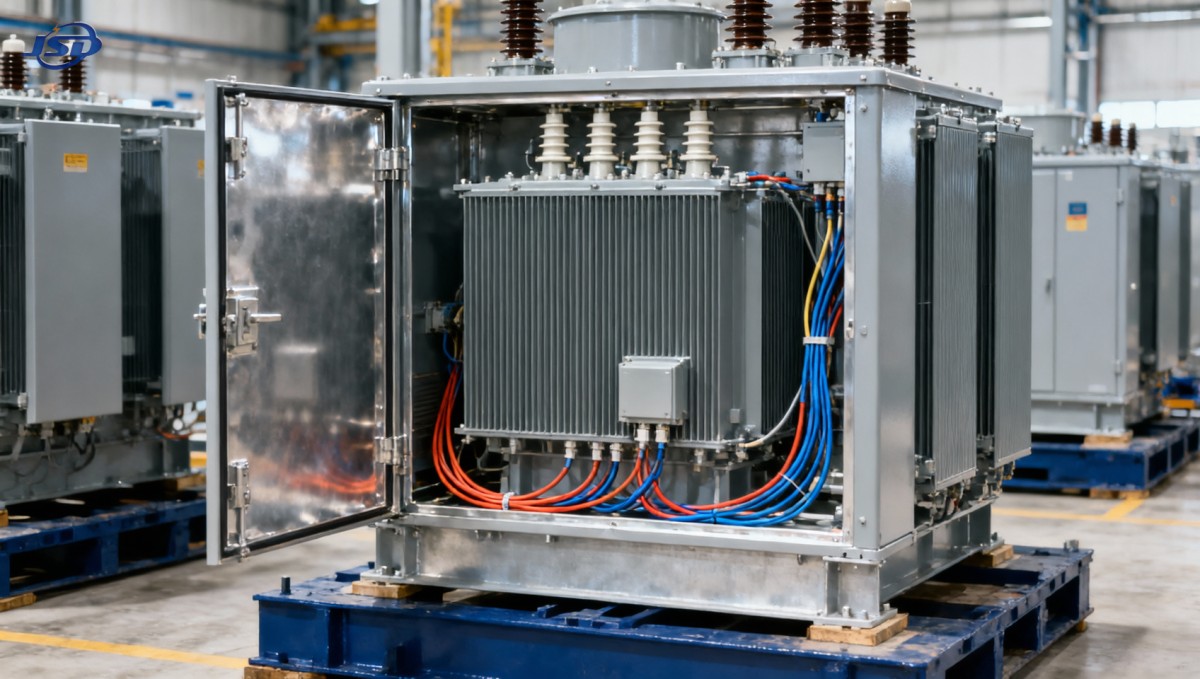
The trade-off is straightforward: more factory integration can mean fewer site interfaces, but more interfaces must be settled before manufacturing. Confirm the exact enclosure protection rating and its scope, alongside heat dissipation and operating conditions. Do not assume that a component rating applies to the complete assembly, or that every catalog maximum is available in one configuration.
Protect the testing window instead of using it as schedule float
When production runs late, testing can become the next target for compression. That is a poor recovery strategy. Factory acceptance testing is where the purchaser verifies agreed requirements before the equipment becomes expensive to return or modify.
Agree the inspection and test plan before production is well advanced. Define applicable standards and editions, routine tests, any required type-test evidence or additional tests, witness points, acceptance criteria, and document requirements. IEC 60076 is relevant to power transformers; switchgear and low-voltage assemblies involve other standards, including applicable parts of IEC 62271 and IEC 61439. The precise requirements depend on the equipment and destination.
A standards list is not proof of compliance. Ask which documents cover the offered design, ratings, and scope. Likewise, a quality management certificate does not replace product test evidence or local approval requirements.
Reserve witness attendance early, whether on site or through an agreed remote arrangement. Include time for report review, corrective action, and retesting where necessary. Define which punch-list items prevent release and who authorizes shipment. Otherwise, a technically completed unit can remain at the factory while commercial and engineering teams debate acceptance.
Check whether the site can receive what the factory finishes
Transport planning should begin with preliminary dimensions and weights, then be finalized using approved shipping data. Confirm lifting points, center of gravity information, packing arrangements, unloading responsibility, and any transport restrictions. A compact enclosure can simplify site assembly while still presenting a difficult lifting or access problem.
Check the receiving area, foundation, anchor positions, cable trenches, and crane access against approved drawings. If site works are delayed, establish storage requirements with the manufacturer rather than leaving equipment in unsuitable conditions. Protection from moisture, contamination, and handling damage remains necessary after factory acceptance.
Shipping documentation deserves its own deadline. Packing lists, invoices, transport documents, test reports, manuals, and destination-specific paperwork should be prepared according to the agreed scope. Missing documents can hold up clearance or commissioning even when the hardware is ready.
Choose the supplier whose schedule you can manage
Compare each electrical substation transformer factory on the same basis: technical scope, lead-time trigger, approval assumptions, testing obligations, delivery point, and site responsibilities. A shorter quotation with exclusions may leave your team carrying more coordination risk than a longer, clearly supported schedule.
Jinshida Electric Power Technology Co., Ltd. focuses on the R&D, manufacturing, and application of power transmission and distribution equipment for grid, industrial, renewable energy, and infrastructure projects. Its technical team, manufacturing processes, and quality management approach provide a basis for early coordination. For a specific order, those capabilities should be translated into approved interfaces, inspection arrangements, named responsibilities, and dated milestones—not assumed to guarantee a particular lead time.
Before placing the order, send the supplier your required energization date, single-line diagram, equipment specification, site conditions, and approval requirements. Request a backward-planned schedule that identifies critical dependencies and recovery options. If acceleration is proposed, ask exactly which activity changes and whether the revised plan preserves inspection and acceptance requirements.
The decisive question is not simply whether the factory says it can deliver. It is whether both teams can see what must happen, who must act, and when a missed milestone starts threatening commissioning. That is the difference between a promised date and a delivery plan you can use.

Get a Quote
Regardless of whether you require general advice or specific support, we are happy to help you.
Send Us Your Inquiry Today

Jinshida Electric remains committed to contributing to global energy development through professional manufacturing and superior service.