





Why does a soundless diesel generator still seem loud after installation?
Many service teams run into the same complaint after commissioning: the unit is sold and installed as a soundless diesel generator, yet the customer still says it is “too loud.” In most cases, that complaint is not caused by one obvious defect. It is the result of how noise behaves after installation, especially when vibration paths, room acoustics, exhaust routing, and load conditions were not assessed as a system.
For after-sales maintenance personnel, this matters because the issue is rarely solved by replacing the enclosure or arguing over catalog decibel values. The real task is to identify what kind of noise the customer is hearing, where it is being amplified, and whether the source is mechanical, aerodynamic, structural, or operational. Once that distinction is clear, the corrective action becomes much more practical.
The first misunderstanding: “soundless” does not mean silent on site
In industrial projects, “soundless” usually refers to a generator set equipped with an acoustic enclosure, intake and exhaust noise reduction measures, and vibration isolation designed to lower perceived noise compared with an open-frame set. It does not mean the machine will remain equally quiet in every installation environment.
This is where expectations often go wrong. Factory test conditions are controlled. Site conditions are not. A unit that performs acceptably in a manufacturer’s test area can still sound intrusive once installed near reflective walls, lightweight steel structures, cable trenches, building corners, or poorly designed exhaust systems. For maintenance teams, the complaint should therefore be treated as a site performance issue first, not only as a product issue.
What the customer is actually hearing
When a customer says the generator is loud, they may be describing several different phenomena:
- Low-frequency rumble transmitted through the floor or foundation
- Sharp exhaust noise at the discharge end
- Fan or airflow noise around louvers and ventilation openings
- Panel rattling or enclosure resonance
- Intermittent noise under load steps, startup, or shutdown
- Noise reflected and amplified by the room, wall, or canopy arrangement
If these are not separated during inspection, teams often replace the wrong parts. A muffler will not solve structure-borne vibration. Additional insulation inside the canopy will not fix a rigid exhaust connection. Tightening bolts may reduce rattling but will do nothing for acoustic reflection in a narrow service corridor.
Vibration transfer is one of the most common post-installation causes
In field conditions, “loudness” is frequently a vibration problem disguised as an airborne noise problem. The generator may be performing within expected airborne noise limits, while vibration is being transferred into the foundation, base frame, adjacent wall, fuel piping, or cable support structure. Once that energy reaches the building, the building itself becomes a secondary sound radiator.
Typical causes include worn or incorrectly selected anti-vibration mounts, uneven mounting surfaces, foundation flatness issues, rigid pipe connections, and fastening points that bypass the isolation design. A silent enclosure cannot compensate for a vibration path that has effectively turned the installation into a sounding board.
For maintenance teams, one practical check is to compare subjective loudness close to the enclosure with loudness at nearby structural surfaces. If a wall, floor slab, or metal support feels unusually “alive” during operation, the complaint may be driven more by transferred vibration than by direct engine noise.
Inspection points worth checking on site
- Are all vibration isolators present, correctly oriented, and loaded evenly?
- Has the skid base twisted after installation due to poor foundation levelness?
- Do fuel, exhaust, or cooling-related connections include flexible sections where required?
- Are cable trays, pipe brackets, or metal guards touching the enclosure or frame?
- Has any field modification created a rigid bridge between the machine and the building?
These checks are basic, but they solve many disputes faster than arguing over the original factory noise certificate.
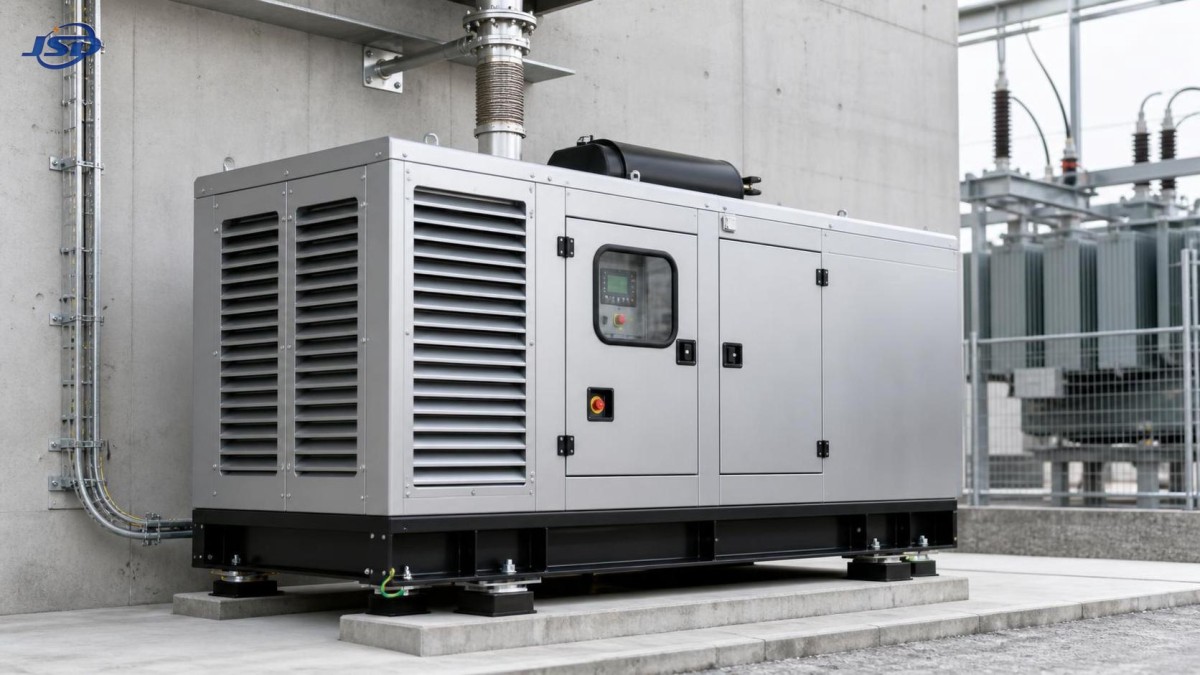
Exhaust layout can make a quiet unit sound harsh
Another frequent reason a sound-reduced set still seems noisy is the exhaust system outside the enclosure. In many projects, the attention goes to the generator canopy, while the exhaust route is treated as a simple installation detail. That is a mistake.
Exhaust noise changes significantly with pipe length, diameter, backpressure, bends, termination direction, and silencer selection. A muffler that is suitable in one layout may perform poorly in another. If the exhaust outlet points toward a wall, a lane, or a hard-surfaced yard, reflected sound can create the impression that the generator itself is much louder than expected.
There is also a maintenance dimension. Leaks at flanges, cracked bellows, failed supports, internal silencer deterioration, or condensate-related corrosion can all increase perceived noise over time. A set that was acceptable at handover may attract complaints months later because the exhaust system changed condition, not because the core machine degraded.
Where repeated complaints occur, teams should inspect not just the silencer but the entire exhaust path, including support spacing, expansion allowance, and whether the pipe load is being transferred back into the engine connection.
Site acoustics often matter more than buyers expect
In transformer yards, substations, industrial compounds, and backup power rooms, acoustics are highly site-specific. Hard concrete walls, sheet-metal roofs, narrow equipment clearances, and partially enclosed generator bays can all reflect and concentrate sound. A unit that measures reasonably in open space may feel much louder in a confined or reflective installation.
This is especially relevant in mixed equipment environments. Where transformers, cooling fans, switchgear rooms, and diesel generation are located close together, people do not always distinguish one source from another. The generator may be blamed for a total noise environment that is actually being reinforced by several assets operating at once.
For service teams, the useful question is not simply “How loud is the generator?” but “How does the generator interact with the space?” A practical site review should look at:
- Distance to reflecting surfaces
- Whether ventilation openings face a wall or corridor
- Presence of roof canopies or recesses that trap sound
- Nearby equipment that masks the true source
- Operating periods when ambient noise is lower and the unit becomes more noticeable
In some projects, a modest change in discharge direction or local acoustic treatment does more than major work inside the enclosure.
Cooling airflow noise is easy to underestimate
Maintenance teams tend to focus first on engine and exhaust, but airflow noise is another common source of customer complaints. On enclosed units, radiator fans, intake louvers, discharge openings, and ventilation resistance can generate a very noticeable broadband sound, especially under high load or high ambient temperature.
If the ventilation path is partially obstructed, if aftermarket mesh or weather covers were added, or if the unit operates in a hot, dusty environment, fan demand may increase and with it the perceived noise. Sometimes the machine is not “louder” because it is faulty; it is louder because the cooling system is working harder in the actual site condition than it did during acceptance testing.
This is one reason service engineers in power facilities increasingly look at the whole energy and thermal environment rather than treating each asset in isolation. In some facilities, storage and backup systems are planned together to reduce generator runtime during sensitive periods. That is where a solution such as 1MW/2MWh Liquid Cooling Container Energy Storage System may enter the discussion, not as a replacement for diesel in every case, but as part of a broader noise, load-shifting, and resilience strategy.
Load condition changes the noise profile
A generator that sounds acceptable at light load may become objectionably loud at higher output, during transient steps, or when large motor loads start. After-sales teams should therefore be cautious about inspecting only at idle or under no-load conditions. That may reproduce neither the customer complaint nor the actual operating stress on the system.
Noise that appears only under load can be linked to fan speed changes, combustion behavior, exhaust gas flow, structural resonance, or accessory vibration. In some cases, poor load matching causes the set to operate in a range where combustion is rougher or mechanical excitation is more noticeable. In others, customer process equipment introduces rapid load variations that were not considered during selection or commissioning.
When available, compare the complaint timing against load logs, operating hours, and maintenance records. The pattern often reveals whether the issue is installation-related, wear-related, or application-related.
Maintenance condition still matters, even on a correctly installed unit
Not every post-installation noise complaint comes from design or site conditions. Some are straightforward maintenance issues that become more obvious because the customer expected a low-noise unit in the first place.
Common examples include:
- Loose enclosure panels, hinges, or latch assemblies
- Aged door seals and degraded acoustic lining
- Engine mounting wear
- Fan imbalance or guard contact
- Air filter restriction affecting combustion or airflow behavior
- Exhaust leak points after thermal cycling
- Improper valve clearance or other engine-related mechanical noise【待核实具体机型适用性】
What matters in practice is sequence. Start with simple condition-based inspection before proposing major modifications. Service teams lose credibility when they recommend acoustic reconstruction while basic mechanical looseness remains unresolved.
How to structure a useful field diagnosis
A good diagnosis is less about advanced theory and more about separating variables in a disciplined way. For after-sales personnel, a repeatable process is usually enough:
This approach helps avoid a common service mistake: treating every complaint as a muffler problem. In reality, the corrective measure may be mount replacement, exhaust support correction, enclosure repair, airflow path improvement, or local acoustic treatment around the installation.
What is worth escalating, and what is not
Some complaints deserve immediate escalation because they may indicate reliability risk as well as noise risk. These include new metallic impacts, sudden changes in exhaust tone, visible movement at pipe connections, severe vibration felt through the base, or rapidly worsening panel resonance. These are not cosmetic issues; they may point to mounting failure, support fatigue, or mechanical deterioration.
Other complaints are real but should be handled as expectation and environment management. If the generator is performing normally and the issue is primarily acoustic reflection or neighborhood sensitivity, the right answer may involve site modification, operating schedule adjustment, or adding noise control measures outside the generator package.
That distinction is important commercially. When service teams confuse a system-level site issue with an equipment defect, they create avoidable disputes between owner, installer, and manufacturer.
For power-equipment users, the broader lesson is system thinking
In transformer and power distribution projects, end users often evaluate each asset by nameplate and brochure performance, but field performance depends on interfaces. Noise is one of the clearest examples. The generator, foundation, exhaust route, ventilation path, surrounding structures, and operating profile all shape the customer’s experience.
That is also why maintenance teams who understand adjacent equipment environments tend to solve these cases faster. In facilities adding new loads, storage, or hybrid backup arrangements, the discussion may shift from “How do we make this set quieter?” to “How do we reduce the conditions that force it into the most disruptive operating pattern?” In that context, even a product reference like 1MW/2MWh Liquid Cooling Container Energy Storage System can be relevant as part of a site-level power strategy rather than as a standalone sales item.
When a soundless diesel generator still seems loud after installation, the practical answer is usually not hidden in the catalog. It is found on site, by tracing the actual noise path and checking whether the installation still matches the assumptions behind the original low-noise design.

Get a Quote
Regardless of whether you require general advice or specific support, we are happy to help you.
Send Us Your Inquiry Today

Jinshida Electric remains committed to contributing to global energy development through professional manufacturing and superior service.