





Which installation conditions affect the performance of a silent type generator?
Which installation conditions affect the performance of a silent type generator?
A silent type generator is often chosen because the project cannot tolerate high noise, unstable output, or frequent maintenance interruptions. But in technical evaluation, one mistake shows up again and again: too much attention is placed on the generator set itself, and too little on the installation environment around it.
In practice, the same model can behave very differently from site to site. One unit starts cleanly, carries load without complaint, and stays within expected temperature rise. Another, installed in a cramped enclosure or on a poor foundation, runs hot, becomes harder to service, and develops vibration or noise complaints that are wrongly blamed on manufacturing quality. For a silent type generator, installation conditions are not secondary details. They directly affect cooling, combustion air supply, acoustic performance, electrical stability, and service life.
This matters even more on industrial and infrastructure projects where the generator is only one part of the power chain. Companies such as Jinshida Electric, which work across transmission and distribution equipment, tend to look at the whole system rather than a single machine in isolation. That is the right approach. A generator that is well specified but poorly installed can still become the weak point of the site.
Ventilation is usually the first performance limiter
With silent enclosures, ventilation is more sensitive than many people expect. The acoustic canopy reduces noise by controlling openings, lining surfaces, and guiding airflow, but those same features also create resistance. If inlet and outlet paths are undersized, obstructed, or poorly oriented, heat removal drops quickly.
What happens on site is straightforward. Engine radiator air recirculates, alternator temperature rises, and control systems may begin limiting performance or alarming during sustained load. In enclosed rooms, the problem becomes worse if exhaust heat is allowed to accumulate. A generator can pass factory testing and still struggle in operation simply because the installation allows hot discharge air to flow back toward the intake.
Evaluators should not only ask for rated power. They should check whether the installation layout supports that rating in local ambient conditions. Air path length, louver resistance, room pressure drop, and maintenance clearance around the cooling side all matter. A common red flag is a project that focuses heavily on external noise reduction while leaving too little free area for intake and discharge airflow.
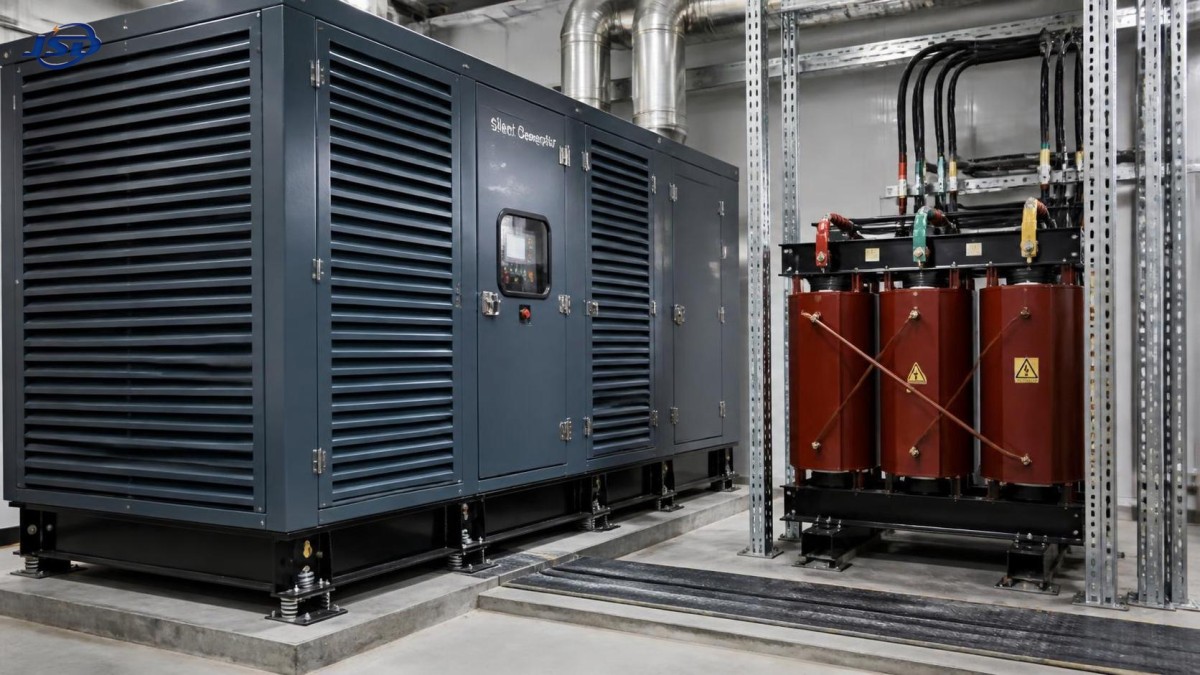
Foundation quality affects more than vibration
A poor foundation does not only create an annoying hum. It changes how the entire set behaves. Silent type generators combine engine, alternator, base frame, enclosure, fuel system, and often control accessories in one integrated assembly. If the base is uneven, too flexible, or inadequately isolated, vibration can transfer into the enclosure panels, exhaust supports, cable trays, and nearby building structure.
That leads to several practical problems. Fasteners loosen faster. Door seals and acoustic panels wear unevenly. Exhaust joints take more stress. In some cases, the measured noise level rises not because the engine itself is louder, but because the installation creates secondary structure-borne noise. Technical reviewers should pay attention to flatness, anchor arrangement, anti-vibration mounting details, and whether connected piping or cabling introduces rigid mechanical bridges.
This point is often underestimated in mixed electrical rooms where generators are installed near transformers or switchgear. Equipment interaction matters. Even robust distribution equipment, including units such as the 20kV Three-Phase Cast Resin Dry-Type Distribution Transformer, benefits from a layout that keeps vibration, heat concentration, and maintenance traffic under control rather than treating each asset as a separate island.
Ambient temperature changes available output
A silent type generator installed outdoors in a mild climate and the same unit placed in a hot industrial yard are not operating under equivalent conditions. High ambient temperature reduces cooling margin and may require derating depending on the engine and alternator design. This is not unusual; it is simply how thermal limits work.
The issue is not only peak summer weather. Some sites create their own harsh microclimate: reflective concrete yards, adjacent process equipment, rooftop installations, or semi-enclosed spaces with poor heat rejection. Evaluators should ask a practical question: what air temperature actually reaches the generator intake during the hottest operating period? If the answer is unclear, nameplate confidence is not enough.
Cold environments bring a different set of concerns. Starting reliability, battery performance, fuel condition, and condensation management all become more important. A silent enclosure protects the equipment, but it can also trap moisture if drainage and internal airflow are not considered carefully.
Humidity, dust, and corrosive atmosphere shorten life quietly
Some installation risks do not cause immediate failure. They simply reduce reliability month by month. High humidity can encourage insulation deterioration, connector oxidation, and condensation inside control panels or alternator windings, especially where daily temperature swings are large. Coastal or chemical environments add salt spray or corrosive vapors, which can attack metal parts, terminals, and enclosure finishes.
Dust is another overlooked factor. Fine dust clogs filters, reduces radiator efficiency, and increases the cleaning burden. In cement, mining, roadwork, or processing facilities, dust loading can make maintenance intervals much shorter than expected. Silent type generators are often selected for these sites because they are self-contained and easier to place near the load, but that convenience should not hide the environment penalty.
For technical assessment, it is better to define the atmosphere honestly and then confirm protective measures: filtration level, coating expectations, drainage details, cable gland sealing, and access for regular cleaning. If these are not aligned with the site, even a well-built set will look unreliable in service.
Altitude affects combustion and cooling at the same time
High-altitude installation is one of the clearest examples of why standard ratings must be interpreted carefully. As elevation increases, air density drops. That means less oxygen for combustion and less effective cooling. The generator may need derating, and auxiliary systems may need review as well.
This is not something to guess at. The acceptable operating range depends on the engine, alternator, and manufacturer guidance. If a project is located in a plateau region or elevated mining area, altitude should be part of the early technical review, not a late commissioning discovery. Too many specifications only mention rated kVA and forget the environmental correction factors behind that figure.
Noise control depends heavily on layout, not just enclosure design
People sometimes assume a silent type generator will automatically meet site noise expectations. That is rarely safe. The enclosure reduces airborne noise, but final acoustic performance depends on where and how the unit is installed. A generator placed near reflective walls, under a hard canopy, in a courtyard, or facing a sensitive boundary can behave very differently from one tested in a more open environment.
Exhaust routing matters too. The silencer may be correctly selected, but if the pipe support is rigid, if penetrations are not isolated, or if discharge is aimed toward occupied areas, complaints can still happen. In urban infrastructure or commercial backup applications, these details often decide whether the installation is accepted without rework.
This is where technical judgment is more useful than catalog reading. If the site has strict nighttime limits or nearby control rooms, schools, hospitals, or residential buildings, the evaluator should review the entire acoustic path: intake openings, discharge side, exhaust outlet, structural transmission, and boundary orientation.
Cable routing and electrical coordination still shape generator performance
Although the question usually starts with ventilation and foundation, electrical installation conditions matter just as much. Long cable runs, poor termination quality, undersized conductors, weak grounding, and unclear switching logic can all create problems that look like generator defects. Voltage drop, unstable starting of large motors, nuisance trips, and harmonic-related heating are often system issues rather than generator issues alone.
In projects where the generator interfaces with transformers, switchboards, or distributed loads, coordination becomes more important than any single component rating. A supplier with experience in broader power equipment integration usually has an advantage here because the review naturally includes load characteristics, protection philosophy, and connection conditions, not just the genset canopy and engine brand. That system view is one reason integrated power equipment partners remain relevant on grid, industrial, and new energy projects.
Where distribution transformation is part of the same installation, equipment such as a 20kV Three-Phase Cast Resin Dry-Type Distribution Transformer may be selected for safety and indoor suitability, but the real benefit still depends on room arrangement, thermal separation, and maintenance access across the whole electrical space.
A few practical checks before approval
Before signing off a silent type generator installation, it helps to walk through a short but disciplined review:
- Is there a clear airflow path without hot air recirculation?
- Can maintenance doors open fully, and can filters, radiators, and exhaust parts be serviced safely?
- Is the base level, rigid enough, and properly isolated from surrounding structures?
- Have ambient temperature, humidity, dust, and altitude been matched against the manufacturer’s operating limits?
- Will the acoustic layout still work at the actual site boundary, not only on paper?
- Are cable routing, grounding, protection, and transfer logic coordinated with the rest of the power system?
If one of these answers is uncertain, the risk usually shows up later as overheating, noise complaints, shortened maintenance intervals, or unstable operation under load.
So, which installation conditions affect the performance of a silent type generator? In real projects, the biggest ones are ventilation, foundation stability, local temperature, humidity, dust, altitude, acoustic layout, and electrical coordination. None of them are exotic. They are ordinary site conditions. But they decide whether the generator performs like a dependable asset or a recurring problem. For technical evaluation, that is the difference that matters.

Get a Quote
Regardless of whether you require general advice or specific support, we are happy to help you.
Send Us Your Inquiry Today

Jinshida Electric remains committed to contributing to global energy development through professional manufacturing and superior service.