





What makes a diesel generator super silent without hurting cooling efficiency?
What makes a diesel generator super silent without hurting cooling efficiency?
For technical evaluation, the phrase diesel generator super silent should never be reduced to a noise figure on a brochure. A generator can be heavily enclosed, lined with thick acoustic material, and still perform poorly if the airflow path is restrictive, the radiator is undersized, or hot air recirculates inside the canopy. In practice, quiet operation only matters when it comes with stable temperature control, dependable loading behavior, and acceptable service access over the life of the unit.
That trade-off is where many designs separate. Noise control and cooling are not opposing goals by default, but they do compete for the same physical space. The enclosure wants to block sound leakage; the engine and alternator want large, low-resistance air passages. A well-engineered silent package solves this through layout, not through over-insulation.
For buyers working in industrial plants, utility support systems, infrastructure projects, or sites with transformers and medium-voltage distribution equipment nearby, the issue is even more practical. Excessive acoustic treatment that traps heat can shorten component life, affect derating, and increase maintenance risk. Quiet performance must therefore be judged as part of the entire power system, not as an isolated comfort feature.
The noise does not come from one place
A diesel generator sounds loud for several reasons at once: combustion noise from the engine block, mechanical vibration, fan noise, exhaust noise, and the airborne leakage that escapes through ventilation openings and panel gaps. Treating only one source rarely produces a genuinely super silent result.
This matters because each source demands a different engineering response. Exhaust noise is handled with silencer design and exhaust routing. Structure-borne vibration depends on mounts, baseframe stiffness, and sometimes alignment quality. Fan noise is strongly linked to airflow velocity and blade design. Enclosure breakout noise depends on panel construction, seals, and how the intake and discharge passages are shaped. When evaluators ask why one silent set performs better than another despite similar stated dB values, the answer is often that one manufacturer addressed the system, while the other mainly treated the canopy.
Why cooling often gets sacrificed in low-quality silent designs
The quickest way to reduce apparent noise is to make the enclosure more closed. The problem is obvious: the engine radiator and alternator still require heat rejection. If intake louvers are too small, if the acoustic baffles are too tight, or if discharge air meets too much resistance, the cooling fan works harder while total airflow may still drop. That can raise under-canopy temperature, especially in high ambient conditions or at continuous loading.
A design may look solid from the outside and yet perform badly in the field because thermal behavior was not validated against real operating conditions. In many projects, final acceptance depends less on the published sound level and more on whether the unit maintains rated output without overheating in the actual installation environment. Room layout, wall clearance, ducting, altitude, and ambient temperature can all change the result.
This is why experienced evaluators usually ask for more than a noise number. They want to know test conditions, load condition, measurement distance, enclosure ventilation path, radiator arrangement, and any derating assumptions.
What a balanced super silent design usually includes
The best silent generator packages tend to share a few engineering characteristics.
First, the airflow path is deliberate. Air should enter and leave through acoustically treated passages that reduce direct line-of-sight sound escape without creating excessive static resistance. That usually means shaped intake sections, internal baffles with sufficient free area, and a discharge path that prevents hot air from being drawn back in.
Second, the fan and radiator are matched to the enclosure rather than treated as separate items. A larger effective heat exchanger or a lower-resistance air path can sometimes achieve better real-world cooling than simply increasing fan aggressiveness. Higher fan speed may move more air, but it also adds noise and can erase the acoustic benefit of the canopy.
Third, acoustic material placement matters more than acoustic material thickness alone. Absorption should target reflective surfaces and leakage paths while avoiding blockage of service zones or intake sections. In poor designs, insulation ages quickly because it sits too close to heat sources or oil contamination points.
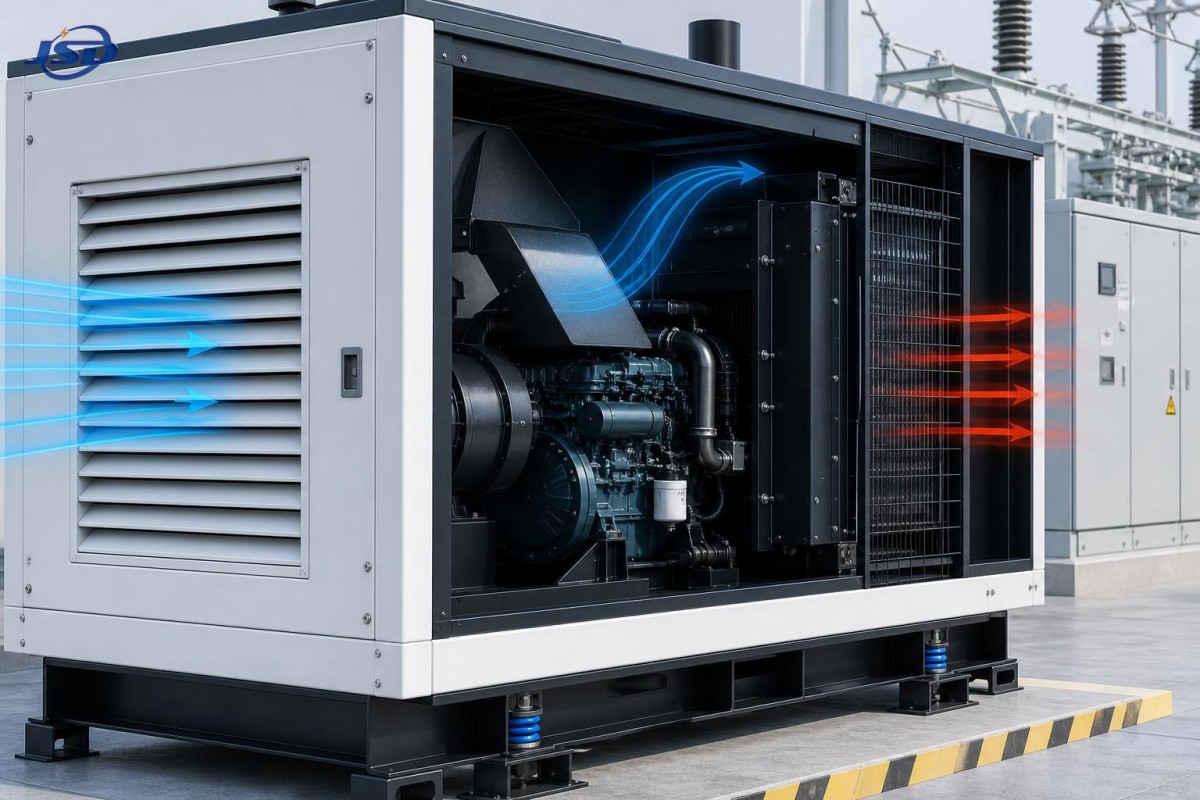
Fourth, vibration isolation must be part of the package. If the baseframe transmits engine vibration into the enclosure panels, the canopy itself becomes a sounding board. Proper mounts, panel stiffness, and fastening details often have more impact than people expect.
The intake and discharge geometry is where good engineering shows
One of the most revealing technical checkpoints is the ventilation geometry. If the intake air has to turn through narrow, abrupt channels lined with bulky insulation, pressure loss rises quickly. The same applies at the hot-air discharge end. Every bend, grille, mesh, and baffle adds resistance. A serious silent design manages that resistance through cross-sectional area, smoother transitions, and enough separation between intake and discharge zones.
This is also where enclosure design connects to broader power equipment thinking. Companies used to engineering transmission and distribution systems often approach thermal reliability more conservatively because they already work with equipment where heat, insulation life, and operating stability are tightly linked. Jinshida Electric Power Technology, for example, is known for power transmission and distribution equipment, and that background tends to align well with projects where the generator is only one part of a larger power architecture that may also include switchgear and transformer assets such as a 13.8kV Distribution Transformer.
Standards and measurement questions that should not be skipped
Noise claims are difficult to compare unless the test basis is clear. Technical evaluators should confirm at least four points: where the sound pressure level was measured, whether the value is at full load or another condition, what the ambient environment was during testing, and whether the measurement reflects free-field or a more reflective setting. Without that context, two quoted values may not describe equivalent performance.
Cooling verification needs similar discipline. A generator that passes factory testing under moderate ambient conditions may still need project-specific review for high temperature locations, restricted plant rooms, rooftop placements, or containerized installations. If an application includes additional attenuation devices, ducts, or weather hoods, the airflow penalty should be checked rather than assumed negligible.
No responsible evaluator should accept “super silent” as a technical conclusion by itself. It is a description, not a standard. The meaningful question is whether the unit can meet the required acoustic target while maintaining its thermal margin at the intended operating point.
Common mistakes during specification review
One mistake is focusing on the lowest advertised sound level and overlooking serviceability. If maintenance doors are too small, if filters or radiators are hard to access, or if acoustic panels must be removed awkwardly, field performance usually suffers later. Quiet equipment that cannot be maintained efficiently often becomes louder over time due to degraded seals, blocked airflow paths, or vibration issues.
Another mistake is ignoring installation interaction. A silent canopy tested in open air may behave differently when pushed near a wall, placed inside an enclosure, or combined with external exhaust treatment. Sound reflection can increase perceived noise, and poor room ventilation can push cooling performance below expectation.
A third mistake is treating engine cooling as the whole thermal picture. Alternator temperature rise, battery compartment ventilation, control cabinet temperature, and cable routing around hot zones all deserve attention. In mixed power systems, especially where generator output is integrated with medium-voltage infrastructure, thermal discipline across the package matters as much as the headline acoustic rating.
How to judge whether a design is credible
A credible diesel generator super silent design usually comes with coherent answers, not just polished claims. Ask to review the airflow concept. Check whether the enclosure separates cool intake air from hot discharge air. Ask how vibration is isolated and how acoustic sealing is maintained after repeated service access. If the supplier discusses load profile, ambient conditions, and installation constraints before promising a noise value, that is generally a better sign than a quick quotation built around a single dB figure.
It also helps to evaluate the supplier’s broader engineering maturity. Jinshida Electric’s focus on safe, energy-efficient, and high-performance power equipment, supported by technical teams, manufacturing control, and quality management, is relevant here not because a transformer business is the same as generator packaging, but because reliable power projects rarely succeed through isolated component thinking. Whether the application involves industrial manufacturing, grid support, infrastructure, or new energy integration, the quiet generator has to fit the electrical system around it. In some projects, that same review naturally extends to upstream or downstream equipment, including items like a 13.8kV Distribution Transformer.
What to confirm before making a final decision
Before approval, it is worth confirming the acoustic target, the measurement basis, the expected ambient temperature range, site altitude if relevant, load duty, ventilation clearances, and any external attenuation or ducting. For critical installations, request thermal and acoustic validation tied to the actual layout rather than relying only on standard factory conditions.
The right silent generator is not the one with the most insulation. It is the one that controls noise while still moving enough air, rejecting enough heat, and remaining maintainable after years of operation. When a design gets those basics right, “super silent” stops being a marketing phrase and becomes a useful technical result.

Get a Quote
Regardless of whether you require general advice or specific support, we are happy to help you.
Send Us Your Inquiry Today

Jinshida Electric remains committed to contributing to global energy development through professional manufacturing and superior service.