





How to judge build quality before choosing a super silent diesel generator
It often starts with a familiar procurement problem: a unit looks good on paper, the noise level seems acceptable, and the supplier claims it is a super silent diesel generator built for demanding sites. Then the questions begin. Will the enclosure hold up after repeated transport? Are the doors and hinges solid enough for regular inspection access? Will vibration loosen internal fittings after months of operation? For people responsible for quality control or site safety, these are not minor details. A generator that appears quiet and compact at first glance can still become a source of maintenance risk, fire hazard, or downtime if its build quality is weak.
Another common difficulty is that poor build quality rarely reveals itself during a short showroom visit or a basic quotation review. Surface paint can hide thin sheet metal. A neat external finish can distract from poor welds, weak base frames, or badly supported cable routing inside the canopy. If you are trying to make a decision before purchase, the real task is not simply comparing specifications. It is learning how to judge whether the unit was assembled with long-term use, service safety, and transport stress in mind.
Where buyers usually misjudge the unit
Many evaluations focus too heavily on rated power, fuel consumption, and stated noise figures. Those matter, but they do not tell you enough about structural integrity. A quiet machine with a weak enclosure may still create problems later because panels begin to rattle, seals deteriorate, access doors sag, or vibration transfers into parts that should remain stable. In practical terms, the outer package and the internal support structure deserve almost the same level of attention as the engine and alternator.
A second mistake is assuming that “silent” automatically means “well built.” In reality, extra acoustic materials can sometimes hide poor workmanship rather than prove good manufacturing. Sound insulation, if badly fixed, may loosen, absorb moisture, or interfere with airflow. This is why visual inspection and process review are more useful than relying on appearance alone.
Start with the base frame, not the paint
If you only have limited time with a candidate unit, begin at the bottom. The base frame carries the entire assembly, absorbs handling stress, and influences alignment. Look for continuous, consistent welds rather than scattered tack welds or sections that appear uneven in thickness. A frame should feel like a load-bearing structure, not just a support for presentation.
Check whether lifting points are reinforced and logically positioned. If they look like an afterthought, transport damage becomes more likely. Forklift openings, if present, should be cleanly finished and supported so that repeated movement does not distort the skid. A base that twists easily can create later issues with door alignment, vibration isolation, and piping stability.
It also helps to ask how the manufacturer protects the base frame against corrosion at joints and cut edges. Good coating coverage matters most where moisture can collect. A smooth visible finish is not enough if hidden corners, drainage points, or underside weld areas are left vulnerable.
The enclosure tells you a lot about manufacturing discipline
When reviewing a super silent diesel generator, inspect the canopy as if it were a working structure, not decorative housing. Panel thickness is one clue, but fit-up accuracy is just as important. Uneven gaps between doors and frames often suggest loose fabrication tolerance. When tolerances are poor, weather sealing, noise control, and maintenance access all suffer.
Open and close every accessible door. Hinges should move smoothly without visible strain. Latches should engage securely without requiring excessive force. If a technician needs to push, pull, or slam a panel to close it, the problem is usually not the latch alone; it can indicate warped metal, weak mounting points, or poor alignment from assembly.
Pay attention to whether doors stay open safely during inspection and whether service points are reachable without awkward body position. Build quality includes maintainability. A unit that forces unsafe access habits during routine checks is not truly a robust choice.
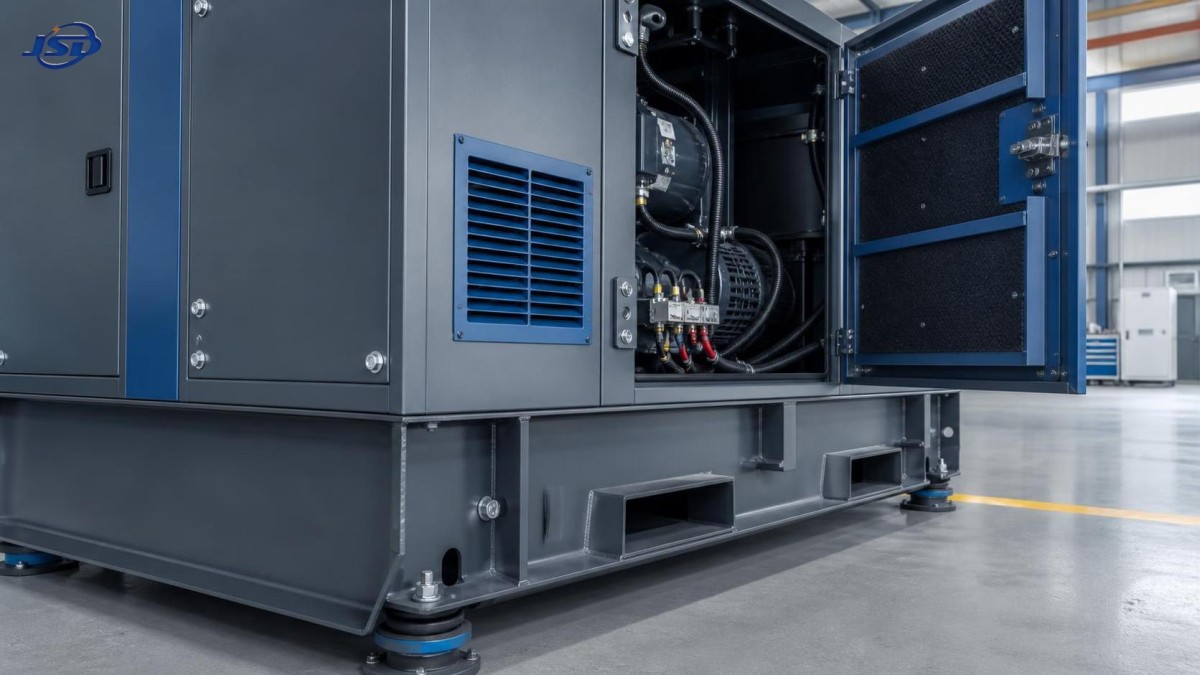
Weld quality is one of the fastest ways to spot hidden risk
You do not need laboratory tools to notice bad welding. In a pre-purchase review, look for obvious inconsistency: undercut edges, spatter left in place, abrupt starts and stops, visible porosity, or welds that vary sharply in width along the same joint. These signs do not automatically prove failure, but they do raise questions about process control.
Good welds on a generator enclosure and frame usually look deliberate and repeatable. Corners should align properly before welding, not be forced together afterward. If sealant is heavily used to hide rough joints, treat that as a signal to inspect more carefully. The concern is not cosmetic perfection. The concern is whether the structure can handle vibration, lifting, and thermal cycling without cracking or loosening.
Do not ignore vibration control details
Build quality is closely tied to vibration management. Even when the engine itself is reputable, poor mounting design can shorten the life of many surrounding parts. Check the quality and placement of anti-vibration mounts. They should appear correctly sized for the assembly rather than improvised. Mounting brackets need enough stiffness to support the load without flexing excessively.
Then look beyond the main mounts. Fuel lines, cable harnesses, battery trays, exhaust supports, and radiator connections should all be arranged with vibration in mind. If hoses are stretched too tightly, if wiring is left unsupported across long spans, or if metal edges sit close to moving parts, the unit may develop reliability issues long before major components wear out.
One useful habit is to imagine routine site conditions rather than ideal factory conditions. Transport bumps, uneven foundations, temperature changes, and frequent starts all put stress on the assembly. A well-built generator shows evidence that these realities were considered during design and assembly.
Internal layout matters as much as external strength
Open access panels and study the arrangement inside. A quality build tends to look organized for function, not only for first impression. Wiring should be routed cleanly, protected where it passes through metal, and separated from hot zones where necessary. Fasteners should appear consistent in type and installation. Loose mixed hardware can be a sign of weak assembly discipline.
Look at battery positioning, terminal protection, grounding points, and the path of maintenance access to filters and drains. If a routine service task requires reaching past hot surfaces or moving unrelated parts out of the way, that design increases operational risk. Safety managers often notice these issues quickly because inconvenient access tends to produce shortcuts in the field.
Cooling airflow is another area where build quality becomes visible. Baffles, ducting, and acoustic treatment should work together without obstructing service space or leaving loose edges. Quiet operation depends partly on controlled airflow, but if the enclosure sacrifices thermal management for noise reduction, the compromise may surface later as overheating or material fatigue.
Ask process questions that reveal more than brochures do
Sometimes the most useful evaluation happens during discussion with the supplier. Instead of asking only for catalog specifications, ask practical manufacturing questions. How are enclosures checked for dimensional consistency? Are doors tested repeatedly during assembly? How are acoustic materials fixed in place? What inspection points exist before painting and before shipment? Clear, direct answers often tell you more than polished presentations.
You can also ask whether the supplier can provide close-up production photos of frames, internal routing, or unfinished enclosures before final coating. This is a reasonable request when build quality is a key decision factor. It helps separate real fabrication control from surface-level finishing.
In some projects, teams compare generator quality with standards used in other power equipment purchases. That cross-check can be useful. For example, people familiar with containerized power systems often pay close attention to enclosure stiffness, thermal management, and service access because those factors affect long-term reliability across different applications. That same thinking is relevant when reviewing integrated equipment such as 1MW/2MWh Liquid Cooling Container Energy Storage System, where enclosure integrity and internal arrangement also influence safety and maintenance behavior.
Small signs that should slow down your decision
Some warning signs are easy to dismiss because they seem minor during inspection. A panel that vibrates when tapped. Sharp unfinished edges near cable entry points. Hinges with visible side play. Fasteners already showing corrosion. Sound insulation with gaps, peeling corners, or uneven adhesion. These are not always deal-breakers by themselves, but together they suggest the unit may have been rushed through production.
Be careful with units that look heavily reinforced in one visible area while neglecting less obvious parts. For instance, a thick outer door does not compensate for weak inner bracing. A solid-looking canopy does not help much if the exhaust support is poor or the cable terminations are exposed to unnecessary vibration. Build quality should feel consistent across the whole assembly.
A practical way to compare two similar options
When two models seem close in specification, avoid making the final choice based on noise rating alone. Create a short internal review around five areas: frame rigidity, enclosure fit and access, weld consistency, vibration-sensitive component support, and internal service safety. This kind of comparison is more useful than a long generic checklist because it focuses on the features most likely to affect actual site performance.
If one supplier is slightly more open about inspection points, assembly methods, and material details, that openness can be meaningful. The better choice is often not the unit with the most polished brochure, but the one whose construction can be examined without hesitation.
It is also worth considering the operating context. If the generator will be stationary in a controlled location, some structural risks may be easier to manage. If it will be transported often, exposed to weather, or expected to support frequent maintenance entry, then enclosure quality and frame durability should carry more weight in the decision. The same evaluation mindset is often used when teams review packaged infrastructure equipment such as the 1MW/2MWh Liquid Cooling Container Energy Storage System, where environmental protection and maintainability need to be assessed before installation rather than after problems appear.
Making the final judgment before purchase
A reliable pre-purchase judgment is usually built from several modest observations rather than one dramatic finding. You are looking for evidence of manufacturing control: stable structure, repeatable welding, sensible internal routing, durable access points, and parts that appear designed to stay secure under vibration and service use. If those basics are solid, the unit is much more likely to remain safe and manageable over time.
When evaluating a super silent diesel generator, the most useful question is not whether it looks impressive for a moment. It is whether the build shows respect for long-term operation. If the answer is unclear, slow the process down, inspect more deeply, and ask better questions before committing. That usually prevents far more trouble than fixing avoidable quality issues after the generator arrives on site.

Get a Quote
Regardless of whether you require general advice or specific support, we are happy to help you.
Send Us Your Inquiry Today

Jinshida Electric remains committed to contributing to global energy development through professional manufacturing and superior service.