





Large Power Transformers: Transport, Installation, and Project Risk Control
Large power transformers are among the most consequential assets in a grid, industrial, or infrastructure project. Long before they energize a substation or support a process plant, they create a demanding chain of decisions: route surveys, lifting studies, civil readiness, interface control, preservation, testing, and contingency planning. A transformer may arrive as a single item on a procurement schedule, but in practice it behaves like a project within the project.
For project managers, the central challenge is not simply getting the unit to site. It is delivering it without hidden damage, installing it in a condition that supports reliable commissioning, and keeping one late or uncertain activity from affecting every connected contractor. The following guidance focuses on how to manage large power transformers from factory release through energization, with attention to the risks that are most likely to influence schedule, cost, and long-term asset performance.
Begin with the route, not the shipping date
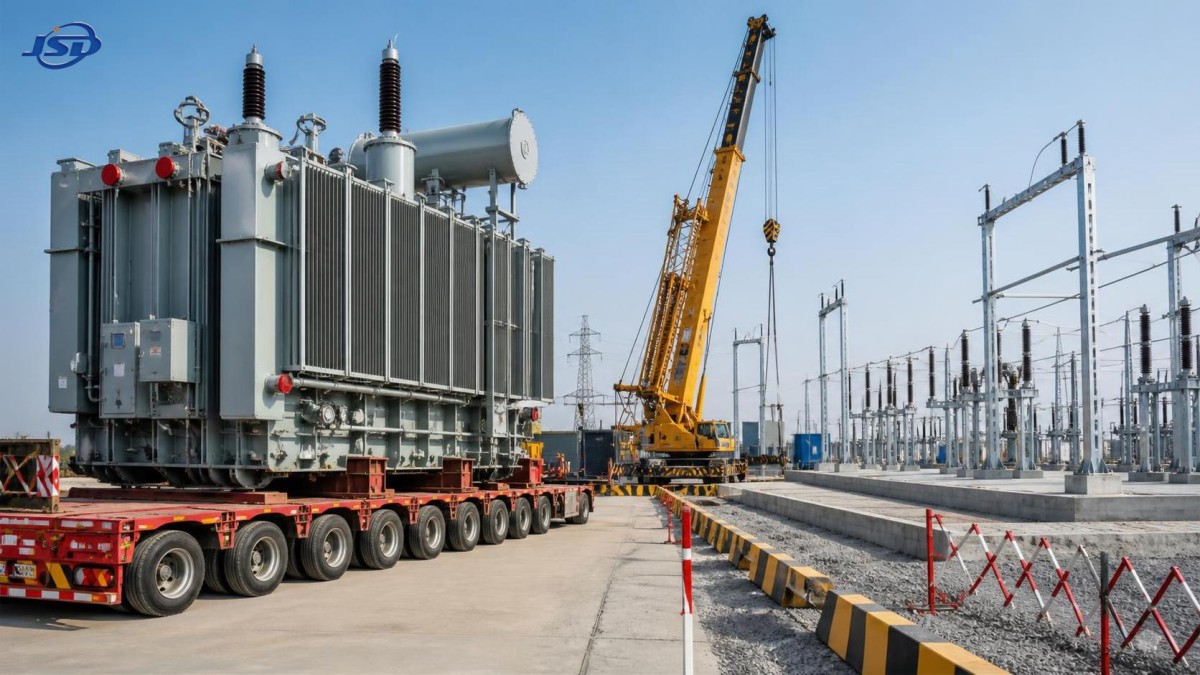
Transport planning for a large transformer should begin while the delivery strategy is still being defined. Gross shipment weight is important, but it is only one part of the problem. Project teams also need confirmed information on transport dimensions, axle loads, center of gravity, lifting points, rail or road restrictions, bridge capacities, port limitations, turning radii, overhead clearances, and the condition of the final access road.
A route that appears acceptable on a map can fail at a narrow bridge approach, an unrecorded utility line, soft ground near the substation gate, or a temporary culvert installed for construction traffic. These issues are expensive when discovered after the transformer is already at port or waiting on a heavy-haul vehicle. They are manageable when found early enough to reinforce a road section, adjust the trailer configuration, relocate a line, or revise the sequence of site works.
The practical lesson is simple: do not treat the route survey as a logistics formality. It is an engineering deliverable. The survey should be reviewed jointly by the logistics provider, civil contractor, transformer supplier, lifting specialist, and project team. Any assumption that cannot be verified should be recorded as a risk, assigned an owner, and closed before dispatch authorization.
Information that should be locked before shipment release
- Final shipping mass and dimensions, including separate accessories and transport frames.
- Confirmed center of gravity, approved lifting and jacking instructions, and permitted handling orientations.
- Route-specific constraints, required permits, escort requirements, and weather limitations.
- Site access readiness, including gate widths, crane standing areas, road bearing capacity, and drainage.
- Receiving responsibilities: who inspects, signs delivery records, monitors impact indicators, and manages storage.
- A communication protocol for route changes, delays, incidents, or unusual shock readings.
It is also wise to distinguish between the “transport route” and the “last 200 meters.” The last section inside the site often has the greatest uncertainty because it is shared with excavation work, cable trenching, temporary facilities, and other contractors. A heavy transformer move cannot safely depend on a work area that changes every day.
Protect the transformer from the damage that is not immediately visible
Visible damage receives attention because it is easy to see: a dented radiator, damaged paint, a broken bushing crate, or shifted packaging. More concerning are the conditions that can affect the active part without leaving an obvious external mark. Excessive shock, vibration, moisture ingress, loss of dry-air pressure, contamination, or poor storage practice can all introduce problems that become apparent only during testing or, worse, after energization.
Impact recorders and tilt indicators are useful, but they are not a substitute for disciplined inspection. Their readings should be checked at agreed transfer points, typically at factory dispatch, port handling, site arrival, and final placement. If a recorder indicates an event outside the agreed range, the response should not be an automatic acceptance or rejection. The team needs a defined escalation path: secure the unit, notify the manufacturer, preserve records, inspect relevant areas, and determine whether electrical or mechanical verification is required.
Moisture control deserves equal attention. Many large power transformers travel with dry air or nitrogen protection, depending on the approved preservation method. Pressure readings, dew point records where applicable, and seal condition should be monitored throughout transport and storage. A unit can sit safely for an extended period when preservation is controlled; it can also lose months of schedule if that control is assumed rather than documented.
The installation window is a coordination test
Transformer installation is often described as a lifting operation. In reality, the lift is only one tightly controlled moment in a broader installation window. The foundation must have achieved the required condition. Oil containment and drainage arrangements need to be complete. Fire-protection interfaces, earthing, cable routes, control-room readiness, and access for assembly crews must be coordinated. If these work fronts are incomplete, the transformer may arrive on site yet remain exposed to unnecessary handling, storage, or rework.
Before the unit is moved from the transport vehicle, hold a formal readiness review. This is not a ceremonial meeting; it is the opportunity to stop a poorly prepared operation before it becomes an incident. Review the approved lift plan, crane certificates and capacities at actual radius, ground bearing calculations, weather forecast, exclusion zones, communication channels, contingency arrangements, and the qualifications of everyone with a critical role.
The transformer manufacturer’s handling instructions take priority over informal site habits. Jacking points, pull directions, lifting lugs, spreader beam requirements, and permissible inclinations are specific to the unit. A crew experienced with similar equipment should still work from the approved instructions for this equipment. “We have done this before” is not an engineering control.
Common installation risks that deserve active management
Storage is not idle time
When construction schedules shift, transformers and their accessories may need to remain on site longer than planned. This is where projects can unintentionally turn a manageable delay into an asset-quality issue. Storage conditions should follow the manufacturer’s preservation requirements, with a clear inspection frequency and named responsibility. The team should record pressure condition, desiccant status where used, external corrosion, weather protection, packaging integrity, and any signs of water accumulation around the foundation or storage area.
Accessories need their own controls. Bushings, tap-changer parts, cooling equipment, marshalling cabinets, and gasket kits should not disappear into a general warehouse system. A missing or improperly stored accessory can delay assembly as effectively as a late transformer. Package-level traceability reduces this risk and helps the commissioning team confirm that the final configuration matches the approved documentation.
Commissioning should validate the whole installation, not just the transformer
A successful commissioning program confirms more than insulation resistance values and ratio checks. It verifies that the transformer, protection system, cooling controls, tap changer, earthing arrangement, auxiliary supply, alarms, and operational procedures work as one integrated system. The exact test scope depends on voltage class, design, project specifications, and manufacturer guidance, but the project manager should understand the logic behind the sequence.
Tests and inspections commonly include visual and mechanical checks, oil condition assessment, insulation and winding tests, transformer turns ratio verification, vector group confirmation, bushing tests where specified, functional checks of cooling equipment, tap-changer operation, alarm and trip verification, and protection-system checks. Results should be reviewed against factory records and acceptance criteria, not treated as isolated numbers.
One frequent mistake is compressing commissioning because civil work or transport has consumed float earlier in the programme. This is understandable under schedule pressure, but it is a poor trade. Commissioning is the final opportunity to identify installation defects, wiring errors, shipping-related concerns, or configuration mismatches under controlled conditions. A disciplined test hold point can protect years of operational service.
Temporary power belongs in the risk plan
During installation and commissioning, temporary power may be needed for lighting, oil processing equipment, control circuits, testing instruments, pumps, ventilation, communications, and site security. Losing that supply at the wrong time can affect preservation activities or interrupt carefully sequenced work. For projects that require dependable on-site generation, an Open Type Diesel Generator Set can support temporary power planning across industrial, commercial, agricultural, and construction environments.
Selection should match the actual load profile rather than only the largest nameplate rating. Consider starting loads, voltage and frequency requirements, runtime, fuel arrangements, earthing, weather exposure, noise restrictions, and whether automatic transfer switching or parallel operation is needed. Generator sets with 50kVA–500kVA prime power ratings, brushless alternators, electronic governors, and optional ATS capability can be relevant where temporary power must remain stable through extended site activities. The key project question is not “Do we have a generator?” but “Can the temporary power system reliably support the critical work that cannot be interrupted?”
Turn risk control into a live project routine
The best controls for large power transformers are usually straightforward; what makes them effective is timing and ownership. Build a transformer-specific risk register early, then review it at the milestones where conditions change: design freeze, route approval, factory release, shipment transfer, site arrival, installation readiness, assembly completion, and energization readiness.
Each item should have a clear trigger and response. For example, an access-road concern should not remain as “monitor site roads.” It should state the required bearing verification, the person responsible, the deadline, and the action if the result is unacceptable. Similarly, a low gas-pressure reading should trigger a defined preservation response rather than a vague instruction to “check later.” Clear actions reduce ambiguity when the project is under pressure.
Document control is part of this routine. The team should maintain the latest approved drawings, packing lists, factory test records, transport logs, storage records, installation checklists, inspection reports, and commissioning results in a controlled system accessible to the right parties. When an issue occurs, incomplete records can turn a short technical investigation into a prolonged dispute.
What project leaders should ask before authorizing energization
Before the final energization decision, step back from the individual work packages. Has the transformer experienced any abnormal transport or storage event, and has it been formally closed? Are all accessories installed and correctly identified? Have outstanding punch-list items been assessed for operational impact? Do protection, control, cooling, alarms, and emergency procedures reflect the installed configuration? Are test results complete, reviewed, and accepted by the responsible stakeholders?
These questions are not meant to delay the project. They create the confidence needed to energize a high-value asset responsibly. Large power transformers are expected to serve for decades, often in locations where outages carry serious operational and public consequences. A careful transport, installation, and risk-control process protects that expectation from the first route survey to the first successful energization.
For project teams, the most useful mindset is to view the transformer as a connected system of engineering, logistics, construction, and operational decisions. When those disciplines are brought together early, risks become visible while there is still room to manage them—and the path to reliable power becomes far more predictable.

Get a Quote
Regardless of whether you require general advice or specific support, we are happy to help you.
Send Us Your Inquiry Today

Jinshida Electric remains committed to contributing to global energy development through professional manufacturing and superior service.